Finding the right guide to AI-powered student productivity tools is harder than it looks, because nearly every book in this category promises the same three things: study smarter, save time, and get better grades. After comparing all 15 side by side, I gave the best overall spot to AI Tools for Students: The Ultimate Guide to 50+ AI Tools for its wide coverage and its rare attention to earning a side income alongside coursework. Don’t Let AI Think for You stands out for students worried about outsourcing their thinking, while The AI-Powered Student Operating System suits anyone who wants a complete framework rather than a tool list. The real tradeoff in this category is breadth versus depth: some books catalog 50 or 60 apps with brief notes, and others teach a smaller set of skills in far more detail. Price, prompt quality, and how honestly each author handles academic integrity separated my top picks from the padding. Keep reading for the full ranked breakdown of all 15.
Listen free for 30 days with Audible
Thousands of audiobooks and originals — cancel anytime.
Start your free trialAs an affiliate, we earn on qualifying purchases.
Key Takeaways
- AI Tools for Students: The Ultimate Guide to 50+ AI Tools took the top spot because it pairs broad tool coverage with extras most rivals skip, like side-income strategies and productivity systems beyond homework.
- The two prompt-only books, The AI Student Prompt Book and Prompts for Students, deliver the fastest results but the shallowest learning; they landed mid-pack because pasted prompts teach little judgment and age quickly.
- Academic integrity turned out to be a genuine dividing line: Don’t Let AI Think for You and The AI-Powered College Super Student address using AI without abusing it, while most catalog-style guides barely mention school policies at all.
- Tool count proved to be a weak quality signal: the 50-tool and 60-tool guides overlap heavily on the same well-known apps, so curation quality mattered more than quantity in my ranking.
- The AI-Powered Student Operating System was the only entry connecting studying, research, writing, and career planning into one system, which is why it ranks as the premium pick despite being less friendly to beginners.




| AI-powered student productivity tool | ASIN | Content type | Audience |
|---|---|---|---|
| AI Tools for Students: The Ult | B0GX2XB5W4 | — | — |
| Free AI Tools for Students: Un | B0FHWWG43K | — | — |
| AI Tools for Student Productiv | B0GMDM1LDR | — | — |
| AI Productivity for Students: | B0H5G7XS6H | — | — |
| Don’t Let AI Think for You: Ho | B0GX377NP1 | — | — |
| The AI Student Prompt Book: 50 | — | Prompt collection | Students |
| Prompts for Students: Your AI- | — | Prompt guide | Students |
| Top 10 AI Study Assistants: Bo | — | Curated tool roundup | Students |
| AI Tools for Students: 50 Powe | — | AI tool directory | Students |
| AI for Students: Study Smarter | — | Strategy guide | Students new to AI workflows |
| AI Tools for Students: Study S | B0H6CK5XQG | Tool directory with practical usage tips | High school through college students |
| The AI-Powered Student Operati | B0H4WJF16K | Strategy and workflow guide | College students planning for post-graduation |
| Best AI Tools for Students: 20 | B0H8LNVV6V | Curated tool shortlist | Students new to AI tools |
| AI Tools for Students and Lear | B0GT6D9CH5 | Tool guide with practical insights | Students with some AI familiarity |
| The AI-Powered College Super S | B0G2N4WKK1 | Strategy guide, not a tool directory | College students |
More Details on Our Top Picks
AI Tools for Students: The Ultimate Guide to 50+ AI Tools for Study, Writing, Research, Productivity & Side Income
I rank AI Tools for Students: The Ultimate Guide to 50+ AI Tools first because it covers the most ground: study, writing, research, productivity, and even side income, all in one volume. That breadth matters — a freshman who hasn’t figured out where AI fits into their workflow gets a map of the whole territory instead of a close look at one corner. Don’t Let AI Think for You goes deeper on thinking skills, but it can’t match this guide’s sheer range of tools. The tradeoff is depth: with 50+ tools on the menu, individual entries are shorter, and total beginners may find the catalog overwhelming without a clear starting path. I’d treat it as a reference you return to all semester rather than a book you read once.
Pros:- Covers 50+ tools across study, writing, research, productivity, and side income
- Doubles as a semester-long reference you can dip into as needs change
- Adds a money-earning angle most student AI guides skip
- Aims at future-ready skills beyond immediate grades
Cons:- Breadth limits depth — individual tool entries are short
- Can overwhelm beginners with no clear starting point
- No user reviews or detailed feature data to validate the picks
Best for: Students who want one reference covering study, writing, research, productivity, and side-income tools instead of buying several niche guides
Not ideal for: Complete beginners who freeze at long lists — 50+ tools with no guided starting path can stall them before they begin
- AI Tools Covered:50+
- Coverage Areas:Study, writing, research, productivity, side income
- Approach:Wide tool directory
- Skill Outcomes:Learn faster, score higher, build future-ready skills
- Beginner Friendliness:Low — large catalog can overwhelm
- Bonus Focus:Side-income opportunities
- ASIN:B0GX2XB5W4
Our verdict“The one guide I’d buy if you want the widest map of student AI tools and don’t mind exploring on your own.”
Free AI Tools for Students: Unlock the Power of Artificial Intelligence to Study Smarter, Not Harder
Free AI Tools for Students earns its spot as the value pick for a simple reason: every tool it recommends costs nothing, so the book’s advice never hits a paywall halfway through a chapter. Where AI Tools for Students: The Ultimate Guide to 50+ AI Tools sweeps across a huge catalog, this one filters for zero-cost picks only — a real outcome for students whose budget is the binding constraint. The catch is curation depth. The listing is light on instructions and tutorials, and it never spells out exactly which tools make the cut, so you’re buying a starting point rather than a full course. I’d hand this to a cost-conscious sophomore and tell them to pair it with a more tactical guide later.
Pros:- Every recommended tool is free, so the advice never hits a paywall
- Accessible and easy to get into
- Directly improves study efficiency without extra spending
Cons:- Thin on instructions and tutorials for each tool
- Doesn’t disclose exactly which tools are included
- No ratings or reviews to gauge quality
Best for: Budget-conscious students who only want tools they can use without a subscription
Not ideal for: Students who want step-by-step tutorials — the guidance stops at pointing you toward free options
- Tool Cost:Free tools only
- Core Promise:Study smarter, not harder
- Ease of Use:Accessible, beginner-friendly
- Tutorials Included:Limited
- Tool List Disclosure:Not specified upfront
- ASIN:B0FHWWG43K
Our verdict“Buy this if your budget is zero and you want a curated list of free tools to start from.”
AI Tools for Student Productivity: Practical Study Hacks to Learn Faster, Stay Focused, and Get Better Grades
New to AI and just want better grades this semester? AI Tools for Student Productivity is the gentlest on-ramp here, built around practical study hacks — learn faster, stay focused, raise your grades — rather than an exhaustive tool directory. That framing matters for a beginner: small, repeatable tactics beat a 50-item catalog when you don’t yet know what you need. Compared with AI Productivity for Students, which assumes some familiarity with ChatGPT-style chatbots, this one starts closer to zero. The drawback is polish and proof: the listing offers no detailed feature breakdown and there are no customer ratings to validate its claims, so you’re taking the premise on faith. I see it as a low-risk first read before graduating to a heavier reference.
Pros:- Hack-based format is easy to apply immediately
- Targets the outcomes students care about: speed, focus, grades
- Low-commitment entry point before heavier guides
Cons:- No published feature breakdown, so contents are opaque before purchase
- No customer ratings or reviews yet
- Less useful once you outgrow the basics
Best for: AI newcomers who want simple, repeatable study tactics — faster learning, better focus, higher grades — before committing to a bigger reference
Not ideal for: Experienced AI users who already have a workflow and want advanced prompting or platform-specific depth
- Approach:Practical study hacks
- Core Outcomes:Learn faster, stay focused, get better grades
- Content Style:Tactics and strategies over directories
- Reader Ratings:None available yet
- Feature Detail:Not published in listing
- ASIN:B0GMDM1LDR
Our verdict“The right first book for students who’ve barely touched AI and want quick, practical wins.”
AI Productivity for Students: Mastering ChatGPT, Gemini, and Claude for Research Projects, Homeworks, and School Activities
Most guides in this roundup spray attention across dozens of apps; AI Productivity for Students does the opposite, going deep on three platforms — ChatGPT, Gemini, and Claude — and tying them to research projects, homework, and class activities. That narrowness is the point: mastering three chatbots you’ll actually use beats skimming fifty you’ll forget, which is the risk with AI Tools for Students: The Ultimate Guide to 50+ AI Tools. The tradeoff is hand-holding. It skips detailed technical walkthroughs and assumes you’ve at least opened a chatbot before, so true beginners should start with AI Tools for Student Productivity instead. I’d pick this for a junior or senior facing research-heavy coursework who wants strategy, not a directory.
Pros:- Deep coverage of the three chatbots students actually use
- Ties AI directly to research projects, homework, and class activities
- Strategy-driven approach that outlasts any single app update
Cons:- Lacks detailed technical instructions
- Requires some prior familiarity with AI tools
- Ignores the wider ecosystem beyond the big three platforms
Best for: Upper-level students facing research-heavy coursework who want to master ChatGPT, Gemini, and Claude rather than sample dozens of apps
Not ideal for: True beginners — it assumes prior chatbot familiarity and skips detailed technical walkthroughs
- Platforms Covered:ChatGPT, Gemini, Claude
- Coverage Areas:Research projects, homework, school activities
- Approach:Strategy-driven chatbot mastery
- Prerequisites:Some prior AI familiarity recommended
- Technical Instructions:Limited
- ASIN:B0H5G7XS6H
Our verdict“The pick for students who already use chatbots and want a sharper research and homework strategy.”
Don’t Let AI Think for You: How Students Can Boost Real Intelligence Using AI Tools, Smart Prompts & Low-Cost Study Systems
Don’t Let AI Think for You takes a stance none of the other picks do: the goal isn’t faster homework, it’s protecting your own thinking while using AI. Through smart prompts and low-cost study systems, it frames chatbots as sparring partners rather than ghostwriters — a distinction that matters once professors start policing AI-generated work. Against Free AI Tools for Students, which is mainly a list of no-cost apps, this is a philosophy with tactics attached. The cost of that approach is thinner tool coverage and little publisher detail about depth or audience, and with no customer ratings, quality is hard to verify. I’d recommend it to students worried about becoming dependent on AI — and to anyone whose school has strict integrity rules.
Pros:- Builds critical thinking alongside AI use instead of replacing it
- Smart-prompt techniques plus low-cost study systems keep costs near zero
- Integrity-friendly framing suits strict classroom policies
Cons:- Thinner tool coverage than directory-style guides
- Little publisher detail on content depth or target audience
- No customer reviews or ratings to verify quality
Best for: Students worried about over-relying on AI, especially those at schools with strict academic-integrity rules
Not ideal for: Bargain hunters wanting a long tool directory — this is a mindset book with tactics, not a catalog
- Core Focus:Critical thinking with AI assistance
- Key Methods:Smart prompts and low-cost study systems
- Cost Approach:Low-cost systems throughout
- Stated Goal:Boost real intelligence without outsourcing thinking
- Tool Directory:Not the emphasis
- ASIN:B0GX377NP1
Our verdict“Choose this if you want AI to sharpen your thinking rather than quietly do it for you.”
The AI Student Prompt Book: 500+ AI Prompts for Studying, Learning, Research, and Productivity
With more than 500 ready-to-use prompts spanning studying, research, and productivity, this is the deepest prompt library in the roundup, and it’s my pick for Best Overall. Where Prompts for Students offers a narrower study-session focus, this collection covers a wider range of academic tasks and speaks to ChatGPT, Claude, and Gemini alike, so a reader isn’t locked into one platform. That breadth matters in practice: instead of staring at a blank chat box, a student can flip to a relevant prompt and adapt it in seconds. The tradeoff is curation. A list this long can feel repetitive, and readers still have to judge which prompts fit their assignment. It also ships without customer reviews, so there’s no track record to lean on. For sheer usable volume, though, nothing else here matches it.
Pros:- 500+ prompts span studying, research, and productivity tasks
- Works across ChatGPT, Claude, and Gemini, so there’s no platform lock-in
- Turns a blank chat box into a usable starting point in seconds
- Broadest single volume in this roundup
Cons:- A list this size risks repetition and makes browsing a chore
- No customer reviews or ratings yet to gauge real-world usefulness
Best for: Students who already use ChatGPT, Claude, or Gemini and want one large prompt library covering essays, exam prep, and research
Not ideal for: Readers who want heavy curation — 500-plus prompts means sifting through filler to find what fits a given assignment
- Format:Kindle eBook
- Content type:Prompt collection
- Prompt count:500+
- AI tools covered:ChatGPT, Claude, Gemini
- Subject areas:Studying, learning, research, productivity
- Audience:Students
- Customer ratings:None yet
- Price:Not listed
Our verdict“If a student buys one prompt book, this 500-prompt, multi-platform library is the one I’d hand them.”
Prompts for Students: Your AI-Powered Study Assistant (Power Prompting Book 4)
I’d point AI newcomers here first. As Book 4 in the Power Prompting series, Prompts for Students comes from an established prompting framework, and its study-session angle keeps things manageable: a reader learns to prompt for exam prep, note review, and homework help without wading through 500 options the way The AI Student Prompt Book asks them to. That narrower scope is the whole appeal — less choice paralysis, faster first wins. The downside is transparency. The listing gives almost no detail on how many prompts are inside or which AI tools they target, and there are no customer ratings to fill that gap. Compared with the multi-tool coverage of its bigger rivals, this feels like a single-lane road: easy to drive, but it won’t take a student everywhere.
Pros:- Study-session focus keeps the scope manageable for new users
- Backed by an established Power Prompting series framework
- Aims at concrete outcomes like better study efficiency
- Narrower choice set reduces choice paralysis versus 500-prompt rivals
Cons:- Listing reveals little about prompt count or target AI tools
- No customer reviews available
- Single study focus may not stretch to research or writing tasks
Best for: First-time AI users who want a gentle, study-focused intro to prompting without a huge catalog to dig through
Not ideal for: Students who need to know which AI tools the prompts target before buying — the listing doesn’t say
- Format:Kindle eBook
- Content type:Prompt guide
- Series:Power Prompting, Book 4
- Focus:Study sessions and learning efficiency
- AI tools covered:Not specified
- Audience:Students
- Customer ratings:None yet
- Price:Not listed
Our verdict“The right first prompt book for a student who wants small, study-focused steps into AI.”
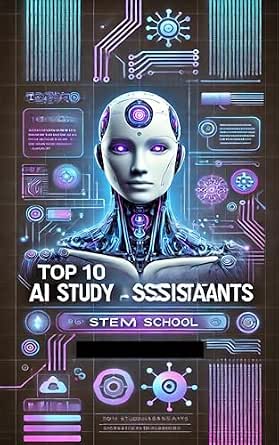
Top 10 AI Study Assistants: Boost Learning Speed and Productivity with Smart Tools
Some students don’t want to learn prompting at all — they want an app that already works. This guide answers that with a shortlist of ten AI study assistants built to speed up learning and organize study tasks, which makes it the fastest read-to-action path in this lineup. Against the 50-tool sprawl of AI Tools for Students: 50 Powerful AI Tools, ten picks is a feature, not a limitation: a reader can trial every option in a weekend instead of drowning in a directory. The catch is depth. With so few tools covered and thin feature descriptions, there’s little room for comparisons or pricing guidance, and no user reviews exist yet to confirm the selections hold up. I see it as a starting menu, not a reference book.
Pros:- Ten-tool shortlist is actionable in a single weekend
- Focuses on ready-made apps, so no prompting skill required
- Directly targets learning speed and study-task management
Cons:- Thin feature descriptions leave real differences between tools unclear
- No user reviews or ratings to confirm the picks
- A small app shortlist can date quickly in a fast-moving market
Best for: Students who’d rather install a ready-made study app this week than learn prompt writing
Not ideal for: Comparison shoppers who want pricing, platform support, and feature depth on each tool
- Format:Kindle eBook
- Content type:Curated tool roundup
- Tools covered:10 AI study assistants
- Focus:Learning speed and study-task management
- Depth per tool:Not detailed
- Audience:Students
- Customer ratings:None yet
- Price:Not listed
Our verdict“For students who want working apps by Monday rather than a new skill, this ten-tool shortlist does the job.”
AI Tools for Students: 50 Powerful AI Tools to Study Smarter, Save Time, and Improve Productivity
Between the ten-tool skim of Top 10 AI Study Assistants and the 60-plus-entry catalogs elsewhere in this roundup, this guide lands on a middle ground of 50 tools — wide enough to cover writing, research, and time management, small enough to finish. That range is why I’d call it the value pick: one purchase gives a student a working map of the AI landscape without a semester-long reading commitment. The promise is practical, too — each tool is framed around saving time and studying smarter, outcomes any student can measure. Where it falls short is follow-through. The listing offers little on how deeply each tool is covered, so entries may read as name-plus-blurb rather than real walkthroughs, and with no reviews available, quality per entry is an open question.
Pros:- 50 tools give broad coverage without a 60+ entry reading commitment
- Framed around measurable outcomes: time saved and smarter study
- One purchase maps most of the student AI landscape
- Middle ground between skimpy 10-tool lists and bloated catalogs
Cons:- Per-tool depth looks thin — entries may read as name-plus-blurb
- No customer ratings or detailed contents listed
- Crowded category, with several near-identical 50-tool guides on offer
Best for: Budget-conscious students who want one survey of the AI tool landscape instead of several narrow guides
Not ideal for: Readers who need deep tutorials per tool — breadth here likely means shallow entries
- Format:Kindle eBook
- Content type:AI tool directory
- Tools covered:50
- Focus:Study efficiency, time saving, productivity
- Tool descriptions:Limited detail provided
- Audience:Students
- Customer ratings:None yet
- Price:Not listed
Our verdict“The sensible middle option for students who want wide AI tool coverage in a single, finishable read.”
AI for Students: Study Smarter, Boost Productivity & Save Time Using AI Tools
Every other pick in this batch hands students prompts or app lists; this one tries to change how they work. Its pitch is AI strategy beyond ChatGPT prompting — building habits for studying, productivity, and time savings across a range of tools. Compared with The AI Student Prompt Book, which gives a reader fish, this aims to teach fishing: less copy-paste, more repeatable workflow. That’s the right call for a student who already has chatbot access and wants structure. The limitations cut the other way, though. Light on step-by-step instruction, it won’t satisfy readers who want exact prompts, and the listing itself concedes advanced users may find it thin. With no ratings posted yet, I’m treating it as a mindset book first and a manual second.
Pros:- Teaches workflows and habits rather than one-off prompts
- Covers AI uses beyond ChatGPT, widening a student’s toolkit
- Strategy angle stays useful even as individual apps change
- Targets time savings students can feel within the first week
Cons:- Light on step-by-step instructions for hands-on readers
- May feel basic to anyone already comfortable with AI tools
- No ratings posted to confirm the strategies land
Best for: Students past the novelty stage who want study workflows and habits, not another prompt list
Not ideal for: Prompt hunters and power users — it skips exact scripts and may feel basic to advanced AI users
- Format:Kindle eBook
- Content type:Strategy guide
- Scope:AI tools beyond ChatGPT prompting
- Focus:Study efficiency, productivity, time saving
- Technical depth:Light — few step-by-step instructions
- Audience:Students new to AI workflows
- Customer ratings:None yet
- Price:Not listed
Our verdict“Buy this for study systems and habits; pick a prompt book instead if you want scripts to copy tonight.”
AI Tools for Students: Study Smarter, Write Faster & Learn Better with 60+ Essential AI Tools
With 60+ AI tools spread across research, writing, studying, coding, and general productivity, this guide earns its spot at the top of my ranking on range alone. Where Best AI Tools for Students (the 20-tool pick below) gives you a shortlist, this one gives you a full map, so you’re far more likely to find something that fits an unusual workflow, like coding assignments or data-heavy projects. The tradeoff is depth: with that many tools in one book, individual write-ups stay brief, and I’d steer total newcomers toward the 20-tool option to avoid feeling swamped. Compared with The AI-Powered Student Operating System, which teaches a framework instead of listing tools, this works better as a reference you return to whenever a new study problem shows up. If you only buy one tool-finder from this list, my pick is this one.
Pros:- Covers 60+ tools, the widest selection in this roundup
- Spans five categories: research, writing, studying, coding, and productivity
- Works as a long-term reference you revisit as assignments change
- Strong fit for STEM students thanks to dedicated coding coverage
Cons:- Individual tool write-ups stay shallow given the breadth
- Can flood beginners with too many choices at once
- No hands-on testing data or ratings to rank the tools against each other
Best for: Students across disciplines — including coding and STEM majors — who want one wide-ranging reference for discovering new AI tools as their needs change semester to semester
Not ideal for: First-time AI users who freeze at long option lists — 60+ entries can swamp someone who just wants three apps to start with
- AI Tools Covered:60+
- Coverage Areas:Research, writing, studying, coding, productivity
- Content Type:Tool directory with practical usage tips
- Audience:High school through college students
- Skill Level:Beginner to intermediate
- Category:Education / AI study guides
- ASIN:B0H6CK5XQG
Our verdict“Buy this if you want the single widest map of student AI tools and don’t mind skimming past the ones you’ll never use.”
The AI-Powered Student Operating System: A Practical Framework for Learning, Research, Writing, Productivity and Career Development in the Age of AI
Most books in this roundup answer “which tool do I use?” — this one asks “what does my whole system look like?” Its practical framework ties AI into learning, research, writing, productivity, and career development as one connected workflow, which makes it my runner-up and the best pick for students thinking past graduation. Where AI Tools for Students: Study Smarter, Write Faster & Learn Better (my Best Overall) hands you 60+ tools to try, this teaches you how to slot any tool into a durable routine, so it ages better as apps come and go. The catch: with no specific software covered, you’ll want a catalog-style companion — like the 60-tool guide — to actually pick your apps. Readers who just want quick homework help will find this more book than they need.
Pros:- Builds one connected workflow across learning, research, writing, and career prep
- Framework approach stays useful as individual apps rise and fall
- One of the only picks here addressing career development, not just coursework
Cons:- Names no specific tools, so readers must pair it with a catalog-style guide
- Overkill for students who only want quick homework shortcuts
Best for: Juniors, seniors, and grad students building a repeatable AI workflow that carries into job hunting and early career work
Not ideal for: Students hunting for a quick app recommendation for tonight’s homework — it teaches a system, not a shortlist of tools
- Approach:System framework rather than tool listings
- Coverage Areas:Learning, research, writing, productivity, career development
- Content Type:Strategy and workflow guide
- Audience:College students planning for post-graduation
- Specific Tools Named:None
- Category:Education / AI study guides
- ASIN:B0H4WJF16K
Our verdict“Buy this if you’d rather build one AI system that survives graduation than chase individual apps semester by semester.”
Best AI Tools for Students: 20 AI Tools to Study Smarter, Save Time, Improve Grades, and Boost Productivity
A list of 20 tools might sound thin next to the 60+ in my Best Overall pick, but that smaller number is exactly why I’d hand this to someone just starting out. Each tool gets more breathing room, and the promise is concrete — study smarter, save time, improve grades — rather than an encyclopedia of options you’ll never open. Compared with AI Tools for Students and Learning (the 30-tool middle ground), this is the gentler on-ramp, though the 30-tool book pushes further into skill development once you’ve got the basics down. The drawbacks are real: with no detailed breakdowns of individual tools and no user-review grounding, you’ll do some of your own experimenting. Think of it as a starter shortlist, not a manual.
Pros:- Tight 20-tool shortlist keeps choices manageable for newcomers
- Direct focus on grades and time savings makes outcomes easy to judge
- Short enough to read and act on in a single weekend
Cons:- No per-tool feature detail, so real evaluation is left to the reader
- No user-review grounding or comparisons between the 20 picks
- Redundant for anyone who already owns a larger tool guide
Best for: High school and first-year college students who have barely touched AI and want a short, grade-focused list to start with
Not ideal for: Experienced AI users — with no detailed per-tool breakdowns, anyone past the basics will outgrow it in a weekend
- AI Tools Covered:20
- Stated Outcomes:Study smarter, save time, improve grades, boost productivity
- Content Type:Curated tool shortlist
- Audience:Students new to AI tools
- Skill Level:Beginner
- Category:Education / AI study guides
- ASIN:B0H8LNVV6V
Our verdict“Buy this if you’re new to AI and want twenty vetted starting points instead of a wall of options.”
AI Tools for Students and Learning: 30 Powerful AI Tools to Study Faster, Improve Skills, and Learn Smarter
Sitting between the 20-tool beginner list and the 60+ tool catalog, this guide’s 30 tools could feel like a compromise — but its angle is different: it pairs tool picks with skill development, so the goal is becoming more capable, not just finishing homework faster. That makes it a better fit than Best AI Tools for Students for a student who already uses ChatGPT casually and wants to level up research or writing technique. Against my Best Overall pick, it covers half the tools but spends more attention per tool. The downsides: there are no technical requirements or compatibility notes, so you can’t tell which tools fit your devices without checking separately, and the overlap with other 20-to-60-tool lists in this roundup is hard to avoid.
Pros:- Balances a mid-size 30-tool list with more attention per entry
- Emphasis on skill building, not just task completion
- Practical guidance aimed at making study habits stick
Cons:- Omits technical requirements and compatibility details for its tools
- Sits in a crowded middle — overlapped on both sides by the 20- and 60-tool guides
Best for: Students who already use a chatbot casually and want to turn that habit into stronger research, writing, and study skills
Not ideal for: Detail-oriented buyers who want specs, pricing tiers, or device compatibility for each tool — none of that is included
- AI Tools Covered:30
- Coverage Areas:Study speed, skill development, smarter learning
- Content Type:Tool guide with practical insights
- Audience:Students with some AI familiarity
- Skill Level:Beginner to intermediate
- Compatibility Details:Not provided
- ASIN:B0GT6D9CH5
Our verdict“Buy this if you already dabble with AI and want your tool use to turn into durable academic skills.”
The AI-Powered College Super Student: How to Use (Not Abuse) AI to Supercharge Your College Life
The title’s parenthetical — Use (Not Abuse) — tells you the angle: this is the only book in my five that treats academic integrity as the main event rather than a footnote. For college students whose professors are actively policing AI use, that focus matters more than another list of apps; it teaches judgment about when AI help crosses into cheating, which the tool-count books largely skip. Compared with The AI-Powered Student Operating System, the other strategy-first book here, this one is narrower and more campus-specific — college life is the whole frame. The tradeoffs keep it at the bottom of my ranking: there’s limited detail on specific tools, and high schoolers or lifelong learners get little from it. Pair it with the 60+ tool guide and you’ve covered both the “how” and the “which.”
Pros:- Leads with responsible-use strategy other books treat as an afterthought
- Directly addresses academic integrity and where AI help crosses the line
- College-life framing covers more than just study sessions
Cons:- Thin on specific tool recommendations
- College-only focus excludes high schoolers and independent learners
Best for: College students under strict AI policies who need clear judgment calls on what’s allowed, not just what’s possible
Not ideal for: Anyone outside a college setting — high schoolers and self-directed learners will find the campus focus limiting, and tool hunters get few specific app picks
- Focus:Responsible AI use and academic integrity
- Coverage Areas:College life, productivity, academic success
- Content Type:Strategy guide, not a tool directory
- Audience:College students
- Specific Tools Named:Limited
- Category:Education / AI study guides
- ASIN:B0G2N4WKK1
Our verdict“Buy this if your biggest AI question is "am I allowed to do this?" rather than "which app do I pick?"”

How We Picked
I evaluated all 15 books through one lens: what helps a student choose and actually use AI tools, not just read about them. Each entry was judged on five criteria. Practical actionability came first — could a student apply the advice tonight, or is it generic cheerleading? Next came depth versus breadth, because a 60-tool directory and a focused prompting guide serve different buyers and shouldn’t be scored the same way. I also weighted coverage of current mainstream AI (ChatGPT, Gemini, Claude, and their free tiers), each author’s stance on academic integrity, and value for money relative to what free online lists already offer.
The ranking logic follows from those criteria. Books that combine wide coverage with genuine technique ranked highest, which is why the Ultimate Guide to 50+ AI Tools leads. Distinctiveness broke ties: titles offering something the others don’t — a critical-thinking angle, a full operating system, a 500-prompt library — outranked interchangeable mid-list catalogs. Pure tool roundups with no methodology and no integrity guidance sit at the bottom, not because they’re useless, but because a student can get the same information from a ten-minute search.
Factors to Consider When Choosing AI-powered Student Productivity Tools
Before picking any of these 15 books, it helps to know that the category quietly splits into different product types wearing similar covers. The factors below will help you match the right type to your situation, avoid the most common buying mistakes, and know when a pricier, denser guide is actually worth it.
Decide Between a Tool Directory and a Skill-Building Guide
Roughly two-thirds of this roundup are tool directories: numbered lists of apps with short descriptions of what each one does. The rest are skill-building guides that teach workflows, prompting technique, or full study systems. A directory makes sense if you genuinely don’t know what tools exist for tasks like flashcard generation, citation management, or lecture summarization. A skill guide is the better buy if you already use ChatGPT or Gemini but get mediocre output from them. The most common mistake in this category is buying the wrong type for your actual problem — a longer tool list won’t fix weak prompting, and a methodology book won’t help if you’ve never heard of the apps it assumes you know. Some students legitimately need one of each, but be honest about which gap you’re filling before spending on both kinds of catalog by accident.
Treat the Tool Count on the Cover as Marketing
The numbers splashed across these titles — 20, 30, 50, 60+ tools — tell you almost nothing about quality. When I compared the lists, the same handful of mainstream apps appeared in nearly every book, so a 60-tool guide often just adds longer tails of niche or redundant apps. What actually differs between books is how much guidance each tool gets: the best entries explain what a tool is good at, where it falls short, what it costs, and how it fits a study workflow, while weak entries read like reworded app-store blurbs. There’s also a freshness problem. AI tools change pricing, features, and names fast, and any printed directory starts aging the day it ships. Judge a book by the depth of curation per tool and the quality of its organization by task, not by the biggest number on the cover.
Match the Book to Your Level and Your Coursework
These books aim at noticeably different readers, and buying above or below your level wastes money in both directions. Broad, friendly primers like AI for Students: Study Smarter suit high schoolers or first-year students who haven’t built any AI habits yet. Research-heavy titles — the ones built around ChatGPT, Gemini, and Claude for projects and papers — pay off most for college students in writing-intensive majors. Framework books like The AI-Powered Student Operating System assume you’re already comfortable with the tools and want structure; beginners often abandon them halfway. Prompt books work best for students who already have a study routine and want to speed it up. A frequent misstep is grabbing the most advanced-looking title for motivation, then never finishing it — pick for where you are now, not where you hope to be by finals.
Check How Each Book Handles Academic Integrity
Schools and professors differ wildly on what AI use is allowed, and a book that ignores this can quietly lead you into trouble. A few titles in this roundup — Don’t Let AI Think for You and The AI-Powered College Super Student most explicitly — build their advice around using AI to support your own thinking rather than replace it, and they cover habits like verifying output, disclosing assistance, and keeping your skills sharp. Most catalog-style guides skip the topic almost entirely, which is a real gap if your program has strict rules. No book can substitute for reading your own school’s policy, since what’s encouraged in one course can be misconduct in another. If integrity rules are a live concern on your campus, weight this factor heavily — it’s the difference between a book that makes you a better student and one that just makes you faster at risky shortcuts.
Weigh Free-Tool Coverage Against Paid-Stack Recommendations
Student budgets are tight, and some of these guides quietly assume you’re willing to pay for subscriptions like ChatGPT Plus or premium app tiers on top of the book’s price. Before buying, check whether the core workflows have a no-cost path; the better books flag which tools have usable free tiers and design their advice around them. Free AI Tools for Students exists precisely for this buyer, and even the broader guides vary in how often their recommendations hit a paywall. A reasonable rule of thumb: if a book’s three flagship techniques all require paid plans, its true cost is the cover price plus $20 or more per month. Also watch for books that read like funnels toward specific paid products, where recommendations feel more like promotion than curation. The most honest guides tell you when the free version is genuinely enough.
Frequently Asked Questions
Is a book about AI tools worth buying when free tool lists exist online?
It depends on which type of book you’re considering. For pure tool directories, the honest answer is that free online lists cover much of the same ground, so a catalog-style book is only worth it if its curation and organization save you real time — task-based grouping, honest pros and cons, and free-tier notes are what you’re paying for. Skill-building guides are a different story: prompting technique, study systems, and integrity-safe workflows are much harder to assemble from scattered blog posts, and that’s where these books earn their price. If you’re only after app names, start online. If you want structure and method, a book is the better buy.
Will a guide to AI tools go out of date quickly?
Parts of it will, and it’s smart to buy with that in mind. Specific app recommendations age fastest — pricing changes, features move between tiers, and new tools replace listed ones within a year or two. What ages slowly is the methodology: how to write effective prompts, how to verify AI output, how to build a study system around these tools. This is exactly why framework and technique books ranked well in my roundup despite covering fewer apps. If longevity matters to you, favor books that teach skills over books that list products, and treat any directory as a snapshot that’s most useful in its first year.
Should I choose a prompt book or a broad tool guide?
Choose based on what’s actually slowing you down. If you already know which tools you use — say, ChatGPT for explanations and a flashcard app for review — a prompt book like The AI Student Prompt Book gives you immediate, copy-ready material for that existing routine. If you’re still figuring out which tools handle which tasks, prompts alone won’t help, and a broad guide like the top-ranked Ultimate Guide is the right starting point. The tradeoff is speed versus durability: prompt books pay off on day one but teach you little about adapting when a prompt falls flat. Students who only ever paste other people’s prompts tend to plateau, so treat a prompt library as a supplement, not a foundation.
Could following these books get me in trouble with my school’s AI policies?
The book itself won’t get you in trouble, but uncritically following any guide can. Policies vary by school, by professor, and sometimes by assignment, and no author can know your situation. The safer books in this roundup address this directly — Don’t Let AI Think for You and The AI-Powered College Super Student both draw a clear line between using AI to support learning and using it to replace your work. Catalog-style books rarely mention policies at all, so the responsibility lands on you. The practical approach: read your syllabus and school policy first, then apply book advice only where it’s clearly permitted, especially for graded writing.
Which type of guide is best for a student on a tight budget?
Start with the books that build their advice around free tools, and check that a book’s core techniques work without paid subscriptions. Free AI Tools for Students is the obvious fit here, but several broader guides also flag free tiers throughout their recommendations. The hidden cost to watch for isn’t the book’s price — it’s a guide whose flagship workflows assume a $20-per-month AI subscription you hadn’t budgeted for. Prompt books are also budget-friendly in practice, since good prompts deliver most of their value on free chatbot tiers. Whatever you buy, the test is simple: you should be able to follow its main advice spending nothing beyond the book itself.
Conclusion
The right pick comes down to what kind of help you actually need. For most students, AI Tools for Students: The Ultimate Guide to 50+ AI Tools is the best overall choice — wide coverage, practical organization, and extras like side-income strategies that no rival matches. On a tight budget, Free AI Tools for Students is the clear value pick, since its entire approach avoids stacking subscription costs on top of the book’s price. Beginners who feel behind on AI should start with AI for Students: Study Smarter, Boost Productivity & Save Time Using AI Tools, the most approachable entry point in the lineup. If you want depth over breadth and are willing to pay for it, The AI-Powered Student Operating System is the premium choice, tying research, writing, and career planning into one framework. For faster results within an existing routine, The AI Student Prompt Book delivers 500+ ready prompts, and for anyone uneasy about over-relying on AI, Don’t Let AI Think for You is the one book in this roundup that makes your own thinking the priority. Match the book to your gap, and any of these seven will serve you well.
NFL season / tailgating Picks
team gear
As an affiliate, we earn on qualifying purchases.