AI hardware has evolved from relying on CPUs to using GPUs, which excel at parallel processing for neural networks. While GPUs sped up training and real-time inference, their high energy consumption limited use in mobile and edge devices. That’s why developers shifted to NPUs—designed specifically for neural tasks—offering faster, more energy-efficient performance. To discover how this shift shapes the future of AI technology, keep exploring these exciting advancements.
Key Takeaways
- GPUs revolutionized AI processing with their parallelism, enabling faster neural network training and real-time inference.
- Limitations of high energy consumption in GPUs led to the development of energy-efficient NPUs.
- NPUs are specialized for neural network tasks, offering faster inference with lower power consumption.
- The shift from GPUs to NPUs reflects a trend toward more tailored, efficient AI hardware for diverse devices.
- Future AI hardware will increasingly focus on balancing performance and energy efficiency through specialized processors.
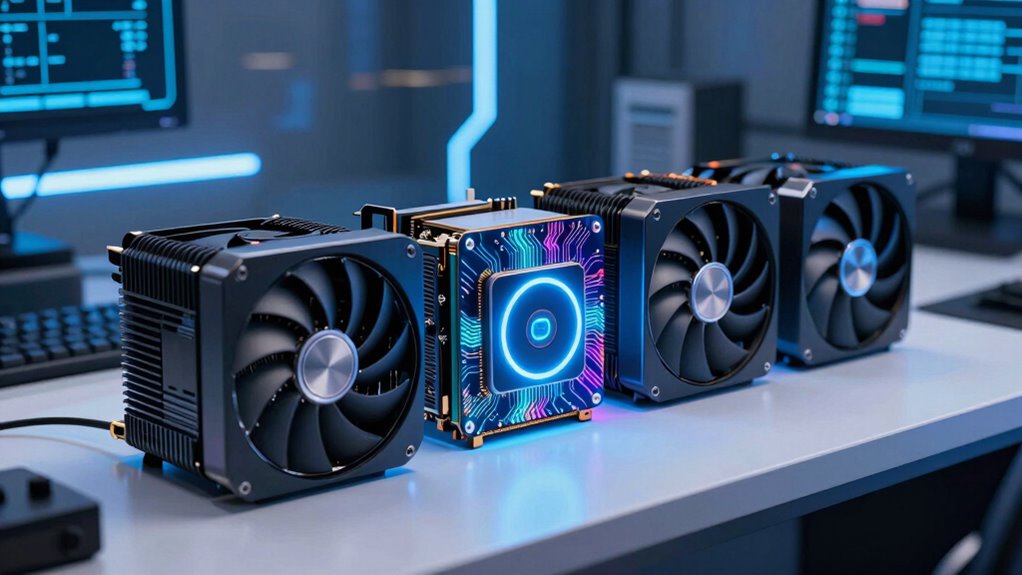
Have you ever wondered how artificial intelligence tasks have evolved in hardware? It’s a fascinating journey that’s shaped the way we process data and run complex algorithms today. In the early days, general-purpose CPUs handled AI workloads, but they soon proved inefficient for the massive parallelism required by neural networks. This led to the rise of specialized hardware designed to accelerate AI computations, starting with GPUs. Known for their ability to perform many operations simultaneously, GPUs revolutionized neural acceleration, making it faster and more efficient to train and deploy AI models. Their parallel architecture allows them to handle the vast matrix calculations involved in deep learning, significantly reducing training times and enabling real-time inference in applications like speech recognition, image analysis, and autonomous driving.
GPUs revolutionized AI by enabling faster training and real-time inference through massive parallel processing.
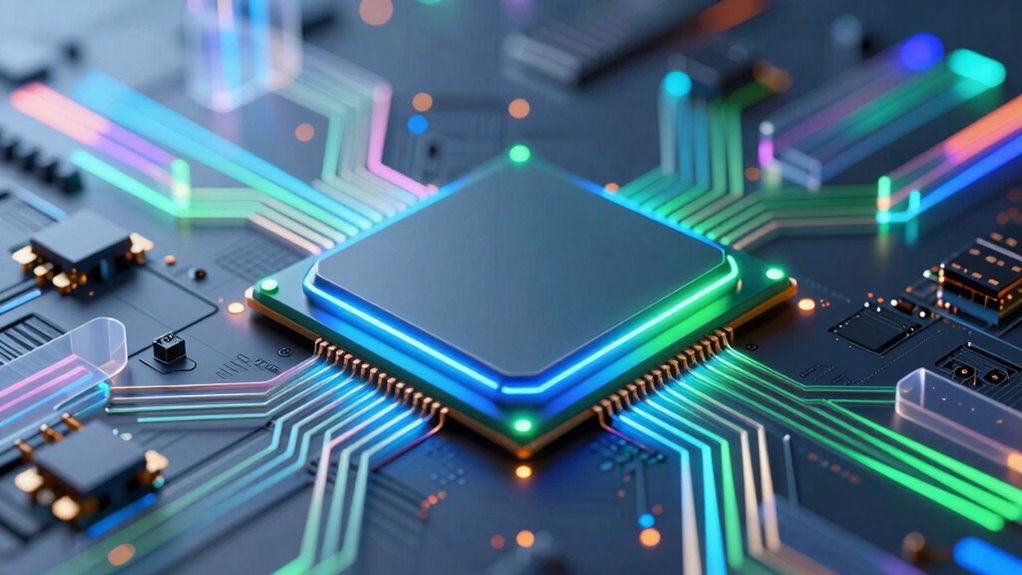
However, as AI models grew more complex and demanding, the need for even greater power efficiency became clear. GPUs, while powerful, consume a substantial amount of energy, which limits their deployment in edge devices and mobile environments. This challenge prompted the development of dedicated AI hardware like neural processing units (NPUs). Unlike GPUs, NPUs are designed from the ground up for neural acceleration, optimizing power efficiency without sacrificing performance. They integrate specialized components that process neural network operations more efficiently, reducing energy consumption and heat generation. This means that AI tasks can run on smaller, less power-hungry devices, expanding AI’s reach into everyday gadgets like smartphones, wearables, and IoT devices. Additionally, the specialized design of NPUs often allows for easier integration into existing hardware architectures, facilitating faster adoption in the industry.
The transition from GPUs to NPUs marks a significant shift in the AI hardware landscape. While GPUs still dominate in research and data centers due to their flexibility and raw power, NPUs are becoming increasingly popular for deployment in consumer electronics. They provide tailored solutions for neural networks, offering faster inference times and lower power draw. This evolution allows AI applications to become more accessible and sustainable, supporting the growth of smart devices and edge computing. You can see this change in the way devices process AI locally rather than relying solely on cloud-based servers, which reduces latency and privacy concerns. Additionally, the development of specialized AI hardware like NPUs reflects a broader trend toward optimizing neural network performance with greater energy efficiency. As AI models continue to evolve, hardware specialization plays a crucial role in making these advancements feasible across diverse environments, including those utilizing natural language processing and other AI techniques.
In essence, the move from GPUs to NPUs reflects a broader trend toward more specialized, efficient AI hardware. It’s about achieving the delicate balance between neural acceleration and power efficiency, making AI better suited for a range of environments — from massive data centers to tiny sensors. As the technology continues to evolve, you’ll likely see even more innovative hardware tailored for specific AI tasks, pushing the boundaries of what’s possible in intelligent systems.

youyeetoo AI Accelerator Card up to 64TOPS, PCIe Gen3 x16, Based on 16 x G-oogle Coral Edge TPU Processor, Enabling AI-Based Real-time Decision Process at Edge(CRL-G116U-P3DF)
※The AI accelerator Support up to 8~16 x G-oogle Coral Edge TPU M.2 modules(CRL-G18U-P3DF have 8 edge TPU…
As an affiliate, we earn on qualifying purchases.
As an affiliate, we earn on qualifying purchases.
Frequently Asked Questions
How Do NPUS Differ From Traditional CPUS in AI Processing?
You’ll find that NPUs differ from traditional CPUs by focusing on neural network acceleration, making AI tasks faster and more efficient. Unlike CPUs, which handle diverse computing needs, NPUs optimize quantum operations and neural network processing specifically. This specialization allows them to perform complex AI calculations more quickly, enabling advanced quantum optimization and deep learning applications. As a result, NPUs boost AI performance markedly over traditional CPU architectures.
What Industries Are Most Impacted by the Shift to NPUS?
You’re likely to see significant shifts in sectors like healthcare, automotive, and finance, where AI accelerates applications. Industries embracing edge deployment benefit from NPUs’ power-efficient processing directly on devices, while data center integration boosts large-scale AI tasks. This shift transforms how you handle real-time data, enabling faster insights, smarter automation, and more seamless experiences, ultimately revolutionizing industries that rely heavily on rapid, reliable AI computations.
Are NPUS More Energy-Efficient Than GPUS for AI Tasks?
Yes, NPUs are more energy-efficient than GPUs for AI tasks. They are designed to optimize power consumption, leading to significant energy savings, especially during intensive computations. This efficiency means you can reduce power usage while maintaining high performance, which is critical for data centers and edge devices. By choosing NPUs, you benefit from lower power consumption, improved energy efficiency, and cost savings, making AI deployment more sustainable.
How Does the Adoption of NPUS Affect AI Model Training Speed?
Adopting NPUs can substantially boost your AI model training speed, especially when combined with edge deployment, as they’re optimized for specific AI tasks. Unlike GPUs, NPUs often handle data more efficiently, reducing training time. While quantum computing isn’t mainstream yet, it promises future breakthroughs. Overall, NPUs accelerate AI workloads, enabling faster model development and deployment, particularly in edge environments where quick processing is essential.
What Challenges Exist in Integrating NPUS Into Existing Hardware Ecosystems?
You face challenges with integrating NPUs into existing hardware ecosystems due to hardware compatibility issues, such as differing architectures and interfaces. Ensuring seamless ecosystem integration requires significant software updates, driver support, and interoperability between components. You might also encounter limitations in existing infrastructure, making it difficult to fully leverage NPU capabilities without extensive upgrades, which can be costly and time-consuming. Overcoming these hurdles is essential for smooth adoption and peak performance.

Energy Management (CRC Press Focus Shortform Book Program)
As an affiliate, we earn on qualifying purchases.
As an affiliate, we earn on qualifying purchases.
Conclusion
As you explore the evolving landscape of AI hardware, remember that each step forward is like a gentle shift in a grand symphony—subtle yet profound. Moving from GPUs to NPUs isn’t just technological progress; it’s a quiet promise of better efficiency and innovation. Embrace this gentle transformation, knowing it’s guiding us toward a brighter, more harmonious future where possibilities quietly expand, inspiring hope and new dreams along the way.

Edge AI on Embedded Devices Running Machine Learning on Microcontrollers and Low-Power Hardware
As an affiliate, we earn on qualifying purchases.
As an affiliate, we earn on qualifying purchases.

NZXT Vertical GPU Mounting Kit – AB-RH175-B1-175 mm PCIe 4.0×16 Riser Cable – GPU Holder – Sturdy Steel Bracket – Black
STURDY STEEL BRACKET: The thick steel bracket holds even heavy graphics cards vertically and prevents them from sagging.
As an affiliate, we earn on qualifying purchases.
As an affiliate, we earn on qualifying purchases.