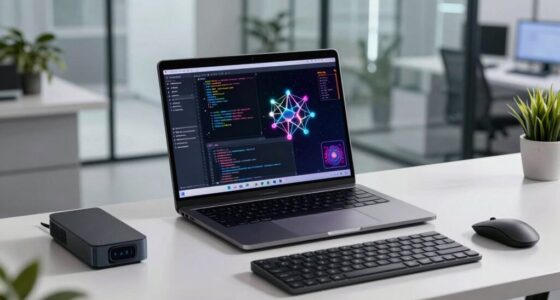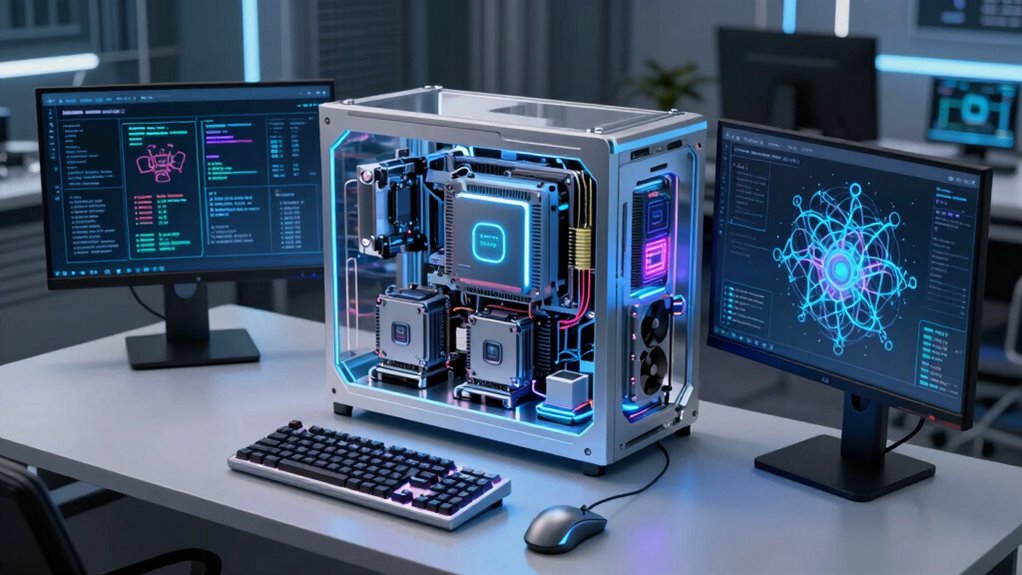

When selecting a desktop workstation for AI engineering, powerful processing, ample memory, and GPU capabilities top the list. The Lenovo ThinkStation P2 Gen 2 stands out as the best overall with its high-end specs, while the Dell Precision 3660 offers a superb balance of performance and reliability. Other models like the Lenovo ThinkStation P3 Tower excel in expandability, but often come at a higher price. Buyers face tradeoffs between raw power, future-proofing, and budget constraints. Continue reading for a detailed breakdown of each option and what makes it suitable for different needs.
Open a free Amazon Business account
Business pricing, bulk buying and tax-exempt orders.
Create a free accountAs an affiliate, we earn on qualifying purchases.
Complete the kit

Key Takeaways
- High-end CPUs like Intel Ultra 7 and 9 series are common among top picks, emphasizing core performance for AI workloads.
- GPU options vary from professional Nvidia RTX and Quadro cards to AMD Radeon PRO, impacting compatibility with AI frameworks.
- Memory capacity in these workstations often exceeds 64GB, reflecting the need for large datasets and model training.
- Expandability and future-proofing are key differentiators, with some models offering multiple PCIe slots and storage bays.
- Tradeoffs often involve balancing initial cost versus long-term performance, with premium models providing more sustainable options.
| Lenovo ThinkStation P2 Gen 2 Workstation Desktop with Intel Core Ultra 7 265K, 128GB DDR5 RAM, 3TB Storage, Windows 11 Pro |  | Best Overall for Power and Upgradability | Processor: Intel Core Ultra 7 265K, up to 5.5 GHz, 20 Cores | RAM: 128GB DDR5 | Storage: 3TB (2TB SSD + 1TB HDD) | VIEW ON AMAZON | See Our Full Breakdown |
| Lenovo ThinkStation P3 Tower Gen 2 Workstation |  | Best for AI-Ready Processing and Professional Security | Processor: Intel Core Ultra 9 285 vPro, up to 5.40 GHz | Cores/Threads: 24 Cores, 24 Threads | RAM: 128GB DDR5-4400MHz | VIEW ON AMAZON | See Our Full Breakdown |
| Lenovo ThinkStation P2 Tower Desktop AI PC with Bundle |  | Best for Versatile, Portable Data and AI Work | Processor: Intel Core Ultra 5 225 | Cores: 10 | Threads: 10 | VIEW ON AMAZON | See Our Full Breakdown |
| Dell Precision 3660 Tower Computer with Intel i9-13900, 64GB RAM, 2TB NVMe SSD, Nvidia RTX A4000 16GB, Windows 11 Pro |  | Best for GPU-Accelerated AI and Visual Workloads | Processor: Intel i9-13900 | RAM: 64GB | Storage: 2TB NVMe SSD | VIEW ON AMAZON | See Our Full Breakdown |
| Lenovo ThinkStation P2 Tower Desktop Computer with Intel Core Ultra 7 265k |  | Best for AI-Driven Design and Engineering | Processor: Intel Core Ultra 7 265k | Cores: 20 | RAM: 32GB DDR5 | VIEW ON AMAZON | See Our Full Breakdown |
| Lenovo ThinkStation P3 Tower with Intel Core Ultra 9 285, 64GB DDR5, NVIDIA RTX 2000 |  | Best Overall for Demanding AI and Simulation Workflows | Processor: Intel Core Ultra 9 285 vPro | Graphics: NVIDIA RTX 2000 | Memory: 64GB DDR5-5600MT/s | VIEW ON AMAZON | See Our Full Breakdown |
| Dell Pro Max Tower T2 with AMD Radeon PRO W7500 and Intel Ultra 7 265 |  | Best for Creative Professionals with High-Resolution Display Needs | Graphics: AMD Radeon PRO W7500 8GB GDDR6 | Processor: Intel Ultra 7 265 | RAM: 64GB DDR5 | VIEW ON AMAZON | See Our Full Breakdown |
| Dell Pro Max Tower T2 with NVIDIA RTX 2000 Ada 16GB and Intel Ultra 7 265 |  | Best for High-End Graphics and AI Workloads | Graphics: NVIDIA RTX 2000 Ada 16GB GDDR6 | Processor: Intel Ultra 7 265 | RAM: 64GB DDR5 | VIEW ON AMAZON | See Our Full Breakdown |
| HP Z2 SFF G1i Workstation Desktop, Intel Core Ultra 5 235, 32GB DDR5, 1TB SSD |  | Best Compact Workstation for Moderate AI and Engineering Tasks | Processor: Intel Core Ultra 5 235 | RAM: 32GB DDR5 | Storage: 1TB PCIe NVMe SSD | VIEW ON AMAZON | See Our Full Breakdown |
| Dell Pro Tower Plus Core Ultra 7 265 16GB DDR5 1TB SSD Desktop Computer |  | Best for Entry-Level AI and Multitasking with Good Connectivity | Processor: Intel Core Ultra 7 265 | RAM: 16GB DDR5 | Storage: 1TB SSD | VIEW ON AMAZON | See Our Full Breakdown |
| desktop workstations for ai engineer | Processor | Storage | RAM | Graphics |
|---|---|---|---|---|
| Lenovo ThinkStation P2 Gen 2 W | Intel Core Ultra 7 265K, up to 5.5 GHz, 20 Cores | 3TB (2TB SSD + 1TB HDD) | 128GB DDR5 | — |
| Lenovo ThinkStation P3 Tower G | Intel Core Ultra 9 285 vPro, up to 5.40 GHz | 2TB PCIe Gen 5 SSD | 128GB DDR5-4400MHz | — |
| Lenovo ThinkStation P2 Tower D | Intel Core Ultra 5 225 | 2TB SSD | 64GB DDR5 | — |
| Dell Precision 3660 Tower Comp | Intel i9-13900 | 2TB NVMe SSD | 64GB | — |
| Lenovo ThinkStation P2 Tower D | Intel Core Ultra 7 265k | 1TB SSD | 32GB DDR5 | — |
| Lenovo ThinkStation P3 Tower w | Intel Core Ultra 9 285 vPro | 1TB high-speed storage | — | NVIDIA RTX 2000 |
| Dell Pro Max Tower T2 with AMD | Intel Ultra 7 265 | 2TB SSD | 64GB DDR5 | AMD Radeon PRO W7500 8GB GDDR6 |
| Dell Pro Max Tower T2 with NVI | Intel Ultra 7 265 | 2TB SSD | 64GB DDR5 | NVIDIA RTX 2000 Ada 16GB GDDR6 |
| HP Z2 SFF G1i Workstation Desk | Intel Core Ultra 5 235 | 1TB PCIe NVMe SSD | 32GB DDR5 | Intel Graphics |
| Dell Pro Tower Plus Core Ultra | Intel Core Ultra 7 265 | 1TB SSD | 16GB DDR5 | Integrated Intel Graphics |
More Details on Our Top Picks
Lenovo ThinkStation P2 Gen 2 Workstation Desktop with Intel Core Ultra 7 265K, 128GB DDR5 RAM, 3TB Storage, Windows 11 Pro
The Lenovo ThinkStation P2 Gen 2 stands out for its exceptional processing power, featuring an Intel Core Ultra 7 265K with 20 cores, making it ideal for heavy data processing and multitasking. Its massive 128GB DDR5 RAM allows for virtualization and large dataset handling without breaking a sweat, and the 3TB storage offers ample space for big projects. Compared to other options like the Dell Precision 3660, it provides easier upgradeability thanks to its tool-less design, although this comes at a premium price. It’s best suited to AI engineers who need a future-proof, highly customizable workstation that can grow with their demands. The main tradeoff is the high cost, which may be prohibitive for less demanding users or smaller budgets.
Pros:- Exceptional multi-core performance for demanding workloads
- Massive 128GB DDR5 RAM supports heavy multitasking
- Flexible, tool-less upgrade design for future expansion
- Fast storage with RAID-ready options
Cons:- High price point may be prohibitive for some buyers
- Potentially overpowered for light or occasional use
Best for: AI engineers requiring maximum processing power, large memory capacity, and easy upgrades for complex workloads.
Not ideal for: Casual users or small startups with tighter budgets who need only basic AI or data analysis capabilities.
- Processor:Intel Core Ultra 7 265K, up to 5.5 GHz, 20 Cores
- RAM:128GB DDR5
- Storage:3TB (2TB SSD + 1TB HDD)
- Connectivity:Ethernet, WiFi 7, Bluetooth 5
- Operating System:Windows 11 Pro
Our verdict“This workstation is best for AI professionals who prioritize power, expandability, and longevity over initial cost.”
Lenovo ThinkStation P3 Tower Gen 2 Workstation
The Lenovo ThinkStation P3 Tower Gen 2 offers a high-performance setup centered around an Intel Core Ultra 9 285 vPro processor, with 24 cores and Turbo Boost up to 5.40 GHz, making it ideal for intensive AI and data tasks. Its 128GB DDR5-4400MHz RAM ensures smooth multitasking, while the 2TB PCIe Gen 5 SSD provides rapid data access. Unlike the Dell Precision 3660, which includes a discrete GPU, the P3 emphasizes CPU and memory performance, but that means it might fall short for GPU-heavy workloads. Designed for professional workloads like engineering and machine learning, it features advanced security and expandability, but at a premium cost. This makes it ideal for AI engineers needing robust CPU performance and enterprise-grade features, though those reliant on GPU acceleration may look elsewhere.
Pros:- Powerful multi-core CPU with AI acceleration capabilities
- High-speed DDR5 RAM for demanding multitasking
- Excellent security and professional-grade features
- Fast PCIe Gen 5 SSD for data-intensive tasks
Cons:- No included discrete GPU limits graphics performance
- Higher price may be restrictive for some users
- Designed mainly for enterprise use, not gaming
Best for: AI developers and data scientists who need CPU-centric power with enterprise security features.
Not ideal for: Graphics-intensive workflows requiring high-end discrete GPUs, or budget-conscious freelancers.
- Processor:Intel Core Ultra 9 285 vPro, up to 5.40 GHz
- Cores/Threads:24 Cores, 24 Threads
- RAM:128GB DDR5-4400MHz
- Storage:2TB PCIe Gen 5 SSD
- Connectivity:Wi-Fi 7, Bluetooth 5.4
Our verdict“Best suited for AI engineers focusing on CPU-driven workloads and enterprise-grade security, less so for GPU-dependent tasks.”
Lenovo ThinkStation P2 Tower Desktop AI PC with Bundle
The Lenovo ThinkStation P2 Tower Desktop with an Intel Core Ultra 5 225 processor and 64GB DDR5 RAM provides a balanced mix of performance and portability, especially with the included 64GB USB flash drive. Its 2TB SSD ensures fast data access, supporting multiple 4K display setups for enhanced productivity. Compared to the more powerful P3 or P2 models, this unit is better suited for users who need a reliable workstation that can handle demanding tasks without the extreme specs—making it perfect for mobile work or collaborative environments. Its open upgrade path is a double-edged sword, offering flexibility but risking warranty issues if not handled properly. The bundle offers added value, but the bulkier design might not fit well into tight spaces.
Pros:- Solid CPU performance suitable for demanding workloads
- Large 64GB DDR5 RAM supports multitasking
- Supports 3 in 4K displays for enhanced productivity
- Includes convenient portable USB flash drive
Cons:- Open upgrade options may void warranty if not careful
- Bulkier design limits placement flexibility
- Less CPU power compared to higher-end models
Best for: AI professionals needing portable, versatile workstations with scalable storage and display support.
Not ideal for: Power users requiring maximum CPU cores or GPU support for deep learning training.
- Processor:Intel Core Ultra 5 225
- Cores:10
- Threads:10
- Max Turbo Frequency:4.9 GHz
- RAM:64GB DDR5
- Storage:2TB SSD
- Display Support:Supports 3 displays in 4K
Our verdict“A versatile, portable workstation ideal for mobile AI tasks and professional multitasking, with some upgrade risks.”
Dell Precision 3660 Tower Computer with Intel i9-13900, 64GB RAM, 2TB NVMe SSD, Nvidia RTX A4000 16GB, Windows 11 Pro
The Dell Precision 3660 Tower features an Intel i9-13900 processor combined with 64GB RAM and a Nvidia RTX A4000 16GB GPU, making it a prime choice for AI training, 3D rendering, and visualization. Its high-performance specs surpass many in the lineup, especially in GPU-accelerated tasks, but this also means a significantly higher price point. While the Lenovo P2 offers more RAM and storage for multitasking, the Dell’s dedicated GPU makes it better suited for deep learning models or graphics-heavy workflows. Its form factor demands ample space, and the cost may exclude casual or budget-conscious buyers. If GPU power is your priority, this workstation justifies its premium.
Pros:- High-end Intel i9 CPU delivers top-tier processing
- Nvidia RTX A4000 GPU with 16GB VRAM accelerates deep learning
- Large 64GB RAM supports multitasking and data loading
- Fast 2TB NVMe SSD for rapid data access
Cons:- High cost limits accessibility for casual users
- Larger desktop size requires spacious setup
- Designed mainly for GPU-intensive workloads, less for simple tasks
Best for: AI engineers and visualization professionals needing GPU-accelerated processing for training and rendering.
Not ideal for: Users focused solely on CPU-based tasks without GPU requirements or those with limited space and budget.
- Processor:Intel i9-13900
- RAM:64GB
- Storage:2TB NVMe SSD
- GPU:Nvidia RTX A4000 16GB
- Operating System:Windows 11 Pro
Our verdict“This workstation excels for GPU-accelerated AI and visualization, though at a premium price and space requirement.”
Lenovo ThinkStation P2 Tower Desktop Computer with Intel Core Ultra 7 265k
The Lenovo ThinkStation P2 with an Intel Core Ultra 7 265k and 32GB DDR5 RAM offers a balanced platform for CAD, 3D modeling, and AI-assisted design. Its 1TB SSD delivers quick file access, while support for NVIDIA RTX 5000 Ada Generation graphics makes it suitable for complex visual tasks. Compared with the P3 model, it provides a more affordable option with slightly less CPU power but still excellent GPU support for rendering and simulations. Its connectivity options, including WiFi 7 and multiple display outputs, make it flexible for multi-monitor setups. However, the workstation’s high cost might deter casual users, and it’s primarily aimed at professional engineering and design workflows rather than gaming or casual AI projects.
Pros:- Powerful CPU with AI acceleration capabilities
- Supports professional-grade NVIDIA RTX 5000 GPU
- Fast 1TB SSD for rapid data handling
- Extensive connectivity including WiFi 7
Cons:- High price for non-enterprise users
- Designed mainly for professional use, not gaming
- Limited upgrade options compared to larger models
Best for: AI-driven designers and engineers focused on complex visualizations and 3D modeling.
Not ideal for: Enthusiasts seeking gaming performance or casual AI experimentation on a budget.
- Processor:Intel Core Ultra 7 265k
- Cores:20
- RAM:32GB DDR5
- Storage:1TB SSD
- Graphics Support:NVIDIA RTX 5000 Ada Generation
Our verdict“An excellent choice for AI professionals in design and engineering demanding GPU support and high processing power.”
Lenovo ThinkStation P3 Tower with Intel Core Ultra 9 285, 64GB DDR5, NVIDIA RTX 2000
The Lenovo ThinkStation P3 Tower Gen 2 excels in handling complex simulations and large datasets thanks to its Intel Core Ultra 9 285 vPro processor and NVIDIA RTX 2000 graphics, making it ideal for AI engineers who need raw power. Compared with the Dell Pro Max T2 with RTX 2000 Ada, this model offers a more balanced blend of security, connectivity, and high-speed DDR5 memory, though it’s less upgrade-friendly and may arrive with delays due to unopened packaging. Its comprehensive port selection and security features make it a top choice for those prioritizing stability and security in demanding environments. However, the limited information on upgradeability and potentially high price point could be drawbacks for future scalability or budget-conscious buyers.
Pros:- Excellent computational power for demanding workflows
- High-speed DDR5 memory and fast SSD storage improve multitasking
- Versatile port options support extensive connectivity
- Enhanced security features like ThinkShield and TPM
Cons:- Unopened retail packaging may delay setup
- High-end price may be prohibitive for some users
- Limited information on upgrade options
Best for: AI engineers working on large-scale simulations or sensitive projects requiring robust security and high-speed memory
Not ideal for: Casual users or those seeking a budget-friendly workstation because of its high cost and limited upgrade notes
- Processor:Intel Core Ultra 9 285 vPro
- Graphics:NVIDIA RTX 2000
- Memory:64GB DDR5-5600MT/s
- Storage:1TB high-speed storage
- Front Ports:USB-C, USB-A, headphone/mic, microphone
- Rear Ports:USB-A, HDMI 2.1, DisplayPort 1.4, Ethernet, line-out
Our verdict“This workstation suits AI engineers who need maximum power and security, but it’s less ideal for those with tight budgets or future upgrade plans.”
Dell Pro Max Tower T2 with AMD Radeon PRO W7500 and Intel Ultra 7 265
This Dell Pro Max Tower T2, equipped with the AMD Radeon PRO W7500 and Intel Ultra 7 265 processor, is tailored for creative workflows like 3D modeling and content creation, supporting up to four 8K displays. While it offers exceptional graphics and AI capabilities, it’s resealed for upgrades, which may concern buyers wanting straightforward, untouched packaging. Its extensive connectivity, including Thunderbolt 4 and multiple USB ports, makes it a versatile choice for demanding visual projects. However, its premium price and size could limit appeal for those with space constraints or tighter budgets. Compared to the NVIDIA-focused models, this provides better graphics for detailed visual work but may lag in raw AI processing power.
Pros:- Supports up to four 8K displays for expansive visual work
- Strong AI and professional-grade graphics performance
- Multiple high-speed connectivity options including Thunderbolt 4
- Excellent for demanding creative workflows
Cons:- Resealed packaging may concern some buyers on authenticity
- Large and heavy, requiring ample workspace
- Premium cost limits accessibility for some users
Best for: Creative professionals working on high-resolution visual projects and demanding rendering tasks
Not ideal for: Budget-conscious users or those primarily focused on pure AI training, due to its higher price and emphasis on graphics
- Graphics:AMD Radeon PRO W7500 8GB GDDR6
- Processor:Intel Ultra 7 265
- RAM:64GB DDR5
- Storage:2TB SSD
- Display Outputs:Four Mini DisplayPort, supports 8K
- Connectivity:USB-C, Thunderbolt 4, USB-A, Ethernet
Our verdict“This workstation is best suited for creative professionals needing high-resolution display support and advanced graphics, but less so for AI-only workflows or budget-sensitive buyers.”
Dell Pro Max Tower T2 with NVIDIA RTX 2000 Ada 16GB and Intel Ultra 7 265
The Dell Pro Max Tower T2 with NVIDIA RTX 2000 Ada 16GB graphics and the Intel Ultra 7 265 processor delivers stellar performance for intensive AI training and graphics-heavy tasks. Its upgraded GPU makes it a more suitable choice than the AMD Radeon model for users prioritizing cutting-edge AI acceleration and rendering. Like its sibling, it’s resealed for upgrades, which could cause hesitation for purists. Its support for up to four 8K displays and extensive connectivity makes it a versatile option for demanding workflows. The higher price reflects its premium specs, yet buyers should consider whether they need the additional GPU power or can settle for a less costly alternative with similar CPU performance.
Pros:- Exceptional GPU for AI training and rendering
- High-performance processor with abundant RAM and fast SSD
- Supports multiple 8K displays for complex visual setups
- Rich connectivity including Thunderbolt 4
Cons:- Resealed packaging may concern some buyers
- Higher cost due to premium GPU and specs
- Large size requiring ample space
Best for: AI engineers and visual artists requiring top-tier GPU acceleration and multi-display support
Not ideal for: Those seeking a more budget-friendly or straightforward workstation, given its high cost and resealed packaging
- Graphics:NVIDIA RTX 2000 Ada 16GB GDDR6
- Processor:Intel Ultra 7 265
- RAM:64GB DDR5
- Storage:2TB SSD
- Display Outputs:4 Mini DisplayPort 1.4a
- Connectivity:USB-C, Thunderbolt 4, USB-A, Ethernet
Our verdict“This workstation caters to AI professionals needing maximum GPU performance and display support, though it’s less suitable for budget-conscious users or those with limited space.”
HP Z2 SFF G1i Workstation Desktop, Intel Core Ultra 5 235, 32GB DDR5, 1TB SSD
The HP Z2 SFF G1i offers a compact yet capable solution for engineers and designers working on 3D modeling, simulation, and moderate AI tasks. Its Intel Core Ultra 5 235 processor and 32GB DDR5 RAM provide solid performance in a small form factor, supported by fast 1TB SSD storage. While it supports high-resolution displays through DisplayPort options, the absence of a dedicated GPU limits its suitability for graphics-intensive AI training or rendering. Its MIL-STD 810H testing ensures durability in demanding environments, but the relatively lower specs make it less suitable for heavy-duty AI workloads compared to larger, dedicated workstations.
Pros:- Compact, space-saving design
- Durable MIL-STD 810H certification
- Good performance for moderate workloads
- Extensive connectivity including 8K display support
Cons:- No dedicated GPU, limiting graphics-intensive tasks
- Resealed for upgrades, which may concern some buyers
- Price may be high relative to performance for its size
Best for: Engineers and designers needing a space-efficient workstation for moderate AI and visualization work
Not ideal for: High-end AI training or heavy graphics rendering, due to its integrated graphics and lower processing power
- Processor:Intel Core Ultra 5 235
- RAM:32GB DDR5
- Storage:1TB PCIe NVMe SSD
- Graphics:Intel Graphics
- Display Support:DisplayPort 1.4, supports 8K
- Durability:MIL-STD 810H
Our verdict“This small form factor workstation fits engineers needing reliable performance in tight spaces, but it’s not suited for high-end AI training or graphics workloads.”
Dell Pro Tower Plus Core Ultra 7 265 16GB DDR5 1TB SSD Desktop Computer
The Dell Pro Tower Plus with Core Ultra 7 265 and 16GB DDR5 RAM offers a balanced entry point for AI engineers starting out or handling less intensive workloads. Its support for triple 4K displays via DisplayPort makes it suitable for multitasking and data visualization. While it features a straightforward setup and decent performance, the absence of a dedicated GPU and WiFi limits its appeal for graphics-heavy AI training or mobile setups. The 16GB RAM may become a bottleneck for larger datasets, but for lighter AI tasks or general engineering work, it provides a capable platform at a lower price point than the higher-end models.
Pros:- Solid CPU with AI acceleration features
- Supports triple 4K monitors for productivity
- Fast SSD and DDR5 RAM improve performance
- Multiple USB ports and Ethernet for connectivity
Cons:- No dedicated graphics card limits high-end AI training
- Lacks WiFi, requiring wired Ethernet or adapters
- Only 16GB RAM may restrict large dataset processing
Best for: AI beginners or engineers doing moderate workloads who need multiple displays and reliable connectivity
Not ideal for: Power users requiring intensive AI training or advanced graphics, due to limited RAM and integrated graphics
- Processor:Intel Core Ultra 7 265
- RAM:16GB DDR5
- Storage:1TB SSD
- Graphics:Integrated Intel Graphics
- Display Support:Triple 4K via DisplayPort
- Networking:Gigabit Ethernet, no WiFi
Our verdict“This system is a good entry-level choice for AI engineers with moderate workloads but less focus on graphics-intensive tasks or future scalability.”
How We Picked
These workstations were selected based on their processing power, GPU options, memory capacity, expandability, and overall build quality. Emphasis was placed on models that cater specifically to AI workloads, which require high-performance CPUs and GPUs, large RAM, and reliable thermal management. Cost-to-value ratio was also considered, ensuring that buyers get a balance of performance and investment. Models are ranked by how well they meet the demands of AI engineers, with a focus on future scalability and system durability.| desktop workstations for ai engineer | Graphics |
|---|---|
| Lenovo ThinkStation P2 Gen 2 W | — |
| Lenovo ThinkStation P3 Tower G | — |
| Lenovo ThinkStation P2 Tower D | — |
| Dell Precision 3660 Tower Comp | — |
| Lenovo ThinkStation P2 Tower D | — |
| Lenovo ThinkStation P3 Tower w | NVIDIA RTX 2000 |
| Dell Pro Max Tower T2 with AMD | AMD Radeon PRO W7500 8GB GDDR6 |
| Dell Pro Max Tower T2 with NVI | NVIDIA RTX 2000 Ada 16GB GDDR6 |
| HP Z2 SFF G1i Workstation Desk | Intel Graphics |
| Dell Pro Tower Plus Core Ultra | Integrated Intel Graphics |
Factors to Consider When Choosing Desktop Workstations For Ai Engineers
Choosing the right desktop workstation for AI engineering involves several key considerations. Beyond raw specs, factors like expandability, thermal management, and software compatibility influence long-term satisfaction. Understanding these aspects helps avoid common pitfalls, such as overspending on features you won’t need or missing out on future upgrade paths. The right balance depends on your specific workloads, budget, and growth plans.Performance and CPU Power
AI workloads demand high-performance processors, often multi-core CPUs like Intel Ultra 7 or 9 series. Investing in a CPU with multiple cores and high clock speeds ensures faster training times and smoother multitasking. However, more powerful CPUs typically come with higher costs and increased thermal output, so cooling solutions must be considered. Buyers should match CPU performance to their workload intensity—over-specifying can lead to unnecessary expense, while under-specifying hampers productivity.
GPU Capabilities
GPUs accelerate AI training significantly, making professional-grade graphics cards like Nvidia RTX A4000 or Quadro series essential. Compatibility with AI frameworks such as TensorFlow or PyTorch depends on the GPU, so choosing the right model impacts development speed. AMD Radeon PRO cards can be an alternative but may limit some software options. Consider future GPU upgrade paths and whether the workstation supports multiple high-end cards if scalability is a priority.
Memory and Storage
Ample RAM—often 64GB or more—is critical to handle large datasets and complex models without bottlenecks. Storage speed and capacity also matter; NVMe SSDs dramatically reduce data access times, speeding up workflows. For long-term projects, additional storage options like HDDs or secondary SSDs provide valuable capacity. Be wary of systems with limited RAM or slower storage, as these can hinder performance during intensive training sessions.
Expandability and Future-Proofing
AI engineering is an evolving field requiring systems that can adapt over time. Workstations with multiple PCIe slots, additional RAM slots, and easy access to upgrade components offer better longevity. Avoid systems that are tightly integrated or difficult to upgrade, as they may become obsolete quickly. Remember, investing in a slightly more expandable system often pays off in the long run, especially when AI projects grow in complexity and size.
Build Quality and Reliability
High-quality components and solid thermal management reduce downtime and extend system lifespan. A well-built workstation with efficient cooling fans and good airflow prevents overheating during prolonged training sessions. Reliability also depends on brand reputation and warranty support—consider these factors to minimize maintenance hassles. Cheaper options may save money upfront but can lead to higher repair costs or system failures over time.
Frequently Asked Questions
How much RAM do I need for AI training?
For most AI training tasks, 64GB of RAM is a practical minimum, allowing for larger datasets and more complex models. If your work involves very large models or multiple concurrent projects, considering 128GB or more can help maintain smooth performance. Keep in mind that upgrading RAM later is easier if the motherboard supports additional slots, so choose a system with room for expansion if future needs are anticipated.
Should I prioritize GPU over CPU for AI work?
While both are important, GPU performance often has a more immediate impact on training times for AI models. High-end Nvidia RTX or Quadro cards can significantly accelerate computations. However, a balanced system with a strong CPU ensures overall stability and performance, especially for data preprocessing and model development. The best approach is to match your GPU choice with your specific AI frameworks and workload demands.
Is it better to buy a prebuilt workstation or assemble my own?
Prebuilt workstations offer convenience and warranty support, which can be valuable for professional use. They are optimized for reliability and often come with tested configurations. Building your own system can provide more customization and potentially save costs, but it requires technical expertise and may void warranties if not done correctly. For most AI engineers focused on productivity and reliability, a well-chosen prebuilt offers the best balance.
How important is thermal management in these workstations?
Thermal management is critical because prolonged AI training sessions generate significant heat, which can throttle performance or damage components. Quality cooling solutions, airflow design, and high-quality fans keep temperatures stable, ensuring consistent performance and longer component lifespan. Ignoring thermal considerations can lead to frequent system crashes and increased maintenance costs, making it a key factor in choosing a workstation.
Should I consider future GPU upgrades when buying?
Yes, planning for future GPU upgrades can extend the useful life of your workstation. Look for systems with multiple PCIe slots, adequate power supply capacity, and sufficient cooling. This flexibility allows you to upgrade to newer or more powerful GPUs as your AI projects evolve, avoiding the need for a complete system overhaul. Prioritizing upgradeability can be a wise investment, especially in a rapidly advancing field like AI.
Conclusion
For those seeking the best overall performance and reliability, the Lenovo ThinkStation P2 Gen 2 is a strong choice, especially for professional AI engineers. Budget-conscious buyers aiming for solid performance might find the Dell Pro Tower Plus offers excellent value. Beginners or those new to AI work should consider systems with straightforward upgrade paths and reliable support, such as the HP Z2 SFF G1i. For users with specific needs, like multi-GPU setups or future expansion, models like the Lenovo ThinkStation P3 Tower provide added flexibility. Ultimately, matching the workstation to your workload, budget, and growth plans ensures the best long-term investment.
As an affiliate, we earn on qualifying purchases.Flea & tick season Picks
flea and tick prevention