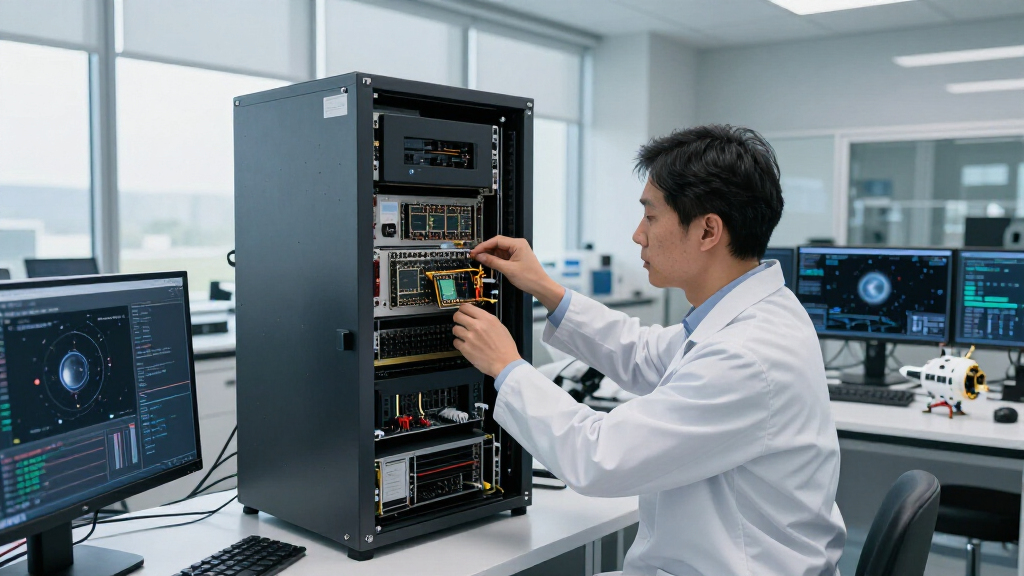

📊 Full opportunity report: Can Nvidia Vera CPUs Revolutionize AI Operations In Space? Insights From SpaceXAI on ThorstenMeyerAI.com — validation score, market gap, and execution plan.
TL;DR
SpaceXAI announced plans to deploy Nvidia Vera CPUs for AI workloads on Earth and in space. The company aims to use Vera Rubin NVL72 systems in orbit, but specific details and timelines are not yet available. The move signals a potential shift toward space-based AI processing.
SpaceXAI has announced plans to deploy standalone Nvidia Vera CPUs for Grok’s agentic workloads and to use an optimized Vera Rubin NVL72 system in space with a Starmind satellite. These initiatives link the company’s AI computing efforts directly with space-based infrastructure, although no deployment dates, technical specifications, or performance data have been disclosed.
The first component involves deploying standalone Nvidia Vera CPUs to support Grok’s agentic AI workloads on Earth. These workloads typically involve multi-step tasks, tool integration, and state management, which can demand significant CPU resources. SpaceXAI has not specified which Grok services will run on these CPUs, nor whether they will handle inference, orchestration, or data processing.
The second part of the announcement pertains to an optimized Vera Rubin NVL72 configuration intended for space use with a Starmind satellite. While the wording suggests adaptation for orbital conditions, no design changes or hardware modifications have been detailed. The hardware’s power, cooling, radiation shielding, and communication strategies remain unconfirmed, and there is no indication whether the system has undergone testing in space conditions.
This dual approach signifies a move toward integrating AI hardware directly into space infrastructure, potentially enabling onboard processing capabilities that reduce reliance on ground-based data centers. However, the technical readiness and operational specifics are still under wraps.
Implications for Space-Based AI Infrastructure
This development could mark a significant shift in how AI processing is conducted in space, potentially enabling more autonomous and efficient satellite operations. Deploying Nvidia Vera CPUs for agentic workloads in orbit might reduce latency, improve data handling, and support complex AI tasks directly onboard satellites. Such capabilities could enhance space missions, satellite management, and real-time data analysis, paving the way for more advanced autonomous space systems.
Furthermore, integrating AI hardware like Vera Rubin NVL72 systems into space infrastructure tests the durability and performance of rack-scale AI hardware in orbit. Success could lead to broader adoption of AI processing directly in space, reducing dependency on terrestrial data centers and enabling new mission profiles.
However, the lack of detailed performance data, testing results, and operational plans means the practical benefits and challenges remain uncertain. The initiative’s success will depend on hardware resilience, power management, thermal regulation, and communication reliability in the space environment.
As an affiliate, we earn on qualifying purchases.
Background on Nvidia Vera and SpaceXAI’s Space Initiatives
Nvidia’s Vera CPU and Rubin accelerator architecture are designed for high-performance AI workloads, with Vera Rubin serving as a scalable platform for large AI systems. SpaceXAI’s interest in these architectures aligns with broader industry trends toward edge and space AI processing, aiming to reduce latency and increase autonomy in satellite systems.
Prior to this announcement, SpaceX and related entities have explored space-based AI applications, primarily focusing on communication, navigation, and remote sensing. The current plan to deploy Vera CPUs and NVL72 systems in orbit represents a step toward more complex onboard AI capabilities, potentially supporting autonomous satellite operations and deep-space missions.
While no specific launch or testing milestones have been disclosed, the move reflects a growing interest in integrating advanced AI hardware into space infrastructure, driven by the need for real-time processing and reduced reliance on ground stations.
“We are exploring the integration of advanced AI hardware into our space infrastructure to enhance satellite autonomy and processing efficiency.”
— SpaceXAI spokesperson
space-grade Nvidia Vera Rubin NVL72 system
As an affiliate, we earn on qualifying purchases.
As an affiliate, we earn on qualifying purchases.
Unanswered Questions About Deployment and Performance
It remains unclear when the Nvidia Vera CPUs will be deployed or operational in either ground or space environments. Details about the hardware configurations, testing procedures, and performance benchmarks are not yet available. The actual capabilities of the Vera Rubin NVL72 system in orbit, including power consumption, thermal management, and radiation shielding, are still unknown. Additionally, whether the hardware has undergone space qualification tests or is still in development phases has not been disclosed. These uncertainties mean the project’s feasibility and potential benefits are still to be demonstrated through future testing and validation.
AI hardware for satellite applications
As an affiliate, we earn on qualifying purchases.
As an affiliate, we earn on qualifying purchases.
Upcoming Milestones and Testing Expectations
Next steps include the release of technical specifications for the Vera CPUs and the NVL72 system, along with detailed plans for deployment timelines. Ground testing of the hardware in simulated space conditions is expected to precede any orbital deployment. Details about the satellite, launch windows, and in-orbit testing plans for the NVL72 configuration will clarify the project’s progress. Monitoring performance data from initial tests will determine whether the hardware can operate reliably under space conditions and support the intended AI workloads. These developments will shape the future of onboard AI processing in space missions.
space-based AI processing hardware
As an affiliate, we earn on qualifying purchases.
As an affiliate, we earn on qualifying purchases.
Key Questions
Are Nvidia Vera CPUs already in use for space missions?
No, Nvidia Vera CPUs are currently in the planning or development stage for this specific application. SpaceXAI has announced plans but has not disclosed operational deployment or testing results yet.
What are the potential advantages of using Vera CPUs in space?
Using Vera CPUs could enable onboard processing of complex AI workloads, reduce latency in satellite operations, and increase autonomy, potentially transforming satellite management and deep-space exploration.
Has SpaceXAI tested the Vera Rubin NVL72 system in space conditions?
No, there are no publicly available test results or validation data for the NVL72 system in space. Its adaptation for orbital use remains a future milestone.
When might we see these systems operational in orbit?
Specific timelines have not been announced. Future updates on deployment schedules, testing phases, and mission milestones are expected to clarify when the hardware will become operational.
How does this development compare to existing space AI hardware?
Current space AI hardware primarily involves radiation-hardened processors designed for specific tasks. Nvidia Vera’s architecture, if successfully adapted, could offer higher performance and flexibility, but its space qualification process is still underway.
Source: ThorstenMeyerAI.com