
📊 Full opportunity report: Could A Task-Based Workspace Simplify Social Media Management? on IdeaNavigator AI — validation score, market gap, and execution plan.

Get business pricing on tech for your team
- Business-only prices and quantity discounts
- Tax-exempt purchasing
- Multiple users, one account, clear invoices
TL;DR
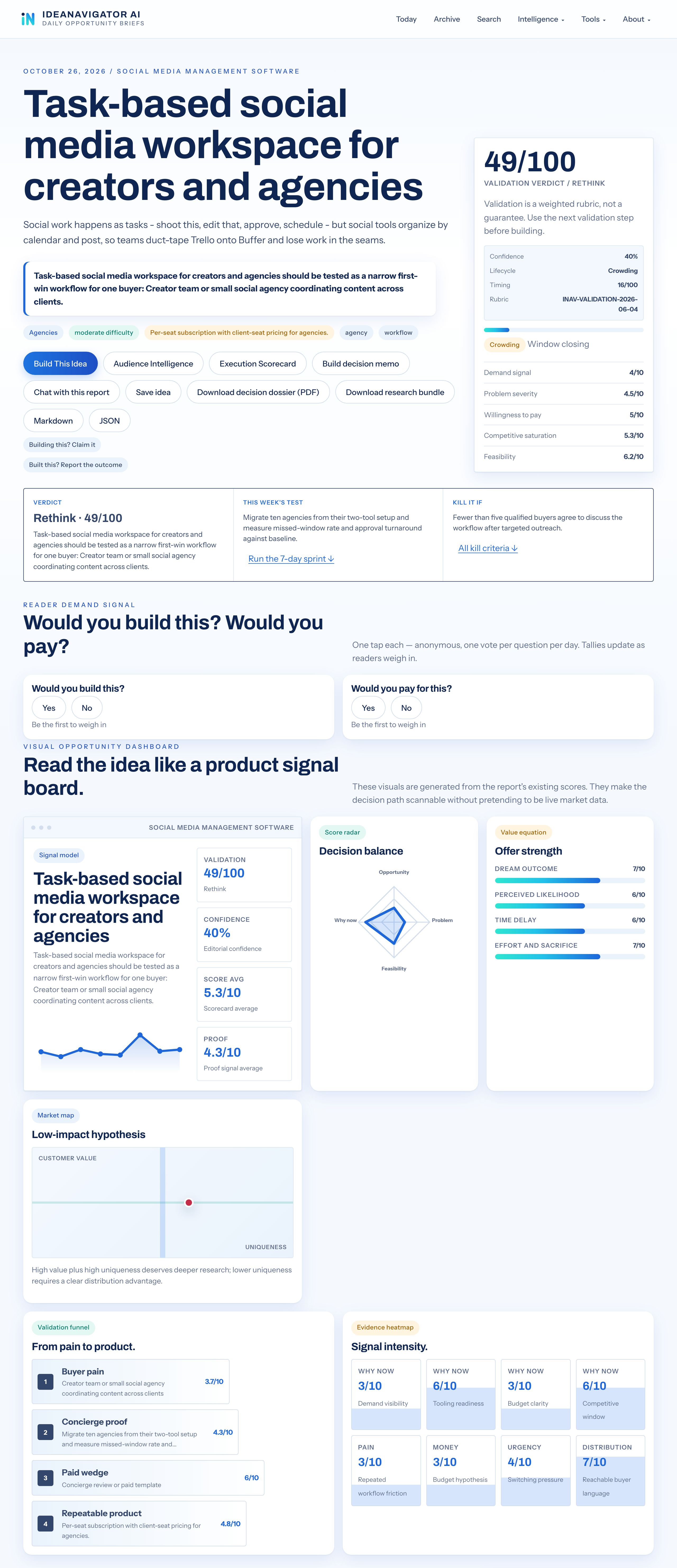
IdeaNavigator AI has outlined a proposed task-based workspace for creator teams and small social agencies, organizing each social post through briefing, editing, approval and scheduling. The idea is a product proposal, not a launched service or validated result; its suggested test is to migrate ten agencies and compare missed publishing windows and approval times with their current setup.
IdeaNavigator AI has proposed a task-based social media workspace for creator teams and small agencies, framing it as a product opportunity rather than reporting a launched tool. The concept would put each post through one workflow, from brief and asset preparation to approval and scheduling, addressing a coordination problem the proposal says is often split between social schedulers and general project-management software.
The proposed workspace treats each post as a task, with stages for briefing, assets, editing, approval and scheduling. Its suggested minimum viable product would also include client-facing approval links and asset versioning, then schedule a post natively after approval. The aim is to connect the work surrounding publication to the publishing step itself, rather than requiring a team to reconcile separate tools.
The initial audience is deliberately narrow: creator teams and small social agencies coordinating content for multiple clients. The business model proposed is a per-seat subscription, with pricing for client seats at agencies. These are product and pricing recommendations, not confirmed features, commercial terms or evidence of customer demand.
To test whether the workflow solves a measurable problem, the proposal recommends moving ten agencies from their existing two-tool setups and comparing missed publishing windows and approval turnaround with their prior performance. No agencies are named, and no baseline, test duration, measured outcome or comparison data is supplied. The proposal does not establish that the product has been built or that the suggested trial has begun.
A Test of the Work Behind Posts
The proposal focuses on coordination for teams publishing across client accounts: a post passes through several people and stages before it goes live, while tools for publishing and team work may be separate. When tasks, feedback, assets and scheduling are spread across systems, staff may need to track status manually. The proposal provides no measurements of how often this occurs or how much time it takes.
The proposed test would assess whether the workflow reduces handoffs without requiring teams to abandon the social platforms they use. It identifies missed-window rates and approval turnaround as measures. To assess any change, the test would need defined baselines and comparable observation periods.
The proposal combines task management and scheduling in one workflow. It also identifies client access, asset histories and the connection between approval and publication as components of the concept. The material does not report how these elements would work in practice or whether the workspace would replace existing steps.
Products Worth Considering

Logitech MX Keys S Wireless Keyboard, Graphite

Sony WH-1000XM4C Wireless Noise-Cancelling Headphones, Black

Jackery Explorer 300 Portable Power Station, 292Wh
As an affiliate, we earn on qualifying purchases.
From Calendar to Content Workflow
The proposal describes a mismatch between how social media software is commonly organized and how teams carry out the work. Scheduling products tend to center on calendars and posts, while the production process includes briefs, asset creation, edits and client sign-off. According to the IdeaNavigator AI proposal, some teams bridge that gap with a social scheduling tool and a separate project tool such as Trello. The description is a market thesis; it is not accompanied by an independent survey or market data.
Its rationale for pursuing the idea now is that higher expectations for content output have multiplied coordination needs, while scheduling incumbents have left work management to general-purpose tools. No figures are provided for growth in posting volume, the size of the market, or the share of teams using this two-tool arrangement. The argument should therefore be read as the proposal’s account of a possible gap, not as a verified industry-wide finding.
The recommendation is to begin with a specific customer and workflow rather than build a broad social-media suite. That makes the proposed ten-agency migration a test of both the problem and the product: agencies would have to be willing to move their work, and the workspace would have to improve the selected measures relative to each agency’s existing process.
Product Status and Evidence Still Open
No product launch or operating service is confirmed in the available material. It does not identify a developer, release date, integrations, supported social networks, security provisions or price. The per-seat and client-seat model is a suggested way to charge, not a published offer.
It is also unclear whether agencies experience the described tool separation widely enough to support a standalone product, or whether existing platforms can already cover the workflow through integrations and add-ons. The proposed test has no reported participants, baseline figures, measurement period or results. Without those details, there is no basis to say the concept reduces missed posts, speeds approvals or is commercially viable.
Even a favorable test would need careful interpretation. Agencies differ in client approval rules, team size and posting cadence, and the proposal does not specify how those differences would be controlled. Whether a task-based workspace can connect approvals to native scheduling across the platforms its target users need is also unspecified.
Validate With Agency Workflows
The next step described is a pilot with ten agencies currently coordinating social work across two tools. A meaningful report would identify participating agencies, record each team’s existing missed-window rate and approval turnaround, and compare those measures after migration over a stated period. It would also explain how a missed window and an approval turnaround are defined.
No pilot schedule or results are available in the proposal. Before a test can assess the idea, its developers would need to establish which platforms and approval steps the MVP supports, how client access and asset versions are handled, and whether scheduling follows approval reliably. Until those details and test findings emerge, the workspace remains a product hypothesis, not a proven alternative to existing social and project-management tools.
Source: IdeaNavigator AI
Key Questions
Has the task-based workspace launched?
No launch is confirmed in the available proposal. It describes an MVP concept and a way to test it, but gives no product name, release date or operating details.
Who is the proposed workspace for?
The proposed first customers are creator teams and small social agencies coordinating content across clients. The scope is narrower than a general social-media management platform.
What would the proposed MVP include?
Each post would move through brief, asset, edit, approval and scheduled stages. The suggested features also include client approval links, asset versioning and native scheduling after approval.
How would the idea be tested?
The proposal recommends migrating ten agencies from two-tool workflows and comparing missed publishing windows and approval turnaround with baseline performance. No test results or schedule are reported.
Is there evidence that the workspace improves results?
No measured evidence is provided. The material identifies outcomes to test, but does not report that a pilot has run or that agencies have seen faster approvals or fewer missed windows.
Source: IdeaNavigator AI