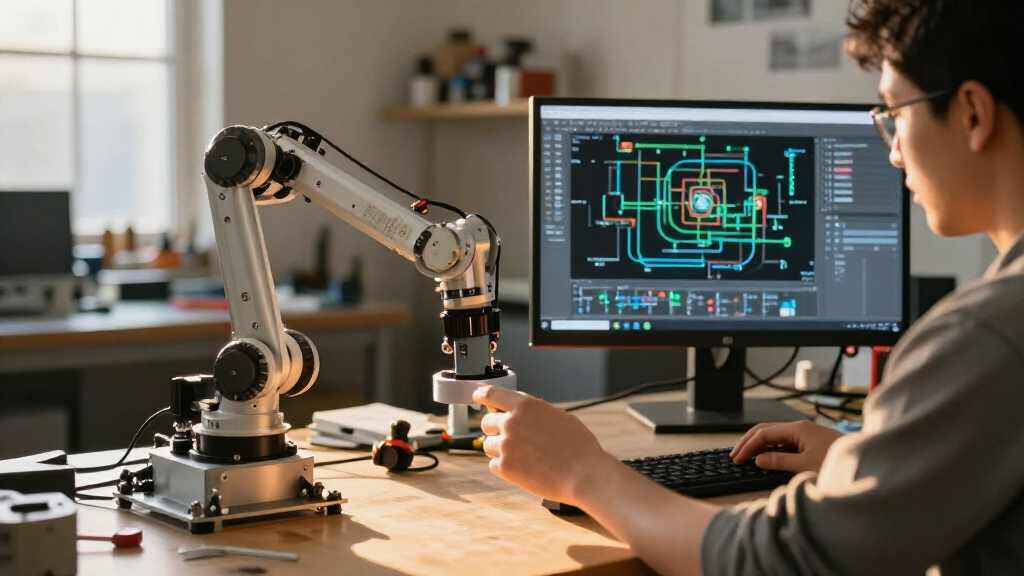

🔍 Read the full analysis: How AI Is Accelerating Engineering For The Physical World on ThorstenMeyerAI.com

Get business pricing on tech for your team
- Business-only prices and quantity discounts
- Tax-exempt purchasing
- Multiple users, one account, clear invoices
TL;DR
OpenAI’s website lists a page titled “Accelerating engineering for the physical world.” The source material available for review contains only the title and URL, so it does not confirm what OpenAI is doing, whether it involves a product or research effort, or whether any engineering results have been demonstrated.
OpenAI’s website lists a page titled “Accelerating engineering for the physical world,” but the material available for review includes only the title and URL, not the page’s text. The original analysis likewise does not establish what the company is announcing, which engineering work it concerns, or whether any product, research effort or measured result is involved.
The supplied reference identifies the page at openai.com/index/accelerating-engineering-for-the-physical-world. It does not provide a publication date, article text, linked announcement or supporting documentation. The confirmed information is limited to the page title and URL; its substantive content could not be assessed from the material provided.
The title suggests a subject involving engineering beyond purely digital tasks, but it does not specify a technology or workflow. It does not confirm whether the page concerns product design, manufacturing, robotics, industrial systems or another field. Those are possible interpretations of the phrase, not verified descriptions of OpenAI’s work.
The reference names no participants or partner organizations and includes no technical details, performance measures or direct quotations. It also does not say whether a system has been tested, released or used in real-world engineering. Claims about capabilities, access or completed results would go beyond the evidence supplied.
What Engineering Claims Would Mean
Engineering work affects physical products, infrastructure and industrial processes, so credible tools that assist with design or testing could have consequences beyond the software sector. Depending on the task and evidence, such tools might affect development time, cost, reliability or safety. These are potential stakes of the topic, not outcomes established by the OpenAI page title.
For readers evaluating any claimed benefit, the missing details matter. A useful assessment would identify the engineering task, the people using the system, the conditions of testing and the comparison baseline. Without those details, there is no basis to conclude that engineering has become faster, cheaper or more reliable as a result of this work.
The distinction is especially relevant when a headline uses broad language such as “accelerating.” That word does not by itself say what was accelerated, how the change was measured or whether the result applies outside a specific test. Until the page’s substance and evidence are available, the title signals an area of interest rather than a demonstrated change in engineering practice.
Products Worth Considering

Logitech MX Mechanical Wireless Illuminated Keyboard, Tactile Quiet, Graphite

Sony WH-1000XM6 Wireless Noise-Canceling Headphones, Black

DJI Mini 3 Drone with DJI RC and 3-Axis Gimbal
As an affiliate, we earn on qualifying purchases.
What the Page Reference Establishes
The source material describes an OpenAI URL whose path matches the title “Accelerating engineering for the physical world.” It does not reproduce the page body or provide a date. No additional attributable source is included to clarify the announcement or verify what the page says.
That limitation shapes the report: a page title is not a technical description, product specification or result. The phrase “physical world” could cover different kinds of engineering, but the reference does not identify any of them. Nor does it establish whether the page describes completed work, a future direction, a case study or an available tool.
The material also contains no statements from OpenAI representatives or outside experts. As a result, there are no direct quotations to report, and there is no independent evidence against which to assess a claim. Further reporting would require the complete, dated page and any documentation it cites.
What the Source Does Not Show
The main unknown is what OpenAI actually describes. The supplied reference does not reveal the page’s content, so it is not possible to determine whether the title refers to research, a product, an initiative or another kind of announcement. The page’s publication date and whether it remains current are also unverified.
No information is provided about the engineering fields covered, the methods used, the intended users or any participating organizations. There are no benchmarks, test conditions, comparison baselines or independent evaluations. The source also does not address human review, limitations, safety measures, customer access or deployment plans. These are unanswered questions, not evidence that the work lacks capabilities or impact.
The absence of the page text in the material reviewed does not prove that the full announcement contains no supporting detail. It means only that those details cannot be confirmed here. Reporting a specific capability or outcome without reviewing the complete page would overstate what is known.
What to Verify in the Full Page
The next reporting step is to review the complete OpenAI page and confirm its publication date, specific claims and supporting material. If it describes a tool or project, follow-up reporting should establish what tasks it is intended to support, who can use it, whether it is available now and whether the work has been tested in practical engineering settings.
Any performance claim should be tied to a defined measure, a stated time window and an appropriate comparison baseline. Examples from engineering teams, information about limitations and independent evaluation would help show whether the work changes practice or remains at an early stage. The supplied reference identifies no release schedule or next milestone, so no launch or follow-up date can be reported at this point.
Key Questions
What has OpenAI confirmed in the material reviewed?
The supplied reference identifies an OpenAI page titled “Accelerating engineering for the physical world” and gives its URL. It does not include the page text or confirm the details of an announcement.
Does the page describe a new AI product?
The material does not establish that. It provides no description of a product, model or research project, so the page’s subject cannot be classified from the title alone.
Has OpenAI shown that engineering work is faster?
No such result is included in the supplied reference. It contains no performance figures, test conditions or comparison baseline that would support a claim about speed or other outcomes.
What information is needed to assess the announcement?
The complete, dated page is needed, along with details about the work, intended users, testing and any evidence supporting performance claims. Independent evaluation and stated limitations would also help readers judge its practical significance.
Primary source: OpenAI · via ThorstenMeyerAI.com