TL;DR
Google said on November 12 that CSIRO researchers used a kelp-trained version of its DeepVariant tool to analyze DNA from 600 wild giant kelp specimens collected at 40 Tasmanian coastal sites. The analysis is intended to help scientists select kelp for selective breeding, but the reported findings have not yet been published in a paper or dataset, and survival in warmer seas remains unproven.
CSIRO researchers are using AI to analyze DNA from wild giant kelp in Tasmania, in a project that aims to help select plants for breeding as the underwater forests face warmer, nutrient-poor water. Google described the work in a post published November 12, saying a kelp-trained version of its DeepVariant tool was used on 600 specimens. Whether kelp bred from the remaining populations can survive warmer summers on reefs is still unknown.

Get business pricing on tech for your team
- Business-only prices and quantity discounts
- Tax-exempt purchasing
- Multiple users, one account, clear invoices
According to Google, the 600 specimens were collected from 40 sites along Tasmania’s coast. The AI compares each specimen’s DNA with a reference genome to identify genetic differences. Those results can help researchers choose which wild survivors to cross in a laboratory. The tool does not itself test heat tolerance or plant kelp at sea: laboratory work links genetic information to observed traits, while researchers carry out breeding and reef trials.
The project also produced two Australian giant kelp reference genomes, built with long-read DNA sequencing and Google tools DeepConsensus and DeepPolisher. A study by CSIRO scientists and a Google researcher was published in the peer-reviewed journal BMC Genomics in June 2026, and the genome data is public. The study reported that the Australian kelp genome differed from a Californian reference by 1.5%, while the two Australian genomes differed from each other by 0.2%.
Other details in Google’s November announcement have a different level of evidence. The reported analysis of 600 specimens and the finding that surviving Tasmanian patches are genetically isolated were described in Google’s post and video. The source material says no paper or dataset for those results had been found at publication time. They should be treated as company-reported findings pending further documentation.

A Breeding Tool for Kelp Recovery
The project addresses a steep decline in a habitat-forming species. CSIRO reports that giant kelp forests around Tasmania have declined by 95%. The forests provide habitat for marine life, including fish, octopuses and sea lions. CSIRO attributes pressure on the forests to warmer, nutrient-poor water and sea urchins arriving as the East Australian Current extends farther south. The Tasman Sea is warming at twice the global average, CSIRO says.
Genomic analysis could help researchers make better-informed choices about which surviving plants to breed, particularly if genetic variation is associated with traits that help kelp withstand heat. That is a possible contribution to restoration, not evidence that AI can reverse the decline on its own. The practical test is whether selected, bred kelp survives at sea, where temperature, nutrients, grazing and other conditions affect its growth.
Products Worth Considering

Samsung Galaxy Tab A11 8.7-Inch Wi-Fi Tablet, 64GB, 4GB RAM, 90Hz, Gray, with 20W Charger

DJI Osmo Mobile 8 Phone Gimbal with Mic Mini Transmitter, Infinity Black

Logitech MX Keys S Combo Wireless Keyboard and Mouse, Graphite
As an affiliate, we earn on qualifying purchases.
From Genome Maps to Reef Trials
The collaboration was announced in February 2024 by Google Australia and CSIRO, alongside the University of Tasmania’s Institute for Marine and Antarctic Studies, The Nature Conservancy, the Great Southern Reef Foundation and the Kelp Forest Alliance. It included two strands: mapping remaining kelp and analyzing its genetics. The mapping work was planned to use Google Earth Engine and Vertex AI to examine more than 7,000 square kilometers of satellite imagery. The November 2026 announcement concerns the genomics strand.
Macrocystis pyrifera, or giant kelp, grows in cold, shallow seas. CSIRO says Tasmanian plants reach around 30 metres, and that kelp can grow as much as 50 centimetres in a day. Earlier research cited in a 2026 preprint estimated a 95% to 98% loss of giant kelp cover in eastern Tasmania since 1940. The genome paper supports the existence of Australian reference genomes; the preprint’s historical loss estimate and Google’s latest analysis are separate claims with distinct sources.
“The remaining Tasmanian patches are genetically isolated.”
— Google, in its November 12, 2026 announcement
The Warm-Water Test Is Pending
No published survival results show that the bred kelp can withstand warmer summers at sea. The source material also reports no paper or dataset yet for Google’s analysis of 600 specimens or its conclusion that remaining patches are genetically isolated. It is not clear when those results will be published, how researchers linked genetic variation to heat-tolerance traits, or how much the proposed breeding can improve survival under reef conditions. Laboratory traits and DNA patterns alone cannot establish how kelp will fare in the ocean.
Breeding and Replanting on Reefs
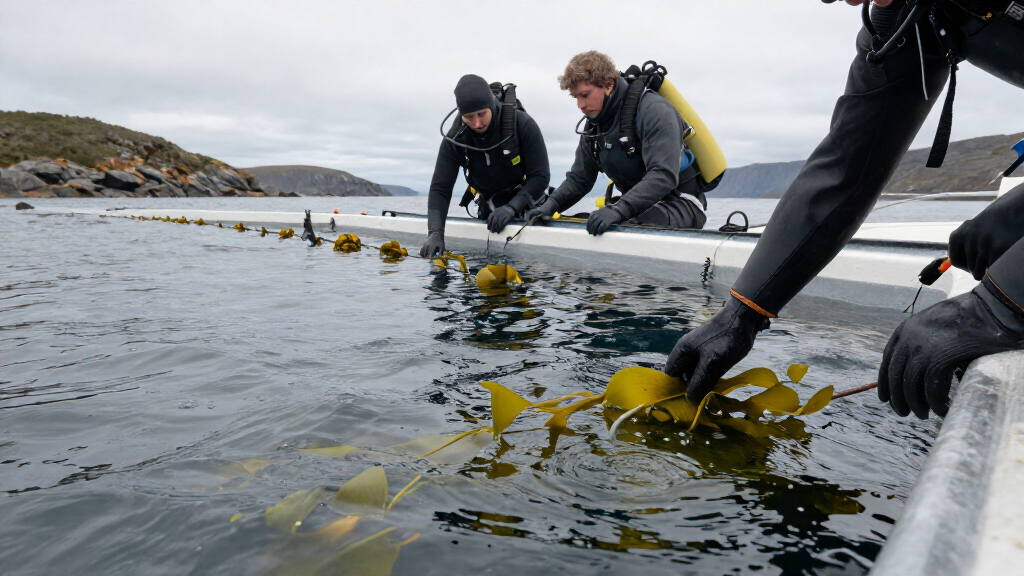
Researchers plan to cross distinct native survivors in the laboratory using selective breeding, not genetic modification, then attach young kelp to rocky reefs in pilot tests. Monitoring those plantings through warm conditions should show whether the selected kelp survives and grows. The source material does not give a schedule, trial locations or a date for results. Further reporting will depend on publication of the genetic analysis and evidence from the reef trials.
Key Questions
What did the AI analyze?
Google says a kelp-trained version of DeepVariant analyzed DNA from 600 wild specimens collected at 40 Tasmanian coastal sites, identifying differences among plants relative to a reference genome.
Does the AI test whether kelp can tolerate heat?
No. The AI analyzes DNA. Researchers must link genetic patterns to traits through laboratory work and then test selected kelp under real reef conditions.
Is the 600-specimen analysis peer-reviewed?
The source material says the analysis and the reported genetic isolation of remaining patches were described in Google’s post and video, but no paper or dataset for those results had been found at the time. The separate study describing two Australian reference genomes was peer-reviewed in BMC Genomics in June 2026.
Are the kelp being genetically modified?
No. The planned approach is selective breeding: crossing native kelp survivors with distinct genetic variation and relevant traits.
Has the restoration approach worked at sea?
That remains unclear. Pilot reef plantings are planned, and the source material reports no survival data showing whether bred kelp withstands warmer summers.
Source: Thorsten Meyer AI