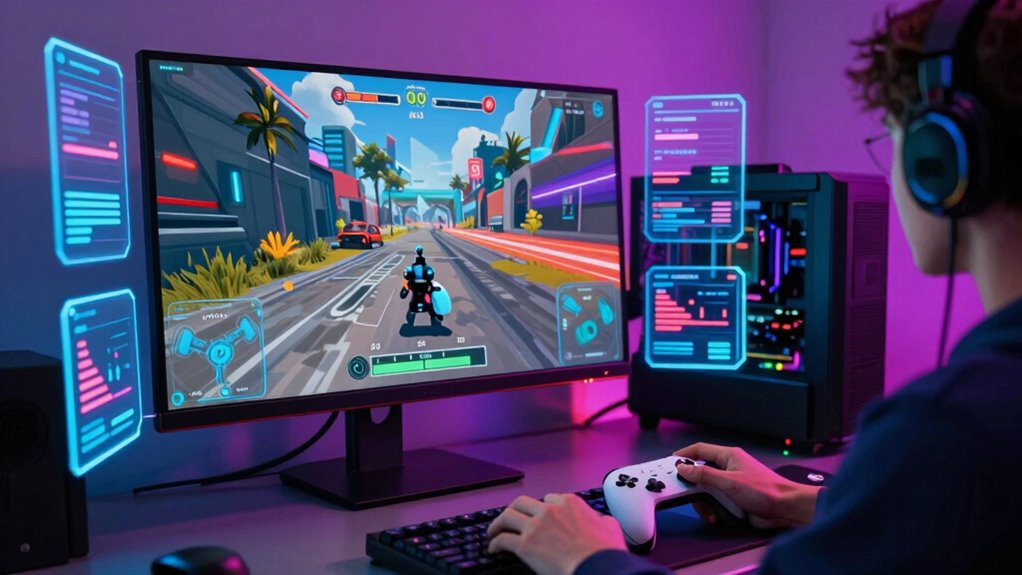

AI can personalize your gaming experience by dynamically adjusting obstacles, enemy tactics, and difficulty levels based on your skills and emotional responses. It monitors your facial expressions, voice tone, and in-game actions to keep you engaged and motivated, preventing frustration or boredom. This creates a seamless, immersive environment that evolves with you, ensuring balanced challenges at all times. If you stay with it, you’ll discover how these intelligent systems can redefine your gameplay journey.

Get business pricing on tech for your team
- Business-only prices and quantity discounts
- Tax-exempt purchasing
- Multiple users, one account, clear invoices
Key Takeaways
- AI dynamically adjusts game difficulty based on real-time player performance and emotional feedback.
- Procedural content generation creates unique challenges tailored to individual skill levels.
- Adaptive enemy strategies evolve to match player tactics, maintaining balanced challenge.
- Emotional analysis ensures gameplay remains engaging, reducing frustration and boredom.
- Continuous data-driven adjustments foster personalized, immersive gaming experiences.

Artificial intelligence has become an essential tool in maintaining and enhancing balance within video games. It allows developers to craft dynamic experiences that adapt in real-time, ensuring players stay engaged without feeling overwhelmed or bored. One powerful way AI achieves this is through procedural content generation, which creates diverse environments, challenges, and scenarios tailored to each player’s skill level. This adaptive environment means that no two players encounter the same obstacles, allowing the game to fine-tune difficulty on the fly based on individual performance.
AI-driven procedural content creates personalized, dynamic gaming experiences that adapt to each player’s skill level in real-time.
Another key aspect is player emotion analysis, where AI monitors and interprets your emotional responses during gameplay. By analyzing cues such as facial expressions, voice tone, or in-game behavior, AI can gauge whether you’re frustrated, bored, or excited. When your frustration spikes, the AI might subtly ease up the difficulty or introduce a supportive element to keep you motivated. Conversely, if you seem bored, it could ramp up the challenge to reignite your interest. This continuous feedback loop helps maintain a critical balance, ensuring that the game remains engaging without becoming too frustrating or too dull. As a result, you experience a more personalized journey that responds directly to your emotional state.
AI also plays a crucial role in refining enemy behaviors and adaptive difficulty systems. Instead of preset difficulty levels, AI-driven opponents analyze your tactics and adjust their strategies accordingly. If you’re consistently defeating enemies with ease, the AI might increase their intelligence or resilience, pushing you to improve your skills. On the other hand, if you’re struggling, it could weaken opponents or provide more resources to help you progress. This dynamic balancing act prevents the game from feeling either too easy or impossibly hard, keeping your experience both challenging and rewarding. Implementing adaptive difficulty enhances engagement by responding intelligently to player performance.
Furthermore, AI’s ability to analyze procedural content and player emotions allows for a more immersive experience. When the game responds intelligently to your actions and feelings, it fosters a sense of agency and connection that static difficulty settings often lack. You don’t just passively play; instead, the game becomes a responsive environment that evolves with you. This ongoing adaptation helps maintain flow, reduces frustration, and heightens enjoyment. Additionally, integrating net worth considerations can enable the game to tailor challenges based on your in-game success and resources, further personalizing the experience. This approach leverages real-time data to create a more seamless and engaging gameplay environment. As AI technology advances, its ability to analyze and adapt to various player metrics will likely grow, making each playthrough uniquely tailored to your preferences and skill, ultimately redefining what it means to find the perfect difficulty level. Furthermore, understanding and optimizing color accuracy in visual displays can contribute to a more comfortable and engaging gaming experience, especially during prolonged sessions.
AI adaptive difficulty video game
As an affiliate, we earn on qualifying purchases.
As an affiliate, we earn on qualifying purchases.
Frequently Asked Questions
How Does AI Adapt to Individual Player Skill Levels in Real-Time?
You observe how AI adapts to your skill level through personalization techniques and adaptive algorithms. As you play, the AI analyzes your actions, strengths, and weaknesses in real-time. It then adjusts the game difficulty accordingly, providing a tailored experience. This dynamic process guarantees the game remains challenging yet enjoyable, keeping you engaged without frustration. By continuously learning from your gameplay, AI creates a more immersive and balanced gaming experience just for you.
Can AI Predict Future Player Strategies During Gameplay?
Yes, AI can predict future player strategies during gameplay by analyzing patterns and adapting through procedural generation and narrative adaptation. It learns your tendencies, then anticipates your next move, creating dynamic challenges. This real-time prediction keeps gameplay engaging and personalized, as AI adjusts obstacles or story elements based on your evolving tactics. Consequently, you experience a more immersive game where your strategies influence the unfolding narrative and difficulty.
What Ethical Concerns Arise From Ai-Driven Game Difficulty Adjustments?
AI-driven game difficulty adjustments raise ethical concerns like player privacy, as sensitive data may be collected without clear consent. Additionally, algorithm bias can lead to unfair experiences, favoring certain player groups over others. You might worry about manipulation or unfair treatment, which could diminish trust in the game. Developers need to prioritize transparency, safeguard privacy, and regularly audit AI algorithms to guarantee fairness and respect for players’ rights.
How Does AI Impact the Replayability of Video Games?
AI boosts your game’s replayability through procedural generation and narrative customization. It creates unique levels, enemies, and stories each time you play, making every experience fresh. You’ll find that no two playthroughs are alike, encouraging you to revisit and explore new paths. This dynamic adaptation keeps the game engaging, ensuring long-term interest and challenge, as AI personalizes content based on your gameplay style and choices.
Will AI Make Traditional Game Testing Obsolete?
AI won’t make traditional game testing obsolete; instead, it enhances it. Studies show AI can reduce testing time by up to 50%, making processes more efficient. With procedural generation and narrative personalization, AI can simulate countless player experiences, uncovering bugs and balance issues faster than humans. However, human testers still provide valuable insights on player engagement and emotional responses, ensuring a well-rounded game experience.
emotion recognition gaming headset
As an affiliate, we earn on qualifying purchases.
As an affiliate, we earn on qualifying purchases.
Conclusion
As AI continues to evolve, it’s poised to transform gaming from static challenge to dynamic masterpiece. Imagine a game that adapts to your every move, pushing you just beyond your limits while never overwhelming you. This isn’t just progress; it’s a revolution in experience. With AI shaping the future, you won’t just play games—you’ll live them, face your fears, and discover your true potential. The future of gaming is waiting—are you ready to embrace it?
procedural content generation game
As an affiliate, we earn on qualifying purchases.
As an affiliate, we earn on qualifying purchases.
game controller with adaptive AI
As an affiliate, we earn on qualifying purchases.
As an affiliate, we earn on qualifying purchases.
Halloween Picks
halloween
As an affiliate, we earn on qualifying purchases.