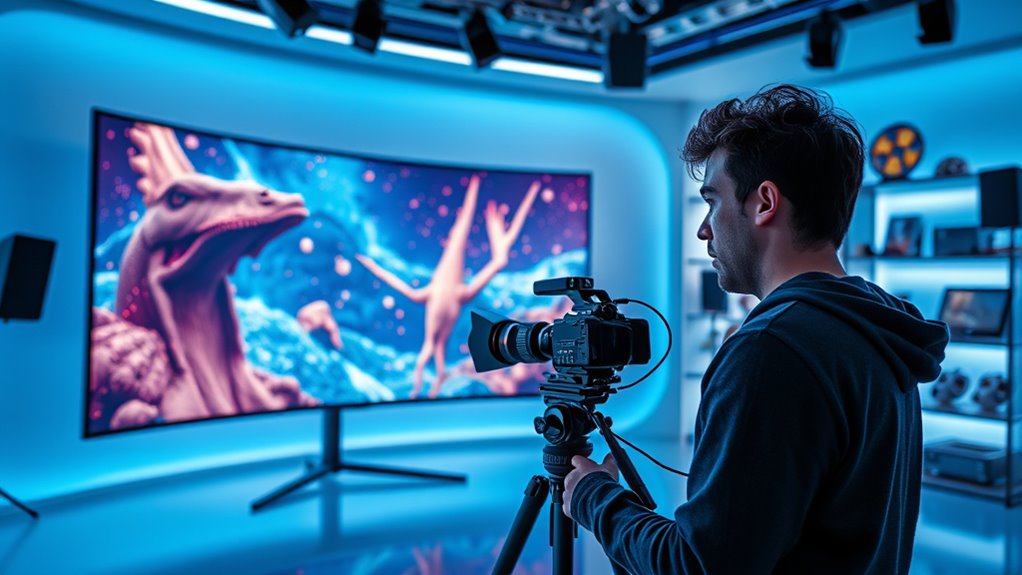

A new AI tool can turn text prompts into short films, transforming storytelling and challenging Hollywood’s traditional process. You can now experiment with creating scenes, characters, and narratives rapidly, reducing costs and barriers for filmmakers. This innovation opens doors for more diverse voices and creative exploration. As industry insiders assess its potential, you’ll find out how this technology could reshape entertainment and spark major changes further ahead. Keep exploring to discover what’s next.
Key Takeaways
- AI tools can now convert text prompts into short films rapidly, transforming traditional filmmaking workflows.
- This technology democratizes content creation, enabling aspiring filmmakers to produce films with minimal resources.
- Hollywood is exploring AI integration, prompting industry debates on originality, ownership, and ethical use.
- The innovation risks disrupting established pipelines and redefining roles within the film industry.
- Concerns about misuse, deepfakes, and intellectual property highlight the need for regulation and responsible AI deployment.

Have you ever imagined turning simple text prompts into full-fledged short films? Thanks to recent technological advancements, this vision is now a reality. An innovative AI tool has emerged that can generate short films solely from written descriptions, captivating filmmakers and audiences alike. This breakthrough not only pushes the boundaries of creativity but also raises important ethical implications. As AI takes on a more prominent role in content creation, questions about authorship, originality, and the potential for misuse come to the forefront. Will AI-generated films diminish the value of human artistry, or will they serve as powerful tools to enhance storytelling? These are debates that industry professionals and audiences are starting to grapple with.
This new AI technology leverages deep learning algorithms and vast datasets to interpret text prompts and translate them into visual narratives. It analyzes the story elements, mood, and tone embedded in your descriptions, then constructs scenes, characters, and progressions that align with your vision. The process is remarkably fast, allowing creators to produce short films in a fraction of the time traditional methods require. For aspiring filmmakers, this opens doors to experimentation and storytelling without the need for extensive resources or technical skills. Hollywood, on the other hand, feels the tremors of this disruption. Studios are exploring how to incorporate AI-generated content into their pipelines, recognizing both the potential for cost reduction and the challenge of maintaining artistic integrity. Additionally, advancements in home theatre projectors could enhance the viewing experience of AI-created films at home, making it more immersive.
However, with these technological advancements come serious ethical considerations. Who owns the rights to an AI-generated film—the user, the developers, or the AI itself? Can the originality of a piece be questioned when an algorithm creates it? There’s also concern about the potential for AI to replicate existing styles or even plagiarize content, raising questions about intellectual property. Moreover, as AI becomes more capable of producing realistic visuals, the risk of deepfakes or misleading content increases, prompting debates about regulation and responsible use.
Despite these concerns, the core promise of this AI tool is its ability to democratize filmmaking. It lowers barriers for those who lack traditional training or resources, enabling more diverse voices to tell their stories. As these technological advancements continue, the industry stands at a crossroads—balancing innovation with responsibility. Whether this tool will redefine the creative process or spark new ethical challenges remains to be seen. What’s clear is that the way we think about storytelling is changing, and you’re part of this exciting shift.
Frequently Asked Questions
Can This AI Tool Create Full-Length Feature Films?
This AI tool can’t yet create full-length feature films, but it pushes AI creativity and film innovation forward. While it excels at short films from text prompts, producing a full-length movie requires more complex storytelling, character development, and technical work. As technology advances, you might see future tools capable of handling entire features, but for now, it’s mainly a breakthrough for short-form content and experimental projects.
How Does the AI Interpret Complex or Abstract Prompts?
Think of the AI as a painter blending colors; for complex prompts, it uses visual interpretation to turn abstract ideas into vivid images. It analyzes symbols and metaphors, translating their meanings into scenes, characters, and settings. With abstract comprehension, the AI grasps underlying themes, weaving them into the story’s fabric. This process allows it to create nuanced visuals, capturing the essence of your intricate prompts with surprising clarity and depth.
What Are the Ethical Considerations of Ai-Generated Films?
You should consider that AI-generated films raise ethical concerns around copyright and artistic authenticity. You might worry about who owns the rights to AI-created content and whether it diminishes human creativity. As you explore this technology, stay mindful of respecting original works and ensuring transparency. Balancing innovation with ethical responsibility will help you navigate the evolving landscape of AI in filmmaking, protecting both creators and audiences alike.
Is the Technology Accessible to Independent Filmmakers?
You might find this AI technology to be a game-changer, especially if you’re an independent filmmaker. While the tools are becoming more accessible, budget constraints can still pose a hurdle, but they’re often less costly than traditional methods. It gives you more creative control, letting you craft stories without big studio backing. With some effort, you can leverage this tech to bring your vision to life and stand out in the industry.
How Does Ai-Generated Content Impact Traditional Hollywood Jobs?
AI-generated content impacts traditional Hollywood jobs by causing creative job displacement, especially for roles involving repetitive tasks like editing or basic animation. You might find fewer opportunities for entry-level or routine positions, as AI can handle those efficiently. However, it also raises concerns about intellectual property, making it essential for you to stay updated on legal and ethical standards to protect your creative work and adapt to this evolving industry landscape.
Conclusion
You might be amazed to learn that this AI tool can create a complete short film in just minutes from simple text prompts. Imagine the possibilities for filmmakers and storytellers—over 70% of industry insiders believe AI will revolutionize Hollywood. As technology advances, you’ll find yourself at the forefront of a new creative era, where your ideas can come to life faster than ever before. This innovation truly has the power to change how stories are told.