
AI-powered medical imaging enhances radiology by automating routine tasks, speeding up diagnoses, and reducing manual effort. It improves accuracy by detecting subtle abnormalities, early signs of disease, and differentiating benign from malignant features. AI supports advanced imaging techniques like photon-counting CT and MRI, resulting in clearer images at lower doses. This technology also boosts workflow efficiency, especially in emergency care, and prioritizes patient safety. Discover more about how these innovations are transforming radiology.
Key Takeaways
- Algorithms automate routine tasks, speeding up image sorting, report writing, and case prioritization to enhance workflow efficiency.
- AI improves diagnostic accuracy by detecting subtle abnormalities and early disease signs, reducing errors and variability.
- Advanced image analysis highlights minute details, enabling early detection of micro-lesions and supporting high-resolution imaging modalities.
- AI enhances image quality with lower radiation doses through denoising and super-resolution, improving patient safety and diagnostic clarity.
- Machine learning enables real-time decision support, rapid triage, and management of large image volumes, especially in emergency and critical care.
Enhancing Workflow Efficiency With AI Integration

AI integration substantially boosts workflow efficiency in radiology by automating routine tasks and streamlining processes. You’ll notice faster turnaround times as AI handles initial image sorting and prioritizes urgent cases, allowing you to focus on complex diagnoses. Automated report writing and real-time dictation reduce manual effort and human errors, making your workflow smoother. AI also assists with image analysis, identifying anomalies quickly and accurately, which cuts down on unnecessary double reviews. As a result, you spend less time on repetitive tasks and more on patient care. This efficiency helps address radiologist shortages and high workloads, ensuring timely diagnoses and improving overall department productivity. Embracing AI tools means your workflow becomes more effective, freeing you to concentrate on what truly matters—delivering precise and prompt patient care. Enhanced natural language processing further streamlines report generation and communication within healthcare teams. Additionally, integrating automated image analysis leverages advanced algorithms to improve diagnostic accuracy and speed. Moreover, the use of AI-powered decision support systems can assist radiologists in making more informed clinical decisions, further enhancing patient outcomes. Incorporating real-time data analysis can also help identify patterns and trends that might be overlooked manually, enabling proactive decision-making. Incorporating emotional support considerations can also aid radiologists in managing stress and maintaining well-being amidst high workload demands.
Improving Diagnostic Accuracy and Detecting Subtle Abnormalities

AI tools substantially boost your ability to detect subtle abnormalities, catching early signs of diseases that may be missed by the human eye. They also help reduce diagnostic variability caused by fatigue or differing experience levels among radiologists. By enhancing precision, AI guarantees you make more accurate diagnoses, especially in complex or ambiguous cases. Incorporating color accuracy and other industry trends ensures you stay current with technological advancements that can further improve diagnostic outcomes. Additionally, ongoing AI security monitoring is essential to safeguard patient data and maintain trust in AI-assisted diagnostics.
Early Detection Capabilities
Have you ever wondered how technology can detect subtle abnormalities that often go unnoticed? AI-powered imaging tools excel at identifying early signs of disease, even when they’re barely visible. By analyzing vast amounts of data, these algorithms can spot tiny lung nodules, micro-fractures, or subtle tissue changes that might escape human eyes. This early detection allows for quicker diagnosis and intervention, improving patient outcomes. AI also maintains consistency, reducing human error and diagnostic variability caused by fatigue or workload. Diagnostic accuracy can be enhanced through advanced pattern recognition, enabling machines to distinguish between benign and malignant features more reliably. Incorporating machine learning algorithms further refines detection capabilities by continuously learning from new data, leading to ongoing improvements in diagnostic precision. AI can flag suspicious areas, prompting further review before symptoms become severe. Additionally, awareness of divorce statistics can inform expectations about case outcomes and legal processes. This proactive approach empowers you to catch health issues sooner, often before they develop into critical conditions, ultimately saving lives through more precise and timely detection. Moreover, ongoing research into medical imaging advancements continues to expand the potential for earlier and more accurate diagnoses.
Reducing Diagnostic Variability
Did you know that diagnostic variability among radiologists can lead to missed or inconsistent results? AI algorithms help reduce this variability by offering consistent, objective assessments. When you use AI-powered tools, you get standardized interpretations that minimize differences caused by fatigue or experience levels. These tools highlight subtle abnormalities, such as early-stage nodules or micro-fractures, that might escape manual detection. Additionally, AI can incorporate antioxidant benefits to assist in detecting early signs of disease progression, further enhancing diagnostic accuracy. Incorporating advanced imaging techniques can also provide more detailed data, complementing AI analysis for better results. These technological advancements are part of a broader trend towards automation in healthcare, which aims to improve diagnostic efficiency and consistency. By providing second opinions, AI enhances your confidence, especially in complex cases. This consistency ensures patients receive accurate diagnoses regardless of who reads the images. Furthermore, machine learning algorithms can adapt over time to improve their diagnostic capabilities with new data, making them increasingly reliable. For example, integrating standardized protocols helps ensure uniform imaging and interpretation standards across facilities. Ultimately, AI helps you deliver more reliable, precise results, reducing the chances of missed diagnoses and improving overall patient care.
Enhancing Subtle Abnormality Recognition
By analyzing minute details often missed by the human eye, AI-powered tools considerably enhance the detection of subtle abnormalities in medical images. You can now identify early-stage lung nodules, micro-fractures, and tissue changes with higher accuracy. These algorithms improve diagnostic precision, reducing false negatives. To visualize this, consider the following:
| Detail Level | Human Detection | AI Enhancement |
|---|---|---|
| Micro-fractures | Sometimes missed | Consistently identified |
| Small nodules | Occasionally overlooked | Detected reliably |
| Tissue changes | Hard to spot | Highlighted automatically |
This precision helps catch critical conditions early, boosting your confidence and diagnostic consistency. AI’s ability to highlight these subtle signs transforms radiology from a subjective art into a precise science.
Expanding Imaging Modalities Supported by Artificial Intelligence
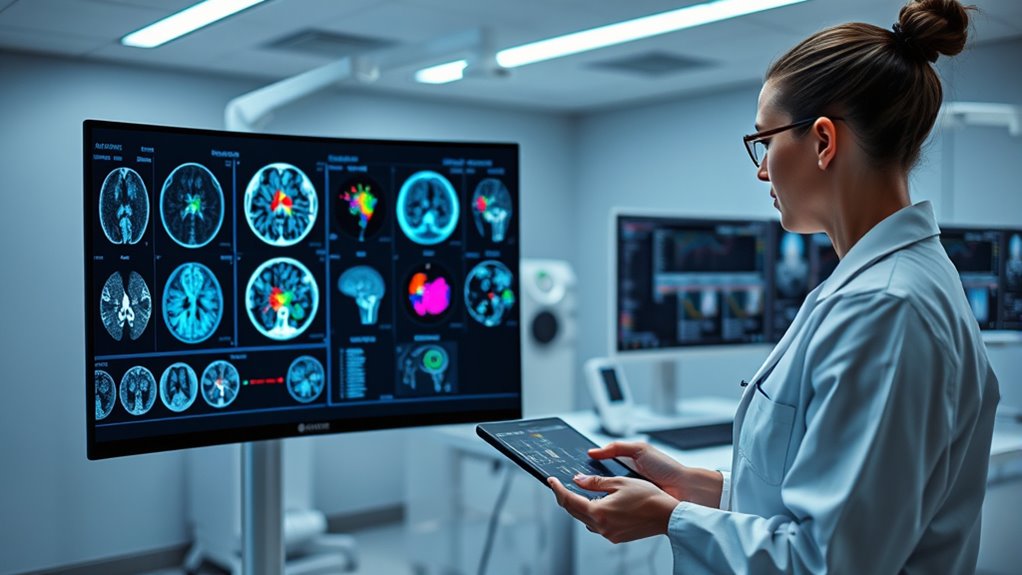
You can now leverage AI to support a wide range of advanced imaging technologies, from photon-counting CT to whole-body MRI, enhancing both speed and accuracy. These modalities are benefiting from AI-driven interpretation, leading to higher resolution images at lower radiation doses and faster processing times. As a result, more precise diagnostics become accessible across various medical specialties, improving patient outcomes. AI-driven interpretation is transforming diagnostic workflows by enabling quicker and more reliable analysis of complex imaging data. Additionally, the integration of high-quality imaging techniques with AI algorithms ensures more consistent and reproducible results, further advancing medical diagnostics. Moreover, the continuous evolution of content creation tools in medical imaging, inspired by platforms like TikTok, fosters innovative educational and training resources for healthcare professionals. Incorporating medical imaging advancements is essential for keeping pace with the rapid technological progress in healthcare.
Advanced Imaging Technologies Integration
Advanced imaging technologies are rapidly evolving as AI integration enhances their capabilities and expands their clinical applications. You can now leverage AI to support emerging modalities and improve diagnostic accuracy. An additional benefit is the potential for ethical considerations to guide responsible implementation and ensure patient safety as these technologies become more widespread. 1. Photon-counting CT offers higher resolution images with lower radiation doses, thanks to AI-driven image interpretation. 2. Whole-body MRI benefits from AI algorithms that speed up detection and streamline image processing. 3. MRI-guided ultrasound combines AI for real-time neurological disease diagnosis, enabling precise cross-modality insights. 4. Dual-energy CT, analyzed by AI, reveals detailed disease mechanisms like Long COVID lung pathology. These advancements allow you to access clearer, more informative images, facilitating faster, more accurate diagnoses while reducing patient radiation exposure and improving overall clinical workflows. Additionally, the integration of AI in medical imaging is expected to accelerate the development of personalized treatment plans, further enhancing patient outcomes. Furthermore, innovations like image reconstruction algorithms continue to push the boundaries of resolution and diagnostic confidence in clinical settings.
Enhanced Resolution and Lower Doses
Have you noticed how AI is transforming medical imaging by delivering sharper, more detailed images at lower radiation doses? Advanced AI algorithms enhance image quality by reducing noise and improving resolution, even with less radiation exposure. For example, AI-powered denoising techniques in CT and MRI enable clinicians to obtain clearer images while minimizing patient risk. Technologies like photon-counting CT leverage AI to produce higher-resolution images at a fraction of the traditional dose. Similarly, AI-driven super-resolution methods enhance existing images, revealing subtle abnormalities that might otherwise go unnoticed. By combining sophisticated algorithms with innovative imaging modalities, AI helps you achieve better diagnostic insights while prioritizing patient safety through lower radiation exposure. Additionally, Kia Tuning techniques share a focus on optimizing performance through advanced modifications, illustrating how targeted improvements can significantly enhance overall outcomes.
Market Growth Trends and Global Adoption of AI in Radiology
The global market for AI in radiology is experiencing rapid growth, driven by technological advancements and increasing healthcare investments worldwide. You’re witnessing a surge in AI adoption, transforming how radiology departments operate. Here’s what’s fueling this expansion:
- The U.S. market was valued at around $524 million in 2024, with a projected CAGR of 33% until 2030.
- The worldwide market is expected to grow from $1.67 billion in 2025 to over $14 billion by 2034.
- North America and Europe lead adoption, while Asia Pacific is the fastest-growing region.
- Regulatory approvals in 2025 are accelerating clinical integration of AI tools.
This rapid growth reflects a global shift toward smarter, more efficient radiology practices, making AI an essential part of healthcare’s future.
AI’s Role in Emergency and Critical Care Settings
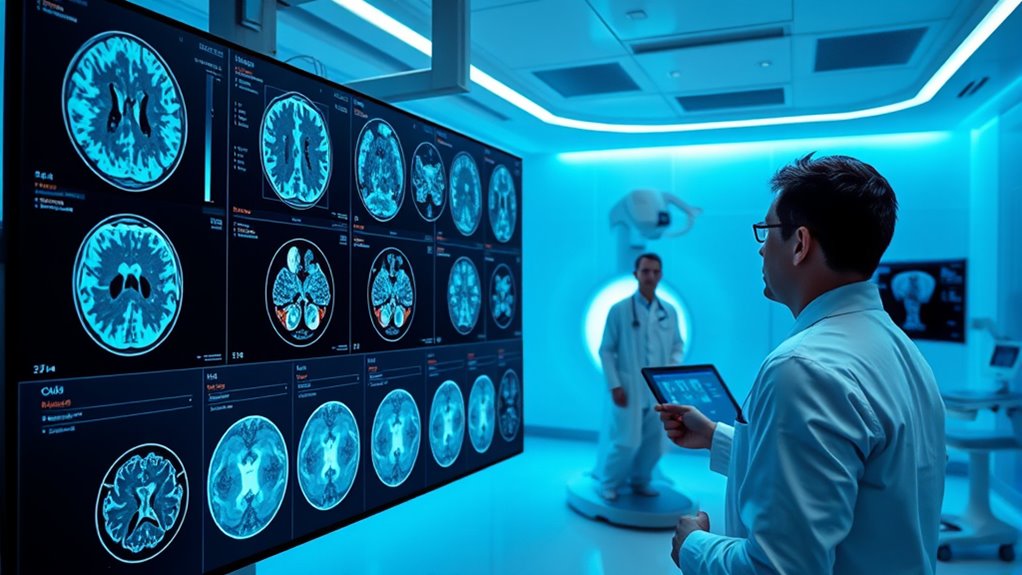
AI plays a essential role in emergency and critical care settings by enabling rapid image analysis and prioritization. You can quickly identify life-threatening conditions like pneumothorax or fractures, streamlining patient management. Automated triage sorts cases by urgency, reducing delays and improving outcomes. AI tools also serve as decision support, highlighting suspicious areas for junior radiologists, boosting confidence and accuracy. Moreover, AI reduces cognitive load by managing large volumes of images efficiently, decreasing the risk of oversight. With the ability to analyze thousands of images swiftly, your workflow becomes more reliable and faster. This efficiency is fundamental in high-pressure environments, ensuring timely interventions that save lives.
| AI Function | Impact in Emergency Settings |
|---|---|
| Rapid analysis | Faster diagnosis of critical conditions |
| Prioritization | Immediate attention to urgent cases |
| Decision support | Improved accuracy for less experienced radiologists |
| Workflow automation | Reduced delays in patient care |
| Image volume handling | Increased throughput and reliability |
Developing Robust AI Models While Protecting Patient Privacy
Developing robust AI models for medical imaging requires balancing innovation with patient privacy. You need techniques that protect sensitive data while enabling effective training. Here are key strategies to contemplate:
- Synthetic Data Generation – Creating realistic, privacy-safe datasets that mimic real patient images without exposing personal info.
- Federated Learning – Training models across multiple hospitals without sharing raw data, keeping patient info local and secure.
- Differential Privacy – Adding controlled noise to data or model outputs, preventing re-identification of individuals.
- Secure Multi-Party Computation – Allowing multiple institutions to collaboratively train models without revealing their private data.
These approaches help you develop reliable AI systems that respect privacy, ensuring ethical standards and fostering trust in clinical deployment.
The Future of Ai-Driven Medical Imaging and Its Clinical Impact
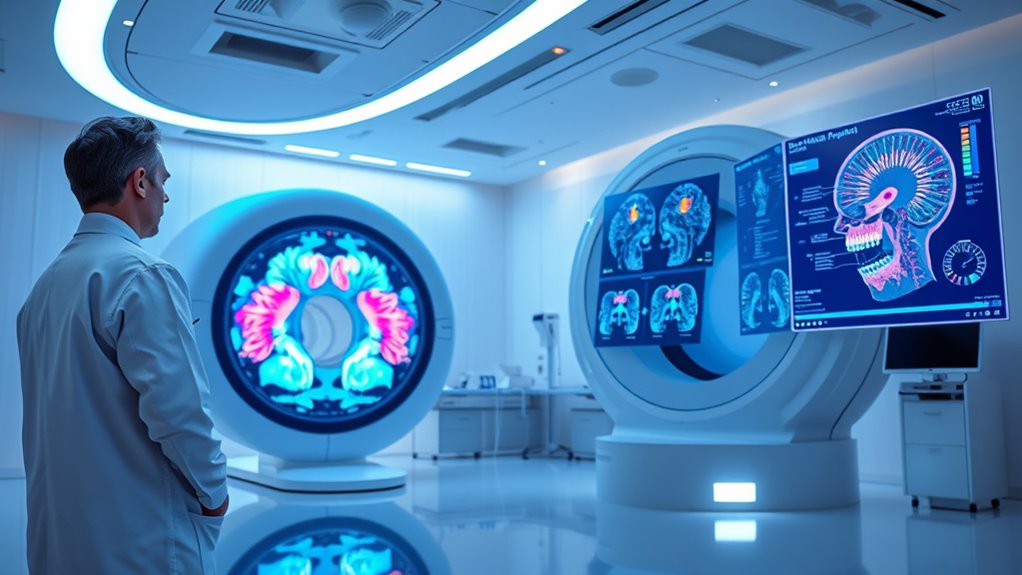
As AI technology continues to advance, its integration into medical imaging is poised to revolutionize clinical practice. You’ll see faster diagnoses as algorithms streamline workflows and reduce radiologist workload. AI will enhance detection of subtle abnormalities, increasing diagnostic accuracy across diverse conditions. Imaging modalities like photon-counting CT and AI-supported MRI will deliver higher resolution images with lower radiation doses, improving patient safety and treatment planning. Real-time decision support will become standard, helping clinicians prioritize urgent cases and reducing diagnostic errors. Market growth will accelerate, making AI tools more accessible worldwide, especially in underserved areas. As these innovations mature, you’ll benefit from more precise, efficient, and personalized healthcare, ultimately transforming patient outcomes and clinical workflows in radiology.
Frequently Asked Questions
How Does AI Handle Rare or Unusual Medical Conditions in Imaging?
AI handles rare or unusual medical conditions by analyzing large, diverse datasets to recognize subtle patterns that might be missed by humans. It can identify atypical abnormalities, micro-lesions, or early signs of uncommon diseases with high sensitivity. By continuously learning from new cases, AI improves its accuracy over time, providing you with more reliable diagnostics even for rare conditions, ultimately helping you catch and treat unusual illnesses faster and more effectively.
What Are the Main Barriers to AI Integration in Smaller Hospitals?
You might face barriers like high initial costs, limited budgets, and lack of technical expertise in smaller hospitals. These facilities often struggle with integrating complex AI systems due to inadequate infrastructure and training resources. Additionally, regulatory hurdles and concerns about data privacy can slow adoption. Without strong support and funding, implementing AI tools remains challenging, making it harder to realize their full benefits in improving diagnostics and workflow efficiency.
How Is AI Trained to Ensure Unbiased Diagnostic Recommendations?
You can guarantee AI remains unbiased by training it on large, diverse datasets representing different demographics and conditions. Developers also continuously evaluate algorithms for biases and adjust them accordingly. Using synthetic data helps protect patient privacy while improving accuracy. Regular validation across various populations, combined with transparent algorithms and ethical guidelines, keeps AI recommendations fair and reliable, helping you trust its outputs for accurate and equitable diagnostics.
Can AI Systems Explain Their Diagnostic Decisions Transparently?
You might wonder if AI systems can truly explain their diagnoses. The answer is yes, increasingly, they do. Developers are embedding transparency features, like highlight overlays and confidence scores, to show how decisions are made. This creates a trail that you can follow, building trust and understanding. As these tools evolve, you’ll gain clearer insights into AI’s reasoning, making clinical decisions more transparent and reliable.
What Measures Are in Place to Prevent Ai-Related Diagnostic Errors?
You can trust that multiple measures are in place to prevent AI-related diagnostic errors. These include rigorous validation and continuous monitoring of AI algorithms, ensuring they meet clinical standards. Human oversight remains essential, with radiologists reviewing AI suggestions before final decisions. Additionally, ongoing training and updates help AI adapt to new data, reducing mistakes. Regulatory approvals and safety protocols further safeguard against errors, promoting accurate and reliable diagnoses.
Conclusion
As you walk through the evolving landscape of AI-powered medical imaging, you almost feel the pulse of innovation syncing with your own heartbeat. Algorithms now silently scan, detect, and enhance, transforming radiology into a seamless symphony of precision and speed. With each breakthrough, you can imagine a future where critical diagnoses are made faster, patient care becomes more personalized, and technology’s gentle touch guides you toward better health—almost as if the future is already whispering your name.