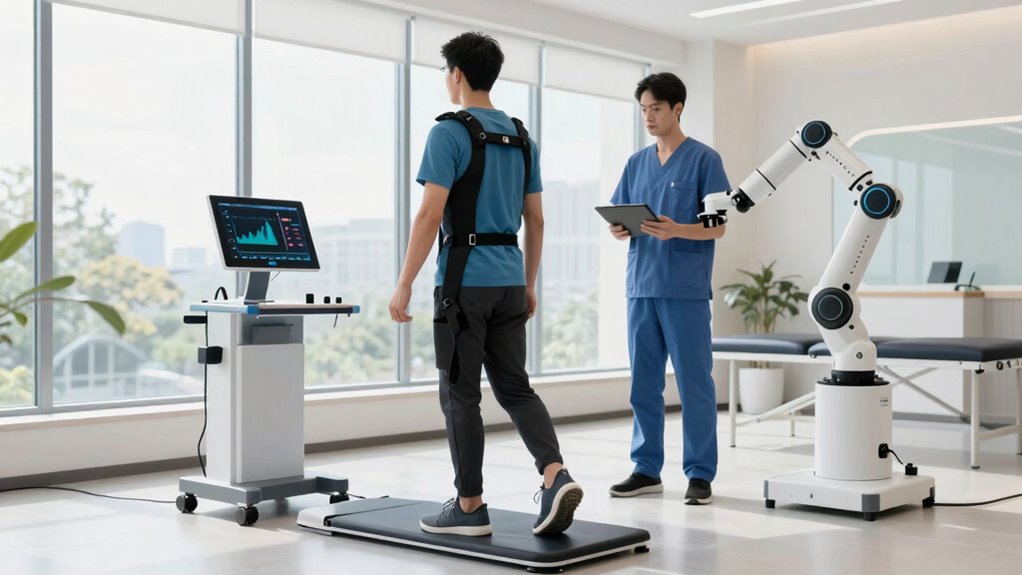

AI is transforming rehabilitation by providing personalized, real-time tracking of your progress. It uses virtual reality to create engaging environments and analyzes your performance to adjust exercises instantly. AI also monitors your responses and offers feedback, making sure your therapy stays challenging yet manageable. With remote options, it allows for consistent care without frequent visits. If you want to see how these innovations can speed up your recovery, there’s more to discover ahead.

Get business pricing on tech for your team
- Business-only prices and quantity discounts
- Tax-exempt purchasing
- Multiple users, one account, clear invoices
Key Takeaways
- AI analyzes real-time performance data to personalize and adapt rehabilitation exercises for optimal recovery.
- AI-driven VR environments increase engagement and motivation during therapy sessions.
- Continuous data collection enables precise tracking of progress and early identification of issues.
- Remote AI monitoring facilitates tele-rehabilitation, allowing healthcare providers to oversee recovery remotely.
- Adaptive AI algorithms ensure therapy remains challenging yet achievable, enhancing overall effectiveness.

Artificial intelligence is transforming how we monitor and support rehabilitation and recovery processes, making them more personalized and efficient. One of the most exciting advancements is the integration of virtual reality (VR) with AI-powered systems. You can now immerse yourself in realistic, interactive environments that simulate real-world scenarios, which helps accelerate recovery. Virtual reality creates engaging, controlled settings where you can perform specific tasks tailored to your needs, making therapy sessions more motivating and effective. Because AI analyzes your performance in real-time, it can adjust the difficulty level, introduce new challenges, or modify exercises to match your progress. This dynamic customization guarantees that your therapy remains relevant and challenging without being overwhelming, ultimately speeding up your recovery process.
AI-enhanced virtual reality personalizes rehab, making therapy engaging, adaptive, and faster for better recovery outcomes.
AI also enables personalized therapy by continuously analyzing data collected during your sessions. Whether you’re recovering from a stroke, injury, or surgery, AI algorithms track your movements, muscle activity, and response times with high precision. This detailed data allows your healthcare provider to design a treatment plan uniquely suited to your strengths and weaknesses. Instead of a one-size-fits-all approach, your therapy adapts to your evolving needs, targeting specific areas that require more focus. This personalization helps prevent plateaus in progress and keeps you engaged, knowing that your program is tailored to your goals. Additionally, precision tracking ensures that every aspect of your movement and response is accurately measured, further enhancing the customization process. Furthermore, machine learning techniques help AI systems learn from ongoing data, continuously refining therapy strategies to improve outcomes. Incorporating emerging technologies like AI and VR is also paving the way for more innovative and effective rehabilitation solutions.
The combination of AI and virtual reality enhances this personalized approach further. As you navigate through VR environments, AI monitors your engagement and performance, providing immediate feedback and adjustments. For example, if you struggle with a particular movement, the system might slow down the pace or offer additional guidance. Conversely, if you excel, the system can introduce more complex tasks to challenge you appropriately. This real-time responsiveness keeps your therapy aligned with your capabilities, maximizing effectiveness without causing frustration or fatigue.
Moreover, AI-driven virtual reality tools facilitate remote monitoring and tele-rehabilitation. You can perform therapy exercises at home while your data is securely transmitted to your healthcare team. They can review your progress, make adjustments, and provide support without requiring frequent in-person visits. This accessibility not only saves time and travel costs but also guarantees consistent, continuous care, which is vital for maximum recovery outcomes. Additionally, adaptive learning algorithms are helping to refine treatment plans over time, ensuring that therapy remains effective and up-to-date with the latest advancements.
Products Worth Considering

LG UltraGear 27-Inch QHD OLED Gaming Monitor, 240Hz, 0.03ms, G-SYNC Compatible, FreeSync Premium Pro, HDMI 2.1

Jackery HomePower 3600 Plus Portable Power Station, 3584Wh, 3600W

Samsung 27 Odyssey OLED G5 (G50SF) QHD QD-OLED Gaming Monitor
As an affiliate, we earn on qualifying purchases.
Frequently Asked Questions
How Secure Is Patient Data in AI Rehabilitation Systems?
You can trust that patient data in AI rehabilitation systems is quite secure because robust security protocols are in place. These systems prioritize data privacy by encrypting information and restricting access to authorized personnel. Regular updates and compliance with healthcare regulations further enhance security. While no system is completely infallible, developers work continuously to minimize risks, ensuring your sensitive health data remains protected during your recovery process.
Can AI Personalize Recovery Plans Effectively for All Patients?
Can AI truly tailor recovery plans to each individual? Yes, with high personalization accuracy, AI systems analyze detailed patient data, adapting plans to unique needs. This boosts patient engagement, making recovery more relevant and motivating. While some patients have complex cases, AI’s ability to learn and adjust continually enhances personalized care. Do you see how this technology can revolutionize recovery experiences, ensuring everyone receives the most effective, customized support?
What Are the Limitations of AI in Early Injury Detection?
AI’s limitations in early injury detection include challenges with false positives, which can lead to unnecessary concern or intervention. Early detection relies on subtle signals that AI might miss or misinterpret, especially in complex cases. You might experience delays or inaccuracies if the AI system isn’t trained on diverse data or lacks the ability to distinguish true injury signs from benign variations. These factors can impact the reliability of early injury detection efforts.
How Accessible Are AI Tools for Underserved Communities?
AI tools for rehabilitation are often less accessible in underserved communities due to the digital divide, meaning limited internet access and technology resources. Cultural barriers can also hinder adoption, as language differences and mistrust may reduce engagement. You might find these tools less available or tailored for mainstream populations, making it harder for you to benefit from AI-driven recovery tracking unless efforts focus on reducing these disparities and ensuring inclusivity.
What Is the Cost Comparison Between AI and Traditional Rehab Methods?
AI-driven rehab methods typically offer better cost efficiency compared to traditional approaches, mainly because they can reduce the need for extensive in-person sessions and streamline progress tracking. However, you might face funding challenges initially, as implementing AI technology requires upfront investments. Over time, though, the reduced long-term costs and improved outcomes can make AI a more economical choice for rehab programs.
Conclusion
Imagine a future where every step you take is quietly watched over by AI, guiding you gently toward healing. As you regain strength, these intelligent systems become your silent partners, illuminating your progress like stars guiding a lost traveler home. With AI transforming rehabilitation and recovery, you’re not alone—every small victory becomes part of a brighter, healthier journey ahead. Together, technology and resilience weave a path toward renewed hope and a stronger tomorrow.