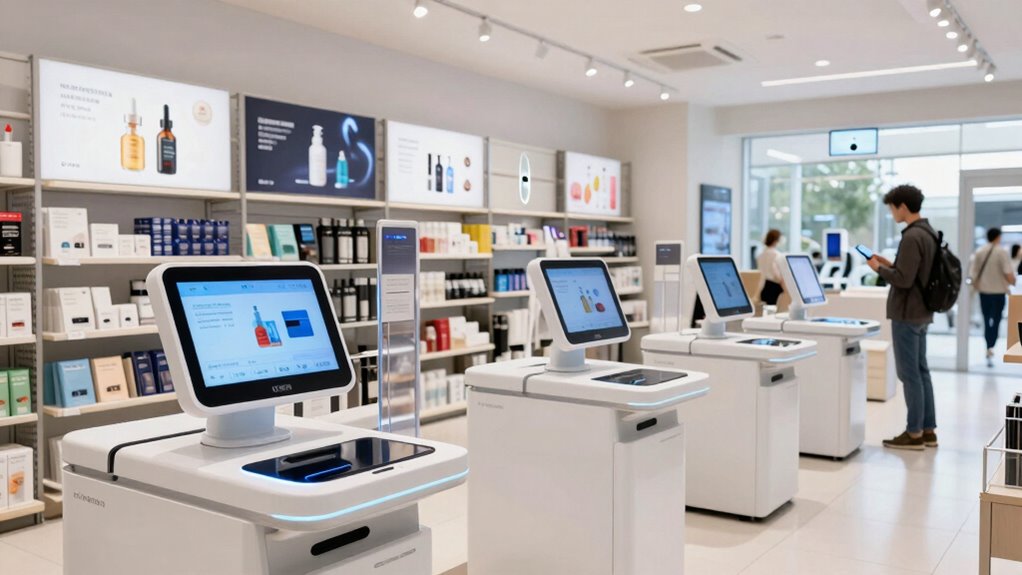

AI is transforming your retail merchandising by helping you make smarter, faster decisions. It analyzes customer data, such as browsing, purchase history, and social media activity, to personalize product recommendations and improve marketing. AI also predicts demand more accurately, optimizes inventory levels, and enables real-time adjustments to trends. Automation streamlines routine tasks, boosting efficiency. As AI continues to evolve, it will further empower you to meet customer needs and stay ahead—if you want to discover how, keep exploring.

Get business pricing on tech for your team
- Business-only prices and quantity discounts
- Tax-exempt purchasing
- Multiple users, one account, clear invoices
Key Takeaways
- AI enables personalized product recommendations, enhancing customer experience and increasing loyalty.
- It improves inventory forecasting accuracy by analyzing trends, seasonality, and external factors.
- Real-time AI insights allow retailers to quickly adapt to emerging market trends.
- Automation of routine tasks boosts operational efficiency and responsiveness in merchandising strategies.
- AI supports smarter decision-making while emphasizing ethical considerations and social responsibility.

Artificial intelligence is revolutionizing retail merchandising by enabling businesses to analyze vast amounts of data quickly and accurately. With AI, you can better understand your customers’ preferences, shopping behaviors, and purchasing patterns, which allows you to tailor your offerings more precisely. Customer personalization becomes more effective as AI algorithms sift through data from online browsing histories, purchase records, and social media activity. This insight helps you craft targeted marketing campaigns, recommend products that resonate with individual shoppers, and enhance the overall shopping experience. Instead of relying on guesswork, you’re able to deliver relevant products at the right time, increasing customer satisfaction and loyalty.
In addition, AI transforms inventory forecasting, a vital aspect of retail success. You no longer have to rely solely on historical sales data or intuition. Instead, AI models analyze trends, seasonal fluctuations, and external factors such as weather or economic shifts to predict future demand with greater accuracy. This means you can optimize stock levels, reduce excess inventory, and avoid stockouts. Accurate inventory forecasting guarantees that you have the right products available when your customers want them, which improves sales and minimizes waste. It also allows you to allocate your resources more efficiently, from procurement to warehouse management. Data-driven decision-making plays a crucial role in enhancing operational efficiency and responsiveness.
The power of AI extends beyond just understanding customer needs and managing inventory. It streamlines your decision-making process by providing real-time insights that help you respond swiftly to changing market conditions. For example, if a new trend emerges or a product suddenly gains popularity, AI can alert you immediately, so you can adjust your merchandising strategy accordingly. This agility helps you stay ahead of competitors and meet customer demands more effectively. Existential themes can also inform ethical considerations in AI deployment, ensuring that technology aligns with your company’s values and social responsibilities.
Furthermore, AI-driven tools can automate routine tasks like pricing adjustments, product placement, and promotional planning, freeing up your staff to focus on strategic initiatives. By integrating AI into your retail operations, you gain a data-driven edge that enhances every aspect of merchandising. You’re empowered to make smarter decisions faster, leading to increased sales, improved customer satisfaction, and a more efficient supply chain. As AI continues to evolve, its role in retail merchandising will only grow, transforming how you understand your customers, manage your inventory, and stay competitive in an ever-changing marketplace.
AI-powered retail inventory management software
As an affiliate, we earn on qualifying purchases.
As an affiliate, we earn on qualifying purchases.
Frequently Asked Questions
How Do Small Retailers Implement AI Without Extensive Resources?
You can implement AI without extensive resources by starting small with affordable tools. Focus on inventory optimization and customer segmentation to make smarter decisions. Use free or low-cost AI platforms that offer basic analytics, and leverage existing data from your sales and customer interactions. Partner with AI providers that offer scalable solutions, and prioritize features that directly impact your business, like improving stock levels or understanding customer preferences.
What Ethical Concerns Arise From Ai-Driven Merchandising Decisions?
You should be aware that AI-driven merchandising raises ethical concerns like consumer privacy, as data collection can feel invasive. Algorithm bias is another issue, potentially leading to unfair treatment of certain groups or skewed product recommendations. To address these, you must guarantee transparent data practices and regular algorithm audits. Prioritizing ethical standards helps maintain customer trust and ensures your AI use aligns with responsible retail practices.
How Does AI Handle Seasonal or Trend-Based Product Changes?
AI acts like a savvy weather vane, constantly adjusting to shifting winds of fashion and seasons. It uses seasonal forecasting and trend analysis to predict product demand, helping you stock what’s hot and avoid excess. By analyzing real-time data, AI swiftly adapts to new trends, ensuring your inventory aligns with current consumer preferences. This agility keeps your offerings fresh, timely, and ready to meet seasonal changes head-on.
Can AI Predict Future Consumer Preferences Accurately?
Yes, AI can predict future consumer preferences with a good degree of accuracy by analyzing patterns in consumer behavior and leveraging vast amounts of data. However, your predictions depend heavily on data accuracy; if the data is flawed or incomplete, forecasts might be off. By continuously learning from new trends and behaviors, AI improves its predictions, helping you make smarter, more proactive merchandising decisions that align with evolving customer demands.
What Skills Are Needed for Staff to Work With AI Merchandising Tools?
Imagine guiding a customer through personalized shelves that seem to read their mind—that’s where your skills come in. You need strong staff training in AI merchandising tools, understanding data insights, and customer personalization strategies. You’ll learn to interpret analytics, adapt quickly, and enhance shopping experiences. Your ability to work alongside AI guarantees you deliver tailored recommendations, making each customer feel valued and understood in a rapidly evolving retail landscape.
personalized product recommendation engine
As an affiliate, we earn on qualifying purchases.
As an affiliate, we earn on qualifying purchases.
Conclusion
You might think AI’s impact on retail merchandising is impressive now, but soon it’ll revolutionize your entire shopping universe — predicting every customer’s desire before they even realize it themselves. With AI, your decisions won’t just be smarter; they’ll be so precise, you’ll practically have a crystal ball guiding every shelf and display. Get ready, because the future of retail isn’t just changing — it’s transforming into a mind-reading, trend-predicting powerhouse that’s unstoppable.
As an affiliate, we earn on qualifying purchases.
As an affiliate, we earn on qualifying purchases.
Halloween Picks
halloween
As an affiliate, we earn on qualifying purchases.