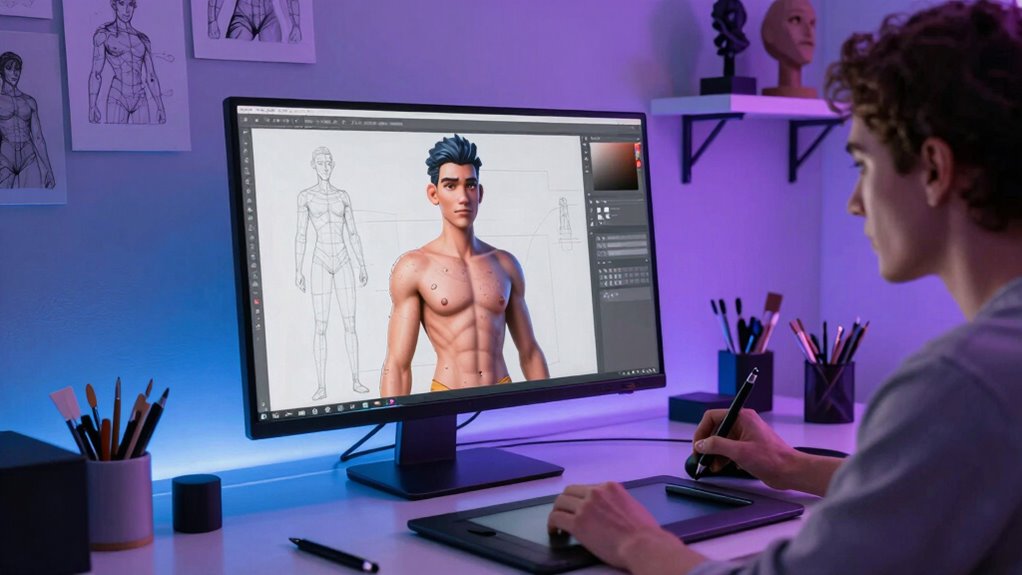

AI is helping you build virtual characters faster and more creatively by automating complex processes and generating detailed, lifelike designs even without extensive technical skills. It allows you to focus on storytelling while improving realism through advanced animation techniques. However, challenges like achieving perfect realism and addressing ethical concerns remain. If you want to discover how to navigate these opportunities and hurdles effectively, keep exploring the latest innovations shaping virtual character creation.

Get business pricing on tech for your team
- Business-only prices and quantity discounts
- Tax-exempt purchasing
- Multiple users, one account, clear invoices
Key Takeaways
- AI accelerates virtual character development by automating detailed design and customization processes.
- It enables the creation of lifelike characters through advanced analysis of datasets and rendering techniques.
- AI tools simplify complex animation tasks, making natural movements and expressions more achievable.
- Creators can use AI ethically to ensure diversity, reduce biases, and promote inclusive representation.
- Ongoing AI advancements help improve character realism, enhancing immersive experiences in games and virtual media.
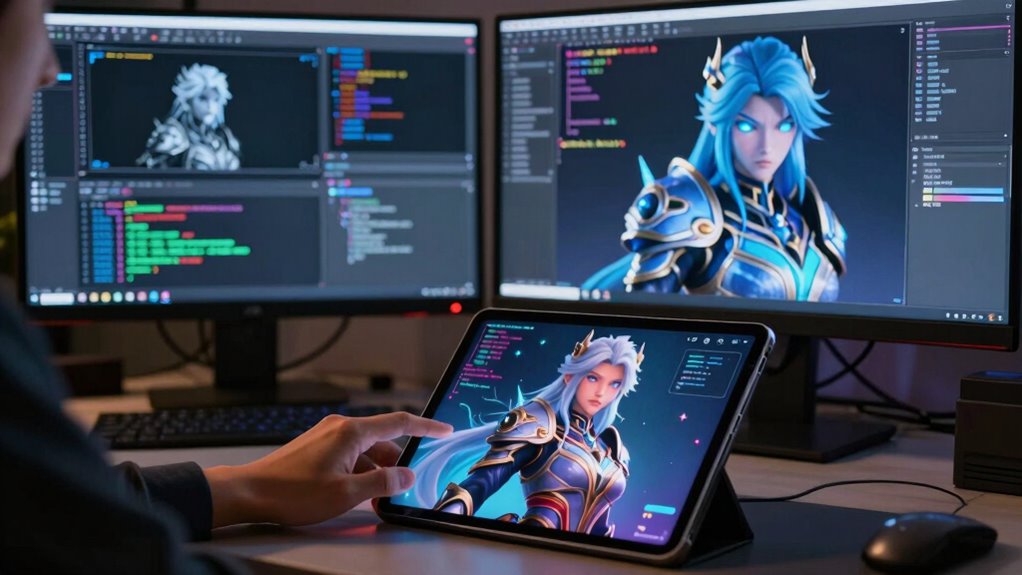
Artificial intelligence is transforming the way creators build virtual characters, making the process faster and more accessible than ever before. With AI tools, you can now generate detailed, dynamic characters without the need for extensive technical skills or resources. These advancements allow you to focus more on storytelling and creativity, rather than getting bogged down by the technical hurdles traditionally associated with character design. AI-powered software can analyze vast datasets to help craft characters that feel more lifelike, enabling you to produce immersive experiences for games, films, or virtual worlds. Additionally, AI’s capacity to explore emerging trends ensures that creators stay at the forefront of digital innovation in character development. The ongoing refinement of AI algorithms also means that the quality of virtual characters will continue to improve over time, opening up new creative opportunities. Staying informed about these innovations can help you leverage AI more effectively and stay ahead in the competitive landscape.
AI tools make creating detailed, lifelike virtual characters faster and more accessible for storytellers and creators alike.
However, as you leverage AI in character creation, you’ll encounter some significant hurdles. One major issue is realism challenges. While AI can generate impressive models and animations, achieving perfect realism remains difficult. Subtle facial expressions, natural movements, and nuanced interactions still pose hurdles, especially when trying to replicate the complexity of human emotions and behaviors authentically. If these details are off, your virtual characters might feel uncanny or artificial, which could break immersion for your audience. Overcoming these realism challenges requires continuous refinement and sophisticated algorithms, but progress is steady, and tools are improving rapidly. Incorporating advanced rendering techniques can help bridge some of these gaps and enhance realism. Furthermore, ongoing research in AI-driven animation continues to push the boundaries of what’s possible in creating believable virtual characters.
Alongside technical challenges, you also need to address ethical concerns. As you create highly realistic virtual characters, questions about authenticity and representation come into play. For instance, generating digital doubles of real people raises privacy issues, especially if you use their likenesses without consent. Additionally, AI can be used to create deepfakes or misleading representations, which could have serious ethical implications. It’s vital to think carefully about how you use these tools and guarantee your virtual characters promote honesty and respect. Ethical concerns also extend to biases embedded within AI models, which can unintentionally reinforce stereotypes or marginalize certain groups. As a creator, you have a responsibility to identify and address these biases to foster inclusivity. Incorporating ethical AI practices into your workflow can help mitigate these risks and ensure your work aligns with responsible standards. Recognizing and mitigating biases in AI is crucial for creating diverse and respectful virtual characters.
Despite these challenges, AI remains a powerful ally in building virtual characters. It accelerates workflows, enables more complex designs, and expands creative possibilities. To make the most of AI, you should stay informed about the latest developments, remain aware of the limitations, and prioritize ethical considerations in your work. By doing so, you can harness AI’s full potential while tracking the realities of realism challenges and ethical concerns. This approach guarantees that your virtual characters are not only visually stunning and believable but also ethically sound and respectful of the diverse audiences they serve.
AI virtual character creation software
As an affiliate, we earn on qualifying purchases.
As an affiliate, we earn on qualifying purchases.
Frequently Asked Questions
How Secure Is the Data Used to Train Virtual Characters?
The data used to train virtual characters is generally secure, but concerns about data privacy and model bias remain. Developers implement encryption and strict access controls to protect sensitive information. However, you should stay aware of potential biases in training data, which can influence virtual character behavior. Ensuring transparent data handling practices and regular audits help mitigate risks, making the process safer and more reliable for creators and users alike.
Can Ai-Generated Characters Display Genuine Emotional Responses?
Imagine a character’s eyes flickering with warmth or narrowing in suspicion — AI can mimic genuine emotional responses through advanced algorithms. While these characters display emotional authenticity, they lack true feelings. Thanks to response variability, they adapt their reactions to different situations, creating a more immersive experience. You see, AI-driven characters may seem emotionally genuine, but their responses are ultimately simulated, not felt.
What Are the Limitations of AI in Creating Realistic Virtual Personalities?
AI faces limitations in creating realistic virtual personalities because it struggles with emotional authenticity, often producing responses that lack genuine depth. While AI can mimic a range of traits, it can’t fully capture the nuances of human emotions. Additionally, achieving true personality diversity remains challenging, as AI models tend to generate characters within predefined patterns. This restricts the richness and unpredictability that make virtual personalities feel truly authentic and relatable.
How Accessible Are These AI Tools for Independent Creators?
Imagine trying to buy a ticket to a concert—sometimes, accessibility barriers and high costs make it feel out of reach. Similarly, AI tools for creating virtual characters are becoming more available, but cost implications and technical skills can still limit independent creators. While some platforms offer affordable options, others remain expensive, making it tough for everyone to access cutting-edge AI. Still, the landscape is gradually becoming more inclusive and affordable.
What Ethical Concerns Arise From Ai-Created Virtual Characters?
You might worry that AI-created virtual characters raise digital ethics concerns, like authenticity challenges and potential misuse. These characters can blur the line between real and virtual, making it hard to trust their origins or intentions. You need to contemplate how ethical guidelines guide AI development, ensuring creators respect privacy, avoid deception, and maintain transparency. Addressing these concerns helps preserve integrity and trust in virtual interactions.
lifelike character animation tools
As an affiliate, we earn on qualifying purchases.
As an affiliate, we earn on qualifying purchases.
Conclusion
As you harness AI’s power to craft virtual characters, the possibilities are endless—and just on the horizon. What’s next could revolutionize storytelling, gaming, and beyond, blurring the lines between reality and imagination. Are you ready to push those boundaries? With AI’s rapid advancements, the virtual worlds you create might soon become indistinguishable from our own. Stay tuned—your next groundbreaking character could be just an algorithm away.
3D character modeling software with AI
As an affiliate, we earn on qualifying purchases.
As an affiliate, we earn on qualifying purchases.
AI-powered character design tools
As an affiliate, we earn on qualifying purchases.
As an affiliate, we earn on qualifying purchases.
Halloween Picks
halloween
As an affiliate, we earn on qualifying purchases.