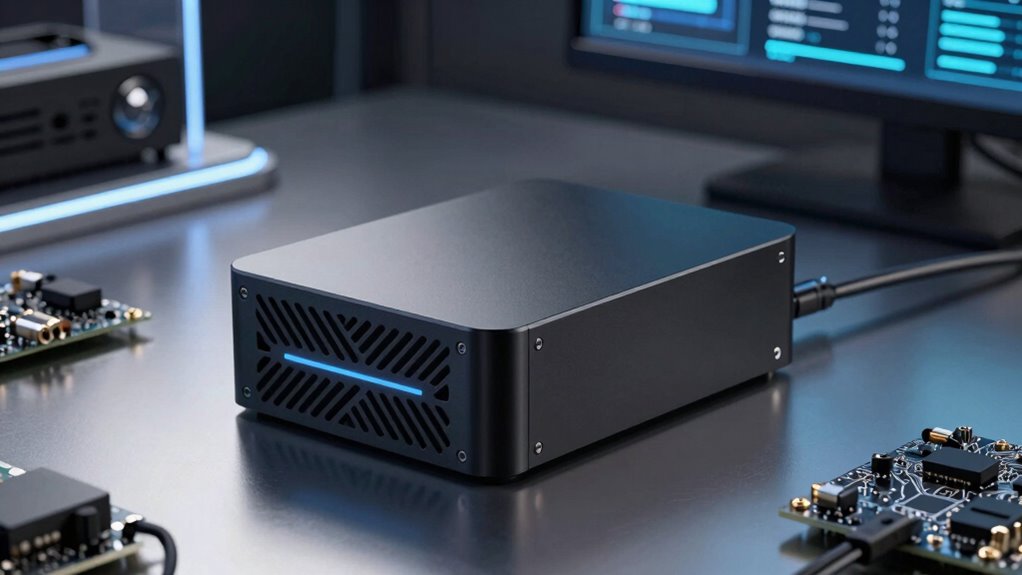

Choosing an industrial mini PC for AI inference requires balancing power, connectivity, and durability in a compact form. The ASRock Industrial NUC BOX-325 stands out as the overall best thanks to its robust NPU AI engine and advanced connectivity options. For fanless, low-maintenance setups, the Seeed Studio reComputer J3011 is a top pick, offering reliable edge AI performance. Meanwhile, the NVIDIA Jetson Xavier NX Developer Kit remains a favorite for developers needing maximum GPU power in a small package. The main tradeoffs involve balancing raw processing power against thermal management, ease of use, and price. Keep reading for a detailed breakdown of these options to find the best fit for your AI inference needs.
Open a free Amazon Business account
Business pricing, bulk buying and tax-exempt orders.
Create a free accountAs an affiliate, we earn on qualifying purchases.
Key Takeaways
- High-performance mini PCs with integrated NPUs or GPUs provide superior AI inference speeds but often come at a higher price.
- Fanless designs excel in durability and low maintenance, but may limit thermal performance under sustained workloads.
- Connectivity options like USB4, Thunderbolt 4, and dual Ethernet are key for integrating these devices into larger AI systems.
- The choice between barebone and pre-assembled models affects ease of setup and upgradeability.
- Price varies widely; investing in a more capable device can save costs on additional cooling or expansion hardware later.
| ASRock Industrial NUC BOX-325 Barebone AI Mini PC, Intel Core Ultra Series 3 with NPU AI Engine |  | Best Overall for Industrial AI Inference | Processor: Intel Core Ultra 5 325 (Panther Lake-H) | Memory Support: Up to 128GB DDR5-6400MHz | Storage: Dual M.2 PCIe Gen5x4 and Gen4x4 SSDs | VIEW ON AMAZON | See Our Full Breakdown |
| Seeed Studio reComputer J3011 Fanless Edge AI Device with Jetson Orin Nano 8GB |  | Best Fanless Edge AI Solution for Industrial Environments | Processor: Jetson Orin Nano 8GB | Temperature Range: -20°C to 60°C | Ethernet: 2x GbE (1 PoE support) | VIEW ON AMAZON | See Our Full Breakdown |
| Seeed Studio reComputer Industrial J4012 – Fanless Edge AI Device with Jetson Orin NX 16GB |  | Best for Heavy-Duty Industrial AI Processing | Processor: Jetson Orin NX 16GB | Temperature Range: -20°C to 60°C | Connectivity: 2x GbE (PoE), serial, USB 3.2, optional LTE/5G | VIEW ON AMAZON | See Our Full Breakdown |
| ASRock Industrial NUCS BOX-325 Slim Barebone AI Mini PC, Intel Core Ultra Series 3 with NPU |  | Best Compact Edge AI Mini PC for Professional Use | Processor: Intel Core Ultra 5 325 (Panther Lake-H) | Memory: Up to 128GB DDR5-7200 | Storage: Dual M.2 PCIe Gen5x4 SSDs | VIEW ON AMAZON | See Our Full Breakdown |
| GMKtec K13 AI Mini PC with Intel Core Ultra 7 and Intel Arc 140V GPU |  | Best for AI and Content Creation with High-Performance GPU | Processor: Intel Core Ultra 7 256V | GPU: Intel Arc 140V | Memory: 16GB LPDDR5X | VIEW ON AMAZON | See Our Full Breakdown |
| reComputer Industrial J3010 Fanless Edge AI Device with Jetson Orin Nano 4GB | | Best for Rugged Industrial Environments | Processor: Jetson Orin Nano 4GB | Form Factor: Fanless, compact | Temperature Range: -20°C to 60°C | VIEW ON AMAZON | See Our Full Breakdown |
| NVIDIA Jetson Xavier NX Developer Kit |  | Best for High-Performance AI Development in Compact Form | Processor: Jetson Xavier NX Module | Power Consumption: 10 W | Performance: Over 10X Jetson TX2 | VIEW ON AMAZON | See Our Full Breakdown |
| ASUS PE1100N Edge Computer for Edge AI/IoT, NVIDIA Jetson Orin Nano 4G, 16GB LPDDR5 |  | Best for Harsh Environment Edge Deployment | Processor: NVIDIA Jetson Orin Nano 4G | Memory: 16GB LPDDR5 | Form Factor: 1.25L compact | VIEW ON AMAZON | See Our Full Breakdown |
| industrial mini pcs for ai inference | Processor | Form Factor |
|---|---|---|
| ASRock Industrial NUC BOX-325 | Intel Core Ultra 5 325 (Panther Lake-H) | 0.9L mini-PC |
| Seeed Studio reComputer J3011 | Jetson Orin Nano 8GB | — |
| Seeed Studio reComputer Indust | Jetson Orin NX 16GB | Compact fanless PC |
| ASRock Industrial NUCS BOX-325 | Intel Core Ultra 5 325 (Panther Lake-H) | 0.9L mini-PC |
| GMKtec K13 AI Mini PC with Int | Intel Core Ultra 7 256V | — |
| reComputer Industrial J3010 Fa | Jetson Orin Nano 4GB | Fanless, compact |
| NVIDIA Jetson Xavier NX Develo | Jetson Xavier NX Module | Compact, small form-factor |
| ASUS PE1100N Edge Computer for | NVIDIA Jetson Orin Nano 4G | 1.25L compact |
More Details on Our Top Picks
ASRock Industrial NUC BOX-325 Barebone AI Mini PC, Intel Core Ultra Series 3 with NPU AI Engine
The ASRock Industrial NUC BOX-325 stands out for its robust industrial design, making it ideal for demanding 24/7 AI inference operations. Its high-performance Intel Core Ultra Series 3 processor paired with an integrated NPU offers strong AI acceleration, surpassing the GPU-dependent options like the GMKtec K13 in terms of dedicated AI processing. The inclusion of dual M.2 slots and support for DDR5-7200 ensures storage and memory flexibility, though you’ll need to purchase RAM, SSD, and OS separately, adding to the overall setup effort. Connectivity is comprehensive with Wi-Fi 7, Thunderbolt 4, and dual 2.5GbE LAN, making it suitable for network-heavy environments. The compact size (0.9L) and wide operating temperature range (0°C to 40°C) make it versatile, but it isn’t designed for extreme temperatures or rugged outdoor use.
Pros:- Robust industrial-grade build suitable for continuous operation
- High-speed DDR5 memory and dual M.2 slots for storage flexibility
- Advanced connectivity with Wi-Fi 7, Thunderbolt 4, and dual 2.5GbE LAN
Cons:- Requires additional components like RAM, SSD, and OS to be fully operational
- Limited to 0°C to 40°C operating temperature, not suitable for extreme outdoor conditions
Best for: Industrial facilities needing reliable, high-performance AI inference in temperature-controlled environments
Not ideal for: Extreme outdoor applications or environments requiring ruggedized hardware beyond standard industrial specs
- Processor:Intel Core Ultra 5 325 (Panther Lake-H)
- Memory Support:Up to 128GB DDR5-6400MHz
- Storage:Dual M.2 PCIe Gen5x4 and Gen4x4 SSDs
- Networking:Dual 2.5GbE LAN, Wi-Fi 7, Bluetooth 6.0
- Dimensions:117.5 x 110 x 49 mm
- Form Factor:0.9L mini-PC
Our verdict“This mini PC is perfect for industrial environments where reliable, high-performance AI inference is needed within a controlled temperature range.”
Seeed Studio reComputer J3011 Fanless Edge AI Device with Jetson Orin Nano 8GB
The reComputer J3011 excels in silent, fanless operation, making it a strong choice for industrial edge AI deployments where noise and dust are concerns. Its Jetson Orin Nano 8GB module provides solid AI processing power, comparable to the more advanced NX models but at a more accessible price point. The device’s support for temperatures from -20°C to 60°C and multiple connectivity options—including GbE, serial, and digital I/O—outperform many fan-cooled units like the reComputer J4012 in terms of heat resilience and durability. However, you’ll need to purchase a power adapter separately, which adds to the initial setup cost. Optional modules like TPM and cellular connectivity can further enhance its industrial usability but require additional investment.
Pros:- Fanless design ensures silent operation and minimal dust ingress
- Wide temperature support suitable for harsh industrial settings
- Multiple connectivity options including serial ports and PoE support
Cons:- Power adapter must be bought separately, increasing initial cost
- Some advanced features like TPM are optional, adding complexity
Best for: Industrial operators needing quiet, reliable AI edge devices in temperature-variable environments
Not ideal for: High-performance applications requiring GPU acceleration or extensive internal storage without expansion options
- Processor:Jetson Orin Nano 8GB
- Temperature Range:-20°C to 60°C
- Ethernet:2x GbE (1 PoE support)
- Serial Ports:1x RS-232/RS-422/RS-485
- Digital Inputs/Outputs:4x DI/DO
- Mounting Options:Desk, DIN rail, wall-mount, VESA
Our verdict“This pick suits industrial environments demanding silent, reliable AI inference across a broad temperature range without active cooling.”
Seeed Studio reComputer Industrial J4012 – Fanless Edge AI Device with Jetson Orin NX 16GB
The reComputer J4012 is designed for demanding industrial AI tasks, featuring a Jetson Orin NX 16GB module that offers substantial AI processing power, suitable for complex inference workloads. Its fanless design guarantees silent, dust-resistant operation, crucial in sensitive environments. The device supports a wide temperature range from -20°C to 60°C and offers extensive connectivity, including GbE with PoE, multiple USB ports, and serial interfaces. Its flexible mounting options allow integration into various industrial setups, and certifications like FCC and CE ensure compliance. Compared with smaller models like the reComputer J3011, this unit provides a significant boost in AI capability but at the cost of increased size and power requirements, which could limit deployment in space-constrained environments.
Pros:- High-performance Jetson Orin NX 16GB module for intensive AI workloads
- Fanless, dust-resistant design suitable for harsh environments
- Wide temperature tolerance and multiple industrial connectivity options
Cons:- Larger size and higher power consumption compared to smaller units
- Additional cost for power supply and optional modules
Best for: Industrial facilities needing high-powered AI inference with robust connectivity and durability
Not ideal for: Limited indoor or space-restricted applications where size and power are constraints
- Processor:Jetson Orin NX 16GB
- Temperature Range:-20°C to 60°C
- Connectivity:2x GbE (PoE), serial, USB 3.2, optional LTE/5G
- Form Factor:Compact fanless PC
- Certifications:FCC, CE, RoHS, UKCA
Our verdict“This device is best suited for industrial scenarios where maximum AI processing power and durability are necessary.”
ASRock Industrial NUCS BOX-325 Slim Barebone AI Mini PC, Intel Core Ultra Series 3 with NPU
The NUCS BOX-325 Slim combines a compact form factor with industrial-grade features, making it suitable for edge AI tasks in space-constrained environments. Its Intel Core Ultra Series 3 processor with built-in NPU provides dedicated AI acceleration, rivaling the performance of larger GPU-based units like the GMKtec K13 but with less power consumption. The device supports DDR5-7200 and dual M.2 PCIe Gen5 storage, offering high-speed data handling. Its extensive I/O options, including USB4 and Thunderbolt 4, enable versatile connectivity, while the operating temperature of 0°C to 40°C limits outdoor or extreme use. This unit is ideal for professional setups where size, power efficiency, and AI performance matter most, though it may require additional setup and compatible chassis.
Pros:- Small, space-efficient design suitable for tight setups
- Supports DDR5-7200 and PCIe Gen5 SSDs for fast data throughput
- Integrated NPU enhances AI inference without GPU dependency
Cons:- Limited operating temperature range (0°C to 40°C)
- Requires compatible chassis and additional setup for full deployment
Best for: Edge AI applications in professional settings requiring a compact, high-performance device
Not ideal for: Outdoor or extreme temperature environments beyond 40°C or where ruggedness is prioritized
- Processor:Intel Core Ultra 5 325 (Panther Lake-H)
- Memory:Up to 128GB DDR5-7200
- Storage:Dual M.2 PCIe Gen5x4 SSDs
- Networking:Dual 2.5GbE LAN, Wi-Fi 7
- Dimensions:117.5 x 110 x 38 mm
- Form Factor:0.9L mini-PC
Our verdict“This mini PC is ideal for professional edge AI deployments where size, AI acceleration, and efficiency are key factors.”
GMKtec K13 AI Mini PC with Intel Core Ultra 7 and Intel Arc 140V GPU
The GMKtec K13 offers a portable yet powerful AI workstation, combining an Intel Core Ultra 7 processor with a dedicated Intel Arc 140V GPU, making it ideal for AI inference and content creation. Its support for triple 4K displays at 60Hz and 16GB of LPDDR5X RAM enables seamless multitasking and visualization. Compared to the NUCS BOX-325, which relies on integrated AI acceleration, the K13’s dedicated GPU provides more raw AI inference power and better support for multimedia tasks. However, its internal storage is limited to 1TB with expansion up to 16TB, and maximum USB4 speeds require compatible cables. Its compact size (7.2 x 3.5 x 1.3 inches) lends portability but may limit internal expansion options.
Pros:- Dedicated Intel Arc GPU enhances AI and multimedia performance
- Supports triple 4K displays for advanced visualization
- Compact, portable design perfect for on-the-go work
Cons:- Limited internal storage without expansion, potentially needing external drives
- Requires compatible cables for full USB4 performance
Best for: AI developers and content creators needing portable processing with high visual output
Not ideal for: Extreme outdoor environments or heavy-duty industrial use where ruggedness is essential
- Processor:Intel Core Ultra 7 256V
- GPU:Intel Arc 140V
- Memory:16GB LPDDR5X
- Storage:1TB SSD (expandable up to 16TB)
- Display Support:Triple 4K at 60Hz
- Network:5GbE LAN
Our verdict“This mini PC suits users needing a portable, high-GPU-performance device for AI inference and multimedia tasks.”
reComputer Industrial J3010 Fanless Edge AI Device with Jetson Orin Nano 4GB
The reComputer Industrial J3010 stands out for its fanless, silent operation and broad temperature range, making it ideal for harsh industrial settings. Compared with the ASUS PE1100N, it offers more connectivity options, including serial ports and optional cellular modules, which are essential for field deployments. However, its processing power is limited for demanding AI inference tasks, so it’s better suited for edge applications that don’t require heavy computation. The fanless design ensures durability and low maintenance, but the need to purchase the power adapter separately can add to initial costs. Its support for wide temperature ranges and flexible mounting make it a reliable choice for embedded AI in factories, transportation, or remote sites.
Pros:- Fanless design provides silent, maintenance-free operation
- Supports wide temperature ranges from -20°C to 60°C
- Multiple connectivity options including GbE, serial, USB, and optional cellular modules
- Flexible mounting options for various industrial setups
Cons:- Power adapter must be purchased separately, increasing initial cost
- Limited processing capability for intensive AI inference
- Some features like 5G/LoRaWAN require optional modules
Best for: Industrial operators needing a durable, fanless edge device with versatile connectivity for basic AI inference tasks in rugged environments
Not ideal for: Developers requiring high computational power or GPU-intensive AI workloads, as the Jetson Nano 4GB limits heavy processing
- Processor:Jetson Orin Nano 4GB
- Form Factor:Fanless, compact
- Temperature Range:-20°C to 60°C
- Connectivity:2x RJ-45 GbE, 1x serial, USB, optional 5G/4G/LTE
- Additional Features:Support for LoRaWAN, GPS, TPM2.0
- Mounting Options:Desk, DIN rail, wall, VESA
Our verdict“This device suits industrial environments needing reliable, low-power edge AI with extensive connectivity but limited processing for heavy inference.”
NVIDIA Jetson Xavier NX Developer Kit
The NVIDIA Jetson Xavier NX Developer Kit offers a significant performance boost over the Jetson Nano, making it a top choice for AI developers needing powerful edge computing. Unlike the reComputer J3010, which is more about rugged deployment, this kit emphasizes raw AI inference speed with over ten times the performance of Jetson TX2, combined with low power consumption at around 10 W. It’s well-suited for prototyping and deploying sophisticated AI models in compact spaces, but requires familiarity with NVIDIA’s software ecosystem. Its limited hardware specifications make it less ideal for environments demanding ruggedness or extensive I/O without additional accessories. This kit is perfect for those focused on AI model development and deployment with moderate environmental constraints.
Pros:- Exceptional performance with over ten times the power of Jetson TX2
- Low power consumption enables battery-powered or energy-efficient deployments
- Supports NVIDIA’s comprehensive AI software stack and pre-trained models
- Ideal for rapid development and testing of AI inference models
Cons:- Requires familiarity with NVIDIA’s ecosystem and software tools
- Limited hardware details in the product description can make integration planning difficult
- Not designed for rugged or industrial environments without additional casing
Best for: AI developers and researchers needing high-performance, low-power edge inference with seamless software updates
Not ideal for: Industrial operators seeking rugged, sealed hardware for harsh environments or those needing extensive I/O ports on the device itself
- Processor:Jetson Xavier NX Module
- Power Consumption:10 W
- Performance:Over 10X Jetson TX2
- Support:NVIDIA software stack, pre-trained models
- Form Factor:Compact, small form-factor
Our verdict“This kit is best suited for AI developers needing high-performance inference in a small, power-efficient package for prototyping or deployment in controlled environments.”
ASUS PE1100N Edge Computer for Edge AI/IoT, NVIDIA Jetson Orin Nano 4G, 16GB LPDDR5
The ASUS PE1100N combines a rugged, fanless design with high memory capacity and robust connectivity, making it a compelling choice for edge AI in challenging environments. Compared with the reComputer J3010, it offers much higher RAM—16GB LPDDR5—supporting larger models and more complex inference tasks. While it excels in durability with vibration and shock resistance, it requires some technical expertise to set up, especially since it lacks built-in Wi-Fi or Bluetooth, relying instead on optional M.2 modules. Its compact size and industrial-grade aluminum chassis make it ideal for deployments in retail, manufacturing, or outdoor settings where environmental resistance is key. It’s less suitable for those needing plug-and-play simplicity or higher GPU performance.
Pros:- Ultra-compact, lightweight, and dust-resistant design
- Vibration and shock resistant, suitable for mobile or outdoor use
- High memory capacity with 16GB LPDDR5 for larger AI models
- Supports dual LAN and M.2 expansion for versatile connectivity
Cons:- Limited to NVIDIA Jetson Orin Nano 4G, restricting higher GPU options
- Requires technical knowledge for installation and setup
- No built-in Wi-Fi or Bluetooth, relying on optional modules
Best for: Industrial or outdoor applications needing durable, high-memory edge devices capable of running complex AI models in harsh conditions
Not ideal for: Users seeking high GPU performance or wireless connectivity out of the box, or those without technical setup skills
- Processor:NVIDIA Jetson Orin Nano 4G
- Memory:16GB LPDDR5
- Form Factor:1.25L compact
- Cooling:Fanless, dust-resistant aluminum chassis
- Connectivity:Dual LAN, M.2 expansion, Dual SIM
- Input Voltage:12–24V DC
Our verdict“This device is well-suited for deployments in demanding environments where durability and high memory are needed, but it demands technical expertise for setup.”
How We Picked
These products were evaluated based on a combination of processing power, AI acceleration capabilities, connectivity options, build quality, and overall value. We prioritized devices with dedicated AI hardware like NPUs or GPUs, as these significantly impact inference performance. Ease of use, expandability, and thermal management were also key factors, especially given the demanding nature of AI inference tasks. Devices were ranked to reflect their suitability for different use cases, from edge deployment to development environments, ensuring a balanced overview for various buyer needs.Factors to Consider When Choosing Industrial Mini Pcs For Ai Inference
When selecting an industrial mini PC for AI inference, it’s important to consider several factors that influence performance, reliability, and future-proofing. Understanding these core criteria can help avoid common pitfalls and ensure you choose a device that meets your specific application requirements.Processing Hardware and AI Acceleration
AI inference heavily depends on the processing hardware. Devices with dedicated NPUs, GPUs, or AI accelerators provide faster inference times and lower latency. Choosing between integrated AI hardware or general-purpose CPUs involves evaluating your workload’s complexity and real-time requirements. Opting for a device with upgradeable AI hardware or multiple acceleration options can extend its useful life and adaptability.
Connectivity and Expansion
Robust connectivity options like USB4, Thunderbolt 4, dual Ethernet, and M.2 slots are vital for integrating mini PCs into larger AI and IoT ecosystems. These features facilitate fast data transfer, peripheral compatibility, and hardware expansion. Overlooking these can bottleneck data flow or restrict future upgrades, so assess your system’s connectivity needs upfront.
Thermal Management and Durability
Many industrial environments demand devices that operate reliably without active cooling, favoring fanless designs. However, passive cooling can limit sustained performance during intensive inference tasks. Consider the thermal design and enclosure quality, especially if your deployment involves continuous workloads or harsh conditions. Balancing thermal capacity with compact size is key.
Ease of Setup and Maintenance
Pre-assembled units save deployment time, but barebones options offer greater upgradeability. Think about your technical expertise and future needs—if frequent updates or hardware swaps are anticipated, prioritize modular designs. Additionally, look for devices with straightforward access to components and good documentation, reducing downtime and maintenance costs.
Price and Total Cost of Ownership
Initial cost is just part of the picture. More capable devices with advanced AI hardware may command higher upfront prices but can deliver better performance and longer relevance. Conversely, budget options might suffice for basic inference tasks but could require additional investments in cooling or expansion. Consider your project’s scale and long-term budget to avoid overspending or underperforming hardware.
Frequently Asked Questions
Can I upgrade the AI hardware in these mini PCs later?
Upgradability varies among models. Some mini PCs with modular designs or accessible components allow upgrades to AI accelerators or memory, extending their lifespan. Others, especially compact fanless units, often have fixed hardware configurations. Assess your future needs and choose a device that offers upgrade paths if long-term flexibility is a priority.
Is passive cooling sufficient for high workloads?
Fanless designs are ideal for durability and dust resistance but can face thermal challenges under sustained high loads. For intensive inference tasks, ensure the device’s thermal management system is well-designed, or consider active cooling solutions. Skipping this step might lead to thermal throttling, reducing performance and potentially damaging hardware over time.
How important is connectivity for AI inference applications?
Connectivity options determine how easily the mini PC integrates with sensors, cameras, and networks. Features like USB4, Thunderbolt 4, dual Ethernet, and M.2 slots support high-speed data transfer and expandability. Neglecting these can bottleneck data flow and limit your setup’s scalability, especially in complex AI deployments.
Should I prioritize pre-assembled or barebone models?
Pre-assembled units are ready to deploy out of the box, saving time and effort. Barebone options offer customization and upgrade potential, which can be advantageous for evolving projects. Your choice depends on your technical skill level, timeline, and need for future upgrades—evaluate these factors to pick the right approach.
How does price correlate with AI inference performance?
Higher-priced mini PCs generally feature more powerful AI hardware, better thermal management, and advanced connectivity, leading to superior inference speeds. Budget models may suffice for basic tasks but can hit performance ceilings more quickly. Investing in a more capable device often results in better long-term value, especially for demanding workloads.
Conclusion
For general enterprise applications and high-performance AI inference, the ASRock Industrial NUC BOX-325 offers a compelling balance of power and connectivity. Beginners or those with light workloads might prefer the Seeed Studio reComputer J3011 for its simplicity and reliability. For developers needing maximum GPU power, the NVIDIA Jetson Xavier NX Developer Kit remains a top choice. Those seeking a premium, feature-rich solution should consider the ASUS PE1100N. Ultimately, your selection should align with your specific use case, budget, and future expansion plans.
As an affiliate, we earn on qualifying purchases.Flea & tick season Picks
flea and tick prevention