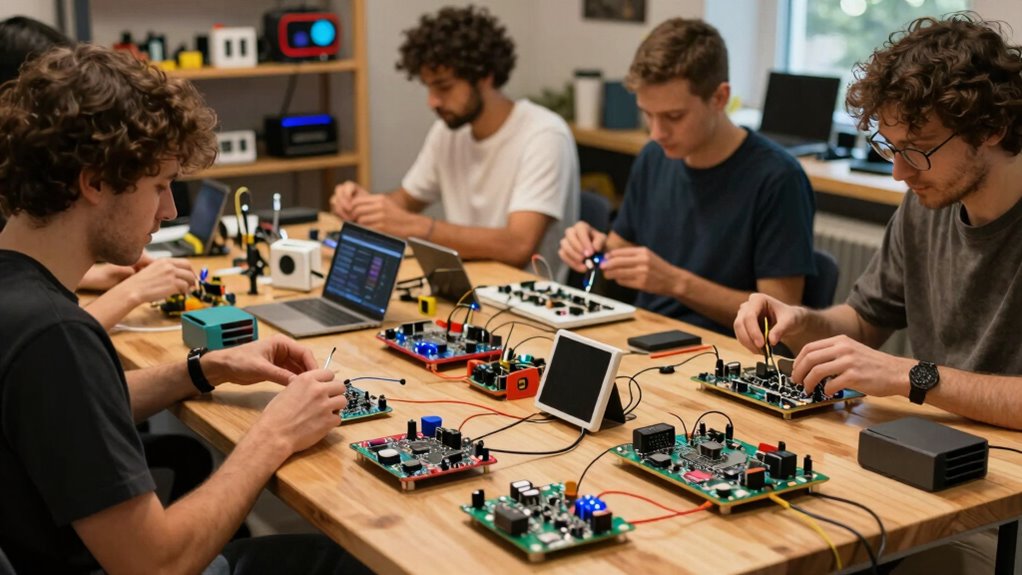

For makers interested in integrating AI into their projects, local AI kits offer a powerful way to develop and deploy AI models without relying on cloud services. The ELECROW AI Starter Kit stands out as the best overall choice, thanks to its comprehensive sensor array and beginner-friendly Python lessons. Meanwhile, the SunFounder AI Fusion Lab Kit appeals to those wanting to explore LLMs and computer vision on Raspberry Pi. The main tradeoffs in this category involve balancing ease of use with customization options—more beginner-friendly kits might limit flexibility, while advanced kits can be complex to set up. Continue reading for a detailed comparison of these options to find the best fit for your maker projects.

Get business pricing on tech for your team
- Business-only prices and quantity discounts
- Tax-exempt purchasing
- Multiple users, one account, clear invoices
Key Takeaways
- The top kits combine accessible hardware with extensive learning resources, making them suitable for both beginners and experienced makers.
- Some kits focus on IoT and sensor integration, while others emphasize AI models like LLMs and computer vision, highlighting different project priorities.
- Build quality and community support vary significantly, often impacting ease of troubleshooting and project development.
- Pricing and included components create clear tradeoffs: more comprehensive kits tend to cost more but offer greater versatility.
- Compatibility with popular development environments like Python, OpenCV, and TensorFlow is crucial for maximizing project potential.
| ELECROW AI Starter Kit for Jetson Orin Nano, 30 Sensors, 38 Python Lessons |  | Best Overall for Comprehensive Edge AI Education | Memory Storage Capacity: 128 GB | Processor Brand: NVIDIA | Item Dimensions: 8.66″L x 4.13″W x 11.81″H | VIEW ON AMAZON | See Our Full Breakdown |
| SunFounder AI Fusion Lab Kit for Raspberry Pi 5/4/3B+/Zero 2W, LLMs ChatGPT/Gemini/Grok, YOLO & OpenCV, MediaPipe, Python, Video Courses for Beginners |  | Best Value for Versatile AI and Vision Projects on Raspberry Pi | Connectivity Technology: CSI, USB | Operating System: Linux | Compatible Devices: Raspberry Pi cameras, sensors, displays | VIEW ON AMAZON | See Our Full Breakdown |
| ESP32-P4-WIFI6-DEV-KIT Based on ESP32-P4 and ESP32-C6 with Wi-Fi 6 and Bluetooth 5 |  | Best for High-Performance Edge IoT and AI Connectivity | Processor: RISC-V 32-bit dual-core and single-core | Memory: 128 KB HP ROM, 16 KB LP ROM, 768 KB HP L2MEM, 32 KB LP SRAM, 8 KB TCM, 32MB PSRAM, 16MB onboard Nor Flash | Connectivity: Wi-Fi 6, Bluetooth 5/BLE | VIEW ON AMAZON | See Our Full Breakdown |
| LAFVIN AIoT Starter Kit with ESP32-S3 and Sensors for DIY Projects |  | Best for Beginners and Educators in IoT and Smart Home Projects | Microcontroller: ESP32-S3 | Included Modules: RGB LED, sensors, relays | Features: AI voice control, pre-compiled firmware | VIEW ON AMAZON | See Our Full Breakdown |
| UNIHIKER K10 AI Coding Board for STEM & Beginners – Computer Vision, Offline Voice Recognition, TinyML, 2.8″ Display, IoT Project Kit |  | Best for Entry-Level AI and IoT Exploration with Visual Interface | Memory Storage Capacity: 16 MB | Connectivity Technology: Bluetooth, USB, Wi-Fi | Operating System: MicroPython | VIEW ON AMAZON | See Our Full Breakdown |
| LAFVIN AI Chatbot Kit for ESP32-S3 with Preloaded OpenAI & Deepseek Voice Projects |  | Best for AI Voice Interaction and IoT Beginners | Memory Storage Capacity: 16MB | Connectivity Technology: Bluetooth, Wi-Fi | Operating System: ESP-IDF | VIEW ON AMAZON | See Our Full Breakdown |
| GeeekPi EmbodiQ AI Starter Kit for Arduino UNO Q |  | Best for Hands-On Robotics and Sensor Projects with AI | RAM: 4GB | Storage: 32GB eMMC | Sensors: Soil moisture, raindrop | VIEW ON AMAZON | See Our Full Breakdown |
More Details on Our Top Picks
ELECROW AI Starter Kit for Jetson Orin Nano, 30 Sensors, 38 Python Lessons
This kit stands out for offering a complete, all-in-one platform tailored for makers eager to dive into Edge AI without complex soldering or wiring. Its integrated sensors, portable display, and voice interaction make it ideal for learners who want hands-on experience with computer vision and sensor control. Compared with the SunFounder kit, ELECROW’s setup emphasizes portability and built-in hardware, but it doesn’t include the Jetson Orin Nano board itself, which means additional investment is needed. This tradeoff favors those wanting an accessible, beginner-friendly ecosystem that scales up for more advanced projects. While this kit simplifies many aspects of AI development, complex projects may push beyond its capabilities due to hardware limitations and the need for additional components.
Pros:- All-in-one platform with integrated sensors, display, and voice interaction
- Includes comprehensive Python tutorials suitable for beginners
- Portable and user-friendly design for educational settings
Cons:- Jetson Orin Nano board not included, requiring extra purchase
- Full functionality depends on additional hardware components
- May not support complex AI projects without upgrades
Best for: Beginners and educators seeking a portable, all-in-one AI learning platform with Python tutorials.
Not ideal for: Advanced developers or makers needing a fully customizable setup with specific hardware components included from the start.
- Memory Storage Capacity:128 GB
- Processor Brand:NVIDIA
- Item Dimensions:8.66″L x 4.13″W x 11.81″H
Our verdict“This kit is best suited for newcomers and educators wanting a complete, portable AI starter with guided learning.”
SunFounder AI Fusion Lab Kit for Raspberry Pi 5/4/3B+/Zero 2W, LLMs ChatGPT/Gemini/Grok, YOLO & OpenCV, MediaPipe, Python, Video Courses for Beginners
This kit excels at transforming a Raspberry Pi into a versatile AI hub capable of running large language models and vision frameworks like YOLO and OpenCV. It offers a rich set of sensors, a camera, and an extensive curriculum, making it ideal for learners who want to explore both AI and computer vision in depth. When compared to the ELECROW kit, it provides more flexibility for software customization but requires users to supply their own Raspberry Pi, which adds a layer of setup complexity. The structured tutorials and technical support are a plus, but the setup can be daunting for absolute beginners who lack experience with Linux or hardware configuration. Overall, this kit provides a comprehensive learning experience with a focus on vision and language models but demands more initial technical skill.
Pros:- Supports multiple large language models and vision frameworks
- Includes sensors, camera, and structured tutorials for guided learning
- Offers extensive software flexibility for advanced projects
Cons:- Requires Raspberry Pi (not included), adding setup complexity
- Setup might be challenging for absolute beginners unfamiliar with Linux
- Limited to Raspberry Pi compatible hardware
Best for: Hobbyists and students interested in deep AI, computer vision, and language models using Raspberry Pi hardware.
Not ideal for: Complete newcomers or users seeking an all-in-one, plug-and-play solution that doesn’t require extra hardware or setup.
- Connectivity Technology:CSI, USB
- Operating System:Linux
- Compatible Devices:Raspberry Pi cameras, sensors, displays
Our verdict“This kit is ideal for learners ready to handle a more involved setup with broad AI and vision capabilities on Raspberry Pi.”
ESP32-P4-WIFI6-DEV-KIT Based on ESP32-P4 and ESP32-C6 with Wi-Fi 6 and Bluetooth 5
This development board is geared toward makers needing high-speed wireless connectivity and advanced interfaces for AI and IoT projects. Its support for Wi-Fi 6 and Bluetooth 5, along with extensive human-machine interfaces, sets it apart from simpler microcontrollers like the LAFVIN S3. It’s especially well-suited for edge computing applications requiring fast data transfer and security features such as secure boot and flash encryption. However, its complexity makes it less accessible for beginners or those seeking straightforward AI kits. The rich feature set and security are advantages, but they come with a steep learning curve, and some users may find it overkill for basic projects.
Pros:- Supports Wi-Fi 6 and Bluetooth 5 for fast, secure wireless communication
- Rich set of multimedia and human-machine interfaces
- Advanced security features including secure boot and flash encryption
Cons:- Setup and configuration require advanced technical knowledge
- Limited user reviews to gauge real-world performance
- Features may be excessive for simple hobbyist projects
Best for: Advanced makers and IoT developers needing high-speed wireless and secure edge AI solutions.
Not ideal for: Beginners or hobbyists who prefer plug-and-play kits without extensive technical setup.
- Processor:RISC-V 32-bit dual-core and single-core
- Memory:128 KB HP ROM, 16 KB LP ROM, 768 KB HP L2MEM, 32 KB LP SRAM, 8 KB TCM, 32MB PSRAM, 16MB onboard Nor Flash
- Connectivity:Wi-Fi 6, Bluetooth 5/BLE
Our verdict“This board makes the most sense for experienced developers targeting high-performance edge AI and IoT applications requiring robust connectivity.”
LAFVIN AIoT Starter Kit with ESP32-S3 and Sensors for DIY Projects
The LAFVIN AIoT Starter Kit offers a straightforward entry point into IoT development with the versatile ESP32-S3 microcontroller and a variety of modules like sensors, LEDs, and relays. Its plug-and-play approach with AI voice control makes it accessible for newcomers, educators, and makers interested in quick deployment of smart home or STEM projects. Compared to the more complex ESP32-P4 board, this kit emphasizes ease of use and hands-on learning, though it restricts advanced customization since you’re limited to included modules. For those with some technical background, it provides a solid foundation without overwhelming complexity. However, users aiming for highly customizable or large-scale projects may find it limiting.
Pros:- Includes a broad array of modules suitable for various IoT projects
- Supports AI voice control with simple integration
- Designed for ease of use with extensive tutorials and support
Cons:- Requires some technical knowledge for secondary development
- Limited to included hardware modules, restricting project scope
- Less suitable for large or complex AI projects
Best for: Beginners, educators, and makers focusing on basic IoT and smart home projects with easy setup.
Not ideal for: Advanced users or makers wanting a fully customizable, open-ended development environment.
- Microcontroller:ESP32-S3
- Included Modules:RGB LED, sensors, relays
- Features:AI voice control, pre-compiled firmware
Our verdict“This kit is perfect for newcomers and educators seeking a straightforward, educational IoT starter kit with voice features.”
UNIHIKER K10 AI Coding Board for STEM & Beginners – Computer Vision, Offline Voice Recognition, TinyML, 2.8″ Display, IoT Project Kit
The UNIHIKER K10 offers a compact, user-friendly platform for those new to AI, IoT, and coding. Its pre-loaded AI models, offline voice recognition, and small display make it accessible for beginners interested in experimenting with computer vision and TinyML models. Compared with the ESP32-based kits, UNIHIKER’s integrated AI capabilities and graphical programming options simplify the learning curve while still supporting custom models. The small form factor and limited internal storage of 16 MB could restrict more data-intensive projects, and some users might find the small display limiting for complex interfaces. Nevertheless, this board provides a balanced starting point for exploring AI applications in a straightforward, educational package.
Pros:- Supports multiple AI functionalities including vision and voice recognition
- Pre-loaded AI models with options for custom TinyML training
- Compact design with wireless connectivity and user-friendly programming options
Cons:- Internal storage limited to 16 MB, restricting data-heavy projects
- Small 2.8-inch display may be restrictive for advanced interfaces
- Requires some technical skills for full feature usage
Best for: Beginning students and STEM educators who want an easy-to-program AI and IoT device with visual feedback.
Not ideal for: Advanced makers or developers seeking extensive storage and larger displays for complex applications.
- Memory Storage Capacity:16 MB
- Connectivity Technology:Bluetooth, USB, Wi-Fi
- Operating System:MicroPython
Our verdict“This board fits well for beginners and educators who want a compact, accessible AI platform with visual and voice features for basic projects.”
LAFVIN AI Chatbot Kit for ESP32-S3 with Preloaded OpenAI & Deepseek Voice Projects
The LAFVIN AI Chatbot Kit for ESP32-S3 stands out for its ease of use in building AI-powered voice assistants, especially for those interested in voice interaction and IoT projects. Compared to the GeeekPi EmbodiQ AI Starter Kit, which offers more advanced onboard AI and sensor versatility, the LAFVIN kit provides a more straightforward, preloaded setup that minimizes initial coding. However, its limited storage and the need for a separate API key for OpenAI functions may slow down more ambitious projects. It’s ideal for newcomers who want a compact, all-in-one platform to learn embedded AI and IoT without extensive customization. The main tradeoff is that more complex or storage-heavy projects will require additional hardware or effort.
Pros:- Preloaded with Deepseek and OpenAI voice projects for quick setup
- Built-in Wi-Fi and Bluetooth for versatile connectivity
- User-friendly design with a color display and modular setup
- Supports learning AI, IoT, and embedded systems
Cons:- OpenAI functionality requires a separate API key and setup
- Limited storage capacity for larger projects
- Requires some technical knowledge for optimal use
Best for: Beginners in AI voice projects and IoT wanting a ready-to-go, user-friendly platform
Not ideal for: Advanced users or those needing large storage and comprehensive AI capabilities for complex applications
- Memory Storage Capacity:16MB
- Connectivity Technology:Bluetooth, Wi-Fi
- Operating System:ESP-IDF
- Wireless Compatibility:Bluetooth Compatible Devices
- RAM Memory Technology:LPDDR4
- Processor Count:1
- Total USB Ports:1
- Item Dimensions:7.8″L x 5.4″W x 1.9″H
Our verdict“This kit is best suited for beginners seeking an accessible entry point into AI voice and IoT projects with minimal configuration.”
GeeekPi EmbodiQ AI Starter Kit for Arduino UNO Q
The GeeekPi EmbodiQ AI Starter Kit offers a powerful combination of onboard AI reasoning and sensor integration, making it ideal for robotics, smart gardening, or weather stations. Unlike the LAFVIN ESP32-S3 Kit, which is more focused on voice interaction, the EmbodiQ provides a broader sensor suite and supports multiple AI providers, granting greater flexibility for complex multi-step tasks. However, its setup demands familiarity with microcontroller programming and API integration, which can be overwhelming for complete beginners. It’s better suited for users with some technical background who want to experiment with real-time reasoning and sensor-driven automation. The main tradeoff is a steeper learning curve compared to plug-and-play voice kits.
Pros:- Natural language control simplifies operation without coding
- Powerful onboard AI for real-time reasoning
- Versatile sensor suite for diverse projects
- Supports multiple AI provider APIs for flexibility
Cons:- Requires familiarity with AI and microcontroller setup
- May be complex for users without prior experience
- Dependence on external AI API services for functionality
Best for: Intermediate makers interested in robotics, sensor-driven automation, and multi-provider AI integration
Not ideal for: Absolute beginners or those looking for simple, voice-only AI projects
- RAM:4GB
- Storage:32GB eMMC
- Sensors:Soil moisture, raindrop
- Servo:9g servo motor
- Display:OLED
- Compatibility:OpenAI, OpenRouter, MiniMax
Our verdict“This kit is ideal for makers with some technical experience aiming to develop sensor-rich, AI-driven robotics or automation projects.”

How We Picked
The products in this roundup were selected based on their ability to deliver local AI processing capabilities tailored for makers. Key criteria included hardware versatility, ease of use, expandability, and the quality of educational resources. We prioritized kits that offer a good balance of beginner-friendly features with enough depth for more advanced projects. Cost-effectiveness and build quality also played significant roles, along with community support and documentation. The ranking reflects how well each kit meets these factors, helping makers choose options aligned with their skill level and project goals.Factors to Consider When Choosing Local Ai Kits For Makers
When selecting a local AI kit for making, it’s essential to consider several factors that influence usability, project scope, and long-term value. Choosing the right kit depends on your experience level, intended project complexity, and whether you prioritize ease of setup or customization. Understanding these key considerations can help prevent common pitfalls like overpaying for features you don’t need or selecting a kit that’s too advanced to start with.Hardware Compatibility and Expandability
Look for kits that support your preferred hardware platforms, such as Raspberry Pi, ESP32, or Arduino. Expandability is equally important; additional sensors, modules, or interfaces can extend your project’s capabilities. Kits with open hardware designs and modular components make it easier to upgrade or customize as your skills grow. Avoid kits with proprietary parts that limit future modifications or integrations.
Ease of Use and Educational Resources
Beginners should prioritize kits that include comprehensive tutorials, sample projects, and active community support. Clear documentation reduces setup time and helps troubleshoot issues effectively. For more experienced makers, flexibility and detailed technical documentation might be more valuable than step-by-step guides. Remember, a well-supported kit accelerates learning and project development.
Processing Power and Storage
The choice of processor impacts what AI models you can run locally. Boards with more powerful CPUs or dedicated AI accelerators enable faster inference and more complex models. Adequate onboard storage is also necessary for handling datasets and models. Be cautious about underpowered hardware if your projects involve real-time processing or large models—performance tradeoffs could limit functionality.
Cost and Value
Value depends on your project scope and budget. More expensive kits often include richer sensor sets and better processing hardware, but simpler, cost-effective options can suffice for basic AI tasks. Consider whether the included components justify the price or if you can source parts separately for a tailored setup. Avoid over-investing in features you won’t use, but don’t compromise on quality for the sake of saving money.
Compatibility With Development Tools
Most makers favor kits that support popular programming languages like Python and frameworks such as OpenCV or TensorFlow. Compatibility affects how easily you can develop, train, and deploy AI models. Kits with pre-installed software or straightforward setup procedures reduce technical barriers. Be wary of platforms that require proprietary or obscure tools, which can slow down progress or limit collaboration.
Frequently Asked Questions
Can I upgrade the hardware components later?
Many local AI kits designed for makers support hardware upgrades through modular components or expansion ports. For example, some boards allow adding more sensors, memory, or AI accelerators. However, it’s important to verify compatibility beforehand, as not all kits are easily expandable. Planning for potential upgrades when choosing a kit can extend its usefulness and adapt to your evolving project needs.
Are these kits suitable for learning AI from scratch?
Most of these kits are designed with educational resources that make starting straightforward for beginners. Kits like the ELECROW or SunFounder include tutorials and lessons that introduce core concepts step-by-step. While some require basic programming knowledge, many are structured to help newcomers grasp AI fundamentals without prior experience. For absolute beginners, selecting a kit with strong documentation and community support is especially helpful.
What kind of AI projects can I build with these kits?
These kits support a wide range of projects, from simple sensor-based automation to complex computer vision and natural language processing. For instance, you could create a voice-controlled robot, real-time object detection system, or IoT device with AI capabilities. The choice depends on the hardware’s processing power and sensor array—more advanced kits enable more sophisticated applications, but simpler kits can still handle basic AI tasks effectively.
Do I need internet access to use these kits?
Many local AI kits are designed to operate offline, allowing you to process data and run models without internet access. This is especially important for privacy-sensitive projects or remote environments. However, some kits that include preloaded cloud-based models or require updates may need periodic internet connection. Clarify your project’s offline requirements when selecting a kit to avoid unexpected limitations.
What’s the best way to learn AI development with these kits?
Hands-on experimentation combined with available tutorials and community forums makes learning more effective. Start with beginner-friendly projects, then gradually explore more complex models and integrations. Many kits offer step-by-step guides, video courses, or example code that accelerate understanding. Building small projects and sharing your progress within maker communities can also deepen your learning and troubleshoot challenges faster.
Conclusion
For those seeking a comprehensive, user-friendly platform, the ELECROW AI Starter Kit offers a balanced mix of sensors, lessons, and expandability—making it ideal for beginners and educators. Makers who prioritize exploring LLMs and computer vision may find the SunFounder AI Fusion Lab Kit more suited, thanks to its support for Raspberry Pi and advanced AI frameworks. Budget-conscious hobbyists or DIYers interested in IoT projects should consider kits like the LAFVIN AIoT Starter Kit or GeeekPi EmbodiQ, which deliver core AI features at a lower price point. For those wanting a premium, ready-to-go development experience, investing in more advanced hardware with dedicated AI acceleration makes sense. Ultimately, your choice should align with your skill level, project ambitions, and budget constraints.
Halloween Picks
halloween
As an affiliate, we earn on qualifying purchases.