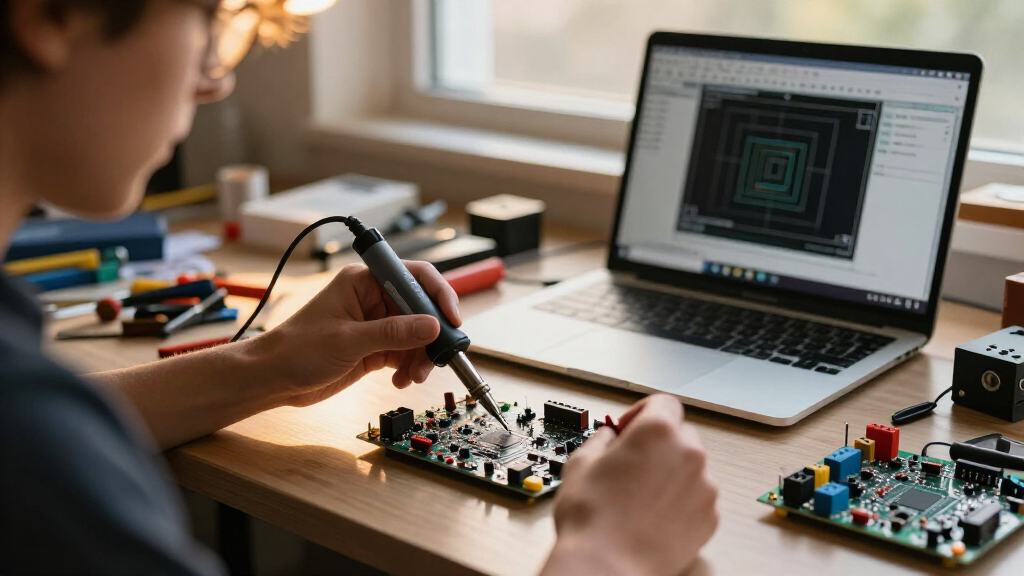

TL;DR
AI tools are increasingly being tested for circuit board design, but it is not yet clear if they can fully replace human engineers. Current developments show promising progress, yet significant uncertainties remain about their practical deployment.
AI tools are now being tested for designing circuit boards, with some claims suggesting significant progress, but it is not yet confirmed that AI can fully replace human engineers in this task. This development matters because it could reshape electronics manufacturing and design workflows, potentially increasing efficiency and reducing costs.
Recent trends indicate a growing interest in applying artificial intelligence to electronic design automation (EDA), specifically for circuit board layout and component placement. Several research groups and startups have reported using machine learning algorithms to generate circuit designs, optimize layouts, and suggest component configurations. However, these claims are primarily based on prototype systems, and there is no definitive evidence that AI can independently produce fully functional, manufacturable circuit boards at scale.
Industry experts acknowledge that AI can assist in certain aspects of circuit design, such as auto-routing and component placement, which traditionally require significant manual effort. Companies like Cadence and Synopsys have integrated AI-assisted features into their EDA tools, but these are described as aids rather than autonomous designers. The extent to which AI can replace human oversight remains unproven and subject to ongoing testing and validation.
Moreover, the complexity of modern circuit boards, especially for high-performance applications like 5G, AI, and automotive systems, presents substantial challenges. These include ensuring signal integrity, thermal management, and compliance with safety standards, areas where human expertise is still heavily relied upon. As such, current AI systems are viewed as complementary tools rather than complete replacements.
Implications of AI-Assisted Circuit Design for the Electronics Industry
If AI can reliably design circuit boards, it could significantly accelerate the product development cycle, reduce costs, and enable more complex designs that are difficult for humans to conceive manually. This could benefit sectors like consumer electronics, aerospace, and automotive manufacturing, where rapid innovation is critical. However, the lack of full validation and regulatory standards means widespread adoption is still pending. The potential for AI to transform the industry hinges on overcoming technical and trust barriers, making this an important area of watchful interest.

Natural Language Processing for Electronic Design Automation
As an affiliate, we earn on qualifying purchases.
As an affiliate, we earn on qualifying purchases.
Recent Advances and Industry Interest in AI for Circuit Design
Interest in AI for electronic design automation has surged over the past year, driven by advances in machine learning and increased computational power. Major EDA firms have announced integrating AI features into their software, and startups are showcasing prototype systems claiming high levels of automation. The trend is fueled partly by the broader push toward automation in manufacturing and partly by the complexity of modern circuit requirements, which challenge traditional design methods.
Despite these developments, there is no current industry consensus that AI can fully replace human engineers for circuit board design. Most systems are still in experimental or assistive phases, with validation and standardization processes ongoing. The unconfirmed nature of these claims has led to cautious optimism within the industry, with many experts emphasizing the need for extensive testing before commercial deployment.
AI-assisted circuit board design tools
As an affiliate, we earn on qualifying purchases.
As an affiliate, we earn on qualifying purchases.
Unconfirmed Capabilities and Validation Challenges
It remains unclear whether AI systems can independently generate fully functional, production-ready circuit boards at scale. Validation processes, reliability, and regulatory standards are still under development, and no AI-based system has yet achieved widespread industry approval for autonomous design. The accuracy, safety, and manufacturability of AI-generated circuits are still being tested, with no definitive benchmarks established.
As an affiliate, we earn on qualifying purchases.
Next Steps in AI-Driven Circuit Design Development
Researchers and companies will continue to refine AI algorithms for circuit design, focusing on validation, reliability, and integration into existing workflows. Pilot projects and industry collaborations are expected to expand, providing more data on AI’s capabilities and limitations. Regulatory standards and industry best practices are likely to evolve alongside these technological advances, shaping the path toward broader adoption. Significant milestones include achieving fully autonomous design validation and gaining certification for AI-generated circuits.
high-performance PCB design software
As an affiliate, we earn on qualifying purchases.
As an affiliate, we earn on qualifying purchases.
Key Questions
Can AI currently fully design a circuit board without human input?
No, current AI systems assist with specific tasks like routing and component placement but do not independently produce complete, manufacturable circuit boards.
What are the main challenges AI faces in circuit board design?
Challenges include ensuring signal integrity, thermal management, compliance with safety standards, and validating the reliability of AI-generated designs.
Are any companies using AI to automate circuit design at scale?
Most companies are still in the testing or prototype phase, with AI tools primarily serving as aids rather than fully autonomous designers.
How soon might AI fully replace human engineers in circuit design?
This remains uncertain; widespread adoption depends on validation, standardization, and regulatory approval, which could take several years.
Why is AI’s role in circuit design important for the industry?
If proven reliable, AI could accelerate product development, reduce costs, and enable more complex, innovative electronic systems.
Source: hn