
TL;DR
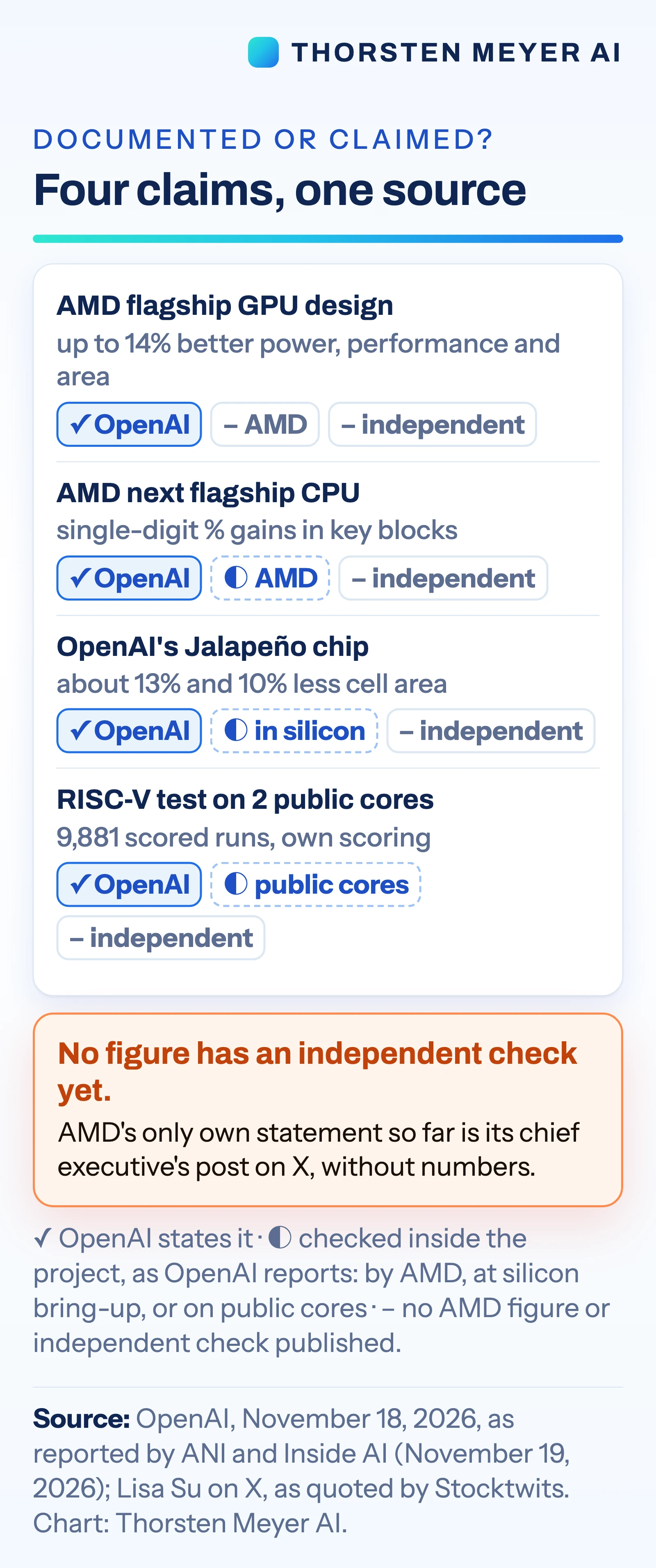
OpenAI says its models rewrote parts of AMD chip designs and produced up to 14% gains in power, performance and area against heavily optimized baselines. The figure is a company-reported best case; block-level details and independent verification have not been published.
OpenAI described the work in a post titled “Advancing chip design with OpenAI models.” The account was reported by ANI, The Decoder and Inside AI; OpenAI’s post was not accessible to the source article’s researchers. The reported 14% is an upper-end result, not a stated average across the GPU. OpenAI did not identify the specific GPU blocks or provide enough detail to independently reproduce the comparison.

Get business pricing on tech for your team
- Business-only prices and quantity discounts
- Tax-exempt purchasing
- Multiple users, one account, clear invoices
The models proposed rewrites to SystemVerilog register-transfer-level code, which specifies how chip circuits behave. OpenAI said Synopsys design tools checked that each proposed version preserved the original behavior and evaluated PPA. The company said some resulting changes were incorporated into a design AMD sent for manufacturing, with others placed in design files for future versions.
OpenAI also reported separate results: AMD had verified single-digit PPA gains in key blocks of a next-generation flagship CPU, according to OpenAI, while OpenAI’s Jalapeño inference chip saw standard-cell area reductions of about 13% in one unit and 10% in another. Reports use different names for the first Jalapeño unit, calling it a warp engine or a vector unit. These figures concern different chips and measures, so they should not be treated as a single combined result.
AI Tools Enter Chip Design
The announcement points to AI models being used to propose changes to the hardware that powers AI services. If the reported improvements hold in production, smaller or faster circuit blocks could affect a chip’s cost, energy use or performance. The practical effect depends on which blocks change, how gains translate through later design stages and whether they persist in manufactured chips.
The commercial relationship also matters when weighing the claims. OpenAI has a warrant for up to 160 million AMD shares, issued in October 2025, that vests as AMD chips are deployed, according to the source material. That financial tie does not establish that the reported measurements are wrong, but it makes clear why independent confirmation would help readers assess them.
Products Worth Considering

Bose SoundTouch 30 Wireless Speaker, Black

Bose TV Speaker Compact Soundbar with Bluetooth and HDMI-ARC, Black

Bose TV Speaker (2nd Gen) Compact Soundbar with Bluetooth and HDMI Connectivity
As an affiliate, we earn on qualifying purchases.
From RTL Code to Silicon
Chip teams describe circuit behavior at the register-transfer level, or RTL, before tools synthesize the code into logic gates and engineers complete placement and wiring. The reported OpenAI approach targets that coding stage: models suggest alternative implementations, then established design tools test function and estimate trade-offs.
OpenAI said its models also worked on two open-source RISC-V processor cores, PicoRV32 and Ibex. It reported 9,881 scored runs across five models and said GPT-6.2 Astra had the highest score. Those benchmark results concern open-source cores and do not independently verify the AMD GPU or CPU claims.
Key Measurement Details Remain Private
OpenAI has not disclosed the names of the AMD GPU blocks behind the 14% result, the number of blocks tested, the average gain, or the exact measurement conditions and baseline data. The comparison is described as being against heavily optimized baselines, but the public reporting does not give enough detail to assess how those baselines were selected.
It is also unclear which of the reported GPU changes have been validated in manufactured silicon, beyond OpenAI’s statement that some changes were included in a design sent for manufacturing. The announcement does not establish what effect the changes will have on a finished product or when a chip incorporating them will ship. AMD has not published its own detailed results, and no independent review is cited.
Watch for AMD’s Validation
The next useful evidence would be detailed results from AMD or OpenAI identifying the affected blocks, measurement methods and baseline comparisons. Confirmation from manufactured chips or a technical review that others can examine would clarify whether estimated design gains carry through to hardware.
For now, the announcement documents OpenAI’s account of model-assisted chip design and the companies’ reported tests. The 14% figure remains a company-reported maximum, while the scale and product impact of the changes remain undetermined publicly.
Key Questions
Did OpenAI prove that AMD chips improved by 14%?
No independent proof is cited. OpenAI reported up to 14% PPA improvement on an AMD flagship GPU design against heavily optimized baselines; it did not publish an average or block-level details.
What does PPA mean?
PPA stands for power, performance and area, three measures chip designers balance when evaluating circuit designs.
Were the changes used in an AMD product?
OpenAI said some model-generated changes were included in an AMD design sent for manufacturing. The public account does not specify the chip’s product name or establish when a product using those changes will be released.
What did the models change?
They proposed rewrites to SystemVerilog RTL code, which describes circuit behavior. OpenAI said Synopsys tools checked whether proposed rewrites preserved behavior and assessed their design trade-offs.
Source: Thorsten Meyer AI