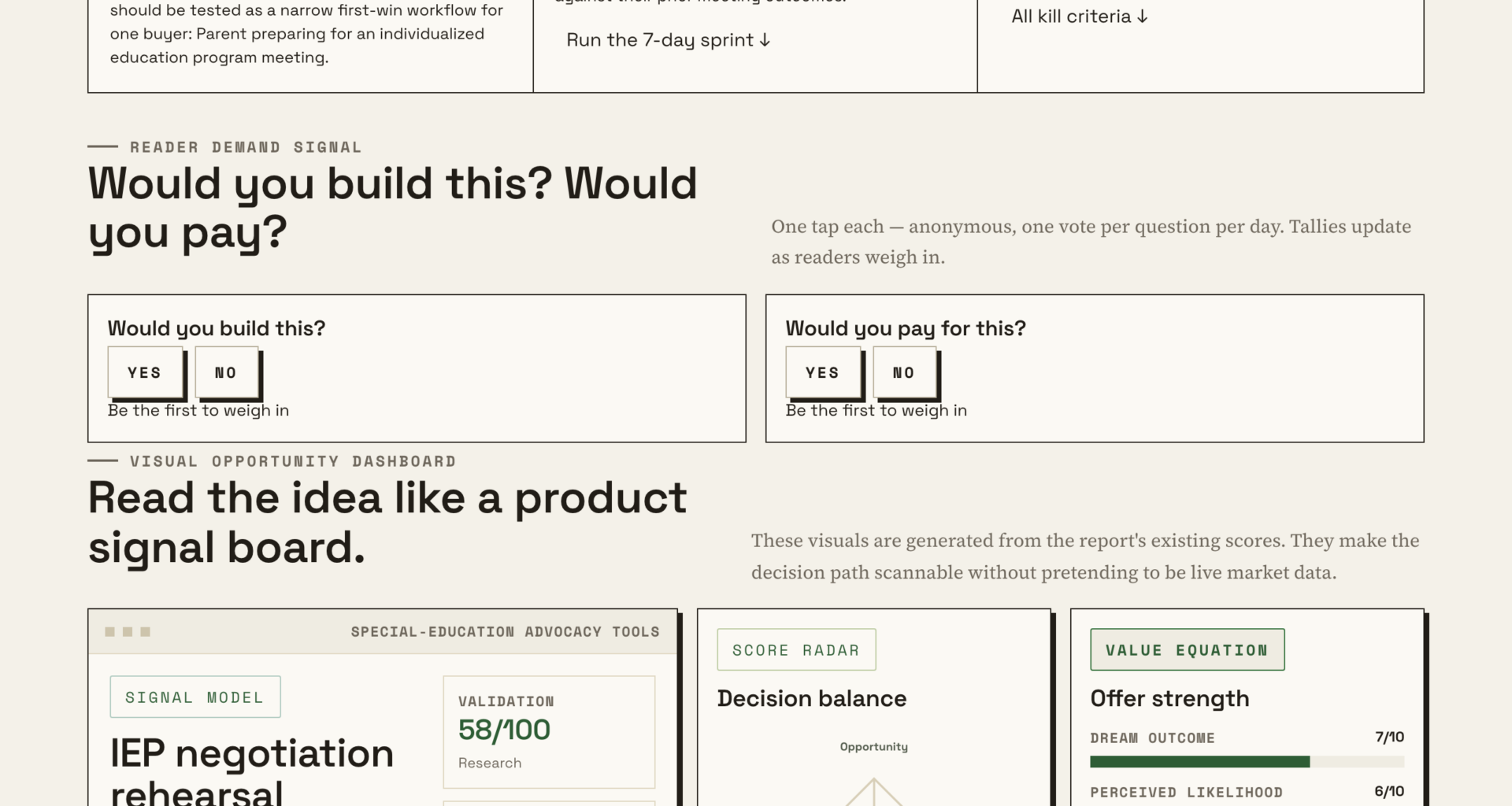
📊 Full opportunity report: How Parents Can Use An IEP Negotiation Rehearsal Simulator To Prepare on IdeaNavigator AI — validation score, market gap, and execution plan.

Get business pricing on tech for your team
- Business-only prices and quantity discounts
- Tax-exempt purchasing
- Multiple users, one account, clear invoices
TL;DR

IdeaNavigator AI has published a product concept for an IEP negotiation rehearsal simulator that would let parents upload their child’s IEP, get plain-language explanations of entitlements, and role-play meetings with realistic pushback. The concept has not been built or validated; the proposal calls for prepping forty parents and measuring outcomes against their prior meetings.
A new product concept from IdeaNavigator AI proposes an IEP negotiation rehearsal simulator that would let parents rehearse their child’s special-education meeting against an AI playing the role of district staff — a tool the proposal says could address a preparation gap that currently leaves many families relying on advocates who charge $150 or more per hour. The concept, framed as a “narrow first-win workflow” for a single buyer — a parent preparing for an individualized education program meeting — has been outlined in detail but has not been built, sold, or independently tested.
According to the IdeaNavigator AI concept, the proposed simulator would work in three stages. First, a parent would upload the child’s current IEP and evaluation reports. The system would then explain the family’s entitlements in plain language and generate a request list with legal grounding — what the school must provide and on what basis. Finally, the tool would role-play the meeting itself, including realistic pushback from the simulated school team, repeating until the parent can hold their positions under pressure.
The concept identifies the core problem as an information and power asymmetry: parents walk into IEP meetings opposite a table of professionals fluent in process and jargon, and often do not know what to ask for, what the district is legally required to provide, or how to push back when requests are declined. Professional advocates, the proposal notes, cost $150 or more per hour, placing sustained paid help out of reach for many families.
On the business side, the concept proposes per-meeting-prep pricing or an annual family subscription covering the full IEP cycle, targeting the special-education advocacy tools market. The stated rationale for building now is twofold: large language model role-play has become capable enough to simulate a realistic IEP meeting, and special-education identification rates keep climbing while district resources tighten — conditions the proposal says are making meetings more adversarial.
Why Families Might Want Rehearsal
IEP meetings determine the services, accommodations, and placement a child with a disability receives, and the outcomes are difficult for an unprepared parent to influence. If such a simulator worked as described, it could shift some of the preparation burden from paid advocates — at $150+ per hour — to a low-cost tool available before each meeting. The emphasis on role-play with realistic pushback, rather than static information, is the distinguishing element: the concept’s stated goal is that parents can hold their positions in the room, not just read about their rights beforehand.
The concept also matters as a signal of where AI product development is heading. It reflects a broader pattern of applying large language models to adversarial or high-stakes conversations — negotiation, interviews, difficult workplace discussions — and special-education advocacy is a market where the cost of human expertise is high and demand is growing, according to the proposal’s own framing about rising identification rates and tightening district budgets.
Top picks for "parent negotiation rehearsal"
As an affiliate, we earn on qualifying purchases.
The Advocacy Cost Gap
An IEP is the legally binding plan required in the United States under the Individuals with Disabilities Education Act for students who qualify for special education. Meetings to draft or revise the plan typically include district staff — teachers, specialists, administrators — while parents participate as equal team members in law, though often with far less familiarity with the terminology and process in practice.
Families who can afford it frequently hire special-education advocates to prepare requests, attend meetings, and push back on service denials. The IdeaNavigator AI concept positions its proposed simulator as an alternative aimed at the preparation stage specifically: it scopes the product narrowly to one buyer and one moment — the parent with a meeting scheduled — rather than attempting to cover the full advocacy workflow.
Unbuilt and Unproven
The simulator described is a concept, not a shipping product. No company, build timeline, or pricing has been announced, and no named vendor is associated with the proposal. Its central claims rest on two untested assumptions: that current large language models can realistically simulate an IEP meeting’s dynamics, and that rehearsal translates into better meeting outcomes for parents.
The proposal’s own success metric — comparing requested-versus-received services for forty prepped parents against their own prior meetings — has not been run, so there is no evidence yet that the approach improves results. Also unaddressed in the concept: accuracy of the legal grounding it would generate, how it would handle state-specific special-education rules, and privacy protections for the sensitive documents a parent would upload.
The Forty-Parent Test
The concept’s proposed next step is a validation study: preparing forty parents before their real IEP meetings and measuring the services they receive against what they requested, compared with their own prior meeting outcomes. Any builder acting on the concept would need to recruit those families, implement document upload with appropriate data safeguards, and test whether the role-play loop actually changes parent behavior in live meetings. Whether anyone builds the product, and whether the validation is ever conducted, remains open.
Source: IdeaNavigator AI
Key Questions
Is the IEP meeting simulator available to parents now?
No. It exists only as a published product concept from IdeaNavigator AI. No product has been built, priced, or released, and no launch date has been announced.
How would the proposed simulator work?
According to the concept, a parent would upload the child’s current IEP and evaluation reports. The tool would explain entitlements in plain language, generate a legally grounded request list, and then role-play the meeting — including simulated pushback — until the parent can hold their positions.
How much would it cost?
No prices are set. The concept proposes either per-meeting-prep pricing or an annual family subscription covering the full IEP cycle, positioning the tool well below the $150-plus hourly rate it cites for human advocates.
Is there evidence the approach works?
Not yet. The concept proposes validating the idea by prepping forty parents before real meetings and comparing requested-versus-received services against their prior outcomes. That study has not been conducted.
What are the main open concerns?
Key unaddressed questions include the legal accuracy of AI-generated guidance, handling of state-specific special-education rules, and privacy protections for the sensitive educational and medical documents parents would need to upload.
Source: IdeaNavigator AI
Fall Picks
fall essentials
As an affiliate, we earn on qualifying purchases.