🔍 Read the full analysis: How Self-Checkout And Kiosks Shift Work To Customers on ThorstenMeyerAI.com

Get business pricing on tech for your team
- Business-only prices and quantity discounts
- Tax-exempt purchasing
- Multiple users, one account, clear invoices
TL;DR
Self-service has moved tasks once handled by store workers to shoppers, from selecting groceries to scanning and bagging purchases. U.S. Bureau of Labor Statistics data show cashier employment fell between 2019 and 2025, and the agency projects another 6% decline by 2035, though millions of cashier jobs remain.
A new report published November 26, 2026, traces how self-service retail has shifted tasks from workers to customers, from selecting groceries to scanning and bagging purchases. U.S. Bureau of Labor Statistics figures cited in the report put cashier employment at about 3.1 million in 2025, down from about 3.6 million in 2019, while the agency projects a further decline through 2035.
The shift predates computers. In 1916, Clarence Saunders opened Piggly Wiggly in Memphis, where customers selected groceries from shelves rather than asking clerks to retrieve them. The Tennessee Encyclopedia describes the store as an early example of self-service; Saunders’s patent laid out a customer route through the store ending at a station where goods were checked and paid for. Staff still handled those final steps.
Technology later moved more checkout work to shoppers. GS1 says the first retail product scanned with a barcode was a ten-pack of Juicy Fruit gum at a supermarket in Troy, Ohio, on June 26, 1974. A 1984 patent application described a system in which shoppers scanned goods and a scale checked their weights. The report says self-checkout machines were introduced at several Kroger stores in 1986, although the original system still involved a cashier collecting payment.
The report cites BLS estimates of 3,596,630 cashiers in May 2019 and 3,089,410 in May 2025. The BLS Occupational Outlook Handbook projects cashier employment to decline 6% from 2025 to 2035, or about 200,600 jobs. It names self-service checkout and rising online sales among the reasons. Those figures describe employment trends; by themselves, they do not establish how much of the decline self-checkout caused.
Infographic 01 · A short history of self-service
From the clerk to the customer, 1916 to today
Each step moved a piece of the work across the counter: first fetching the goods, then reading the price, then scanning and ordering.
How the customer took over the clerk's work
- Before 1916: a clerk fetched, weighed and wrapped every item at the counter.
- 1916, Piggly Wiggly (Memphis): shoppers take the goods off the shelves themselves and pass a checking station to pay. Clarence Saunders files his patent on 21 October 1916.
- 26 June 1974, Troy, Ohio: a ten-pack of Juicy Fruit gum is the first product scanned with a barcode. A machine now reads the price.
- 9 July 1984: David R. Humble and two colleagues file the CheckRobot patent: the shopper scans, a scale checks the weight, a tunnel stops unscanned items. Payment still goes to a cashier.
- From 1986: CheckRobot machines in several Kroger supermarkets, as reported by CNN (2022).
- 2018: McDonald’s has kiosks in nearly 17,000 restaurants; in France, Italy and Spain well over half of in-restaurant orders go through them (company filing).
Sources differ on the exact opening day of the first Piggly Wiggly (6 or 11 September 1916). The Kroger installation is reported second-hand; we did not retrieve the 1987 newspaper original.
Sources: C. Saunders, US Patent 1,242,872 (1916/17); Tennessee Encyclopedia; GS1 Belgium & Luxembourg; Humble et al., US Patent 4,676,343 (1984/87); CNN (2022); McDonald's Form 10-K 2018.
Powered by Thorsten Meyer AI
Who Performs the Checkout Work
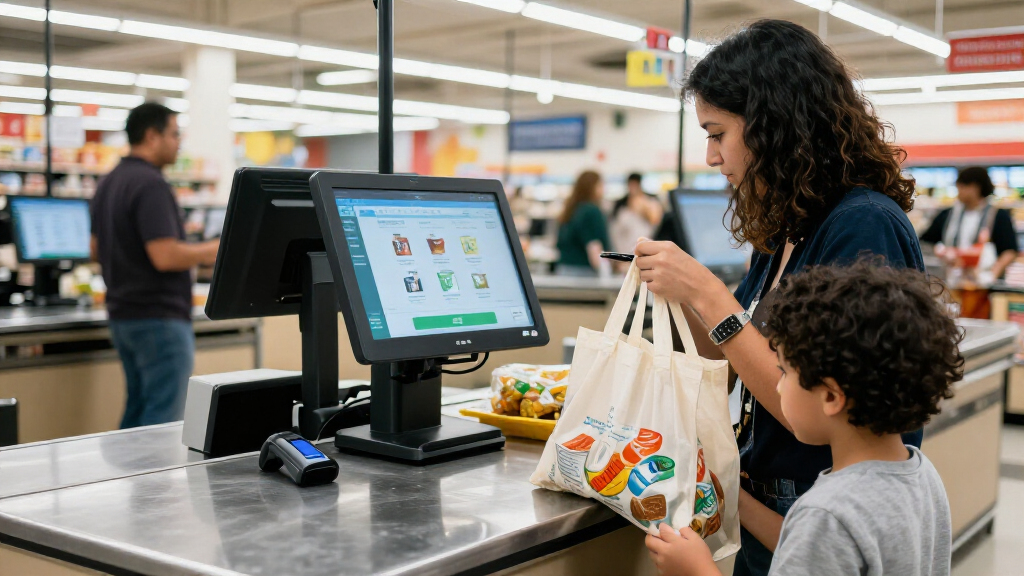
Self-checkout changes more than the location of a payment terminal: it assigns shoppers tasks that a cashier traditionally performed, including scanning, bagging and resolving routine checkout prompts. Retailers can have one employee monitor several stations rather than assigning one cashier to each lane, a labor-saving rationale discussed in the BLS material cited by the report.
For workers, the projected decline signals continuing pressure on a large occupation. For customers, the arrangement can mean more responsibility for completing a purchase and dealing with errors or assistance needs. The report also describes retailers pulling back from self-checkout in some markets between 2023 and 2024, citing service, losses and speed. That retreat suggests the staffing trade-off is not settled: stores weigh labor savings against customer experience and operational problems.
The report frames this unpaid customer effort as “shadow work,” a term associated with social critic Ivan Illich. That is an interpretation of what self-service means, not a BLS category or a measured labor statistic. Its value is in highlighting that automation can transfer work without removing the task itself.
Products Worth Considering

Apple MacBook Air 13-inch with M5 chip, 16GB Memory, 1TB SSD, Starlight

Amazon Kindle Paperwhite (2024, 16 GB) – 7-inch Display, Black

LG UltraGear 34G600A-B 34-Inch Curved WQHD Gaming Monitor, 160Hz, FreeSync Premium, HDR10
As an affiliate, we earn on qualifying purchases.
From Store Aisles to Scanners
Before self-service, grocery customers generally told a clerk what they wanted while the clerk retrieved and prepared the items. Saunders’s Piggly Wiggly changed that division of labor by putting goods within shoppers’ reach. The store’s 1916 patent, granted in 1917, described a route through the merchandise and a final checking station. The early model therefore shifted product selection to customers without eliminating staff from checkout.
Barcodes made item identification machine-readable, while later systems let shoppers operate the scanner. The report identifies a 1984 patent for a self-service distribution system and says installations followed at Kroger supermarkets. Its historical account connects that development to the present-day practice, but the work remains mixed: customers may scan and bag while workers oversee stations, assist shoppers and handle exceptions.
Self-checkout adoption has not followed one uniform path. The report says some retailers in England and the United States scaled back or removed machines during 2023 and 2024, while German and Japanese retailers have continued to use self-service or hybrid arrangements. These examples indicate differing retail strategies; they do not, on their own, provide a directly comparable measure of adoption across countries.
“Self-checkout reduces the need for labor because the main task of scanning and bagging items is transferred to the customer.”
— U.S. Bureau of Labor Statistics, as quoted in its January 2026 review
How Much Automation Explains
The BLS projection identifies self-service checkout and online sales as reasons cashier employment is expected to fall, but the figures provided do not isolate the effect of self-checkout from other causes. The report notes that the 2019-to-2025 comparison spans the pandemic and growth in online shopping; it does not quantify each factor’s contribution.
There is also a small difference between the employment totals cited in the report: its May 2025 estimate is 3,089,410, while it separately gives an Occupational Outlook Handbook count of 3,106,300 cashier jobs for 2025. The two figures are close but not identical, and the report does not explain the difference in measure or source. The longer-term projection is an estimate, not a confirmed outcome.
The material also does not quantify how many customers’ minutes are transferred to checkout tasks, how often workers must intervene, or whether self-checkout reduces total staffing after support and loss-prevention work are counted. Those questions limit what can be concluded about the net effect on stores and shoppers.
Tracking Retail Jobs Through 2035
The next benchmark in the report’s employment story is the BLS’s annual cashier data, followed by the agency’s projected trend to 2035. Readers should distinguish measured employment counts from forecasts and compare like-for-like BLS series when judging changes over time.
Retailers’ decisions will also offer evidence of how the balance is changing. The report describes both pullbacks and continued adoption, but does not provide a common measure of stores’ plans or machine use. Further reporting would need to establish whether retailers are adding, removing or redesigning checkout stations, and how those choices affect staffing, wait times and the help customers receive. For now, the confirmed picture is a large cashier workforce alongside a long-running transfer of some checkout tasks to shoppers.
Key Questions
How many U.S. cashiers were employed in 2025?
The report cites a BLS May 2025 estimate of 3,089,410 cashiers. It also cites a separate Occupational Outlook Handbook count of 3,106,300 cashier jobs for 2025, without explaining the difference.
Does the BLS say self-checkout caused cashier employment to fall?
The BLS lists self-service checkout as one reason cashier employment is projected to decline, alongside increasing online sales. The figures cited do not isolate self-checkout’s share of the change since 2019.
When did self-checkout begin?
The report traces an early self-checkout patent application to 1984 and says machines were introduced at several Kroger supermarkets in 1986. Self-service grocery shopping itself dates back further, to Piggly Wiggly in 1916.
Are retailers still removing self-checkout machines?
The report says some retailers in England and the United States pulled back between 2023 and 2024, citing concerns including service, losses and speed. It also describes continued adoption in Germany and Japan; it gives no current, comparable global adoption total.
Source: ThorstenMeyerAI.com