
📊 Full opportunity report: Is Your Workflow Ready To Automate? Start With An Audit on IdeaNavigator AI — validation score, market gap, and execution plan.

Get business pricing on tech for your team
- Business-only prices and quantity discounts
- Tax-exempt purchasing
- Multiple users, one account, clear invoices
TL;DR
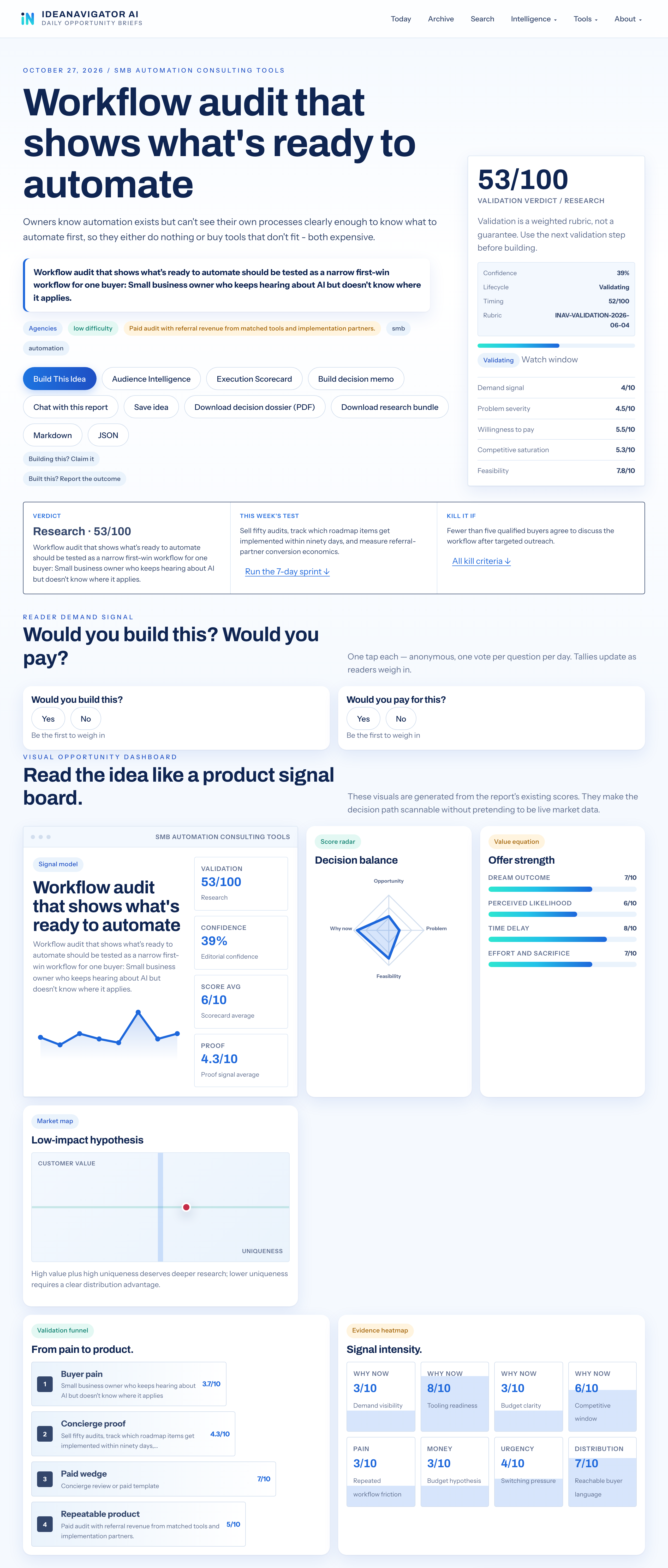
IdeaNavigator AI outlines a proposed service that interviews small-business owners about their operations, then maps processes and ranks them by automation readiness, potential return and difficulty. The concept has not been presented as a launched product or proven business; its proposed test is to sell 50 audits and track implementation and referral results over 90 days.
IdeaNavigator AI has proposed a paid workflow audit for small-business owners who are unsure where automation might fit, with an interview-based assessment intended to map operations and rank possible projects. The concept would pair those rankings with a sequenced 90-day roadmap and suggested tools, but no launch, customer results or evidence of demand has been reported.
The proposed audit would guide an owner through the business’s operations and turn the answers into a process map. Each process would be assessed for automation readiness, potential return on investment and difficulty, helping the owner compare possible projects rather than start with a software purchase. The proposal does not specify the interview format, scoring method or information the service would require.
The suggested minimum viable product would also recommend tools for individual roadmap steps. Revenue could come from a paid audit, alongside referral income from matched software providers or implementation partners. Those are proposed business-model elements; no pricing, partner agreements, tool-selection criteria or revenue figures are provided.
To test the idea, IdeaNavigator AI proposes selling 50 audits, then tracking which recommended roadmap items customers implement within 90 days and measuring conversion economics for referral partners. That is a validation plan, not a report of completed sales or outcomes. No information is given about whether the test has started or what would count as a successful result.
Business systems · Proposal status: untested
Is Your Workflow Ready to Automate? Start With an Audit
IdeaNavigator AI proposes an interview-led service that maps small-business operations and ranks possible automation projects by readiness, potential return, and difficulty. No launch, customer results, or evidence of demand has been reported.
01 / The proposed audit
A roadmap before buying automation tools
The service would help owners compare potential projects by documenting how work gets done before selecting technology.
Interview the owner
Ask about operations and repeatable processes. The interview format and information required have not been specified.
Make workflows visible
Turn answers into a process map so an owner can see what work happens and where automation might fit.
Sequence possible projects
Rank processes and propose tools in a 90-day roadmap. No scoring rubric or tool-selection criteria are described.
02 / What would be assessed
Three decision factors, with no scoring method disclosed
The proposal names the dimensions for comparing processes, but it does not provide scores, sample assessments, or a way to verify interview answers against actual workflows.
03 / Proposed business model
Paid advice, with referrals as a possible second revenue stream
A paid workflow audit
Owners would pay for an assessment and sequenced recommendations. Price, delivery time, human review, and implementation support are not stated.
Matched tools or implementers
Referral income from software providers or implementation partners is proposed. No partner agreements, selection rules, or revenue figures are reported.
Trust depends on neutral recommendations
If referrals generate income, customers need to understand how tools are chosen and how financial incentives affect rankings.
The audit’s boundary is still unclear
The proposal does not say whether the service configures systems, trains staff, or monitors results after the assessment.
04 / Validation path
A 50-audit test would measure action after the report
The proposed experiment is a plan to gather evidence. It is not evidence that sales, implementation, or referrals have already happened.
Sell 50 audits
Test whether owners will pay. Price and recruitment method are not given.
Deliver roadmaps
Recommend prioritized projects and possible tools for each business.
Track 90 days
Observe which recommended items customers implement after the audit.
Measure economics
Assess conversion economics for referral partners. Success benchmarks are not defined.
05 / Open questions
What owners and future customers still need to know
Can I buy the audit now?
No launch or sales availability is reported. The 50-audit offer is suggested as a validation test.
Has it saved businesses money?
No pilot findings, savings figures, paying-customer outcomes, or implementation rates are provided.
How accurate are the recommendations?
No scoring rubric or workflow verification method is described. Potential savings will depend on the business, process, and implementation cost.
How would customer data be handled?
The proposal does not describe data handling or safeguards for keeping tool recommendations independent from referral income.
Source: IdeaNavigator AI · Proposal details provided; launch status and test results not reported.
A Roadmap Before Buying Automation Tools
The proposal addresses a practical problem for small businesses: owners may know that automation tools exist but lack a clear view of their own processes. Without that map, a business can delay action or buy software that does not fit the work. An audit could make the decision more concrete by setting out which processes to examine first, the effort involved and the tools that might apply.
That could be useful where owners have limited time or lack in-house automation expertise. But a ranked list is only valuable if the recommendations reflect how the business actually works. The proposed 90-day tracking period would help distinguish a roadmap that prompts implementation from one that merely produces a report. It would also test whether referral revenue can support the service without compromising the neutrality of tool recommendations.
For customers, the distinction between an assessment and implementation matters. The proposal describes suggested tools and possible implementation partners, but does not say whether the audit provider would configure systems, train staff or monitor results. Until those details are defined, owners cannot know how much work or cost follows the audit.
Products Worth Considering

Bose TV Speaker Compact Soundbar with Bluetooth and HDMI-ARC, Black

Bose TV Speaker (2nd Gen) Compact Soundbar with Bluetooth and HDMI Connectivity

LG UltraGear 27-inch QHD OLED Gaming Monitor, 240Hz, 0.03ms, G-SYNC Compatible, FreeSync Premium Pro, HDR True Black 400
As an affiliate, we earn on qualifying purchases.
Why Small Businesses Need Process Maps
The idea is framed against a rapid expansion of AI tools, which can leave business owners facing more choices without a clear way to match them to their daily operations. IdeaNavigator AI argues that guided process-mapping interviews may now be automated with large language models. This is the proposal’s rationale, not independent evidence that an AI interview can reliably map a company’s work or recommend appropriate tools.
The concept focuses on small-business automation consulting, rather than a general-purpose AI assistant. Its premise is that an owner needs help identifying repeatable processes and comparing them before selecting technology. The proposed audit would therefore sit upstream of a software purchase: first document work, then prioritize possible automation, then consider tools and implementation.
No existing product, prior pilot, customer interviews or market-size estimate is described. The material also does not compare the service with existing consultants or software vendors. Those gaps matter because the concept’s commercial case depends not only on whether owners recognize the problem, but on whether they will pay for this particular assessment and act on its recommendations.
The Audit’s Accuracy and Commercial Test
There are no reported pilot findings, paying customers or implementation rates. The proposed 50-audit test would address demand and follow-through, but the plan gives no timetable, recruitment method, price or benchmark for interpreting results. It is also unclear whether the 90-day window would begin when an audit is delivered or when a customer starts a recommended project.
The assessment’s reliability is another open question. No scoring rubric is described for readiness, ROI or difficulty, and no method is given for checking interview answers against actual workflows. Potential savings could vary by business, process and implementation cost, so a score alone would not establish that automation will pay off. The proposal also does not explain how customer data would be handled or how the service would avoid favoring tools that generate referral income.
Finally, the scope of the paid service remains undefined. There is no stated price, delivery time, human review process or commitment to support implementation. Those details will affect whether the audit is accessible to small businesses and whether its recommendations can be acted on.
A 50-Audit Test Would Be Next
The next step described is to offer 50 paid audits and observe what customers do with their 90-day roadmaps. The proposed measures are the share of recommended items implemented during that period and the economics of converting customers through referral partners. No start date has been announced, and there is no indication that sales are underway.
If the test proceeds, useful reporting would include how the service defines an implemented item, whether customers complete the work themselves or hire a partner, and what costs or benefits they report. It would also help to disclose the audit price, the criteria behind readiness and ROI scores, and how tool referrals are selected. Until those details and results are available, the service remains an untested business proposal, not a demonstrated solution.
Source: IdeaNavigator AI
Key Questions
Is the workflow audit available to buy?
No launch or sales availability is reported. IdeaNavigator AI describes a proposed service and suggests selling 50 audits as a validation test.
What would the audit include?
The proposed service would interview a business owner about operations, create a process map, score processes for automation readiness, potential ROI and difficulty, and suggest tools and a sequenced 90-day roadmap.
How would the proposed service make money?
The suggested model combines a paid audit with referral revenue from matched tools and implementation partners. No price or partner arrangements have been disclosed.
Has the idea been shown to save businesses money?
No results are provided. The proposal calls for tracking implementation within 90 days, but no pilot findings, savings figures or customer outcomes are reported.
What would the 50-audit test measure?
It would track which roadmap recommendations customers implement within 90 days and measure conversion economics for referral partners. The proposed plan does not state when the test would begin or how success would be defined.
Source: IdeaNavigator AI