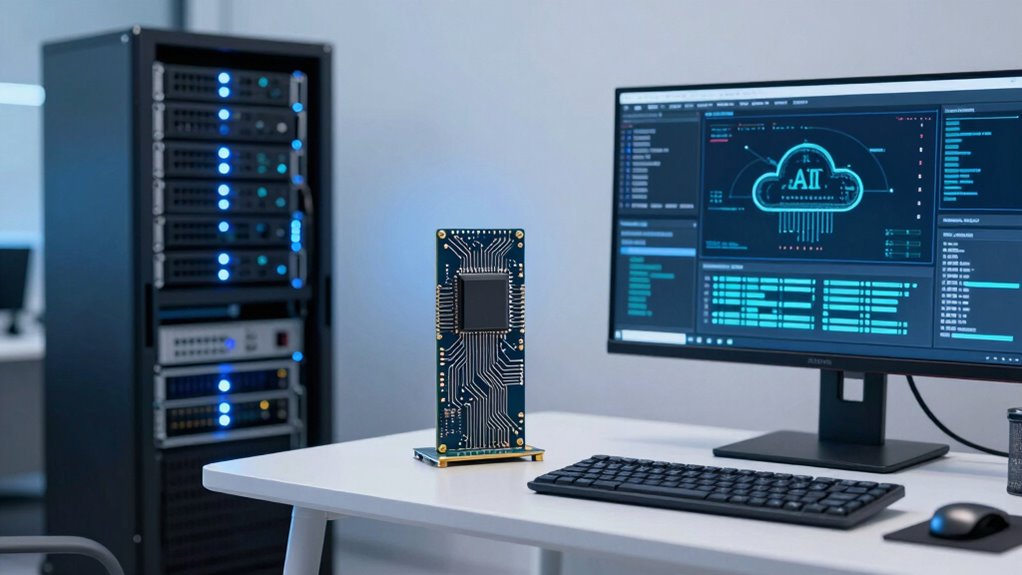

Your hardware plays a vital role when choosing between local inference and cloud AI. For local inference, powerful, specialized chips and hardware optimizations are essential to handle complex models on edge devices. In contrast, cloud AI relies on remote servers with vast computational resources, so hardware is less of a concern. Understanding which hardware matters more will help you decide the best approach for your needs—more details could reveal how to make smarter choices.
Key Takeaways
- Hardware capabilities on edge devices determine the feasibility and performance of local inference.
- Specialized chips and hardware acceleration significantly enhance local inference efficiency.
- Cloud AI relies less on device hardware, instead leveraging powerful remote servers.
- Hardware improvements enable complex models to run locally, reducing dependence on cloud resources.
- The choice depends on balancing hardware constraints with the need for real-time processing and privacy.
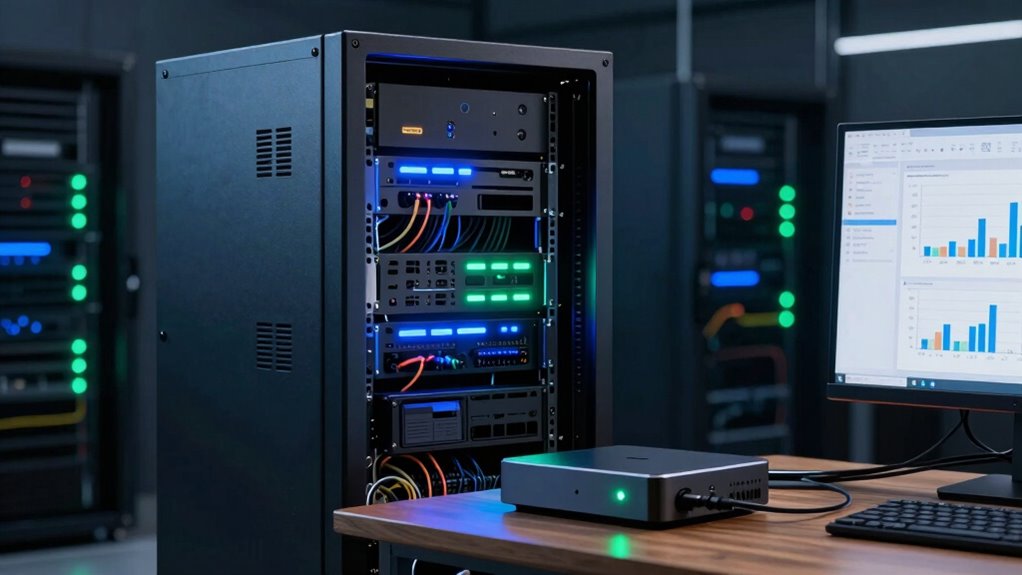
As artificial intelligence continues to evolve, the debate between local inference and cloud AI becomes increasingly pertinent for users and developers alike. You’re probably wondering which approach suits your needs better and what hardware plays a vital role in this decision. When it comes to local inference, edge devices like smartphones, smart cameras, and IoT gadgets handle data processing directly on the device. This setup means that the AI model doesn’t need to send data to external servers, making it faster for real-time applications. Plus, you gain greater control over your data privacy because sensitive information stays on the device. This is especially important if you’re dealing with personal or confidential data, where the risk of breaches or unauthorized access is a concern.
On the other hand, cloud AI relies on powerful remote servers to perform inference tasks. This method allows you to leverage vast computational resources, which means you can run more complex models that wouldn’t fit on edge devices. Cloud AI can often provide more accurate results because it taps into extensive datasets and advanced algorithms. However, this approach depends heavily on internet connectivity, so if you’re in an area with poor or unreliable service, your experience could suffer. It also raises concerns about data privacy, since your information travels over networks and is stored in remote data centers. If security and confidentiality are top priorities, you might prefer local inference to keep control over your data. Additionally, hardware capabilities play a crucial role in determining whether local inference can meet your performance needs, especially as edge devices become more powerful with specialized chips for AI tasks. As technology advances, hardware optimization is increasingly important for maximizing the efficiency of local inference systems. If security and low latency are critical, you’ll lean toward local inference. If scalability and access to cutting-edge models are more important, cloud AI may be the better fit. Moreover, security measures are essential in safeguarding data, particularly when deploying AI across diverse environments. As the hardware for edge devices continues to improve, the feasibility of deploying complex AI models locally becomes more realistic, making hardware evolution a key factor in future AI deployment strategies. In addition, ongoing advancements in hardware acceleration can significantly enhance the performance of local inference systems. Ultimately, both approaches have their strengths and trade-offs. Your choice hinges on factors like data privacy, hardware capabilities, internet reliability, and the complexity of AI tasks you want to perform. Understanding these differences will help you select the right hardware and architecture to serve your goals effectively.
AI edge device hardware
As an affiliate, we earn on qualifying purchases.
As an affiliate, we earn on qualifying purchases.
Frequently Asked Questions
How Do Costs Compare Between Local Inference and Cloud AI?
The cost comparison between local inference and cloud AI depends on your specific needs. With local inference, you face higher upfront expenses for hardware, but ongoing costs are lower. Cloud AI offers flexible pay-as-you-go pricing, which can be cost-effective for sporadic use but adds up over time. An expense analysis shows that local hardware might save money long-term, while cloud AI provides scalability without large initial investments.
What Security Risks Are Associated With Cloud AI?
Imagine your data is a treasure chest. Cloud AI poses risks like pirates trying to breach your defenses. You face security threats such as data breaches or unauthorized access. To guard your treasure, you need strong data encryption and strict access control measures. These safeguards help prevent theft and guarantee only trusted allies can access your valuable information, reducing vulnerabilities and keeping your data secure in the cloud.
How Does Latency Differ Between Local and Cloud AI?
You’ll notice latency is generally lower with local AI because edge optimization processes data closer to you, reducing delays. With cloud AI, data travels to remote servers, increasing latency due to network transmission. If data sovereignty is a concern, local inference helps keep data on-site, further lowering latency and enhancing security. This setup is ideal when rapid responses are necessary or when data privacy regulations restrict cloud-based processing.
Can Hybrid Solutions Combine Local and Cloud AI Benefits?
Think of a hybrid solution as a symphony, blending local and cloud AI for perfect harmony. You can leverage edge integration to process critical data locally, ensuring swift responses and data sovereignty. Meanwhile, cloud AI handles complex tasks and large-scale analysis. This approach maximizes benefits, balancing speed and power, and keeps your sensitive data secure. You get a flexible, efficient system that adapts to your needs seamlessly.
What Are the Environmental Impacts of Each Approach?
You should consider that local inference generally has a lower energy consumption and carbon footprint since it processes data on-site, reducing data transmission. Cloud AI, however, involves significant energy use due to data center operations, which can increase its environmental impact. By choosing local hardware, you might reduce your carbon footprint, but cloud solutions could offer efficiency gains through optimized data centers. Your choice impacts energy use and environmental sustainability.
specialized AI chips for edge devices
As an affiliate, we earn on qualifying purchases.
As an affiliate, we earn on qualifying purchases.
Conclusion
Ultimately, whether you lean toward local inference or cloud AI, it’s like choosing between a cozy, familiar home and a vast, open landscape. Each offers its own quiet strengths—comfort and control or boundless reach. The right choice depends on what your journey values most. With a gentle touch, consider how the hardware’s subtle presence shapes your experience, guiding you to a path where your needs find their perfect harmony.
AI hardware acceleration cards
As an affiliate, we earn on qualifying purchases.
As an affiliate, we earn on qualifying purchases.
cloud AI server hardware
As an affiliate, we earn on qualifying purchases.
As an affiliate, we earn on qualifying purchases.