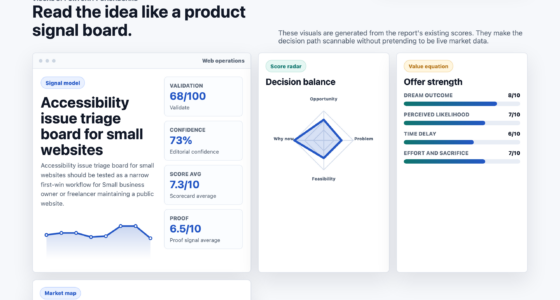

📊 Full opportunity report: Q3 2026 SaaS Earnings Pre-Brief: The Litmus Test for the Agentic-Disruption Thesis on ThorstenMeyerAI.com — validation score, market gap, and execution plan.

Get business pricing on tech for your team
- Business-only prices and quantity discounts
- Tax-exempt purchasing
- Multiple users, one account, clear invoices
TL;DR
Q3 2026 SaaS earnings reports will test the validity of the agentic-disruption thesis, revealing whether SaaS companies are truly shifting toward consumption-based models. Market expectations hinge on these results, affecting valuations and strategic directions.
The Q3 2026 SaaS earnings season will be the first major public test of the ongoing shift toward consumption-based, agentic deployment models, with companies like ServiceNow and Salesforce providing critical data. These results will determine whether the industry’s transition to AI-driven, consumption-oriented revenue streams is accelerating or stalling, directly impacting investor confidence and strategic planning.
In April-May 2026, ServiceNow reported a significant increase in non-seat revenue, with over 50% of new business now coming from consumption models, and raised its AI annual contract value (ACV) guidance from $1 billion to $1.5 billion, signaling a faster shift toward consumption-based revenue. Despite beating top-line and profitability metrics, ServiceNow’s stock declined 18%, reflecting market skepticism about the durability of this transition.
Meanwhile, Salesforce disclosed that its Agentforce Apps segment reached $26.7 billion in subscription revenue, growing 7% in constant currency, with the company introducing the metric of Agentic Work Units (AWUs) to measure AI task completion. Salesforce’s restated segment disclosures explicitly acknowledge the strategic importance of agentic, AI-driven revenue streams, which now account for a significant portion of its business. The company’s stock also experienced volatility, indicating investor uncertainty about the pace and sustainability of this shift.
These developments set the stage for the upcoming Q3 earnings reports, which will reveal whether other SaaS players are experiencing similar acceleration in consumption and agentic deployment or if these trends are stalling. The results will influence valuation adjustments across the sector and inform strategic responses, such as potential JV formations or new pricing models.
Six companies. Four metrics.
The litmus test for the agentic-disruption thesis at scale. July-August 2026.
Q1 baseline: ServiceNow beat earnings, raised AI ACV 50%, lost 18% in a day. Salesforce restated segments to separate Agentforce Apps from Data 360. Both stocks repriced lower despite beats. The Q3 cycle either confirms the consumption pivot is durable or accelerates the cohort selloff.
Four metrics. Four watch thresholds.
Investor focus has consolidated around four metrics that determine Q3 reactions. Each beats or misses produces asymmetric stock reactions: small misses produce large drops, small beats produce muted reactions.
Six companies. July-August 2026.
Six major SaaS companies report Q3 2026 calendar reports across July-August 2026. Each needs to prove specific elements of the four-metric scorecard.
July
name
August
name
August
exposed
July
exposed
July
exposure
August
exposure
Three outcomes. One cohort.
25/50/25 probability allocation reflects genuine uncertainty in the data. Q1 was already mixed (beats produced selloffs); Q3 follows the same pattern unless metrics move decisively.
- Non-seat 50%+ sustainsNOW pivot durable.
- AWU >50% Q/QCRM Agentforce traction holds.
- $1M+ ACV >120% Y/YEnterprise concentration accretive.
- RDR >108%Switching costs real.
- Outcome: NOW recovers 18% drop. Multiple expands.
- Non-seat 50%NOW pivot equilibrium.
- AWU 35-45% Q/QCRM deceleration visible.
- $1M+ ACV 80-100%Saturation early signals.
- RDR 105-110%Durability uncertain.
- Outcome: Multiples compressed through Q4 next litmus test.
- Non-seat <45%NOW pivot stalled.
- AWU <30% Q/QCRM Agentforce deceleration confirmed.
- $1M+ ACV <80%Enterprise saturation visible.
- RDR <105%Consumption customers churning faster than seats.
- Outcome: 10-20% cohort compression. Recovery extends mid-2027.
SaaS as a category is in active structural transformation. Each quarterly cycle through 2026-2027 produces incremental data on whether the per-seat-to-consumption transition is durable or destructive. Q3 2026 is one data point in a longer arc.
Four assignments. By role.
Update positioning ahead of Q3.
Long ServiceNow / Salesforce on non-seat-share + AWU-growth thesis if you believe consumption pivot is durable. Underweight if structurally worse than per-seat. Use four-metric scorecard to update each quarterly cycle through 2027. Asymmetric setup means small misses produce large reactions.
Time the Q3 cycle precisely.
If incumbents miss → accelerate customer-acquisition + fundraising. If incumbents beat → prioritize retention + unit economics over top-line. 25/50/25 probability suggests cautious-optimistic positioning is default. The customer-acquisition window opens or closes based on Q3 prints.
Negotiate multi-year protections.
AWU rate caps, renewal-term commitments, exit provisions. Incumbents that commit are pricing for durable equilibrium; incumbents that resist are extracting transitional premium. Q3 reveals which is which. Time multi-year commitments to incumbent transparency on consumption pricing.
Engage on structured-financing.
Anthropic-Blackstone JV template applies to SaaS facing same scaling challenge. Engagements through July-September; SaaS companies missing on four metrics become more receptive. Window for advantaged structuring is open through Q4 2026; thereafter pricing advantage compresses as template replicates.
Implications of Q3 2026 SaaS Earnings for Industry Transition
The upcoming earnings reports are critical because they will confirm whether the SaaS industry’s shift toward consumption-based, agentic revenue models is gaining momentum or facing setbacks. If the results show acceleration, it could lead to a reassessment of SaaS valuations, with traditional per-seat models becoming less relevant. Conversely, signs of stagnation or reversal could re-rate stocks higher based on confidence in existing models. These outcomes will influence strategic decisions, including potential joint ventures with AI-focused investment pools and new pricing strategies, shaping the future landscape of SaaS economics.
As an affiliate, we earn on qualifying purchases.
Background on the Agentic-Disruption Thesis and Recent Market Movements
The April-May 2026 earnings cycle highlighted a major shift: ServiceNow and Salesforce reported substantial growth in consumption-based and agentic metrics, signaling a transition from traditional per-seat licensing to AI-driven, consumption-oriented revenue streams. ServiceNow’s AI ACV guidance was increased by 50%, and over half of its net new business now derives from consumption models. Salesforce introduced the concept of Agentic Work Units (AWUs) as a core metric, with its Agentforce segment reaching $26.7 billion in subscription revenue, up 7% in constant currency. These moves reflect a broader industry trend, with investors re-evaluating SaaS valuations based on the perceived durability of these shifts. The market’s reaction—marked by stock declines despite strong earnings—indicates skepticism about the sustainability of this transition, making Q3 2026 earnings a crucial test.
“The Q3 2026 SaaS earnings reports will be the first major test of whether the industry’s shift toward consumption and agentic models is truly accelerating or stalling, with significant implications for valuations and strategic planning.”
— Thorsten Meyer
enterprise subscription management tools
As an affiliate, we earn on qualifying purchases.
As an affiliate, we earn on qualifying purchases.
Uncertainties Surrounding the Q3 Earnings Impact
It remains unclear whether other SaaS companies will report similar acceleration in consumption and agentic metrics or if the observed trends are specific to ServiceNow and Salesforce. The degree to which these shifts are sustainable beyond initial growth phases is also uncertain. Additionally, the potential for companies to announce joint ventures or structural responses to these trends at this earnings cycle is still developing, and market reactions could vary significantly based on the actual results.
As an affiliate, we earn on qualifying purchases.
Next Steps and Key Milestones Post-Q3 Earnings
Following the Q3 2026 earnings reports, analysts and investors will closely analyze whether the acceleration in consumption and agentic metrics is consistent across the sector. Companies may update guidance or announce strategic initiatives, such as joint ventures with AI investment pools, to bolster their positions. The sector’s valuation and strategic landscape will likely adjust accordingly, with further data from subsequent earnings cycles providing clarity on the durability of these trends.
consumption-based SaaS billing solutions
As an affiliate, we earn on qualifying purchases.
As an affiliate, we earn on qualifying purchases.
Key Questions
Why are SaaS companies shifting toward consumption-based models?
They aim to better align revenue with actual usage, especially as AI and agentic deployment become more prevalent, enabling more flexible and scalable revenue streams.
What is the significance of Salesforce’s Agentic Work Units (AWUs)?
AWUs serve as a new metric to measure AI task completion, signaling a shift toward tracking AI-driven productivity rather than traditional seat-based metrics, and indicating strategic focus on agentic deployment.
How might the upcoming earnings reports influence SaaS valuations?
If the results confirm acceleration, valuations may be re-rated lower due to perceived risks to traditional models; if stagnation occurs, stocks could re-rate higher based on confidence in existing revenue streams.
Yes, some industry players are considering or may announce partnerships similar to Anthropic-Blackstone or OpenAI-TPG to fund AI engineering pools, which could reshape competitive dynamics.
What is the main risk for investors in this transition?
The primary risk is misjudging the durability of consumption-based revenue streams, which could lead to valuation adjustments if the transition stalls or reverses.
Source: ThorstenMeyerAI.com
Halloween Picks
halloween
As an affiliate, we earn on qualifying purchases.