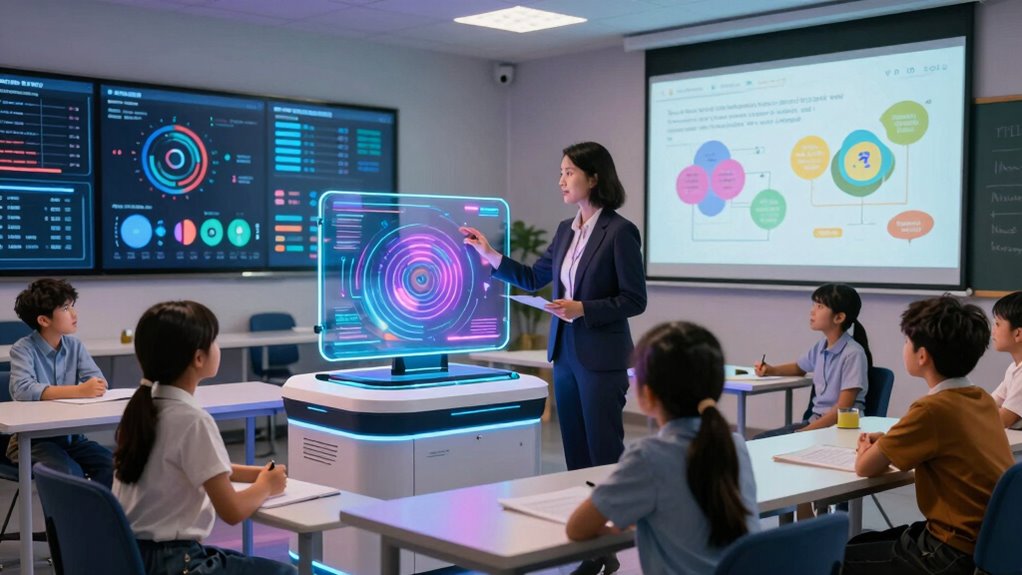

You need better AI teacher training to guarantee responsible and ethical use of technology in your classroom. Effective training helps you understand AI’s limitations, biases, and data privacy concerns, preventing over-reliance or unfair outcomes. It also guides you on interpreting AI insights and maintaining human oversight for balanced decision-making. By improving your skills, you can better protect student rights and foster a fair learning environment. Keep going to discover how these skills make a real difference in education.

Get business pricing on tech for your team
- Business-only prices and quantity discounts
- Tax-exempt purchasing
- Multiple users, one account, clear invoices
Key Takeaways
- To ensure responsible AI integration, teachers require training on ethical issues like data privacy, bias, and transparency.
- Proper training helps teachers interpret AI data accurately and prevent over-reliance on automated suggestions.
- Educating teachers about AI limitations and biases prevents unfair outcomes and promotes realistic expectations.
- Ongoing professional development keeps teachers updated on evolving AI tools and ethical standards.
- Human oversight training is essential to maintain ethical use, ensuring AI supports rather than replaces human judgment.

As artificial intelligence becomes an increasingly integral part of education, schools must prioritize better training for teachers to effectively leverage these tools. When you understand how AI works in the classroom, you can better navigate its benefits and challenges. One of the most important areas to focus on is AI ethics. As you incorporate AI into your teaching, you need to be aware of the ethical considerations, such as data privacy, bias, and transparency. Without proper training, you might unintentionally rely on AI systems that perpetuate biases or compromise student privacy. By understanding AI ethics, you can make informed decisions about which tools to use and how to implement them responsibly, ensuring that technology enhances learning without infringing on rights or fairness.
Effective AI integration requires teacher training on ethics, privacy, bias, and responsible use to enhance learning and protect student rights.
Additionally, AI offers the potential to deliver personalized learning experiences tailored to each student’s needs. However, to harness this potential, you must be skilled in selecting and managing AI-driven tools that adapt to individual learning styles and paces. Better training enables you to interpret AI-generated data about student performance, identify areas where students struggle, and adjust your teaching strategies accordingly. This personalized approach can boost engagement and achievement, but only if you’re equipped with the knowledge to interpret AI insights accurately. Without proper training, there’s a risk of over-relying on data or misjudging what the AI suggests, which could hinder rather than help student progress. Developing a clear understanding of requirements traceability can also assist teachers in tracking how AI recommendations align with educational goals and standards. Moreover, understanding the limitations of AI can help teachers maintain realistic expectations and avoid overdependence on automation. Recognizing the importance of algorithmic bias is essential for identifying and mitigating unfair or prejudiced outcomes produced by AI systems.
Finally, ongoing professional development is essential because AI technology evolves rapidly. You’ll need continuous training to stay current with new tools, ethical standards, and best practices. Schools that invest in comprehensive AI training programs empower teachers to confidently integrate these tools, making education more effective, equitable, and responsive to students’ needs. When you are well-trained, you become a more competent guide in the digital age, ensuring AI serves as a powerful ally in the pursuit of quality education. Additionally, understanding the role of human oversight in AI integration helps maintain a balanced perspective on automation’s capabilities and limitations.
As an affiliate, we earn on qualifying purchases.
Frequently Asked Questions
How Do AI Training Programs Differ Across Various Educational Levels?
AI training programs differ across educational levels because they focus on curriculum adaptation and student engagement strategies suited to each stage. In elementary schools, programs emphasize interactive tools to foster curiosity, while in high schools, they prepare teachers to guide more complex AI applications. At the college level, training centers on advanced tech integration, ensuring teachers can effectively enhance student engagement and tailor curriculum content for diverse learning needs.
What Are the Costs Associated With Implementing AI Teacher Training?
Implementing AI teacher training is like planting a garden—you need to invest in the right tools and nurture growth. The costs include a detailed cost analysis, covering software, hardware, and ongoing maintenance. You also need to take into account infrastructure investment, like upgrading internet connectivity and devices. While initial expenses might seem high, they pave the way for long-term benefits in teacher effectiveness and student success.
How Can AI Training Be Customized for Diverse Teaching Styles?
You can customize AI training for diverse teaching styles by integrating personalized learning modules that adapt to each teacher’s methods. Use adaptive feedback systems to identify strengths and areas for improvement, guiding teachers to refine their techniques. This approach guarantees the AI supports varied teaching approaches, helping educators leverage their unique styles while enhancing student engagement and learning outcomes through tailored, responsive training that evolves with their needs.
What Ethical Considerations Arise From AI Integration in Classrooms?
When integrating AI in classrooms, you must consider ethical issues like privacy concerns, ensuring student data remains secure and confidential. You also need to address bias mitigation, making sure AI systems don’t perpetuate stereotypes or unfair treatment. By actively monitoring AI tools and establishing clear policies, you help foster a fair learning environment, protecting students’ rights while leveraging AI’s benefits responsibly.
How Do Teachers Perceive the Effectiveness of AI Training Programs?
You see AI training programs as a bridge to confidence, transforming uncertainty into mastery. Teachers often perceive these programs as essential for boosting their confidence and improving technological adaptation. While some may feel overwhelmed initially, many recognize the effectiveness as they gain practical skills. Ultimately, well-designed AI training fosters a sense of empowerment, enabling you to embrace technology confidently and enhance your teaching with innovative tools.
educational data privacy training for teachers
As an affiliate, we earn on qualifying purchases.
As an affiliate, we earn on qualifying purchases.
Conclusion
To prepare for the future, you must see AI teacher training as the key to opening a brighter classroom. Without it, you’ll be sailing a ship without a compass—lost amid waves of technology. Embracing better training equips you to navigate this digital ocean confidently, ensuring your students don’t just survive but thrive in an AI-enhanced world. So, invest in your skills now, and turn the tide in education’s favor.
AI bias detection tools for educators
As an affiliate, we earn on qualifying purchases.
As an affiliate, we earn on qualifying purchases.
professional development AI in education
As an affiliate, we earn on qualifying purchases.
As an affiliate, we earn on qualifying purchases.
Halloween Picks
halloween
As an affiliate, we earn on qualifying purchases.