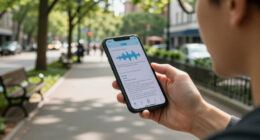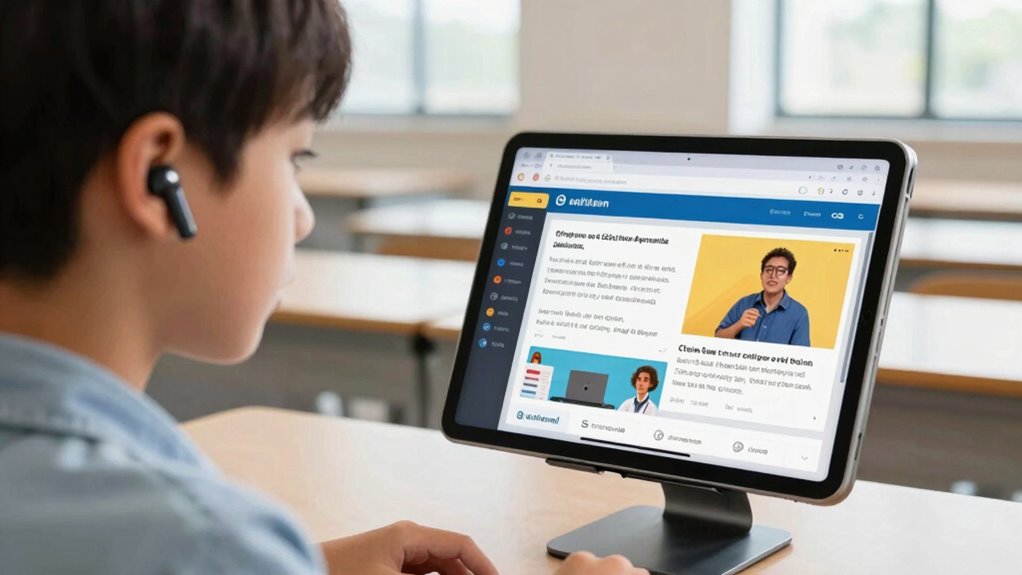

Speech-to-text devices help you participate fully in classroom activities by instantly converting speech into written words. They support students with reading difficulties, dyslexia, or note-taking challenges, allowing for better understanding and independent learning. These tools also promote inclusive discussions by making spoken contributions visible to everyone. As technology improves, they become even more accurate and adaptable to different environments. Keep exploring to discover how these innovations can transform your learning experience.

Get business pricing on tech for your team
- Business-only prices and quantity discounts
- Tax-exempt purchasing
- Multiple users, one account, clear invoices
Key Takeaways
- Convert spoken words into real-time text, aiding students with note-taking and reading difficulties.
- Enable inclusive participation in lectures, discussions, and group activities for all students.
- Support students with learning challenges by providing alternative ways to process and review information.
- Facilitate active engagement and collaboration through instant transcription of speech during class activities.
- Benefit from ongoing technological improvements, increasing accuracy and customization for diverse educational environments.
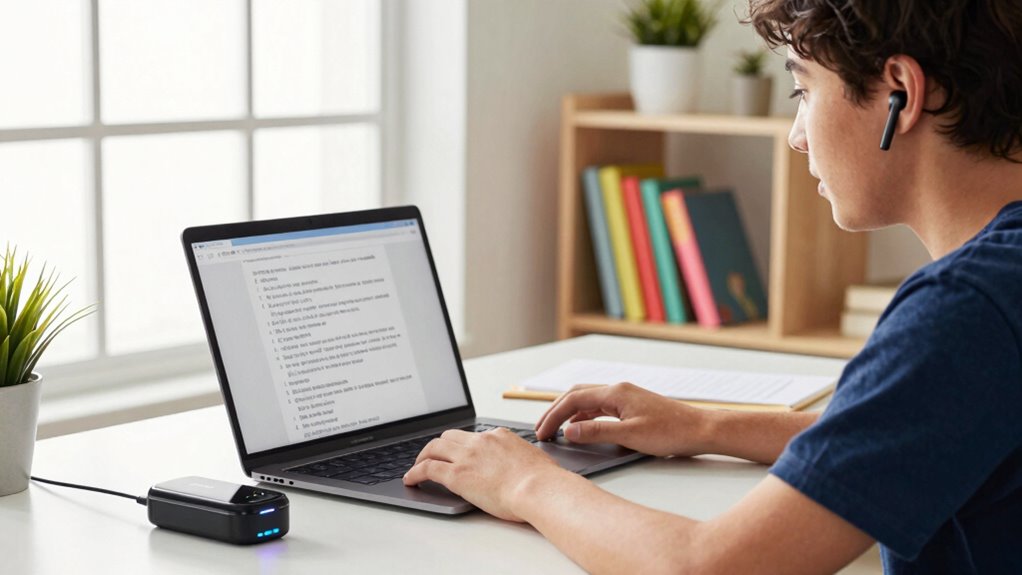
Speech-to-text devices are transforming accessible learning by allowing students with diverse needs to participate more fully in academic activities. These tools utilize voice recognition technology to convert spoken words into written text instantly, providing a seamless way to support students who have difficulties with traditional note-taking or reading. When you speak into a device equipped with real-time transcription, you see your words displayed on the screen almost immediately, enabling you to keep up with lectures, discussions, or instructions without the frustration of missing information.
Speech-to-text devices enable students to follow lessons and discussions instantly, reducing frustration and supporting full participation.
The power of voice recognition lies in its ability to understand natural speech, even when spoken at different speeds or with various accents. This feature helps reduce barriers for students with speech or language challenges, as they can focus on expressing themselves without the concern of their words being misunderstood or not captured accurately. Real-time transcription ensures that your spoken words are instantly transformed into text, allowing you to follow along with lessons, participate in group work, or complete assignments more independently. This immediacy fosters a more inclusive classroom environment where everyone has equal access to learning materials.
Using speech-to-text devices also enhances your ability to review and organize information. Instead of hurriedly jotting down notes, you can listen to the transcribed text afterward, making it easier to study or clarify concepts. The accuracy of voice recognition technology continues to improve, especially with updates tailored for educational settings, making it a reliable tool for capturing complex terminology or fast-paced speech. Additionally, incorporating features such as high refresh rates from projectors can further improve visual clarity during presentations or lectures, supporting better comprehension. As the technology advances, voice recognition also benefits from ongoing improvements in natural language understanding, increasing its effectiveness for diverse vocabularies and contexts. Moreover, the integration of specialized algorithms helps enhance accuracy further, especially in noisy classroom environments.
For students with dyslexia or other reading difficulties, real-time transcription offers an alternative method to process spoken information without the added pressure of decoding written text.
Furthermore, these devices support collaboration and participation. When you’re able to speak naturally and have your words transcribed instantly, you’re more likely to engage actively in class discussions or group projects. Teachers and peers can also benefit by seeing your spoken contributions in written form, creating a more inclusive dialogue. The integration of voice recognition and real-time transcription into everyday learning practices empowers you to overcome communication barriers and build confidence in your academic pursuits. Voice recognition technology continues to evolve, making these tools even more accurate and accessible for a wider range of learners. As the technology advances, it also opens up opportunities for customized learning experiences, catering to individual needs more effectively.
In essence, speech-to-text devices harness voice recognition to turn spoken language into accessible text immediately. They make learning more inclusive and efficient, giving you the tools to express yourself freely, stay organized, and participate fully in your educational journey. As these technologies advance, they become even more crucial in creating equitable learning environments for all students.
speech-to-text device for classroom
As an affiliate, we earn on qualifying purchases.
As an affiliate, we earn on qualifying purchases.
Frequently Asked Questions
Are Speech-To-Text Devices Suitable for All Learning Environments?
Speech-to-text devices are suitable for many learning environments, but not all. They help overcome accessibility barriers for students with hearing impairments or language difficulties, yet may fall short in noisy settings or with complex subjects. User customization enhances their effectiveness, allowing you to adjust settings for your needs. However, consider the environment and individual preferences before relying solely on these devices, as they work best when integrated with other accessibility tools.
How Do Speech-To-Text Devices Handle Different Languages or Accents?
Speech-to-text devices handle different languages and accents through advanced features like multilingual accuracy and accent recognition. They’re designed to adapt to various speech patterns, making it easier for you to communicate in multiple languages. These devices analyze pronunciation and language cues, ensuring more accurate transcriptions. While they work well for many accents, some variations may still pose challenges, so ongoing updates help improve their performance across diverse linguistic backgrounds.
What Are the Costs Associated With Implementing These Devices?
You might find that the costs of speech-to-text devices vary widely, with basic models costing around $100 and advanced options exceeding $1,000. Interestingly, a cost comparison shows that investing in these devices can improve learning outcomes considerably. To manage expenses, explore funding options like grants, school budgets, or nonprofit programs. This way, you can make accessible learning tools affordable and guarantee everyone benefits from inclusive education.
Can Speech-To-Text Technology Improve Note-Taking Efficiency?
Yes, speech-to-text technology can markedly improve your note-taking efficiency. Real-time transcription allows you to capture lectures or meetings instantly, so you don’t miss important details. With high voice recognition accuracy, your notes stay clear and reliable, reducing the need for extensive editing later. This enables you to focus more on understanding the material rather than struggling to keep up with manual note-taking, ultimately making your learning process more effective.
How Do These Devices Integrate With Existing Educational Software?
You can easily integrate speech-to-text devices with existing educational software through voice recognition features and software compatibility. Most modern devices support popular learning platforms, allowing you to convert speech into text directly within applications like Google Classroom or Microsoft Teams. This seamless integration helps you work more efficiently, access assignments easily, and participate fully in class activities, making learning more accessible and adaptable to your needs.
real-time transcription device for students
As an affiliate, we earn on qualifying purchases.
As an affiliate, we earn on qualifying purchases.
Conclusion
Remember, a tool is only as good as how you use it. Speech-to-text devices open doors to accessible learning, breaking down barriers and empowering every learner to succeed. They’re not just gadgets—they’re bridges to understanding and inclusion. Keep in mind, “The journey of a thousand miles begins with a single step.” Embrace these devices, and take that first step toward a more accessible, equitable educational experience for all.
assistive technology speech recognition
As an affiliate, we earn on qualifying purchases.
As an affiliate, we earn on qualifying purchases.
educational speech-to-text software
As an affiliate, we earn on qualifying purchases.
As an affiliate, we earn on qualifying purchases.
Halloween Picks
halloween
As an affiliate, we earn on qualifying purchases.