
TL;DR

Get tech for your team delivered free — and shop member deals
- Fast, free delivery on millions of items
- Access to Prime Big Deal Days deals on October 6–7
- Prime Video, Amazon Music and more included
SSD prices have risen sharply in 2026, with consumer NVMe drives roughly doubling or tripling from recent lows and enterprise SSD contracts rising fast. The confirmed driver is a tighter NAND market; the disputed part is how much of the squeeze comes from real AI demand versus supplier discipline.
SSD prices have moved sharply higher in 2026, with consumer NVMe drives roughly doubling or tripling from 2024 levels and enterprise SSD contract prices rising by more than half in one quarter, according to market data cited by Thorsten Meyer AI, TrendForce reporting, and Nomura Securities notes. The shift matters because AI infrastructure is now consuming flash storage directly, not only crowding it out through shared memory-fab capacity.
The price move is visible at both ends of the market. Thorsten Meyer AI reports that a 2TB consumer NVMe SSD that sold for about $120 to $150 in 2024 now lists around $300 to $480, while a 1TB consumer drive has roughly doubled from late-2025 levels. In the enterprise market, SSD contract prices rose an estimated 53% to 58% in the first quarter of 2026, while broader NAND contract prices have multiplied several times in less than a year.
Separate market reports point in the same direction. TrendForce data reported by Tom’s Hardware projected NAND Flash contract prices rising another 70% to 75% quarter over quarter in the second quarter of 2026, after an increase of roughly 60% in the first quarter. Nomura Securities notes reported by Tom’s Hardware said Sandisk was moving to raise high-capacity enterprise NAND prices by more than 100% in the March quarter.
The confirmed pressure is coming from two sides. NAND flash competes with DRAM and HBM for cleanroom space, capital spending, and engineering attention. At the same time, AI systems are using storage as an active part of inference workloads, including retrieval-augmented generation, vector databases, and key-value cache storage. Thorsten Meyer AI estimates that high-end AI deployments can require large amounts of flash per GPU and per rack, while noting that those per-system figures remain estimates.
The SSD squeeze: storage joined the party
Storage was the last cheap thing in computing. Not anymore — a 2TB NVMe that was $120–150 in 2024 now lists at $300–480. And this time flash isn’t only collateral damage: AI eats storage directly.
both ways
Flash got hit twice — once as collateral sharing fabs with HBM, once directly as AI inference turned fast storage into something it consumes by the petabyte. That second force won’t fade; it grows with every model, every RAG pipeline, every cache that must live somewhere fast. Buy what you need now; favor TLC with DRAM cache, don’t overpay for Gen 5, watch for counterfeits. Relief isn’t forecast before late 2027. When the cheapest component in computing has a two-year waitlist, “commodity” no longer fits. Next: The High-End PC & Workstation Tax.
AI Now Buys The SSDs
The storage increase matters because flash is no longer only a consumer upgrade part. Hyperscalers and AI infrastructure buyers are competing for the same NAND supply used in laptops, desktop SSDs, workstations, and industrial systems. When enterprise buyers lock in supply through long-term agreements, retail channels can face fewer units and higher prices.
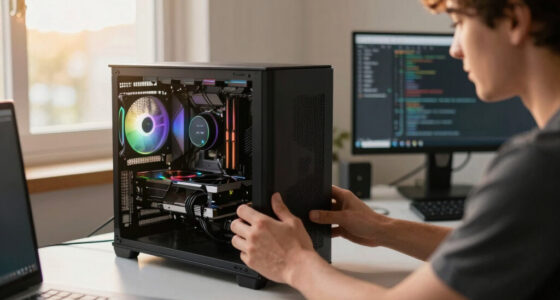
For readers, the impact is practical. A PC build that once treated 2TB of NVMe storage as a small add-on may now need a larger budget. OEMs may also respond by cutting base configurations, with some systems moving from 1TB to 512GB storage tiers to manage costs. Industrial and automotive buyers face a different problem: longer lead times for TLC and pSLC products used in embedded systems.
As an affiliate, we earn on qualifying purchases.
Cheap Flash Era Ends
For much of the past decade, SSD capacity became cheaper even as CPUs, GPUs, and memory moved through tighter cycles. That changed as the broader 2026 memory crunch spread from RAM into NAND. Earlier pressure came from the same supply shift that lifted DRAM prices: manufacturers prioritized HBM, server memory, and higher-margin data-center components.
The storage market then faced its own demand shock. AI inference workloads need fast local storage for model-serving pipelines, RAG indexes, and cache-heavy architectures. Nomura’s cited example of Nvidia infrastructure included 512GB SSDs attached to compute trays for key-value cache storage, showing how flash can become part of the compute stack rather than a passive data store.
Supply behavior is also part of the story, though the exact balance is disputed. Thorsten Meyer AI cites reports that Samsung and SK Hynix trimmed NAND wafer targets, while Micron has said it can satisfy only 55% to 60% of some major customer demand. Phison has said its 2026 output is sold out and that server customers are being prioritized over retail buyers.
“Storage was the last cheap thing in computing. Not anymore.”
— Thorsten Meyer AI
As an affiliate, we earn on qualifying purchases.
Retail Pass-Through Still Unsettled
Several points remain unsettled. It is not yet clear how much of the enterprise NAND increase will pass directly into consumer SSD prices, because retailers, OEM contracts, existing inventory, and promotional pricing can delay or soften price moves. It is also unclear how long buyers will keep accepting higher contract prices if AI server growth slows.
The largest uncertainty is the split between real shortage and supplier discipline. AI demand for storage is real, and new fabs take years to add meaningful output. But reports of reduced wafer targets and server-first allocation mean buyers should not assume fast relief even if consumer PC demand stays soft.
As an affiliate, we earn on qualifying purchases.
Late 2027 Is The Watchpoint
The next signals will come from second-half 2026 NAND contract negotiations, retail SSD pricing, and PC OEM storage configurations. If TrendForce’s projected Q2 increases hold and server demand remains strong, consumer SSD prices could stay elevated through the holiday build season.
Most cited forecasts do not point to broad supply relief before late 2027, with some reports extending tight conditions into 2028. Until new capacity arrives, AI infrastructure buyers, enterprise storage vendors, PC makers, and retail customers will keep competing for a constrained pool of NAND flash.
As an affiliate, we earn on qualifying purchases.
Key Questions
Why are SSD prices rising in 2026?
NAND flash supply is tight because memory makers are prioritizing higher-margin server products while AI workloads are also using more storage directly. That combination has pushed up enterprise SSD and consumer NVMe prices.
How much have consumer SSD prices increased?
Thorsten Meyer AI reports that a 2TB NVMe SSD that cost about $120 to $150 in 2024 now lists around $300 to $480. A 1TB drive has roughly doubled from late-2025 levels.
Is this the same shortage affecting RAM?
Partly. NAND, DRAM, and HBM compete for manufacturing resources. But storage is also being hit by a second force: AI inference systems need fast SSDs for cache, retrieval, and database workloads.
Are the AI storage figures confirmed?
The general demand trend is supported by market reports, but some specific numbers, including flash per GPU and flash per rack, are estimates. Actual storage needs vary by server design, workload, and deployment scale.
When could SSD prices ease?
Current market reports do not point to broad relief before late 2027. That timing depends on new capacity, supplier allocation choices, and whether AI infrastructure demand keeps absorbing high-end NAND supply.
Source: Thorsten Meyer AI
Evergreen bestsellers Picks
bestsellers
As an affiliate, we earn on qualifying purchases.