📊 Full opportunity report: What Can An Empty Trust Tracker Help Law Firms Track? on IdeaNavigator AI — validation score, market gap, and execution plan.

Get business pricing on tech for your team
- Business-only prices and quantity discounts
- Tax-exempt purchasing
- Multiple users, one account, clear invoices
TL;DR

A product concept from IdeaNavigator AI proposes a client-by-client trust funding tracker that lets estate-planning attorneys and financial advisors see which living trusts are partially or fully unfunded, attach proof of retitled assets, and automate client reminders. The core problem it targets: trusts are signed but never funded, forcing assets back through probate.
A new product analysis from IdeaNavigator AI proposes that solo and small estate-planning law firms — along with financial advisors and RIAs who deliver trust-based plans — adopt a simple trust funding tracker to catch a chronic and costly failure mode: living trusts that clients sign but never fund. The proposal, framed as a 60-day pilot recruiting 8–12 firms, is an attempt to turn an invisible liability sitting in every estate practice’s client list into a visible, billable workflow.
The problem the tracker targets is well known to estate planners. Clients sign a revocable living trust expecting to avoid probate, but many never complete the follow-through: retitling their home through a recorded deed, moving bank and brokerage accounts into the trust’s name, and updating beneficiary designations. When the trust stays empty, the assets pass through probate anyway — the precise outcome the trust was purchased to avoid. According to the analysis, attorneys typically hand clients a funding checklist at signing and rarely verify completion, so funding gaps surface only at death, often during litigation, when they are expensive and impossible to reverse.
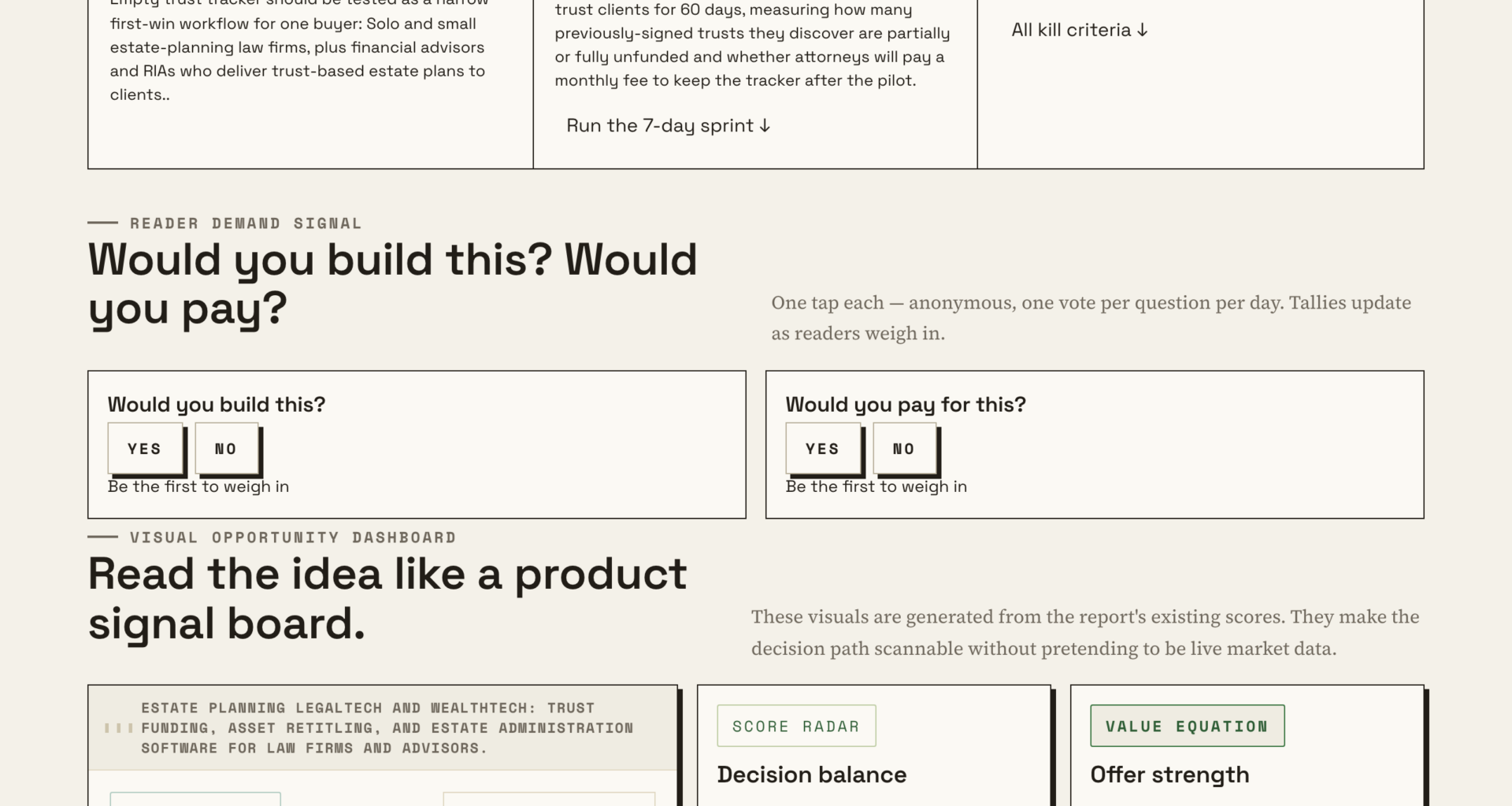
The proposed product is deliberately narrow. For each trust, an attorney or advisor would build a funding checklist across asset categories — real estate, bank accounts, brokerage accounts, retirement accounts, business interests, and beneficiary designations. Each asset gets a status of pending, in-progress, or confirmed funded, with proof attached, such as a recorded deed or a retitled account statement. Automated reminders go to clients, and a firm-level dashboard shows the whole book of trusts by percent funded, letting partners flag dangerously empty trusts before a client dies.
The revenue model is a SaaS seat or per-firm subscription, with optional per-asset add-ons through referral fees or markups on deed-recording and retitling fulfillment, and tiered pricing based on the number of trusts tracked. The analysis positions this in the overlap of estate-planning legaltech and wealthtech, arguing that existing document-drafting software stops at signing and does not close the funding step.
Why Unfunded Trusts Are a Practice-Level Risk
The stakes are both financial and reputational. An unfunded trust is not a technicality — it can defeat the client’s entire estate plan and expose the drafting attorney to malpractice exposure when heirs discover, after death, that the trust held nothing. Because verification today is manual and fragmented, most firms have no systematic way to know which of their existing clients are at risk. A dashboard that ranks trusts by percent funded converts a latent liability into an actionable list.
The timing argument in the analysis rests on market pull from two directions. Estate planning adoption and digital tooling are described as surging in 2026, yet the analysis cites a figure of roughly 11% of Americans holding a trust, implying a large underserved base. Meanwhile, per-deed funding services priced from $250 have already created a paid fulfillment market, meaning a tracking and verification layer would sit on top of existing paid services rather than having to build fulfillment from scratch. Advisors and RIAs bundling funded estate plans into client offerings give the tool a second buyer beyond law firms.
Top picks for "empty trust tracker"
As an affiliate, we earn on qualifying purchases.
The Funding Gap Document Software Leaves Open
Trust funding has historically lived in a gap between professions. Document-drafting platforms help attorneys generate trust instruments, but the work of retitling assets happens afterward, across county recorder offices, banks, and brokerages, with the client responsible for execution. Attorneys who do assist with funding typically do it per-asset, often via per-deed services. The IdeaNavigator AI analysis argues that no widely adopted tool gives a firm a live, per-client view of funding status across an entire book of trusts — which is why, according to the analysis, gaps are typically discovered only at death or during post-death litigation, when they are irreversible.
What the Proposal Has Not Yet Proven
The tracker is a proposal, not a shipped product. No firms have yet been recruited, and the analysis itself defines the open questions: how many previously signed trusts a pilot will reveal as partially or fully unfunded, and whether attorneys will actually pay a monthly fee to keep the tracker once the pilot ends. The severity of the funding-gap problem, while widely described in estate-planning practice, is not quantified in the proposal with survey data — the pilot is explicitly designed to generate that evidence. It is also unclear how responsibility for funding is allocated contractually in participating firms, and whether advisors or attorneys will prove the more durable paying customer. Claims about 2026 adoption trends and the per-deed pricing market are presented in the analysis without independent verification.
The 60-Day Pilot and Its Two Metrics
Per the analysis, the next step is recruiting 8–12 solo and small estate-planning firms to track funding status for a sample of their existing trust clients over 60 days. Two measurements decide whether the idea advances: the count of previously signed trusts discovered to be partially or fully unfunded, and the share of firms willing to pay a monthly subscription to keep using the tracker after the pilot. If both numbers are strong, the natural follow-on is integrating with per-deed fulfillment services so that flagged gaps can be closed, not just recorded. No launch date, pricing, or vendor has been announced.
Source: IdeaNavigator AI
Key Questions
What is an ’empty’ trust?
A living trust that was legally signed but whose assets were never retitled into it. The home, bank, and brokerage accounts remain in the client’s individual name, so at death those assets generally pass through probate despite the trust’s existence.
Who is the tracker intended for?
Per the analysis: solo and small estate-planning law firms, plus financial advisors and RIAs who deliver trust-based estate plans to clients.
How would the tracker work in practice?
Each trust gets a funding checklist by asset type, with statuses of pending, in-progress, or confirmed funded. Proof such as a recorded deed is attached, clients receive automated reminders, and a firm dashboard shows the book of trusts by percent funded.
How would it make money?
A SaaS seat or per-firm subscription, tiered by number of trusts tracked, with optional per-asset add-ons such as referral fees or markups on deed-recording and retitling services.
Does this product exist yet?
No. It is a proposed MVP and pilot design. The next step is a 60-day pilot with 8–12 firms to measure how many unfunded trusts are discovered and whether firms will pay to keep the tool.
Source: IdeaNavigator AI
Halloween Picks
halloween
As an affiliate, we earn on qualifying purchases.