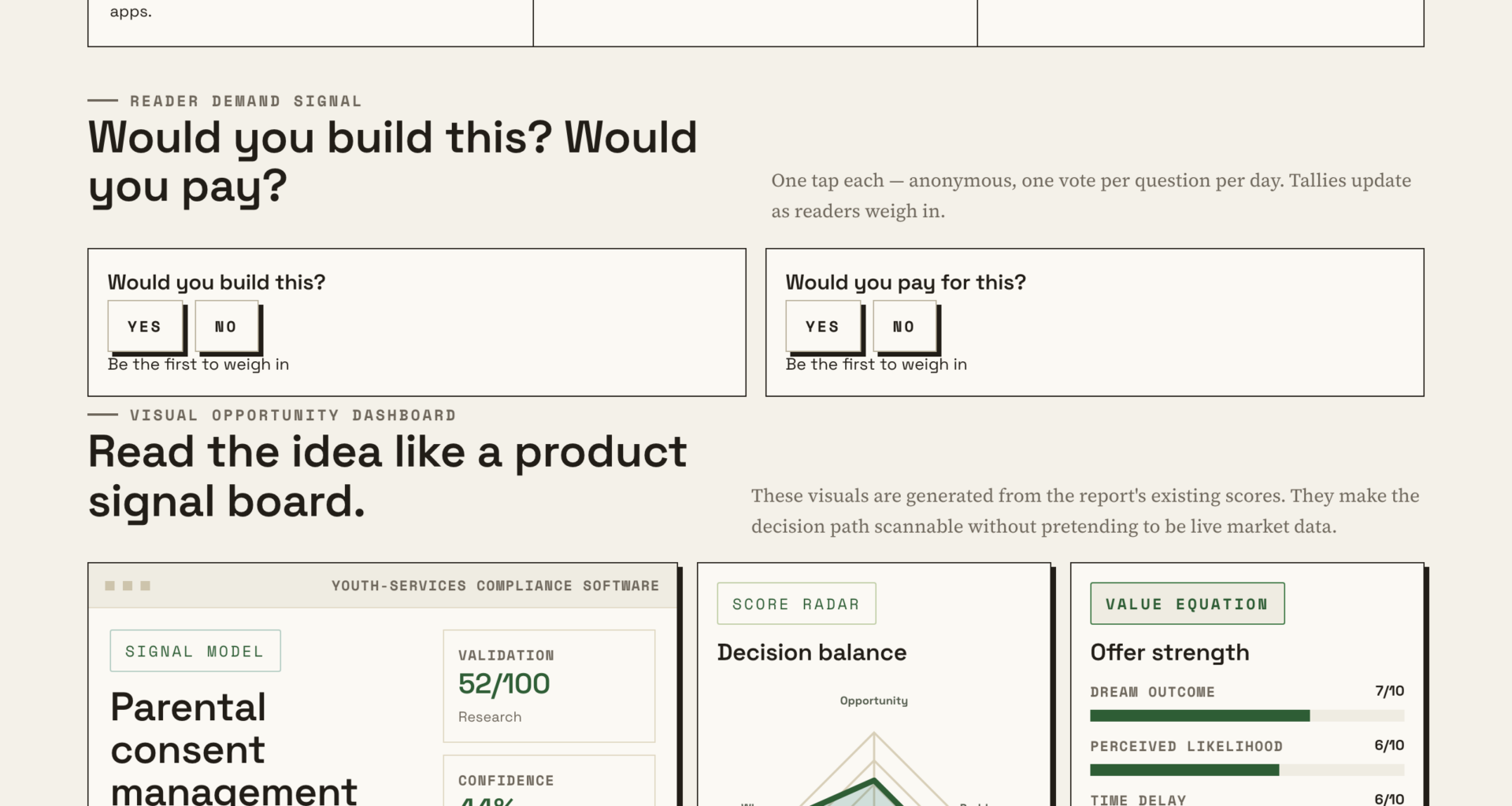

📊 Full opportunity report: What Is Parental Consent Management For Kid-Facing Vendors? on IdeaNavigator AI — validation score, market gap, and execution plan.
TL;DR

IdeaNavigator AI has outlined a proposed parental consent management service for camps, coaches, photographers and youth apps. The concept is an early-stage product proposal; no launch, customer results or regulatory endorsement is reported.
IdeaNavigator AI has proposed a parental consent platform for camps and other businesses working with children, with a suggested pilot involving ten youth programs over one season. The concept would replace scattered paper forms and email approvals with phone-based consent flows and records that vendors can retrieve if a question or dispute arises.
The proposed service would let vendors create branded consent forms for photo use, data collection, medical information and liability waivers. Parents would complete the forms on their phones, while the vendor would maintain a per-child consent ledger showing which approvals were given and when. The concept also includes expiration tracking and an option to export records for an audit.
Identity checks would vary with the risk level of the consent, according to the proposal, though it does not specify verification methods. The suggested business model is a monthly subscription priced by the number of active children. The proposal does not report a working product, paying customers, pilot results or revenue.
To evaluate demand, IdeaNavigator AI recommends testing the service with ten camps and youth programs for a season. The proposed measures are consent completion rates and time saved contacting parents compared with paper-based processes. No pilot start date or participating programs are identified.
A Record of Each Parent’s Approval
For a youth-service provider, consent is useful only if staff can connect an approval to the right child, parent and activity. Forms collected across paper packets and email threads can be hard to retrieve or interpret later. A shared ledger could give staff a single place to check permissions and whether they have expired.
The practical test is whether the proposed workflow improves recordkeeping without creating too much friction for families. A phone-based form could reduce manual follow-up, while risk-based identity checks and separate choices for different uses could help vendors document what parents actually approved. Those are potential benefits, not demonstrated outcomes: the proposal includes no measured results.
For small providers, the subscription price and staff workload would also matter. The active-child pricing model ties fees to program size, but the proposal does not provide prices or evidence that vendors would pay. A pilot measuring completion and follow-up time could help establish whether the service solves a frequent enough problem to support a business.
Top picks for "parental consent management"
As an affiliate, we earn on qualifying purchases.
Consent Rules and Vendor Workflows
The proposal describes a current operational gap: camps, coaches, photographers and youth apps may each handle permissions differently, using paper forms, email waivers or informal records. That can leave a vendor without a readily verifiable record of which parent agreed to a particular use. The idea frames that gap as more consequential when a dispute or privacy question arises.
It also points to COPPA updates and state privacy laws as reasons for vendors to pay closer attention to children’s information. However, the proposal does not identify particular legal changes, dates, enforcement actions or requirements that apply to every listed business. Legal obligations vary by activity and circumstances; the product concept itself does not establish that using a digital consent ledger would satisfy them.
Pilot Results and Legal Fit
No product launch or pilot findings are reported. It is not clear whether any camps or youth programs have agreed to participate, when a test might begin, or how many families would use the system. Completion rates and time saved remain proposed measures, rather than results.
The proposal also leaves open how identity verification would work, how records would be secured and retained, and how a vendor would correct an inaccurate or withdrawn approval. It does not explain how the service would address differing legal duties across businesses or jurisdictions. Whether parents and vendors would adopt the workflow, and what it would cost, are also unknown.
A Season-Long Test Could Follow
The next stated step is to test the concept with ten camps and youth programs for one season. A meaningful assessment would compare consent completion and staff time spent chasing approvals with the programs’ existing paper processes. The proposal does not give a schedule or say that the test has been arranged.
If a pilot proceeds, its results could show whether parents complete forms more reliably and whether staff can retrieve accurate records with less effort. Further product and legal details would still be needed before vendors could judge whether the service fits their operations. For now, the platform remains a proposed opportunity, with adoption and effectiveness unconfirmed.
Source: IdeaNavigator AI
Key Questions
What is parental consent management for youth vendors?
It is a way for organizations working with children to collect, organize and retrieve parents’ permissions for activities such as photography, data collection or medical information.
Who is the proposed platform for?
The concept names camps, coaches, photographers and youth apps as potential customers. No customer commitments are reported.
What would the proposed service include?
It would offer phone-based consent forms, per-child records, expiration tracking, identity checks based on risk and audit exports.
Has the platform been tested?
No test results are reported. The proposal recommends a season-long pilot with ten camps and youth programs.
Would using the platform satisfy privacy laws?
The proposal does not establish legal compliance. Requirements depend on the organization and activity, and no legal assessment of the proposed product is provided.
Source: IdeaNavigator AI