TL;DR
Diffusion models are trained by adding noise to images and learning to predict what was added. To generate an image, they reverse that process from random noise, with text prompts guiding each step. The method explains both the models’ strengths and recurring problems with text, object placement and possible training-image reproduction.
A November 23, 2026 explainer from Thorsten Meyer AI describes how image diffusion models generate pictures by starting with random noise and gradually removing it under the direction of a text prompt. The process helps explain why these systems can create detailed images, yet often struggle with lettering, counting objects and placing them precisely.

Get business pricing on tech for your team
- Business-only prices and quantity discounts
- Tax-exempt purchasing
- Multiple users, one account, clear invoices
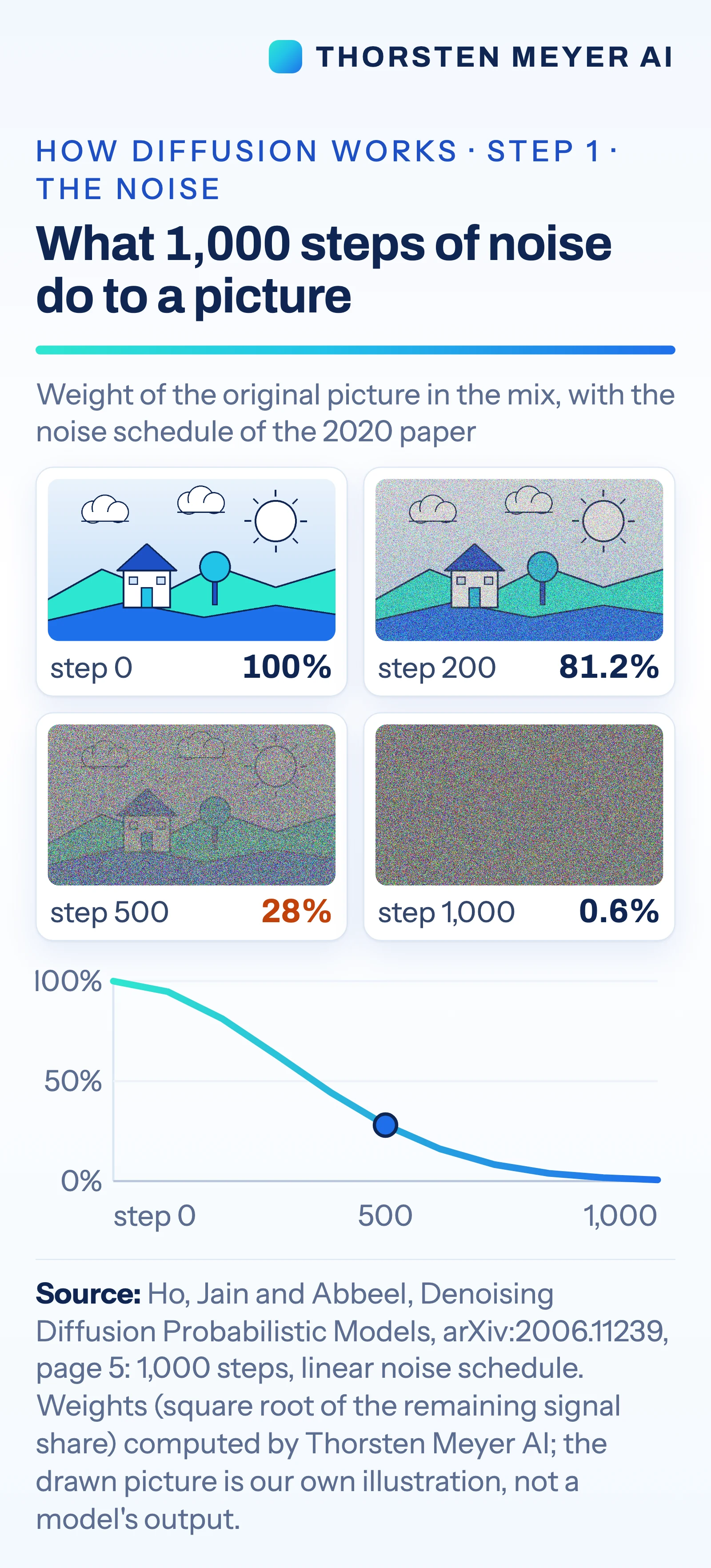
Diffusion models learn through a two-part process. During training, software adds noise to real images in small increments. A neural network then learns to estimate the noise at each stage. At generation time, the model starts with noise and repeatedly removes its estimated contribution, gradually forming an image with diffusion inference in Diffusers. The explainer describes a 2020 research paper that used 1,000 training steps; it also cites a commonly used open-source pipeline whose default generation process uses 50 steps.
The model does not have to work directly on every pixel of a full-size image. Latent diffusion compresses images into a smaller representation before the noise process. The source says that in Stable Diffusion v1, a 512-by-512 image is represented using 48 times fewer numbers. A text encoder converts a prompt into numerical representations, and a guidance method steers the denoising process toward those representations. The source notes that stronger guidance can bring results closer to the prompt, with a possible cost to image quality.
The explainer links design choices to familiar failures: image models may produce garbled lettering or misplace objects, and researchers have extracted near-copies of images used in training. It also summarizes a 2025 UK court finding that Stable Diffusion itself is not an “infringing copy.” That ruling addresses a particular legal question; the source says other questions remain open.
Why Noise Shapes the Result
Starting from noise is central to how these models make new images: each step estimates how the current representation should change, instead of retrieving a finished picture matching the prompt. The process gives the model a way to build an image through repeated adjustments, while text guidance influences those adjustments throughout generation.
The same setup helps explain limits readers encounter. A prompt can describe relationships, exact counts or letters, but the model’s repeated denoising process does not guarantee that every detail will be represented correctly. The explainer also flags possible reproduction of training images as a concern. These issues matter when judging generated images as illustrations, evidence or creative work, and when considering copyright questions.
Products Worth Considering

Jackery Explorer 1000 v2 Portable Power Station

DJI Osmo Action 5 Pro 4K Waterproof Action Camera with Dual OLED Touchscreens, Froggi 47-Piece Sport Kit and SD Card

Apple Watch Series 8 GPS 41mm Smartwatch with Midnight Aluminum Case and Midnight Sport Band (S/M)
As an affiliate, we earn on qualifying purchases.
From Diffusion Theory to Images
The underlying idea predates current image generators. In 2015, Jascha Sohl-Dickstein and colleagues proposed gradually destroying structure in data, then learning a reverse process to restore it. Their paper drew an analogy to diffusion in physics, where a substance spreads out over time.
A 2020 paper by Jonathan Ho, Ajay Jain and Pieter Abbeel, “Denoising Diffusion Probabilistic Models,” helped make the approach practical. It described adding noise through a sequence of steps until the original signal was largely destroyed, then training a model to estimate the added noise. The 2026 explainer cites that paper and Hugging Face’s diffusers documentation for its account of the process. Its numerical examples describe the cited research and software settings, rather than a universal recipe for every image model.
Open Questions on Copying
The source does not establish how often image models reproduce training images, or how that frequency varies across models and prompts. It reports that researchers have extracted near-copies, but gives no rate or comparison baseline. It also does not detail the unresolved legal questions following the 2025 UK ruling. The ruling, as summarized in the source, concerns whether Stable Diffusion itself is an “infringing copy”; it should not be read as resolving every copyright dispute involving generated images or training data.
What Research and Courts May Clarify
The source identifies no specific upcoming research release, court date or product milestone. Further research could clarify how reliably models reproduce training material and how design changes affect prompt accuracy, image quality and computational cost. Legal proceedings and future rulings may address questions left open by the 2025 UK finding. Until then, the explainer’s central account remains a useful description of the cited method, while its examples should not be assumed to apply identically to every model.
Key Questions
Why do diffusion models begin with noise?
They learn to reverse a process that gradually adds noise to training images. At generation time, the model starts from noise and repeatedly removes its estimate of that noise to form an image.
How does a text prompt affect the image?
A text encoder converts the prompt into numerical representations. A guidance method uses those representations to steer the denoising steps toward the requested content.
Why can these models get lettering or object placement wrong?
The generation process builds an image through repeated denoising steps, and matching a general prompt does not guarantee exact letters, counts or spatial relationships. The source identifies these as common limitations.
Does the 2025 UK court finding settle copyright questions about Stable Diffusion?
No. The source says the court found that Stable Diffusion itself is not an “infringing copy,” while other questions remain open. It does not describe the decision as resolving every copyright issue related to training data or generated images.
Source: Thorsten Meyer AI