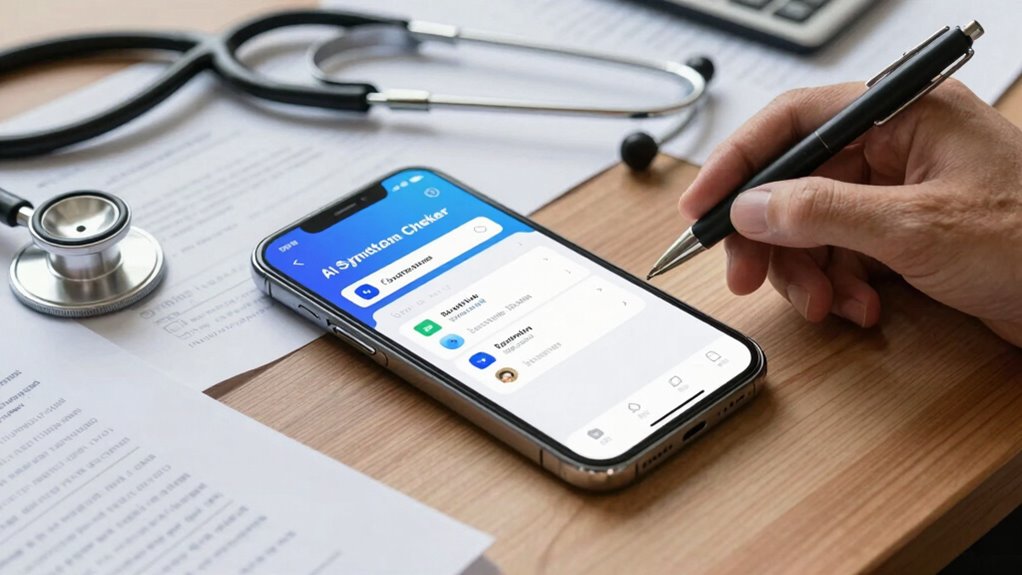
AI symptom checkers can provide quick guidance, but they aren’t a substitute for professional medical advice. They may be inaccurate or incomplete, risking false reassurance or unnecessary worry. Always remember, these tools lack your full health context and shouldn’t replace a doctor’s evaluation. If you want to understand how safe and effective they really are—and learn how to use them responsibly—you’ll find useful insights ahead.
Key Takeaways
- AI symptom checkers are helpful for initial guidance but are not substitutes for professional medical advice.
- They can provide inaccurate or incomplete diagnoses, risking delayed or inappropriate treatment.
- Privacy concerns arise as sensitive health data may be stored or misused without proper safeguards.
- These tools lack individual context, such as medical history, which limits diagnostic accuracy.
- Consulting healthcare professionals remains essential for accurate diagnosis and comprehensive care.
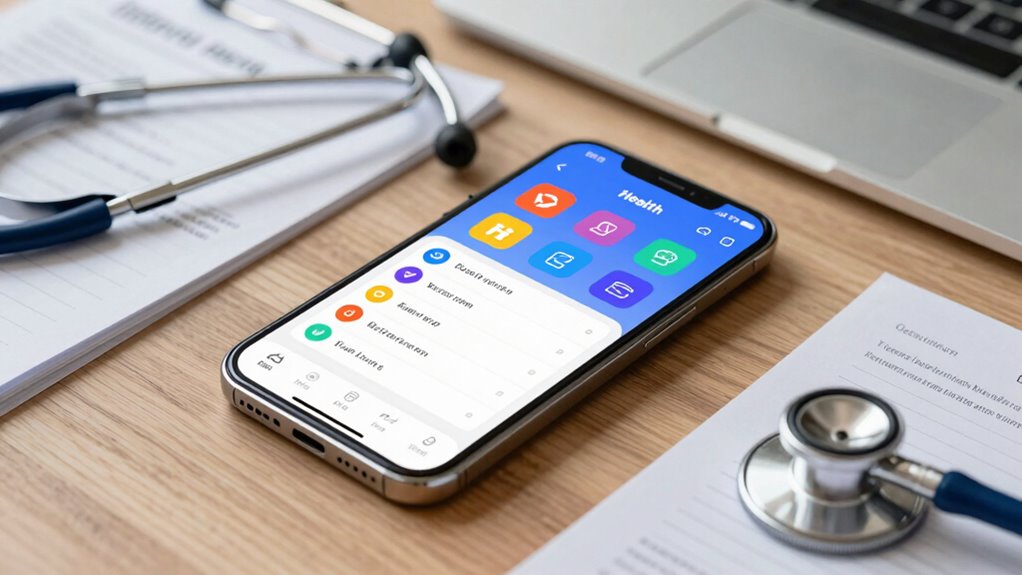
Artificial intelligence-powered symptom checkers have become increasingly popular as a quick way to assess health concerns, but it’s important to understand their limitations. While these tools can be convenient for initial guidance, they’re not a substitute for professional medical advice. One key issue to address is data privacy. When you input personal health information into these systems, you’re sharing sensitive data that could be stored, analyzed, or even misused if not properly protected. Always check the privacy policies of these platforms to verify your data is handled responsibly. Many symptom checkers collect and store user data to improve their algorithms, but this raises concerns about how securely your information is stored and whether it might be shared with third parties. Protecting your privacy should be a top priority, especially when dealing with health-related details that are deeply personal.
Another significant point is diagnostic accuracy. These AI tools rely on algorithms trained on large datasets, but they can’t account for every individual nuance or complex medical history. As a result, their assessments can be inaccurate or incomplete. You might receive a broad range of potential diagnoses, some of which may be misleading or unnecessary. Relying solely on these checkers can lead to false reassurance or unnecessary anxiety, especially if they overlook symptoms or misinterpret the severity of your condition. It’s tempting to trust the instant results, but remember that these tools are designed to assist, not to replace, the expertise of healthcare professionals. If your symptoms persist or worsen, you should seek direct medical attention rather than relying on an online assessment.
Furthermore, these symptom checkers often lack context about your overall health, lifestyle, and medical history, which can influence the accuracy of their recommendations. They might be helpful for getting a general idea or deciding whether to seek immediate care, but they’re not all-inclusive diagnostic tools. You should view them as a starting point rather than a definitive answer. Relying on AI for self-diagnosis can be risky if you’re not cautious, especially when misinterpreting symptoms could delay necessary treatment. Additionally, understanding the role of contrast ratio in projectors can help you choose the right equipment for your needs, as it impacts image depth and clarity—important factors when evaluating visual tools or displays.
To ensure safety, it’s crucial to remember that medical consultation remains the gold standard, especially when symptoms are severe or unusual. Proper requirements traceability processes are essential in healthcare systems to ensure that diagnostic tools adhere to safety and privacy standards, minimizing risks associated with AI-based assessments. Ultimately, while AI symptom checkers are useful for initial insights, your best bet remains consulting a healthcare professional who can evaluate your situation thoroughly, considering all factors that influence diagnosis and treatment.
privacy-focused AI symptom checker
As an affiliate, we earn on qualifying purchases.
As an affiliate, we earn on qualifying purchases.
Frequently Asked Questions
Are AI Symptom Checkers Legally Liable for Misdiagnoses?
AI symptom checkers generally aren’t held legally liable for misdiagnoses because of accountability concerns and their classification as medical tools or decision aids. You should realize that legal liabilities often shift to developers, providers, or users depending on jurisdiction and circumstances. However, laws are evolving, and liability issues remain complex, so you should use these tools cautiously and never solely rely on them for medical decisions.
How Do AI Symptom Checkers Handle Rare or Complex Conditions?
When confronting rare conditions and diagnostic challenges, AI symptom checkers often hit their limits. They rely on extensive databases, but rare diseases can hide behind subtle signs, making them tricky for AI to identify accurately. Suspense builds as you realize these tools aren’t foolproof—leaving complex cases to human experts. So, while they assist, they’re not a substitute for thorough medical evaluation, especially when the stakes are high.
Can AI Symptom Checkers Replace Professional Medical Advice Entirely?
AI symptom checkers can’t replace professional medical advice entirely, as they serve more as tools for initial guidance or alternative diagnosis. You should always trust healthcare professionals for accurate diagnosis and treatment. While these tools boost user trust and offer quick insights, they lack the nuanced understanding a doctor provides. Rely on AI as a helpful supplement, not a substitute, to guarantee your health concerns are properly addressed.
What Data Sources Do AI Symptom Checkers Use to Generate Diagnoses?
Like a detective piecing together clues, AI symptom checkers gather data from medical databases, research articles, and user inputs. They rely on data accuracy and source credibility to generate diagnoses. These tools analyze symptoms against trusted medical sources to provide insights, but their reliability depends on the quality of information they access. Always remember, no matter how advanced, they shouldn’t replace professional advice.
How Secure Is My Personal Health Information When Using These Tools?
Your personal health information’s security depends on the app’s data privacy measures and how it handles user consent. Reputable AI symptom checkers use encryption and strict privacy policies to protect your data. Always review their privacy policies and verify you give explicit user consent before sharing sensitive info. Be cautious with apps that don’t clearly explain their data privacy practices, as your health data should remain confidential.

CMI Health Rechargeable Pulse Oximeter – Adult Finger Sensor for Continuous Monitoring & Spot-Checking – Adjustable Alarm for Pulse Rate and SpO2 Levels – Carry Case, AC Adapter Included
𝗔𝗖𝗖𝗨𝗥𝗔𝗧𝗘, 𝗥𝗘𝗟𝗜𝗔𝗕𝗟𝗘 𝗥𝗘𝗔𝗗𝗜𝗡𝗚 𝗜𝗡 𝗦𝗘𝗖𝗢𝗡𝗗𝗦 – Made to CE, ISO 9001, and ISO 13485 professional standards; Pulse rate…
As an affiliate, we earn on qualifying purchases.
As an affiliate, we earn on qualifying purchases.
Conclusion
So, next time you’re tempted to trust that shiny AI symptom checker, remember: it’s not your personal doctor, just a glorified guesswork machine. While it might save you a few clicks, don’t let it replace real medical advice—unless you’re into self-diagnosing with the confidence of a carnival psychic. Keep your health in human hands, and maybe, just maybe, leave the AI to smarter tasks—like telling jokes or playing chess.
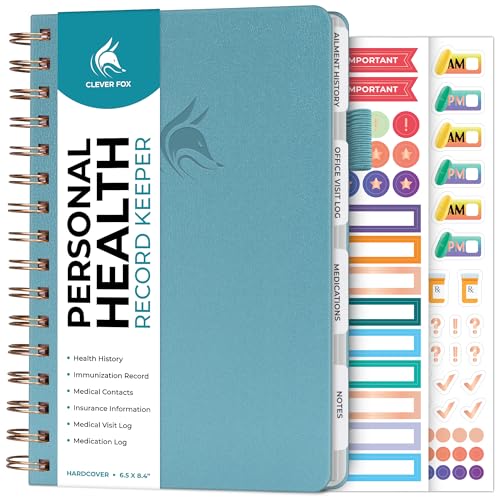
Clever Fox Personal Health Record Keeper – Medical Care Planner – Wellness & Medication Tracker Journal for Patients – Organizer Notebook, Daily Tracking Log Book & Appointment Diary (Aquamarine)
ALL YOUR HEALTH RECORDS IN ONE PLACE – This medical planner journal helps organize vital medical information including…
As an affiliate, we earn on qualifying purchases.
As an affiliate, we earn on qualifying purchases.

The Professional's Guide to Sexuality Consultation
As an affiliate, we earn on qualifying purchases.
As an affiliate, we earn on qualifying purchases.