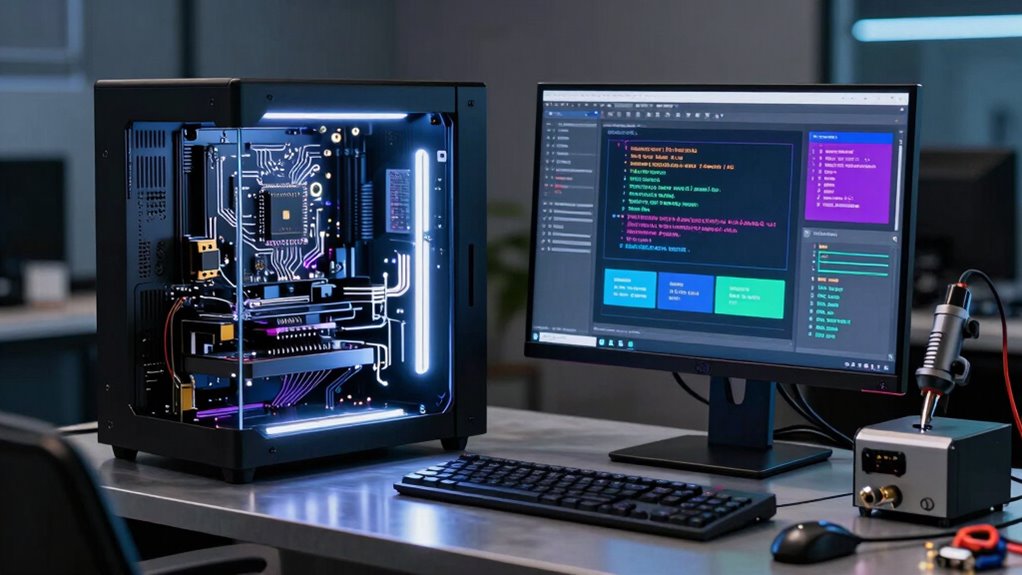

Hardware-software co-design is vital for optimizing AI systems, helping you create solutions that are faster, more energy-efficient, and scalable. By aligning hardware components like processors and accelerators with software, you can reduce latency and power consumption while improving performance. This integrated approach guarantees your AI systems can handle complex tasks in real-time. Keep exploring to discover how this strategy can transform your AI projects and drive better results.

Get business pricing on tech for your team
- Business-only prices and quantity discounts
- Tax-exempt purchasing
- Multiple users, one account, clear invoices
Key Takeaways
- It optimizes system performance by tailoring hardware and software for specific AI workloads.
- It enhances energy efficiency, reducing power consumption without sacrificing speed or accuracy.
- It enables real-time processing essential for autonomous systems and critical applications.
- It helps identify and eliminate bottlenecks early, improving overall system efficiency.
- It ensures scalability and adaptability for evolving AI demands and future technological advancements.

As artificial intelligence (AI) applications become more complex and demanding, the need for integrated hardware and software design has never been more critical. You’re likely aware that AI models now handle massive datasets, perform intricate computations, and require rapid responses to function effectively. To meet these challenges, co-designing hardware and software ensures that systems are optimized from the ground up, delivering both energy efficiency and real-time processing capabilities. When hardware and software are developed together, you can tailor the architecture to suit specific AI workloads, reducing unnecessary power consumption and boosting performance.
Energy efficiency is a fundamental consideration because AI workloads often demand significant computational resources, which can lead to high energy consumption. If you design hardware and software separately, you risk creating systems that are either overpowered or underperforming, leading to wasted energy. Co-design allows you to fine-tune hardware components—like processors, memory units, and accelerators—so they align perfectly with software demands. This harmony minimizes power draw without sacrificing speed or accuracy, making AI deployments more sustainable and cost-effective. For instance, custom hardware accelerators can be integrated into AI systems that specifically target neural network operations, drastically reducing energy consumption compared to traditional CPUs or GPUs. Additionally, understanding color accuracy in projectors can help optimize visual outputs for AI-powered display systems.
Co-design aligns hardware and software to minimize energy use while maintaining performance and accuracy in AI systems.
Real-time processing is another essential aspect where co-design makes a tangible difference. Many AI applications, such as autonomous vehicles, robotics, and real-time analytics, require immediate responses. If hardware isn’t optimized for the software tasks at hand, latency increases, and the system’s ability to respond promptly diminishes. By co-developing hardware and software, you ensure that data flows seamlessly through the system, enabling faster computation and lower latency. This collaboration helps identify bottlenecks early in the design process, so you can implement hardware features—like specialized processing units—that accelerate critical operations. The integration of hardware-software co-design can also facilitate better handling of complex AI models, ensuring that hardware resources are utilized efficiently for specific workloads. The result is a system capable of making split-second decisions, which is indispensable for safety and efficiency in many AI applications.
In essence, hardware-software co-design isn’t just a technical approach; it’s a strategic necessity in today’s AI landscape. It empowers you to build systems that are not only faster and more responsive but also more energy-conscious. As AI continues to evolve, adopting a co-design mindset ensures your solutions remain scalable, efficient, and capable of meeting the increasing demands of real-world applications. This integrated approach is supported by the importance of system optimization, which ensures that both hardware and software work harmoniously to maximize performance and sustainability. Furthermore, embracing emerging trends in co-design can help future-proof AI systems against rapid technological advancements. If you want your AI systems to perform at their best, integrating hardware and software design from the start isn’t just beneficial—it’s essential.
As an affiliate, we earn on qualifying purchases.
Frequently Asked Questions
How Does Co-Design Improve AI Model Training Speed?
Co-design improves AI model training speed by optimizing hardware and software together, enhancing data throughput and enabling efficient model parallelism. You can split large models across multiple hardware units, reducing bottlenecks and accelerating processing. This coordinated approach guarantees that hardware resources are tailored to software needs, minimizing delays and maximizing the flow of data. As a result, training becomes faster and more efficient, helping you achieve better performance in less time.
What Are the Main Challenges in Hardware-Software Integration?
You face main challenges in hardware-software integration, including ensuring hardware compatibility and maintaining software flexibility. Hardware components must seamlessly work together, avoiding bottlenecks or incompatibilities that hinder performance. At the same time, software needs to adapt easily to hardware updates or changes, which can be difficult if systems aren’t designed with co-optimization in mind. Balancing these factors requires careful planning and collaboration between hardware engineers and software developers.
How Does Co-Design Impact AI Energy Efficiency?
Co-design enhances AI energy efficiency by optimizing hardware and software together, leading to better energy management and power consumption reduction. You can achieve energy optimization by designing hardware tailored to specific AI workloads, which minimizes unnecessary power use. Simultaneously, software adjustments allow for dynamic power management, ensuring components only use energy when needed. This integrated approach results in more sustainable AI systems with lower energy footprints, boosting overall performance and efficiency.
Can Hardware-Software Co-Design Reduce AI Development Costs?
Coincidences often lead to smarter solutions, and hardware-software co-design is no exception. By integrating hardware optimization with software collaboration early in development, you can identify issues sooner, reducing costly revisions later. This collaborative approach streamlines the process, cuts down on trial-and-error, and accelerates deployment. Ultimately, it lowers AI development costs by making the entire pipeline more efficient, saving time and resources while enhancing performance.
What Tools Are Available for Co-Design in AI Systems?
You can utilize tools like Xilinx’s Vitis AI, which enables design optimization and seamless system integration for AI hardware. Synopsys’ Design Compiler provides automated design optimization, improving performance and efficiency. Additionally, platforms like MATLAB and Simulink facilitate co-simulation and system integration, allowing you to refine hardware-software interactions. These tools help streamline development, enhance performance, and reduce costs by optimizing your AI system’s hardware-software co-design process.
As an affiliate, we earn on qualifying purchases.
Conclusion
By understanding the importance of hardware-software co-design in AI, you realize how it can boost efficiency and performance. Did you know that AI-specific hardware can reduce energy consumption by up to 50%? This statistic highlights just how vital co-design is for future innovations. Embracing this integrated approach allows you to develop smarter, faster, and more sustainable AI solutions, making a real difference in the tech world. Don’t overlook its potential—it’s key to the next AI breakthrough.
As an affiliate, we earn on qualifying purchases.
As an affiliate, we earn on qualifying purchases.
Halloween Picks
halloween
As an affiliate, we earn on qualifying purchases.