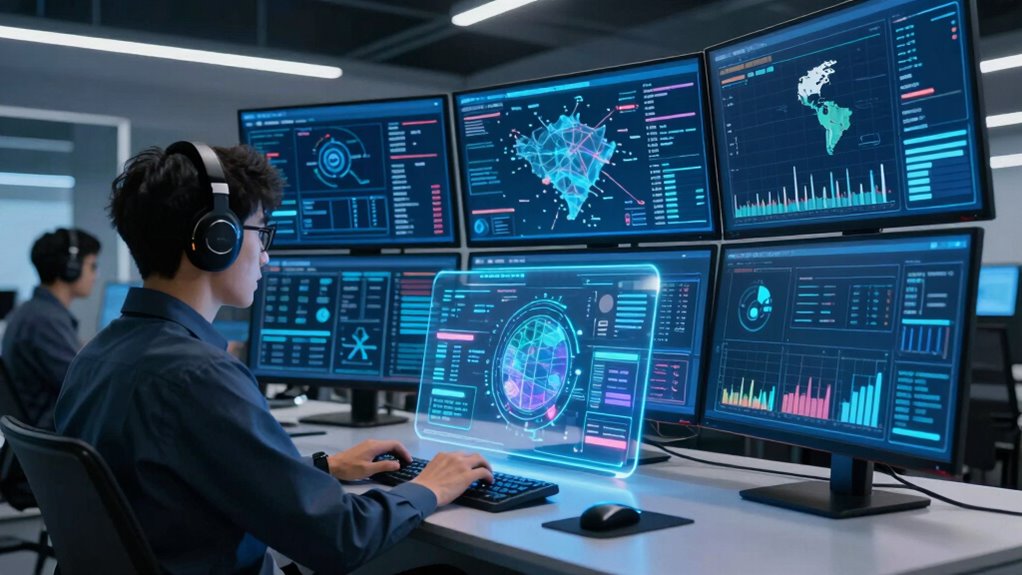

AI is changing your SOC analyst workflow by automating threat detection and response, allowing you to identify anomalies faster and react instantly. It reduces manual work, letting you focus on strategic tasks while automated tools handle routine alerts. AI also provides clearer insights and better collaboration, making your defenses smarter and more proactive. If you keep exploring, you’ll discover how these innovations can make your security operations even more effective.
Key Takeaways
- AI automates routine threat detection and response, allowing SOC analysts to focus on strategic security tasks.
- Automated triage and alerts prioritize critical issues for faster analyst decision-making.
- AI provides real-time, contextual insights, enhancing analysts’ understanding of complex threats.
- Collaboration tools driven by AI facilitate instant data sharing, improving team coordination during incidents.
- Continuous AI learning refines threat detection accuracy, reducing false positives and evolving defense strategies.

Artificial intelligence is revolutionizing how SOC analysts detect and respond to threats, making workflows faster and more efficient. With AI-powered tools, automated threat detection has become a cornerstone of modern cybersecurity strategies. Instead of sifting through endless logs and alerts manually, you now rely on AI systems to analyze vast amounts of data in real time, spotting anomalies that could indicate a breach. This shift not only speeds up detection but also reduces the chances of human error, ensuring threats don’t go unnoticed. AI continuously learns from new data, improving its ability to identify sophisticated attack patterns and zero-day exploits that traditional methods might miss.
Real-time incident response is another crucial area transformed by AI. When a threat is detected, AI can initiate automatic responses, such as isolating affected systems or blocking malicious IP addresses, often within seconds. This rapid response minimizes the window of exposure and helps contain damage before it spreads further. As a SOC analyst, you’re freed from the routine task of manual intervention, allowing you to focus on strategic decision-making and threat hunting. AI-driven automation handles the initial triage efficiently, providing you with prioritized alerts that highlight the most critical issues. Additionally, automated threat detection tools leverage machine learning to adapt to new attack vectors, keeping defenses ahead of evolving threats. Understanding cyber threat intelligence is essential to anticipate and counteract emerging tactics used by attackers.
The integration of AI into your workflows also means you’re working with smarter dashboards. Instead of wading through cluttered alerts, you get clear, actionable insights driven by AI analytics. These insights help you understand the context surrounding a threat, making it easier to determine the appropriate response. Over time, AI systems learn from your actions and feedback, refining their accuracy and reducing false positives. This continuous improvement means your workload becomes more manageable, and your incident response becomes more precise. Moreover, the ability of AI to analyze attack techniques enhances your understanding of attacker behaviors, enabling more proactive defenses. Incorporating advanced analytics further improves detection capabilities by identifying subtle patterns that might otherwise go unnoticed.
Furthermore, AI enhances collaboration across teams. Automated threat detection tools flag potential issues and share relevant data instantly, ensuring everyone is on the same page during a security event. This seamless information flow accelerates decision-making and coordination, which is essential during high-pressure incidents. You benefit from a proactive defense posture, where AI not only detects threats but also predicts and prevents future attacks based on evolving patterns. Additionally, AI can help identify side-channel attacks, which are often subtle and difficult to detect with traditional methods. The ongoing development of AI algorithms ensures that security measures stay current with increasingly complex attack techniques.
In essence, AI is transforming your role from reactive to proactive. Automated threat detection and real-time incident response empower you to act swiftly and accurately, reducing security risks and increasing operational efficiency. As AI continues to evolve, your workflows will become even more streamlined, making cybersecurity defenses more resilient than ever before.

ChatGPT for Cybersecurity Cookbook: Learn practical generative AI recipes to supercharge your cybersecurity skills
As an affiliate, we earn on qualifying purchases.
As an affiliate, we earn on qualifying purchases.
Frequently Asked Questions
How Does AI Handle False Positives in Threat Detection?
AI reduces false positives in threat detection by applying advanced algorithms that analyze patterns more accurately. It filters out benign activities through threat filtering, ensuring you only focus on genuine threats. When a false positive occurs, AI learns from these instances, refining its detection capabilities over time. This continuous improvement helps you avoid wasting time on false alarms, making your threat management more efficient and reliable.
What Skills Do SOC Analysts Need to Work Effectively With AI Tools?
Imagine steering a ship through turbulent waters—your skills guide AI tools in threat detection. You need a solid grasp of automated incident response and predictive threat modeling to work effectively with AI. Critical thinking helps you interpret alerts, while familiarity with cybersecurity principles guarantees you trust the system’s insights. Communication skills let you collaborate with AI developers and team members, transforming complex data into clear action plans.
Can AI Completely Replace Human SOC Analysts?
AI can’t completely replace human SOC analysts because automated incident response and predictive threat modeling still need human judgment. You can rely on AI to handle routine tasks, identify patterns, and flag potential threats quickly. However, complex decision-making, understanding context, and strategic planning require your expertise. So, while AI enhances your workflow, it supports rather than fully replaces your critical thinking and adaptive skills.
How Is Data Privacy Maintained With Ai-Driven Security Systems?
Is your data truly protected with AI-driven security? You can preserve privacy by implementing robust data encryption and strict user authentication protocols. AI systems are designed to process data securely, but it’s essential to continuously monitor and update security measures. By combining advanced encryption methods with multi-factor authentication, you guarantee sensitive information stays private while benefiting from AI’s efficiency in detecting threats.
What Are the Limitations of AI in Cybersecurity Threat Analysis?
AI has limitations in cybersecurity threat analysis because it can struggle with nuanced understanding and adapting to new tactics. It may generate false positives, impacting threat prioritization, and automated reporting can sometimes overlook contextual details. You need to supplement AI with human expertise to interpret complex threats accurately. While AI accelerates detection, its inability to fully grasp evolving tactics means you must remain vigilant and continually refine its algorithms.
Automating Security Operations: A PYTHON GUIDE FOR SOC ANALYSTS AND ENGINEERS
As an affiliate, we earn on qualifying purchases.
As an affiliate, we earn on qualifying purchases.
Conclusion
As AI transforms your SOC analyst workflow, you’ll find efficiency soaring alongside new challenges. While automation handles routine tasks swiftly, it also demands heightened vigilance to interpret nuanced threats. The balance between human intuition and machine precision becomes vital—a paradox where technology simplifies yet complicates your role. Embrace this duality; your adaptability ensures that AI becomes a powerful ally, helping you stay ahead in an ever-evolving threat landscape, even as it reshapes your daily realities.

Security Monitoring with Wazuh: A hands-on guide to effective enterprise security using real-life use cases in Wazuh
As an affiliate, we earn on qualifying purchases.
As an affiliate, we earn on qualifying purchases.
automated threat triage dashboards
As an affiliate, we earn on qualifying purchases.
As an affiliate, we earn on qualifying purchases.