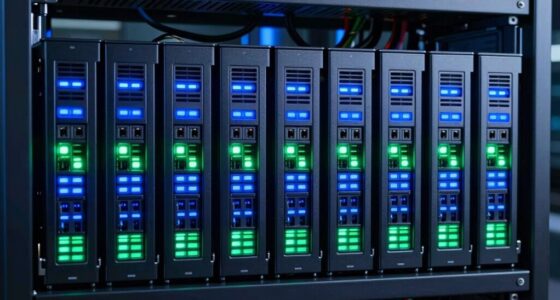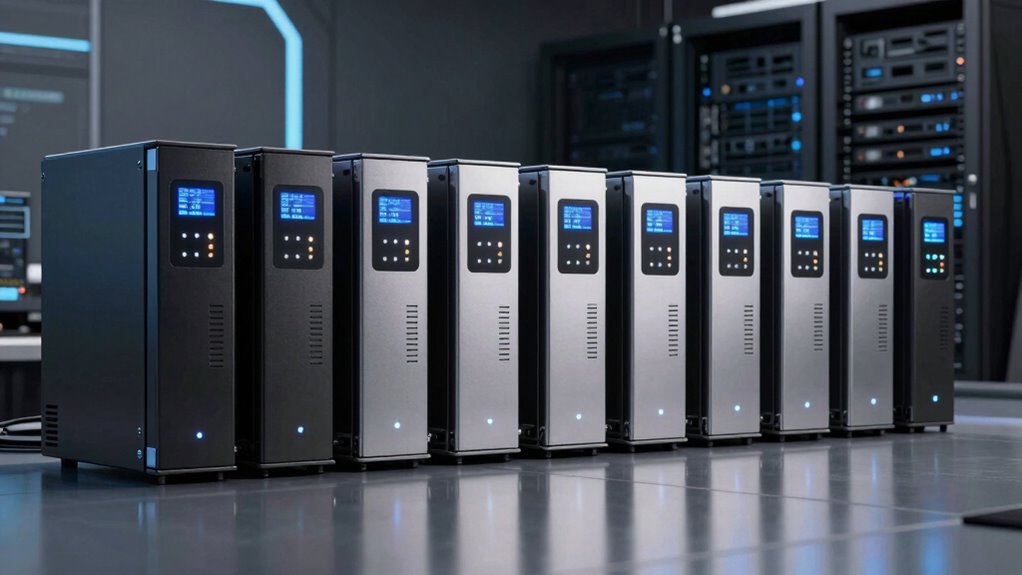

For AI workstation protection, my best overall pick is the CyberPower CP1500PFCLCD: its pure sine-wave output and 1500VA capacity make it a strong match for demanding systems with active PFC power supplies. The Vertiv PSA6-1350LVT is a compelling alternative for buyers who value line-interactive regulation, while the CyberPower CP2000PFCRM2U suits heavier setups that need a rack-mount format. The main tradeoff is between enough watt capacity and runtime for your actual GPU load, versus a smaller, simpler unit that protects only essential gear. Read on for the full comparison and practical guidance on matching a UPS to your workstation.

Get business pricing on tech for your team
- Business-only prices and quantity discounts
- Tax-exempt purchasing
- Multiple users, one account, clear invoices
Complete the kit
Key Takeaways
- Pure sine-wave output separates the strongest workstation candidates: the CyberPower CP1500PFCLCD and rack-mount CP2000PFCRM2U are more suitable starting points for many active-PFC power supplies than basic standby models.
- VA alone does not tell you whether a UPS can support an AI build: compare watt capacity with the workstation’s actual draw; the listed 1500VA models vary in watt rating, including the 900W SKE SK1500 and CyberPower CP1500AVRLCD3.
- Small standby units fit a narrower role: the CyberPower ST625U, SL700U, and APC BE600M1 are better considered for modest loads or essential peripherals than a high-draw GPU workstation.
- Line-interactive models offer a middle ground: picks such as the Vertiv PSA6-1350LVT and CyberPower CST135UC2-R can suit buyers seeking voltage regulation without stepping straight to a larger, more specialized unit.
- Outlets, monitoring, and form factor affect day-to-day usefulness: LCD-equipped desktop models, USB-connected options, and the rack-mount CP2000PFCRM2U address different setups, so the best fit depends on what must stay powered and where the UPS will sit.
| CyberPower ST625U 625VA/360W Standby UPS Battery Backup and Surge Protector |  | Best Value for Basic Home Office Needs | Capacity: 625VA/360W | Output: Simulated sine wave | Outlets: 8 NEMA 5-15R (4 backup, 4 surge only) | VIEW ON AMAZON | See Our Full Breakdown |
| SKE SK1500 1500VA/900W UPS Battery Backup and Surge Protector |  | Best for Mid-Size Critical Systems with Voltage Regulation | Capacity: 1500VA/900W | Output: 120V | Outlets: 8 total: 6 with backup, 2 surge only | VIEW ON AMAZON | See Our Full Breakdown |
| CyberPower CP1500PFCLCD PFC Sinewave UPS Battery Backup and Surge Protector |  | Best for Active PFC Power Supplies and Critical Workstations | Capacity: 1500VA/1000W | Output waveform: Sine wave | Outlets: 12 NEMA 5-15R (6 backup, 6 surge only) | VIEW ON AMAZON | See Our Full Breakdown |
| Vertiv PSA6-1350LVT 1350VA/850W Line-Interactive Desktop UPS |  | Best for Desktop-Level Power Stabilization and Easy Maintenance | Capacity: 1350VA/850W | Input voltage: 120VAC | Outlets: 6 battery/ surge, 2 surge only | VIEW ON AMAZON | See Our Full Breakdown |
| APC BX1500M 1500VA UPS Battery Backup and Surge Protector |  | Best for Balanced Power and Long-Term Ownership | Capacity: 1500VA/900W | Input/output voltage: 120V | Outlets: 5 backup/ surge, 5 surge only | VIEW ON AMAZON | See Our Full Breakdown |
| CyberPower EC850LCD Ecologic UPS Battery Backup and Surge Protector |  | Best for Peripheral Power Management | Capacity: 850 VA / 510 W | Outlets: 12 NEMA 5-15R: 6 battery backup and surge protected; 6 surge protected, including 3 ECO controlled | Output waveform: Simulated sine wave | VIEW ON AMAZON | See Our Full Breakdown |
| CyberPower CP1500AVRLCD3 1500VA/900W LCD UPS Battery Backup |  | Best for Workstations with Voltage Fluctuations | Capacity: 1500 VA / 900 W | Output waveform: Simulated sine wave | Outlets: 12 NEMA 5-15R: 6 battery backup and surge protected; 6 surge protected | VIEW ON AMAZON | See Our Full Breakdown |
| Vertiv Liebert PowerUPS 200 PSA6E-1000LVT 1000VA UPS Battery Backup |  | Best for Replaceable-Battery Ownership | Model: PSA6E-1000LVT | Capacity: 1000 VA | Maximum power: 550 W | VIEW ON AMAZON | See Our Full Breakdown |
| Vertiv Liebert PowerUPS 200 PSA6E-1500LVT UPS Battery Backup, 1500VA |  | Best Vertiv Pick for Higher Workstation Loads | Capacity: 1500 VA | Maximum power: 850 W | Voltage: 120 V | VIEW ON AMAZON | See Our Full Breakdown |
| APC Back-UPS BE600M1 600VA Battery Backup and Surge Protector |  | Best Compact Pick for Networking Gear | Capacity: 600 VA / 330 W | Battery-backed outlets: 5 | Surge-only outlets: 2 | VIEW ON AMAZON | See Our Full Breakdown |
| CyberPower SL700U Standby UPS Battery Backup and Surge Protector |  | Best Slim Backup for Lower-Power Workstations | Capacity: 700VA / 370W | Output waveform: Simulated sine wave | Outlets: 8 total: 5 battery backup and surge protected, 3 surge protected | VIEW ON AMAZON | See Our Full Breakdown |
| APC Back-UPS BE850G2 850VA Battery Backup and Surge Protector |  | Best for Beginner Home-Office Protection | Capacity: 850VA / 450W | Outlets: 9 NEMA outlets: 6 battery backup and surge protected, 3 surge-only | Runtime: Up to 35 minutes at a 100W load | VIEW ON AMAZON | See Our Full Breakdown |
| CyberPower CP2000PFCRM2U PFC Sine Wave UPS Battery Backup |  | Best Rackmount Sine-Wave Pick | Capacity: 2000VA / 1200W | Input voltage: 120 volts | Input connector: NEMA 5-20P | VIEW ON AMAZON | See Our Full Breakdown |
| CyberPower CST135UC2-R Line-Interactive UPS Battery Backup |  | Best Desktop Balance for Midrange Workstations | Capacity: 1350VA / 810W | Output waveform: Simulated sine wave | Input and output voltage: 120V input; 120V AC output | VIEW ON AMAZON | See Our Full Breakdown |
| ups units for ai workstation protection | Capacity | Outlets | Warranty |
|---|---|---|---|
| CyberPower ST625U 625VA/360W S | 625VA/360W | 8 NEMA 5-15R (4 backup, 4 surge only) | 3 years, including battery |
| SKE SK1500 1500VA/900W UPS Bat | 1500VA/900W | 8 total: 6 with backup, 2 surge only | — |
| CyberPower CP1500PFCLCD PFC Si | 1500VA/1000W | 12 NEMA 5-15R (6 backup, 6 surge only) | — |
| Vertiv PSA6-1350LVT 1350VA/850 | 1350VA/850W | 6 battery/ surge, 2 surge only | — |
| APC BX1500M 1500VA UPS Battery | 1500VA/900W | 5 backup/ surge, 5 surge only | — |
| CyberPower EC850LCD Ecologic U | 850 VA / 510 W | 12 NEMA 5-15R: 6 battery backup and surge protected; 6 surge protected, including 3 ECO controlled | 3 years, including battery |
| CyberPower CP1500AVRLCD3 1500V | 1500 VA / 900 W | 12 NEMA 5-15R: 6 battery backup and surge protected; 6 surge protected | 3 years, including battery |
| Vertiv Liebert PowerUPS 200 PS | 1000 VA | 6 NEMA outlets | Conflicting listing details: two years in the product description and three years in item highlights |
| Vertiv Liebert PowerUPS 200 PS | 1500 VA | 8 NEMA outlets | Conflicting listing details: two years and three years |
| APC Back-UPS BE600M1 600VA Bat | 600 VA / 330 W | — | — |
| CyberPower SL700U Standby UPS | 700VA / 370W | 8 total: 5 battery backup and surge protected, 3 surge protected | 3 years, including the battery |
| APC Back-UPS BE850G2 850VA Bat | 850VA / 450W | 9 NEMA outlets: 6 battery backup and surge protected, 3 surge-only | 3 years |
| CyberPower CP2000PFCRM2U PFC S | 2000VA / 1200W | — | 3 years, including the battery |
| CyberPower CST135UC2-R Line-In | 1350VA / 810W | 10 NEMA 5-15R: 5 battery backup, 5 surge-only | — |
More Details on Our Top Picks
CyberPower ST625U 625VA/360W Standby UPS Battery Backup and Surge Protector
The CyberPower ST625U stands out for providing reliable battery backup and surge protection in a compact, affordable package. Its eight outlets include four with battery backup, making it suitable for essential electronics like routers and modems, especially where budget constraints exist. Compared to larger models like the SKE SK1500, it offers a shorter runtime—around two minutes—which limits its ability to handle extended outages but suffices for brief power fluctuations or shutdowns. The inclusion of USB charging ports adds convenience for charging devices without occupying outlets. However, the listed runtime of only 2 minutes is a notable limitation if longer backup periods are needed, and the USB ports sharing 2.1A reduces charging speed when multiple devices are connected. This pick is ideal for users seeking basic, dependable protection without complexity, but not for those needing prolonged backup or high-power loads.
Pros:- Affordable and reliable battery backup and surge protection
- Eight outlets, including four with battery backup
- Two USB charging ports for convenience
- Three-year warranty including the battery
Cons:- Limited runtime of only 2 minutes under typical load
- USB ports share a single 2.1A output, reducing charging speed when both are used
Best for: Home office users with low to moderate power needs who prioritize affordability and simplicity.
Not ideal for: Power users or small businesses requiring longer runtime or higher power capacity for critical AI workstation components.
- Capacity:625VA/360W
- Output:Simulated sine wave
- Outlets:8 NEMA 5-15R (4 backup, 4 surge only)
- USB Charging:2 ports, 2.1A shared
- Input:120V, 5 ft cord
- Surge Protection:890 joules
- Runtime:2 minutes
- Warranty:3 years, including battery
Our verdict“This UPS offers solid basic protection for home office setups but falls short for longer outages or demanding AI workloads.”
SKE SK1500 1500VA/900W UPS Battery Backup and Surge Protector
The SKE SK1500 is designed for larger setups, offering 1500VA/900W capacity and features like automatic voltage regulation (AVR), making it well-suited for protecting more demanding equipment such as AI workstations and network gear. Its LCD display provides detailed real-time info, surpassing the basic LED indicators of the CyberPower ST625U. The inclusion of power management software and audible alarms makes it easier to monitor and control during outages. Compared with the CyberPower CP1500PFCLCD, it provides a similar capacity but has fewer outlets (6 with backup instead of 12) and is heavier, at 26 pounds. The 6 outlets with battery backup are enough for most critical components, but the 2 surge-only outlets may limit flexibility. Its weight and size could be a concern for smaller desks or frequent mobility. This model best fits small data centers or advanced home offices where detailed power monitoring and voltage stabilization are needed without the highest capacity.
Pros:- High capacity with 1500VA/900W power support
- Automatic voltage regulation stabilizes power input
- Detailed LCD status display
- Includes power management software
Cons:- Heavy at 26 pounds, less portable
- Only 6 outlets with backup, limiting expansion
Best for: IT professionals or power users needing stable voltage and detailed status for mid-sized AI workstations.
Not ideal for: Users with limited space or those seeking lightweight, portable backup solutions for casual setups.
- Capacity:1500VA/900W
- Output:120V
- Outlets:8 total: 6 with backup, 2 surge only
- Display:LCD
- Voltage Regulation:Yes, AVR
- Weight:26 pounds
Our verdict“This UPS is best for professionals needing stable power and detailed monitoring but less suited for lightweight or mobile environments.”
CyberPower CP1500PFCLCD PFC Sinewave UPS Battery Backup and Surge Protector
The CyberPower CP1500PFCLCD excels where the power demands are high, supporting active PFC power supplies common in advanced AI workstations. Its sine wave output ensures compatibility with sensitive equipment, reducing risk of damage or performance issues. With 12 outlets—half with battery backup—it offers extensive coverage for multiple devices, including networking gear. The LCD display provides comprehensive real-time data, aiding in proactive management. Compared to the SKE SK1500, it includes a more detailed display and slightly more outlets, but it’s heavier at nearly 25 pounds. The relatively high capacity and sine wave support make it suitable for high-end systems, though the weight and limited number of outlets with backup could be constraints for smaller setups. This model best serves AI workstations with active PFC components requiring smooth, stable power.
Pros:- Supports active PFC power supplies with sine wave output
- 12 outlets for extensive device coverage
- LCD status panel for detailed monitoring
- Three-year warranty including batteries
Cons:- Relatively heavy at 24.9 pounds
- Only six outlets with battery backup, limiting some configurations
Best for: Power-intensive AI workstations with active power factor correction needs and multiple critical peripherals.
Not ideal for: Lightweight or portable setups, or users seeking a compact UPS with fewer outlets for small-scale applications.
- Capacity:1500VA/1000W
- Output waveform:Sine wave
- Outlets:12 NEMA 5-15R (6 backup, 6 surge only)
- USB ports:1 Type-A, 1 Type-C
- Input plug:NEMA 5-15P right angle
- Voltage regulation:Yes, AVR
- Dimensions:14 x 3.9 x 11 inches
- Weight:24.9 pounds
Our verdict“This UPS provides reliable, high-quality power for demanding AI workstations but may be too heavy for portable needs.”
Vertiv PSA6-1350LVT 1350VA/850W Line-Interactive Desktop UPS
The Vertiv PSA6-1350LVT offers a straightforward, reliable solution for desktop setups, combining automatic voltage regulation (AVR) with user-replaceable batteries. Its 1350VA/850W capacity makes it suitable for small to medium AI workstations that do not require extensive backup time. The LCD display provides useful real-time insights, and the USB ports support charging and management. Compared to the CyberPower ST625U, it provides a higher capacity and better power stabilization, but it still uses a simulated sine wave, which could pose issues for sensitive or high-end equipment. The lead-acid batteries require periodic replacement, adding long-term maintenance but keeping initial costs lower. This model suits users who need stable power with minimal fuss and are comfortable with some maintenance.
Pros:- Automatic voltage regulation stabilizes power input
- User-replaceable batteries simplify ongoing maintenance
- Affordable and straightforward design
- Includes LCD for real-time monitoring
Cons:- Simulated sine wave output may not suit sensitive equipment
- Batteries require periodic replacement, adding ongoing costs
Best for: Desktop users with moderate power needs who prioritize power stabilization and simple setup.
Not ideal for: Users with high-demand AI workloads or those requiring long runtime for critical systems.
- Capacity:1350VA/850W
- Input voltage:120VAC
- Outlets:6 battery/ surge, 2 surge only
- Batteries:User-replaceable
- Display:LCD
- Form factor:Tower
Our verdict“This UPS offers a dependable power stabilization solution for desktop AI setups but isn’t suited for high-demand or prolonged outages.”
APC BX1500M 1500VA UPS Battery Backup and Surge Protector
The APC BX1500M offers a solid balance of capacity and features for protecting AI workstations and home office systems. Its 1500VA/900W capacity supports mid-range setups with multiple devices, and the LCD display provides detailed info on load and battery health—an advantage over simpler models like the CyberPower ST625U. The automatic voltage regulation (AVR) ensures stable power input, preventing fluctuations from affecting sensitive components. Its user-replaceable battery extends the lifespan and simplifies maintenance, making it a good choice for long-term setup management. However, the runtime is dependent on load, and the battery replacement is an additional cost, which could be a consideration for users with tight budgets. This model suits those who want reliable, scalable backup for critical systems without excessive weight or complexity.
Pros:- Reliable battery backup and surge protection
- Automatic Voltage Regulation (AVR) stabilizes power
- LCD status display for detailed info
- User-replaceable battery for longevity
Cons:- Runtime varies with load, not suitable for long outages
- Battery replacement sold separately
Best for: Small to medium AI workstations and home offices seeking dependable, long-term power protection with upgradeability.
Not ideal for: High-demand or large-scale setups requiring extended runtime or high wattage capacity.
- Capacity:1500VA/900W
- Input/output voltage:120V
- Outlets:5 backup/ surge, 5 surge only
- Waveform:Stepped approximation to sine wave
- Display:LCD
- Voltage regulation:Yes, AVR
Our verdict“This UPS provides balanced power support and long-term value for small to medium AI setups, with some ongoing maintenance considerations.”
CyberPower EC850LCD Ecologic UPS Battery Backup and Surge Protector
The EC850LCD suits an AI workstation setup where the router, display, and accessories also need surge protection, but where backup runtime is not the main goal. Its 850 VA / 510 W capacity is below the CP1500AVRLCD3’s 900 W, so I would reserve it for a lower-draw workstation or use it to keep networking and peripherals running rather than powering a demanding GPU system. The LCD makes power and battery conditions easier to check, and ECO Mode can shut down selected peripherals when a connected computer sleeps or turns off. That feature depends on a USB connection. The listed two-minute runtime is a serious limit for saving work or orderly shutdown, so this is better viewed as a brief bridge through interruptions than extended protection.
Pros:- LCD shows battery and power conditions
- ECO-controlled outlets can switch off selected peripherals when the computer sleeps or is off
- 12 outlets accommodate a mix of backed-up and surge-only devices
- Three-year warranty includes the battery
Cons:- Listed runtime is only two minutes, limiting time for a controlled shutdown
- 510 W capacity may not suit a demanding AI workstation
- ECO Mode requires a USB connection to the computer
Best for: AI workstation owners with a modest load who want an LCD and ECO-controlled power for peripherals, networking gear, and a monitor.
Not ideal for: Users running a high-draw GPU workstation or needing time to save work during an outage; its listed runtime is only two minutes and capacity is lower than the CP1500AVRLCD3.
- Capacity:850 VA / 510 W
- Outlets:12 NEMA 5-15R: 6 battery backup and surge protected; 6 surge protected, including 3 ECO controlled
- Output waveform:Simulated sine wave
- Input voltage:120 V
- Surge protection:526 joules
- Runtime:2 minutes
- Battery:Sealed lead acid
- Warranty:3 years, including battery
Our verdict“Choose the EC850LCD for a modest workstation setup where peripheral control and status visibility matter more than extended battery runtime.”
CyberPower CP1500AVRLCD3 1500VA/900W LCD UPS Battery Backup
For a workstation facing frequent minor voltage swings, the CP1500AVRLCD3 has a useful advantage over the EC850LCD: its automatic voltage regulation corrects those fluctuations without switching to battery, helping preserve battery charge for outages. Its 900 W capacity also exceeds the EC850LCD’s 510 W, though buyers still need to match the UPS to the workstation’s actual draw. The color LCD and 12 outlets make it easier to monitor conditions and connect a mix of backed-up equipment and surge-only accessories; USB-A and USB-C ports add charging convenience. The tradeoff is simulated sine wave output, rather than the pure sine-wave output found on some alternatives in the wider roundup. Its listed runtime is only three minutes, so I would treat it as shutdown time, not a way to keep AI workloads running.
Pros:- Automatic voltage regulation addresses minor power fluctuations without drawing on the battery
- 900 W capacity is higher than the EC850LCD’s 510 W
- Color LCD displays battery and power conditions
- 12 outlets and USB-A and USB-C charging ports support a varied workstation setup
Cons:- Simulated sine wave output may not suit buyers seeking pure sine-wave power
- Listed runtime is only three minutes
- 23.8-pound mini-tower requires a stable space
Best for: AI workstation owners with a load within its 900 W capacity who experience frequent minor voltage changes and want an LCD plus multiple outlets.
Not ideal for: Buyers needing pure sine-wave output or substantial time to continue work during an outage; the listed runtime is three minutes.
- Capacity:1500 VA / 900 W
- Output waveform:Simulated sine wave
- Outlets:12 NEMA 5-15R: 6 battery backup and surge protected; 6 surge protected
- USB ports:1 Type-A and 1 Type-C
- Input voltage:120 V
- Runtime:3 minutes
- Form factor:Mini-tower
- Dimensions and weight:13.78 x 3.94 x 10.2 inches; 23.8 pounds
- Warranty:3 years, including battery
Our verdict“Pick the CP1500AVRLCD3 when voltage regulation and 900 W capacity matter more than pure sine-wave output or long backup runtime.”
Vertiv Liebert PowerUPS 200 PSA6E-1000LVT 1000VA UPS Battery Backup
The Vertiv Liebert PSA6E-1000LVT is a sensible fit for a smaller workstation or for protecting network equipment alongside a computer, particularly if battery replacement is a priority. Its user-replaceable battery offers a more maintainable path than the APC BE600M1, whose replacement battery is sold separately, while automatic voltage regulation helps handle power fluctuations. The six NEMA outlets are fewer than the CP1500AVRLCD3’s 12, so I would choose this Vertiv when a simpler, smaller outlet plan matters more than connecting a large group of accessories. Its maximum output is 550 W, a firm ceiling for a workstation with a power-hungry GPU. The listing also gives conflicting two- and three-year warranty durations; I would verify coverage before buying rather than assume the longer term applies.
Pros:- User-replaceable battery supports future maintenance
- Automatic voltage regulation helps stabilize power
- USB-A and USB-C charging ports are included
- LED battery indicators and alarm mute aid status checks
Cons:- 550 W maximum output may be too low for a demanding workstation
- Six NEMA outlets provide fewer connections than the CP1500AVRLCD3
- Warranty duration is inconsistent in the listing
Best for: Owners of a lower-draw workstation or network setup who value a user-replaceable battery, voltage regulation, and a compact footprint.
Not ideal for: AI workstation builders with a high-power GPU, many devices to connect, or a need for clear warranty terms; output is limited to 550 W and the listed warranty duration conflicts.
- Model:PSA6E-1000LVT
- Capacity:1000 VA
- Maximum power:550 W
- Voltage:120 V
- Outlets:6 NEMA outlets
- Ports:USB-A and USB-C
- Battery:User-replaceable
- Dimensions and weight:13.98 x 4.72 x 7.1 inches; 13.7 pounds
- Warranty:Conflicting listing details: two years in the product description and three years in item highlights
Our verdict“Choose this Vertiv for a modest workstation or network setup where battery replacement matters more than high output or numerous outlets.”
Vertiv Liebert PowerUPS 200 PSA6E-1500LVT UPS Battery Backup, 1500VA
Within the Vertiv pair, the PSA6E-1500LVT is the stronger choice for a workstation because its 850 W maximum output is 300 W above the PSA6E-1000LVT’s 550 W. That extra headroom can make it a better match for a more capable desktop, though buyers still need to compare the UPS limit with the workstation’s real draw. Automatic voltage regulation, replaceable batteries, runtime indicators, and alarm mute carry over the practical maintenance and monitoring advantages of the smaller model. It also provides eight outlets, two more than the 1000VA Vertiv, but still fewer than the 12 on the CyberPower CP1500AVRLCD3. Warranty details conflict here too: the listing cites both two and three years. This is the more capable Vertiv, not a guarantee of long runtime or suitability for every high-end build.
Pros:- 850 W maximum output is higher than the PSA6E-1000LVT’s 550 W
- User-replaceable batteries support ongoing maintenance
- Eight outlets provide more connections than the smaller Vertiv model
- Runtime indicators and alarm mute make status checks and alerts easier to manage
Cons:- 850 W output may still be insufficient for some high-draw workstation builds
- Eight outlets are fewer than the CP1500AVRLCD3’s 12
- Warranty duration is inconsistent in the listing
Best for: AI workstation owners seeking a compact Vertiv UPS with up to 850 W output, replaceable batteries, and more outlets than the 1000VA Vertiv model.
Not ideal for: Users whose workstation can exceed 850 W, who need more than eight outlets, or who require unambiguous warranty terms.
- Capacity:1500 VA
- Maximum power:850 W
- Voltage:120 V
- Outlets:8 NEMA outlets
- USB ports:USB-A and USB-C
- Output current:7.08 A
- Battery:User-replaceable
- Dimensions:15.75 x 5.71 x 7.68 inches
- Warranty:Conflicting listing details: two years and three years
Our verdict“Choose the PSA6E-1500LVT over the smaller Vertiv when your workstation needs its higher 850 W ceiling and eight outlets.”
APC Back-UPS BE600M1 600VA Battery Backup and Surge Protector
The APC Back-UPS BE600M1 makes most sense as compact backup for a router, network switch, or low-draw office computer—not as the main protection for a powerful AI workstation. Its 600 VA / 330 W capacity falls well below the 850 W Vertiv PSA6E-1500LVT, making the APC easier to place but much less suited to a GPU-heavy desktop. The specified 23-minute runtime applies at a 100 W load, which gives a useful reference for modest equipment but should not be mistaken for runtime at a workstation’s higher draw. Five battery-backed outlets cover essential devices, while two surge-only outlets leave room for equipment that does not need battery power. Its replaceable battery is useful for long-term upkeep, although the replacement is sold separately.
Pros:- Compact 7.5-pound design is easier to place than the larger workstation-class options
- Five battery-backed outlets plus two surge-only outlets separate essential and nonessential devices
- Replaceable battery supports continued use after battery wear
- USB-A charging port is specified to work during outages
Cons:- 330 W capacity is too limited for many high-draw AI workstations
- The 23-minute runtime applies at a 100 W load and varies with connected equipment
- Replacement battery is sold separately
Best for: Home-office users who want compact backup for a router, network gear, or low-draw computer and can work within a 330 W limit.
Not ideal for: AI workstation owners running a demanding GPU or seeking to back up a high-power desktop; its 330 W capacity is far below the larger Vertiv PSA6E-1500LVT’s 850 W.
- Capacity:600 VA / 330 W
- Battery-backed outlets:5
- Surge-only outlets:2
- Total outlets:7
- USB port:1.5 A USB Type-A
- Runtime:23 minutes at 100 W load
- Dimensions and weight:10.79 x 4.13 x 5.47 inches; 7.5 pounds
- Input/output voltage:120 V
- Replacement battery:APCRBC154, sold separately
Our verdict“Pick the BE600M1 for compact backup of networking gear or a low-draw computer, not for a power-hungry AI workstation.”
CyberPower SL700U Standby UPS Battery Backup and Surge Protector
The slim, wall-mountable design makes the SL700U a tidy choice for protecting a router, external drive, or lower-power workstation where floor space is tight. Its 700VA/370W capacity is well below the APC BE850G2 and the larger CST135UC2-R, so I would not choose it for a power-hungry AI workstation with a discrete GPU. Five battery-backed outlets can keep selected gear alive, while three more provide surge protection only. The listed two-minute runtime is best treated as a window for saving work and shutting down, not continuing a long compute job. Compared with the APC BE850G2, this model is slimmer and lighter, but offers less capacity and far less stated runtime. Its simulated sine wave output is another reason to check power-supply compatibility before connecting a sensitive workstation.
Pros:- Slim profile supports discreet placement and wall mounting
- Eight outlets, including five with battery backup
- Two USB-A charging ports can operate during battery backup
- Three-year warranty includes the battery
Cons:- 370W capacity is restrictive for many GPU-equipped AI workstations
- Listed runtime is only two minutes
- Simulated sine wave may not suit every workstation power supply
Best for: Buyers protecting a modest-power workstation, router, and a few peripherals who need a slim unit that can sit on a desk edge or mount on a wall.
Not ideal for: Owners of high-draw AI workstations or GPUs who need longer runtime, higher wattage capacity, or sine-wave output.
- Capacity:700VA / 370W
- Output waveform:Simulated sine wave
- Outlets:8 total: 5 battery backup and surge protected, 3 surge protected
- USB charging:2 Type-A ports, 2.4A shared
- Listed runtime:2 minutes
- Dimensions:2.76 x 12.76 x 5.4 inches
- Weight:6.8 pounds
- Warranty:3 years, including the battery
Our verdict“Choose the SL700U for compact protection of lower-power workstation gear, but pick a higher-capacity unit for a demanding AI build.”
APC Back-UPS BE850G2 850VA Battery Backup and Surge Protector
The BE850G2 is a straightforward step up from small standby units when the goal is keeping a home-office setup running long enough to save files and shut down cleanly. It supplies 450W of capacity, six battery-backed outlets, and up to 35 minutes at a stated 100W load; that runtime figure should not be mistaken for performance at a heavily loaded AI workstation, where runtime will be shorter. The user-replaceable battery gives this APC an ownership advantage over units that require replacement or service when the battery ages. Compared with the CyberPower SL700U, it has more capacity and a much stronger runtime claim, though it is still not a high-wattage solution for a demanding GPU system. The APC also has nine outlets, but only six receive battery backup, and the replacement battery is sold separately.
Pros:- 850VA/450W capacity exceeds compact standby models such as the SL700U
- Up to 35 minutes of runtime at a 100W load
- User-replaceable battery supports longer-term maintenance
- Nine outlets include six battery-backed connections
Cons:- 450W output can constrain a GPU-heavy workstation
- Replacement battery is sold separately
- Only six of the nine outlets provide battery backup
Best for: New workstation owners who want a familiar desktop UPS for a modest-load PC, router, and NAS, with a battery they can replace themselves.
Not ideal for: Users running a high-power AI workstation who need substantial wattage headroom or meaningful runtime while the system is under compute load.
- Capacity:850VA / 450W
- Outlets:9 NEMA outlets: 6 battery backup and surge protected, 3 surge-only
- Runtime:Up to 35 minutes at a 100W load
- Surge protection:354 joules
- USB ports:2 USB-A, 5V/2.4A shared
- Battery:User-replaceable RBC17; replacement sold separately
- Dimensions:12.87 x 4.13 x 5.47 inches
- Warranty:3 years
Our verdict“Pick the BE850G2 for an approachable home-office UPS with a replaceable battery, not for sustaining a high-draw AI workstation.”
CyberPower CP2000PFCRM2U PFC Sine Wave UPS Battery Backup
For a rack-based AI workstation or supporting compute and network gear, the CP2000PFCRM2U stands apart from the desktop-oriented options: it combines 2000VA/1200W capacity with sine-wave output intended to work with active PFC power supplies. That makes it a more fitting match for many modern workstation power supplies than the simulated-sine CyberPower CST135UC2-R, though buyers still need to compare the UPS output limit with the system’s actual draw. Its 2U, 10.8-inch short-depth chassis suits compact racks, and automatic voltage regulation can handle some voltage shifts without switching to battery. The main limitation is the listed two-minute runtime, so this is a shutdown and ride-through tool rather than a way to keep long AI jobs running through an outage. Remote monitoring cards are optional.
Pros:- Sine-wave output supports active PFC and conventional power supplies
- 1200W capacity is higher than the desktop models in this batch
- Short-depth 2U chassis fits space-constrained racks
- Automatic voltage regulation and color LCD provide useful power management and status information
Cons:- Listed runtime is only two minutes
- Remote monitoring cards are optional
- Rack form factor and NEMA 5-20 connections may not suit typical desk setups
Best for: AI workstation owners with a compatible 120V rack setup who prioritize sine-wave output, rack integration, and higher wattage capacity over extended outage runtime.
Not ideal for: Desktop-only users without rack space, buyers needing long battery operation, or anyone whose system exceeds the unit’s 1200W output limit.
- Capacity:2000VA / 1200W
- Input voltage:120 volts
- Input connector:NEMA 5-20P
- Output outlets:8 NEMA 5-20R
- Rack form factor:2U
- Depth:10.8 inches
- Runtime:2 minutes
- Warranty:3 years, including the battery
Our verdict“Choose the CP2000PFCRM2U for a rack-mounted, sine-wave workstation protection setup, provided two-minute backup is enough for your shutdown plan.”
CyberPower CST135UC2-R Line-Interactive UPS Battery Backup
The CST135UC2-R offers a useful middle ground for desktop buyers who need more headroom than the APC BE850G2 without moving to a rack unit. Its 810W capacity and line-interactive design with automatic voltage regulation give it a stronger fit for a midrange workstation, while AVR can correct minor power fluctuations without drawing on the battery. The LCD makes battery, load, and power status easy to check, and USB-C plus USB-A charging adds convenient device charging during an outage. Against the CyberPower CP2000PFCRM2U, this unit is easier to place beside a desk and has more everyday charging convenience, but it uses simulated sine wave output and offers less capacity. Only five of its ten outlets are battery-backed, so I would reserve those for the workstation and essential network gear.
Pros:- 810W capacity exceeds the APC BE850G2 and slim SL700U
- Automatic voltage regulation corrects minor fluctuations without using battery power
- LCD shows battery, load, and power information
- USB-C and USB-A charging ports add practical charging options
Cons:- Simulated sine wave output may not suit every workstation power supply
- Only five of the ten outlets provide battery backup
- Lower capacity than the rackmount CP2000PFCRM2U
Best for: Desktop AI workstation owners with a moderate-power build who want AVR, a clear LCD, and USB-C charging in a mini-tower form.
Not ideal for: Owners of high-draw GPU systems who need sine-wave output, more than 810W, or battery backup for more than five connected devices.
- Capacity:1350VA / 810W
- Output waveform:Simulated sine wave
- Input and output voltage:120V input; 120V AC output
- Outlets:10 NEMA 5-15R: 5 battery backup, 5 surge-only
- Charging ports:USB-C and USB-A
- Form factor:Mini-tower
- Dimensions:13.7 x 3.9 x 9.8 inches
- Weight:22.3 pounds
Our verdict“Pick the CST135UC2-R for a midrange desktop workstation needing AVR and convenient status monitoring, but choose a sine-wave model for a more demanding build.”

How We Picked
I compared these 14 UPS units through the needs of an AI workstation: usable watt capacity, output waveform, power regulation, backup role, monitoring, and physical fit. I gave greater weight to models whose listed output and power features make them plausible matches for demanding desktop power supplies, while treating small standby units as better choices for lighter equipment or selected peripherals. A higher VA number alone did not earn a higher place; watt capacity and compatibility matter more when a GPU can raise system load sharply.
The order reflects how broadly useful each model appears for workstation protection, balanced against its limits. Pure sine-wave and higher-capacity options lead for demanding builds, while line-interactive models offer a practical middle tier. Compact standby units rank lower for a full AI workstation because their capacity can constrain the system they can support. Since runtime depends on the connected load and battery condition, I treat a UPS as a bridge to safe shutdown—not a promise that a GPU-heavy workload can continue uninterrupted.
Factors to Consider When Choosing Ups Units For Ai Workstation Protection
Choosing a UPS for an AI workstation starts with the system’s real electrical demand, not the size of its case or the headline VA figure. These broader checks can help prevent mismatched capacity, unsuitable connections, and unrealistic expectations about backup time.
Match Watt Capacity to the Whole Setup
Add the workstation, monitor, storage, and network gear you want backed up, then compare that total with the UPS’s watt rating. GPU workloads can draw far more power than idle use, and a system may also have brief load spikes that leave little headroom if the UPS is sized too closely. Do not treat VA and watts as interchangeable: VA describes apparent power, while the watt limit is the direct constraint on powered equipment. Include only devices that genuinely need battery backup; a printer or secondary display can consume capacity better reserved for the workstation. If measured load is near the UPS limit, move up a capacity tier or separate nonessential equipment.
Check Waveform and Power-Supply Compatibility
Some workstation power supplies use active power-factor correction, which can make pure sine-wave output a safer fit during battery operation than the simulated waveform common in basic standby units. Compatibility can vary by power supply and UPS, so check both manufacturers’ specifications rather than assuming every desktop will behave the same. A UPS that runs fine on utility power may respond differently when it switches to battery. If the workstation is expensive or downtime is costly, prioritize a clearly specified waveform and verify compatibility before purchase. Smaller standby models may still make sense for a router, monitor, or lower-draw system, but they are not automatically equivalent substitutes for a workstation-focused model.
Plan for Safe Shutdown, Not a Long GPU Session
UPS runtime falls as connected load rises, and a graphics-heavy workstation can use its battery reserve quickly. The practical goal is usually to keep the system stable long enough to save work and shut down cleanly, not to finish a lengthy model run. Check published runtime estimates at loads close to your expected draw; figures at a light load can overstate what a fully configured workstation will get. Monitoring software or a USB connection can help a supported computer react to an outage, but confirm operating-system support and shutdown features. For longer compute sessions through frequent outages, a generator or a different power strategy may be more appropriate than simply buying a small UPS.
Separate Battery-Backed Outlets From Surge-Only Outlets
Many units provide a mix of outlets, and not every socket offers battery backup. Map the workstation and essential network equipment to battery-backed outlets, then reserve surge-only outlets for accessories that can safely switch off. Count plugs and check outlet spacing before buying; large power adapters can block neighboring sockets. USB charging ports and extra surge outlets are useful, but they do not add battery capacity. A common mistake is connecting every desk device to the UPS and leaving too little watt headroom for the computer itself.
Choose Regulation and Form Factor for Your Power Conditions
Line-interactive UPS units can correct some voltage changes without relying on the battery, which may suit areas with fluctuating mains power and help conserve battery cycles. Standby units are generally simpler choices for lighter loads, while a rack-mount model makes sense when the workstation lives in a rack or equipment cabinet. Consider noise, ventilation, weight, and the space needed to replace or access the battery—not only whether the unit fits under a desk. A larger chassis can offer more capacity, but it may be awkward in a shared workspace. Pick the design around the room and electrical conditions you actually have.
Account for Battery Replacement and Monitoring
A UPS battery is a consumable part, so check whether the battery is replaceable and whether replacements are readily specified for the exact model. Keep the unit’s status and self-test features in view; a UPS that silently loses useful runtime can leave a workstation exposed when an outage arrives. LCDs can make load and battery status easier to read, while software monitoring can support automatic shutdown on compatible systems. These features do not increase the UPS’s power capacity, so avoid paying attention to displays while overlooking the watt limit. For equipment that must recover quickly, also plan regular testing and a shutdown procedure that protects active work.
Frequently Asked Questions
Can a 1500VA UPS run an AI workstation with a high-end GPU?
Possibly, but the 1500VA label alone cannot answer that question. Compare the UPS’s watt limit with the workstation’s expected peak draw, including the GPU, CPU, storage, and attached displays. The listed 1500VA options here do not all share the same watt capacity, so check the exact model specification rather than comparing VA figures alone. Leave headroom for load variation, and treat a UPS close to its limit as a poor match. If your system’s peak demand exceeds the rating, choose a higher-capacity unit or reduce what is connected to battery-backed outlets.
Should I choose pure sine wave for my workstation power supply?
Pure sine-wave output is a prudent choice for many demanding desktops, especially when the power supply uses active PFC. It reduces the chance of compatibility problems when the UPS switches to battery, though the specific PSU and UPS combination still matters. In this lineup, the CyberPower CP1500PFCLCD and CP2000PFCRM2U clearly target buyers who want PFC-oriented sine-wave support. A basic standby unit may be sufficient for a low-draw peripheral setup, but it is a less conservative pick for a costly GPU workstation. Check the power-supply and UPS documentation before relying on battery operation.
How long will a UPS keep my AI workstation running during an outage?
Runtime depends on the connected watt load, battery condition, and the UPS’s available battery capacity. A workstation running a GPU-heavy task can drain reserve far faster than a lightly loaded desktop, so runtime figures at low loads may not reflect your situation. Use the manufacturer’s runtime chart at a load close to your measured system draw. For most workstation buyers, the useful target is enough time to save work and shut down safely, rather than continuing compute through an extended outage. If longer operation is a requirement, plan for a separate power source instead of assuming a desktop UPS will provide it.
Should I plug my monitor and network equipment into the battery-backed outlets?
Back up devices that help you save work or complete a clean shutdown, such as the workstation and, if capacity allows, one monitor and essential network gear. A network connection can matter if you need remote access or software-managed shutdown, but it is less important when the workstation is used locally. Check the UPS outlet map because some sockets may provide surge protection without battery backup. Add the connected devices’ watt draw before assigning them to battery outlets. Avoid using those outlets for high-draw accessories that do not need to stay on during an outage.
When is a smaller standby UPS a better choice than a larger workstation model?
A smaller standby UPS can be a sensible choice when you are protecting a router, external storage, a modest desktop, or selected accessories rather than a high-draw GPU system. It may also fit a tight space or a setup where basic outage protection matters more than higher watt capacity, advanced regulation, or a display. In this roundup, the CyberPower ST625U, SL700U, and APC BE600M1 are more naturally suited to lighter loads than to powering a demanding AI workstation. Before choosing one, calculate the load of every device that needs battery backup and confirm it stays within the UPS’s watt rating. If the workstation itself is near that limit, step up to a more capable model.
Conclusion
For the broadest fit among these picks, my best overall recommendation is the CyberPower CP1500PFCLCD, thanks to its PFC-oriented sine-wave output and 1500VA capacity. The best value direction is the CyberPower CP1500AVRLCD3 for buyers who need a 1500VA desktop unit and can confirm its 900W limit suits their setup; choose it for fit and capacity, not as a substitute for checking waveform needs. My best premium choice is the CyberPower CP2000PFCRM2U for buyers who need a rack-mount format and higher-capacity class. For beginners protecting a modest setup, the APC BE850G2 is a more approachable scale than a large workstation unit, provided the connected load stays within its rating. For specific needs, consider the Vertiv PSA6-1350LVT when line-interactive regulation is a priority, and reserve the smaller standby models for lighter systems or peripherals. The final choice should follow your measured watt demand, preferred outlet layout, and safe-shutdown plan.