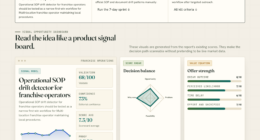
📊 Full opportunity report: A War Room for Your Next Idea: Inside IdeaClyst on ThorstenMeyerAI.com — validation score, market gap, and execution plan.
TL;DR
IdeaClyst is a local-first AI tool designed to help founders rigorously evaluate and develop startup ideas through a structured, debate-driven council. It aims to reduce costly failures by providing rapid, evidence-based validation without data leaving the user’s device.
IdeaClyst has been introduced as a local-first AI tool that functions as a decision-making war room for startup founders, helping them evaluate and develop ideas with structured debates and evidence-based insights. The tool emphasizes privacy, operating entirely on the user’s machine, and aims to reduce costly market failures.
Developed by Thorsten Meyer, IdeaClyst is an open-source application that combines an AI council, discovery engine, and founder workspace to assist entrepreneurs in validating ideas efficiently. It stages structured deliberations among multiple AI models, each playing different roles, to challenge and refine startup concepts. Unlike typical AI tools that offer uncritical approval, IdeaClyst deliberately incorporates disagreement among models to surface potential weaknesses and blind spots. It generates comprehensive founder packets in Markdown that include strategy, architecture, critiques, and validation plans, all stored locally on the user’s device, ensuring data privacy. The tool responds to the high failure rate among startups—particularly the 42% that fail due to lack of market need—by compressing research and validation phases from months into hours. It leverages AI to analyze real-time web data, competitor sites, and discussions, providing evidence-backed insights. This approach aims to help founders avoid the costly trap of building ideas that lack market demand, which industry estimates in 2026 suggest can cost from $35,000 to over $150,000 per project. IdeaClyst’s design explicitly counters the risk of AI echo chambers, where a single model might affirm a flawed idea. Instead, its council format encourages debate, critique, and synthesis, resulting in a more balanced and robust validation process. The open-source, local-first architecture appeals to founders concerned about data privacy and control, setting it apart from cloud-based alternatives.A war room for your next idea
The build isn’t the hard part anymore — conviction is. Knowing which idea deserves the next six months, and being able to defend it. Most founders answer with gut feel and optimistic math. That’s hope wearing a blazer. IdeaClyst replaces it with a process.
The most expensive decision is what to build
The single most valuable thing a tool can do is talk you out of the wrong six months. The numbers make the case better than any pitch.
AI decision-making startup tool
As an affiliate, we earn on qualifying purchases.
As an affiliate, we earn on qualifying purchases.
Three tools in one — on your own machine
Strip away the framing and IdeaClyst is three things at once, all running locally with nothing leaving your laptop.
An AI council
Pressure-tests an idea you bring it — advisors who argue on purpose.
A discovery engine
Finds ideas you didn’t know to look for by hunting real demand signals.
A founder’s workspace
Carries winners from “interesting” all the way to “ready to build.”
local privacy-focused AI app
As an affiliate, we earn on qualifying purchases.
As an affiliate, we earn on qualifying purchases.
Advisors who disagree on purpose
Not one confident, agreeable answer — a structured five-step deliberation where models play different roles and turn on their own work. The disagreement is the feature.
The five-step deliberation
A council that leads with the bad news surfaces the objections you’d otherwise find the expensive way, on month five.
Product strategy
Who’s it for, what’s the wedge, why now, what’s the business model.
Technical architecture
What would it actually take to build — and where’s the risk.
Critique pass
The council turns on its own work. Where’s the hand-waving? What kills this?
Second, independent critique
A different voice, a different angle — so blind spots don’t survive.
Final synthesis
Everything into one coherent founder packet: strategy, architecture, validation, plan.
startup validation software
As an affiliate, we earn on qualifying purchases.
As an affiliate, we earn on qualifying purchases.
When IdeaClyst cites a source, it actually fetched it
The hard departure from “ask an AI what it thinks of my startup.” It runs in a strict, real-data-only mode — if it can’t gather genuine evidence, it says so plainly rather than inventing a plausible paragraph.
Confidence with receipts
No fabricated statistics, no imaginary competitors, no made-up citations. The packet survives a skeptical co-founder or a sharp investor because the reasoning has receipts.
Market research first
Scouts the landscape before the council reasons about anything.
Competitor read
Real positioning, pricing signals, feature claims — differentiation vs. reality.
Validation with links
Not “talk to customers” — concrete signals & sources you can click.
founder idea development tool
As an affiliate, we earn on qualifying purchases.
As an affiliate, we earn on qualifying purchases.
From the blank page to build-ready
Evaluation is half the problem; the blank page is the other half. And a plan is worthless if it dies in a tab you never reopen.
Bring a space, not an idea
“AI for accountants,” “tools for indie game studios” — plus your goal and real capacity. It hunts demand signals across HN, Reddit, Product Hunt, GitHub, pricing pages.
- An honest market read — leads with the bad news when a space is hard
- An opportunity map — high pain, thin competition
- Ranked candidates — wedge, who pays, effort, risk, confidence
- each with KILL CRITERIA — when to walk away
A home and a forward path
Every promising idea gets carried forward, with every artifact in plain files on your disk.
- Validation tooling — sprint board, interview list, evidence browser
- Founder profile — a personal-fit lens; same discovery, different advice
- Build workspaces — funnel, personas, landing draft, version history
- “Build this idea” → a PRD + task queue, ready for a coding agent
Why IdeaClyst Could Transform Startup Validation
IdeaClyst offers a new approach to startup validation by combining AI-driven debate with local data control, potentially reducing wasted investment and accelerating the path to market. Its emphasis on structured disagreement among AI models helps surface weaknesses early, addressing a common failure point for startups. For founders, this means more informed decision-making and less reliance on gut feeling or expensive external validation processes. If widely adopted, it could shift how early-stage companies approach idea testing, making validation faster, cheaper, and more reliable.
The Rise of AI-Enhanced Startup Tools in 2026
By 2026, AI tools have become integral to startup development, with many platforms offering automation in coding, design, and customer research. However, most tools focus on execution rather than strategic validation. Industry reports highlight that a significant portion of startup failures stem from poor market fit, often discovered too late. Traditional validation methods, involving surveys and consulting, remain costly and time-consuming. IdeaClyst emerges in this landscape as a locally operated, privacy-conscious alternative that aims to streamline the critical early validation phase by leveraging AI for rapid, evidence-based insights.
“Our goal is to give founders a structured, debate-driven space to rigorously test their ideas, all while keeping their data private and under their control.”
— Thorsten Meyer, creator of IdeaClyst
Unanswered Questions About IdeaClyst’s Adoption and Effectiveness
It is not yet clear how widely IdeaClyst will be adopted by startups or how effective it will be in preventing market failures compared to traditional validation methods. The actual impact on reducing failure rates remains to be seen, and user feedback from early adopters is still emerging. Additionally, how the AI council’s debates translate into real-world decision-making outcomes is an open question.
Next Steps for IdeaClyst and Its Developer Community
The developers plan to release further updates based on early user feedback, aiming to improve the AI council’s debate quality and integration with existing workflows. They also intend to promote adoption among early-stage startups and incubators. Monitoring user experiences and success stories over the coming months will be key to assessing its real-world impact. Additionally, the open-source community may contribute to expanding its capabilities or integrating it with other tools.
Key Questions
How does IdeaClyst ensure data privacy?
IdeaClyst operates entirely on the user’s local machine, storing all ideas, reports, and plans as plain files without sending data to external servers or cloud services.
Can IdeaClyst replace traditional market research?
It is designed to accelerate and supplement research, not replace direct customer engagement. It compresses research phases but does not eliminate the need for actual customer conversations.
Is IdeaClyst suitable for all startup stages?
It primarily targets early-stage validation but can be useful throughout the development process for ongoing idea refinement and risk assessment.
How does the AI council work in practice?
It stages a structured five-step debate among different AI models, each playing distinct roles such as strategist, architect, critic, and synthesizer, to challenge and refine the idea.
Is IdeaClyst open source?
Yes, it is released under the MIT license, allowing users to customize and contribute to its development.
Source: ThorstenMeyerAI.com