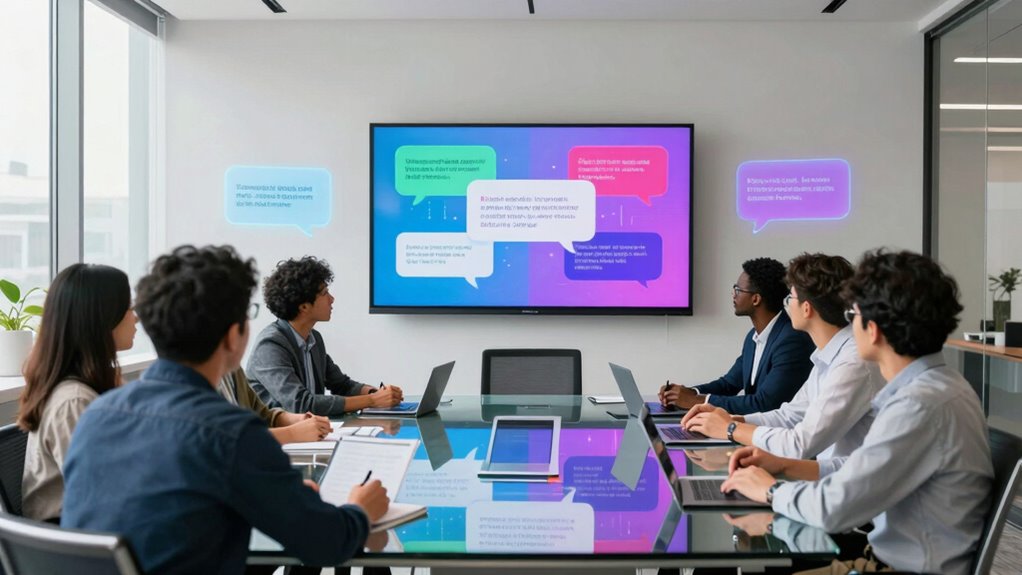

AI helps your team work across languages and markets by providing real-time translation and cultural insights. It enables you to communicate authentically with diverse audiences, respecting customs and norms. AI automates localization and maintains brand consistency, saving time and resources. It also offers targeted insights to customize messages and improve engagement. As you explore further, you’ll discover how these tools can transform your international collaboration and elevate your global outreach efforts.

Get business pricing on tech for your team
- Business-only prices and quantity discounts
- Tax-exempt purchasing
- Multiple users, one account, clear invoices
Key Takeaways
- AI automates and accelerates translation processes, enabling faster communication across languages and markets.
- It analyzes cultural nuances to ensure messaging resonates authentically and avoids miscommunications.
- AI maintains brand consistency by aligning tone and style across diverse languages and regions.
- Real-time translation tools facilitate instant cross-country collaboration, reducing delays and misunderstandings.
- AI-driven insights help tailor targeted outreach strategies based on cultural preferences and market trends.

In today’s interconnected world, AI is transforming the way teams collaborate across different languages and markets. As you work with international clients or partners, you quickly realize that effective communication isn’t just about translating words—it’s about understanding cultural nuances and expectations. AI-powered tools are now essential in helping you navigate these complexities, enabling smoother interactions and stronger relationships. By leveraging AI for cultural adaptation, you can ensure your messaging resonates with diverse audiences, respecting their customs, idioms, and social norms. This makes your outreach more authentic and increases engagement, whether you’re marketing a product or negotiating a deal.
One of the most significant ways AI supports global collaboration is through advanced localization strategies. Instead of relying solely on manual translation, which can be slow and prone to errors, AI automates and accelerates the process. Machine learning algorithms analyze context, idiomatic expressions, and cultural references to produce more accurate and culturally sensitive content. This means you can quickly adapt websites, marketing materials, or customer support content to suit different markets without sacrificing quality. As a result, your team saves time and resources while expanding your reach more effectively.
AI also helps you maintain consistency across multiple languages and regions. When managing large-scale international campaigns, it’s easy to lose track of tone, style, and messaging nuances. AI tools can ensure your brand voice remains uniform, even as you customize content for specific markets. This consistency builds trust with your audience and reinforces your brand identity. Additionally, AI-driven insights can identify cultural preferences and trends, allowing you to tailor your strategies in real-time and stay ahead of competitors. Incorporating cultural insights into your planning can further enhance your ability to connect authentically with diverse audiences. Understanding cultural nuances is crucial for building meaningful relationships and avoiding miscommunications.
Furthermore, AI makes cross-cultural communication more efficient by breaking down language barriers. Real-time translation tools facilitate instant conversations with partners in different countries, reducing misunderstandings and delays. These tools continuously learn and improve, becoming more accurate over time. This means your team can collaborate seamlessly without language getting in the way, fostering innovation and faster decision-making. Incorporating projector technology into presentations can also enhance visual communication, making complex information more accessible across diverse audiences. Incorporating AI-driven insights further enhances your understanding of cultural trends and preferences, enabling more targeted and effective outreach. By combining AI with dog breeds and their unique traits, teams can better tailor their communication styles to resonate with specific cultural audiences.
real-time language translation device
As an affiliate, we earn on qualifying purchases.
As an affiliate, we earn on qualifying purchases.
Frequently Asked Questions
How Accurate Are AI Translations in Specialized Industries?
AI translations in specialized industries can be quite accurate, especially when they incorporate industry-specific terminology and contextual understanding. You’ll find that AI tools excel at capturing technical language, but they still need human review for nuanced meanings or complex concepts. Overall, the technology is improving rapidly, making it a reliable option for facilitating cross-language communication, though it’s best to combine AI with expert oversight for critical, industry-specific content.
Can AI Adapt to Regional Dialects and Slang?
AI can definitely adapt to regional dialects and slang, but it’s not quite hitting the bull’s-eye yet. It learns from vast data, so the more it’s exposed to local variations, the better it gets. However, slang and dialects evolve quickly, and AI sometimes lags behind. You’ll find it works well for common expressions, but for the freshest slang, a human touch still makes a difference.
What Are the Risks of Relying on AI for Multilingual Communication?
Relying on AI for multilingual communication can pose risks like bias concerns, where algorithms may misinterpret or favor certain dialects or viewpoints. Privacy issues also arise, as sensitive data might be exposed or mishandled during translation or analysis. You should stay vigilant, verify AI outputs, and guarantee robust data protection measures. Otherwise, you risk miscommunication, ethical breaches, and potential damage to trust within your international team.
How Does AI Handle Cultural Nuances in Messaging?
AI handles cultural nuances by incorporating cultural sensitivity into its algorithms, ensuring that messages respect different traditions and values. It adapts tone based on the target audience, making communication more effective and appropriate. You can rely on AI to recognize subtle cues, adjust language style, and maintain respectful, culturally aware messaging. This helps bridge cultural gaps, fostering better understanding and stronger relationships across diverse markets.
Is Real-Time Multilingual Support Feasible With Current AI Technology?
Think of AI as a multilingual bridge builder, connecting you instantly across language gaps. Yes, real-time multilingual support is feasible today, enabling seamless multilingual customer service. AI effectively reduces language barriers, allowing you to communicate with global clients without delays. For example, companies now resolve inquiries in multiple languages simultaneously, demonstrating that current AI technology can deliver quick, accurate responses, making international communication faster and more efficient.
multilingual collaboration software
As an affiliate, we earn on qualifying purchases.
As an affiliate, we earn on qualifying purchases.
Conclusion
As you embrace AI’s power, you’ll find breaking down language barriers feels like having a trusty sidekick from the Jetsons. It’s like having a universal translator at your fingertips, making global collaboration smoother than ever. With AI’s help, your team can conquer markets, share ideas, and innovate without missing a beat—no more waiting for the fax machine to catch up. In this brave new world, AI is your secret weapon for seamless, cross-cultural teamwork.
As an affiliate, we earn on qualifying purchases.
cultural insights analytics platform
As an affiliate, we earn on qualifying purchases.
As an affiliate, we earn on qualifying purchases.
Halloween Picks
halloween
As an affiliate, we earn on qualifying purchases.