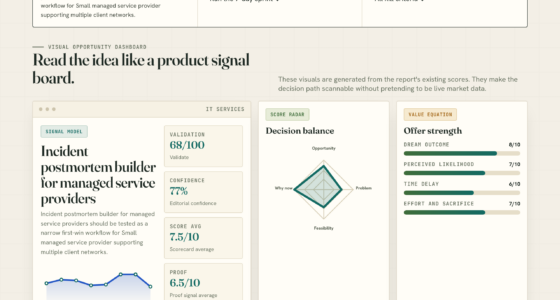

📊 Full opportunity report: Why Building An AI-First Finance Function Was A Game-Changer on ThorstenMeyerAI.com — validation score, market gap, and execution plan.

Get business pricing on tech for your team
- Business-only prices and quantity discounts
- Tax-exempt purchasing
- Multiple users, one account, clear invoices
TL;DR
OpenAI has released an account of lessons learned from building an AI-native finance function. While the report offers insights, specific results and implementation details remain unconfirmed, making the full impact uncertain.
OpenAI has published an article titled “What building an AI-native finance function taught me,” presenting lessons learned from developing a finance operation centered around artificial intelligence. The publication is a firsthand account but does not include detailed results, specific systems used, or performance metrics. This development is significant because it signals a shift toward integrating AI deeply into core finance processes, potentially transforming how finance departments operate and make decisions.
The article, attributed to OpenAI, describes the creation of what it calls an AI-native finance function—a model where AI is embedded into workflows from the outset. However, the publication does not specify which AI tools or systems were employed, nor does it provide data on cost reductions, efficiency gains, or accuracy improvements. It also does not clarify whether the project involved a live finance team or was a conceptual or experimental effort.
While the narrative suggests that AI can reshape finance operations—potentially automating routine tasks, supporting decision-making, and improving control—these claims lack concrete evidence or independent verification. The report emphasizes lessons learned but stops short of offering measurable outcomes or benchmarks, leaving the actual impact uncertain.
Potential Impact of AI-First Finance Models
This development is relevant because finance functions handle sensitive, regulated data and influence critical business decisions. Embedding AI into these processes could lead to increased efficiency, reduced errors, and faster reporting if proven effective. However, without verified results, it remains unclear whether organizations can safely adopt similar models at scale. The account highlights both opportunities and risks, such as maintaining control, ensuring auditability, and managing model errors, which are vital considerations for finance leaders contemplating AI integration.
As an affiliate, we earn on qualifying purchases.
Limited Details on AI-Driven Finance Initiatives
Historically, finance teams have used software for automation tasks like accounting, forecasting, and reporting. The concept of an AI-native finance function implies a broader redesign where AI influences workflows from the ground up, rather than as an add-on. The publication from OpenAI follows broader industry interest in AI’s potential to transform enterprise functions, but it does not specify whether this was a pilot project, a full-scale deployment, or a conceptual framework.
Previous efforts in automation focused on incremental improvements; this account suggests a more fundamental shift but lacks the detailed evidence needed to assess scalability or safety. The absence of independent validation or detailed methodology means the actual benefits and risks remain unknown.
automated financial reporting tools
As an affiliate, we earn on qualifying purchases.
As an affiliate, we earn on qualifying purchases.
Unverified Performance and Implementation Details
It is not yet clear which organizations or teams built the AI-native finance function, what specific AI tools were used, or whether the project was tested in live operational environments. The publication does not provide benchmarks, cost data, error rates, or compliance assessments. Consequently, the actual effectiveness, safety, and scalability of the approach remain unconfirmed, and the potential for wider adoption is uncertain.
As an affiliate, we earn on qualifying purchases.
Awaiting Detailed Results and Independent Validation
The next step is for OpenAI or other organizations to publish comprehensive details, including methodology, performance metrics, and independent evaluations. Future research should focus on verifying whether AI-native models can reliably improve financial accuracy, control, and efficiency without compromising compliance or auditability. Stakeholders will need clear evidence before considering large-scale adoption.
financial decision support AI tools
As an affiliate, we earn on qualifying purchases.
As an affiliate, we earn on qualifying purchases.
Key Questions
What does ‘AI-native finance function’ mean?
The term suggests a finance operation where AI is embedded into workflows from the beginning, rather than being an add-on or automation tool. However, the specific scope and implementation details are not yet defined in the published account.
Are there confirmed benefits from this AI approach?
No, the publication does not include verified data or measurable results. Claims about improvements are based on lessons learned, without independent validation or performance metrics.
Will this change how finance teams work?
Potentially, yes. AI-native models could automate routine tasks, support decision-making, and alter staffing needs. But until more details are available, the extent of these changes remains uncertain.
Is this approach safe and compliant?
It is not yet clear. The publication does not address controls, auditability, or regulatory compliance, which are critical considerations for finance functions handling sensitive data.
When will more information be available?
The next step is the publication of detailed results, methodology, and independent assessments, which are currently not available.
Source: ThorstenMeyerAI.com
Halloween Picks
halloween
As an affiliate, we earn on qualifying purchases.