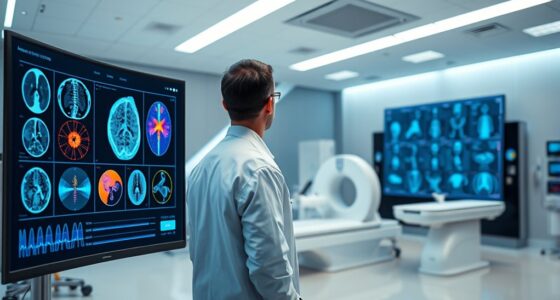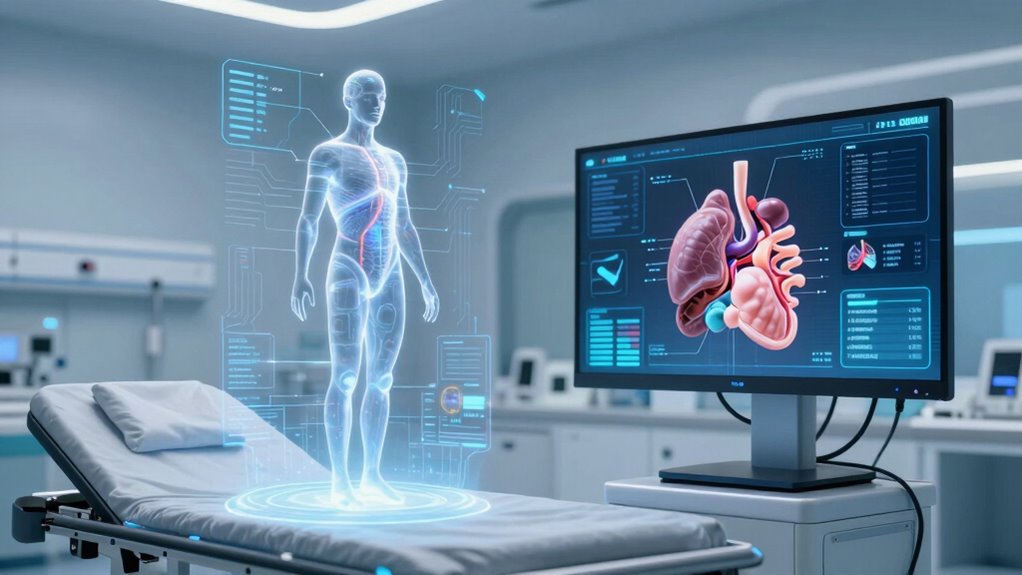
AI and digital twins are transforming personalized healthcare by analyzing vast health data to improve diagnostics and create tailored treatments. Digital twins, virtual replicas of your physiology, help predict health outcomes and optimize care plans. These technologies make healthcare more precise and proactive, but they also raise important questions about data privacy, ethics, and patient control. If you want to understand how these innovations can benefit you while ensuring responsible use, there’s more to discover ahead.
Key Takeaways
- AI analyzes large health data to improve diagnostics and customize treatment plans for individual patients.
- Digital twins create virtual models of a patient’s physiology to predict health outcomes and optimize care.
- These technologies enable more precise, personalized healthcare while raising data privacy and security concerns.
- Ethical oversight ensures fair, unbiased use of AI and digital twins, safeguarding patient rights and accuracy.
- Responsible innovation balances technological advances with ethical standards, transparency, and patient trust.
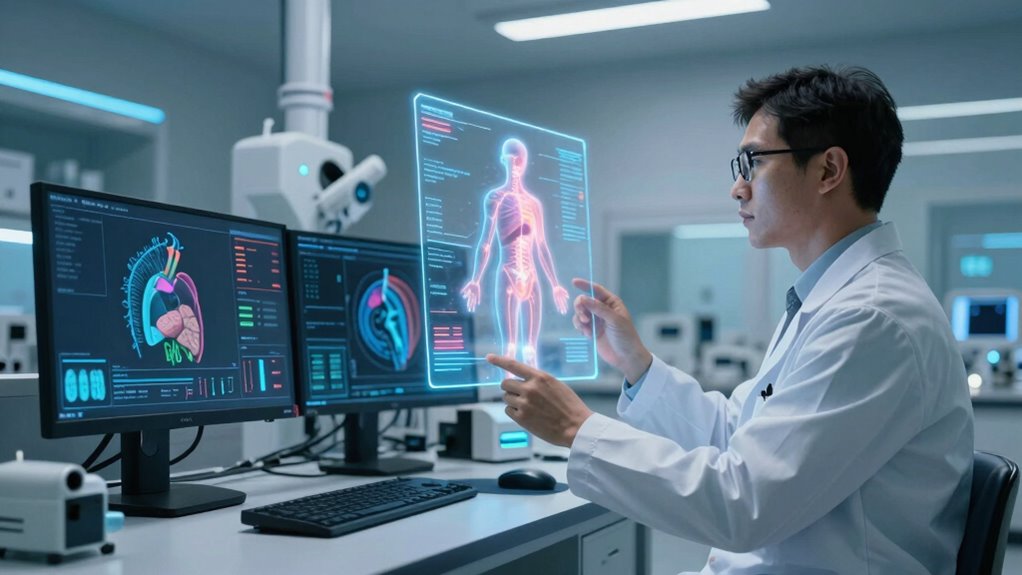
Advancements in artificial intelligence and digital twin technology are transforming personalized healthcare by enabling more accurate diagnostics and tailored treatment plans. As these technologies become more integrated into your healthcare journey, it’s vital to reflect on the ethical implications and data privacy concerns they bring. You might wonder how your personal health information is protected and whether the use of AI respects your autonomy and rights. These questions are central to ensuring that innovative healthcare solutions serve your best interests without compromising your privacy or ethical standards.
AI and digital twins are revolutionizing personalized healthcare, raising important questions about privacy, ethics, and patient rights.
When AI systems analyze vast amounts of health data, they generate insights that can revolutionize your care. However, the sensitive nature of your health information means that data privacy must be prioritized. Healthcare providers and tech developers are responsible for implementing robust security measures to prevent unauthorized access or breaches. You should feel confident that your data is stored securely, anonymized when necessary, and used solely for your benefit. Transparency about how your data is collected, stored, and shared helps build trust and reassures you that your privacy is respected. Additionally, understanding the role of requirements traceability and other technological factors can influence how you perceive and trust these innovations. Incorporating data security protocols is essential to maintaining the integrity of your health data and fostering confidence in these emerging technologies. It is also important to recognize the role of ongoing ethical oversight in overseeing these advancements to ensure they align with societal values and standards.
Ethical considerations extend beyond data security. AI-driven healthcare must balance innovation with fairness, ensuring that algorithms do not perpetuate biases or create disparities. For instance, digital twins—virtual replicas of your physiology—can help doctors predict your health trajectory, but they must be developed with care to avoid inaccuracies that could lead to misdiagnoses or inappropriate treatments. It’s important that the development and deployment of these technologies involve diverse data sets and adhere to ethical standards that prioritize equity and justice.
You also have a role in this evolving landscape. Being informed about how your data is used and advocating for transparent practices can influence how healthcare providers and developers implement AI solutions. Ensuring that your consent is obtained and that you understand how digital twins operate helps you maintain control over your health information. Ethical use of AI in healthcare isn’t just a technical challenge; it’s a shared responsibility to uphold your rights and dignity.
Ultimately, the promise of AI and digital twins in personalized healthcare is significant, but it must be pursued responsibly. By emphasizing data privacy and ethical considerations, the industry can harness these innovations to improve your health outcomes while safeguarding your personal rights. As these technologies advance, staying informed and engaged ensures your healthcare experience remains trustworthy, equitable, and respectful of your individuality.

TensaOne Hidden Camera Detectors – Mini Security Device for Audio Video Wireless Threats, Hotel Safety, Home Privacy and GPS Tracker Detection, Pen RF Spy Cam Voice Recorder Bug Finder for Travelers
MULTI-MODE SWEEPER FOR FULL COVERAGE: 4-in-1 tool scans for Bluetooth, wireless, and radio frequency threats. Use RF mode,…
As an affiliate, we earn on qualifying purchases.
As an affiliate, we earn on qualifying purchases.
Frequently Asked Questions
How Do Digital Twins Adapt to Changing Patient Conditions Over Time?
Digital twins adapt to changing patient conditions through dynamic modeling and real-time monitoring. As new data comes in, the digital twin updates itself, reflecting your current health status. This continuous feedback loop allows healthcare providers to see evolving patterns and adjust treatments promptly. You benefit from precise, up-to-date insights that help improve outcomes, optimize therapies, and anticipate potential issues before they become serious.
What Are the Privacy Concerns With Ai-Driven Personalized Health Data?
You should be aware that AI-driven personalized health data raises privacy concerns related to data security and ethical considerations. Your sensitive information might be vulnerable to breaches if not properly protected, risking misuse or unauthorized access. Ethical issues also come into play regarding consent and data ownership. It’s essential for healthcare providers to implement strict security measures and uphold ethical standards to safeguard your privacy and maintain trust.
How Cost-Effective Is Implementing Digital Twin Technology in Healthcare?
You might think digital twin technology is costly, but it’s actually quite cost-effective in healthcare. Imagine reducing hospital stays and avoiding unnecessary tests—these savings add up fast. The initial investment brings long-term benefits, like improved treatment plans and streamlined workflows. As technology advances, costs decrease even further, making digital twins a smart investment that could transform patient care while saving money. The future of healthcare is closer than you think.
Can Digital Twins Predict Rare or Unexpected Health Events?
Digital twins can assist in predicting rare events and unexpected health triggers by analyzing complex data patterns. While they’re effective at simulating common scenarios, predicting truly rare or unexpected health triggers remains challenging due to limited data. However, as the technology improves and more data becomes available, digital twins will increasingly enhance rare event prediction, helping you proactively address health risks before they escalate.
What Are the Limitations of AI Accuracy in Personalized Treatment Plans?
You might wonder about AI’s accuracy in personalized treatments. The truth is, model bias and data quality can limit its precision. If the data is skewed or incomplete, predictions become less reliable, risking ineffective or even harmful decisions. As you rely on AI, remember these limitations. Improving data collection and addressing biases are essential steps to enhance accuracy and guarantee your treatment plans are truly personalized and effective.

Blockchain and Digital Twin for Smart Hospitals
As an affiliate, we earn on qualifying purchases.
As an affiliate, we earn on qualifying purchases.
Conclusion
As you stand at the crossroads of innovation, AI and digital twins act as your guiding stars, illuminating the path toward personalized healthcare. They weave a tapestry of data and insight, transforming raw information into a symphony of tailored treatments. Embrace this technological dance, where each step brings you closer to a future where health is no longer one-size-fits-all but a masterpiece uniquely crafted for you. The horizon beckons with promise, waiting for you to step into the dawn of medicine’s new era.
UJS 2026 Bluetooth OBD2 Scanner for iPhone & Android – AI Powered Wireless Car Diagnostic Scan Tool, Check Engine Code Reader with Real-Time Data, No Subscription Fee for All Cars and Trucks 1996+
AI-Powered Car Health Reports in Minutes – Get beyond confusing codes. Our scanner connects to your phone and…
As an affiliate, we earn on qualifying purchases.
As an affiliate, we earn on qualifying purchases.

AI-Driven Personalized Healthcare Solutions
As an affiliate, we earn on qualifying purchases.
As an affiliate, we earn on qualifying purchases.