

AI is rapidly transforming drug discovery by speeding up target identification, molecule design, and clinical trials. It helps you analyze vast datasets to find new drug candidates, predict their effectiveness, and personalize treatments. AI also streamlines trial processes, reduces costs, and enhances success rates. With ongoing regulatory support and innovative techniques, AI is paving the way for faster, more efficient development of new medicines. Keep exploring to discover how AI is shaping the future of healthcare.
Key Takeaways
- AI accelerates early-stage drug discovery by analyzing complex biomedical data and exploring vast chemical spaces rapidly.
- Machine learning and deep learning optimize molecule design, predicting properties like efficacy and toxicity to reduce development failures.
- AI enhances clinical trials through patient recruitment, outcome prediction, and safety monitoring, shortening timelines and increasing success rates.
- Integration of multi-omics and real-world data helps identify precise targets and develop personalized therapies efficiently.
- Regulatory support and validation frameworks are fostering trust and safety in AI-driven drug development processes.

Computational Drug Discovery with Python: QSAR, Docking, and Molecular Machine Learning: Design and Predict Molecules with Python (Python for Health Science and Bioinformatics Book 3)
As an affiliate, we earn on qualifying purchases.
As an affiliate, we earn on qualifying purchases.
The Growing Impact of AI on the Pharmaceutical Industry

AI is transforming the pharmaceutical industry at a rapid pace, revolutionizing how drugs are discovered and developed. You see, the AI-driven drug discovery market is projected to grow from about $2.6 billion in 2025 to between $8 billion and $20 billion by 2030, with a CAGR of up to 31%. Major companies like Eli Lilly are launching AI platforms, such as TuneLab, to analyze billions of R&D data points. Regulatory agencies like the FDA now provide guidance on AI use, encouraging broader adoption. Recently, the first AI-designed drug candidate, rentosertib, entered Phase 2 trials, showing promising results. Larger pharma firms are opening their AI platforms to external partners, fostering collaboration. Overall, AI is accelerating innovation and transforming how the industry approaches drug discovery. AI security technologies are also being integrated to ensure data integrity and protect sensitive research information throughout the process. Moreover, regulatory guidance is evolving to better accommodate AI-driven methodologies, supporting safer and more efficient development pipelines. Additionally, ongoing research emphasizes the importance of AI safety measures to prevent vulnerabilities and ensure trustworthy outcomes in critical applications, especially considering the ethical implications associated with AI use in healthcare. As AI models become more sophisticated, the development of robust validation protocols is crucial to ensure reliable and accurate results in drug discovery processes.
24Genetics PHARMACOGENOMICS: DNA Home Test for PGx Pharmacogenomics and Personalized Medicine. Includes at-Home Swab Collection kit
The most complete test of pharmacological predisposition
As an affiliate, we earn on qualifying purchases.
As an affiliate, we earn on qualifying purchases.
How AI Enhances Every Stage of Drug Development
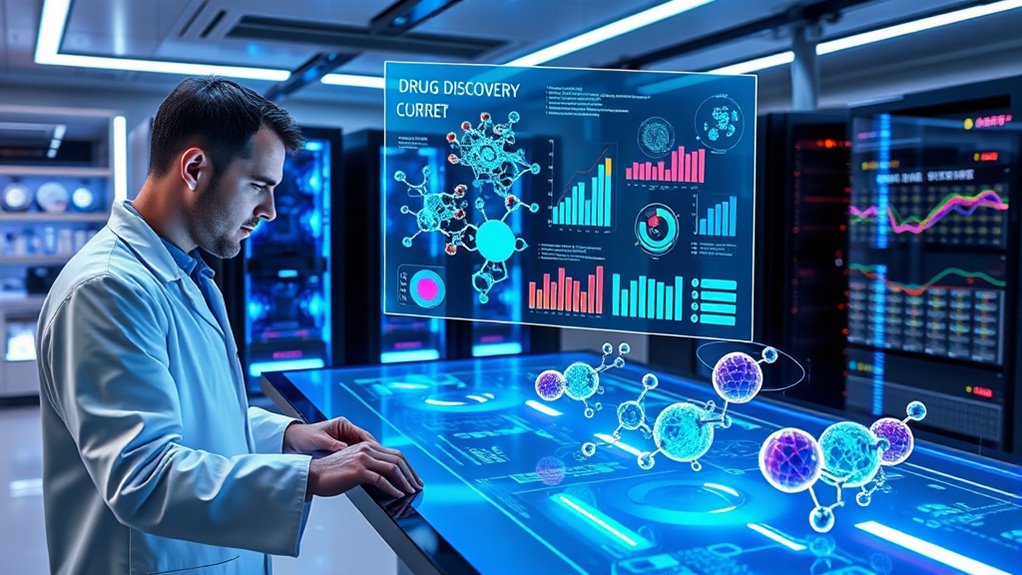
AI accelerates target discovery by analyzing vast datasets to identify promising therapeutic areas faster. It streamlines molecule optimization, making the process more efficient and reducing development time. During clinical trials, AI provides valuable insights that improve patient selection and predict outcomes, enhancing overall success rates.
Target Discovery Acceleration
By leveraging advanced machine learning and deep learning techniques, drug developers can substantially accelerate target discovery, the critical first step in the development pipeline. AI analyzes vast biomedical datasets—genomics, proteomics, and clinical data—to identify disease-driving molecules and pathways more efficiently than traditional methods. Natural language processing extracts insights from scientific literature, uncovering emerging targets that might otherwise go unnoticed. Reinforcement learning models optimize biomarker selection and prioritize promising targets for validation. These tools enable you to explore complex biological interactions, predict target relevance, and reduce trial-and-error efforts. Additionally, predictive modeling enhances the ability to forecast which targets are most likely to succeed in clinical trials, streamlining decision-making. Incorporating biomedical data analysis techniques allows for a more comprehensive understanding of disease mechanisms, further accelerating the discovery process. For example, integrating wicks and candle components knowledge can inspire innovative approaches to functional assays and target validation. Moreover, advancements in AI-powered data integration facilitate the seamless combination of heterogeneous datasets, providing deeper insights into disease pathways. Leveraging multi-omics integration techniques can uncover novel biomarkers and therapeutic targets that might be missed by single-data-type analyses. As a result, AI shortens the time from hypothesis to validation, allowing you to focus resources on the most promising targets and speed up the entire drug development process.
Molecule Optimization Efficiency
Harnessing advanced computational techniques, drug developers can substantially improve molecule optimization throughout the entire development pipeline. AI accelerates the design, evaluation, and refinement of drug candidates, making the process more precise and efficient. You can leverage AI to:
- Rapidly generate and test millions of molecular variants, identifying ideal structures faster.
- Predict key properties like bioavailability, toxicity, and binding affinity, reducing late-stage failures.
- Automate the scoring and ranking of candidate molecules, focusing resources on the most promising options.
- Incorporate diverse design options such as unique and innovative molecular structures, to further enhance candidate selection.
- Additionally, AI enables the integration of retail hours, ensuring that the drug development process aligns with operational and regulatory schedules, streamlining overall project management.
- This approach also benefits from the ability to evaluate molecular stability, which is crucial for developing durable and effective medicines. Moreover, AI can assist in predicting off-target effects, improving safety profiles early in development.
- The use of high-throughput screening powered by AI further accelerates the identification of promising compounds, reducing the time needed for experimental testing.
This targeted approach minimizes trial-and-error, shortens development timelines, and lowers costs. AI-driven optimization allows you to fine-tune molecules with greater accuracy, ensuring they meet safety and efficacy standards before advancing to clinical testing. Ultimately, it transforms molecule refinement into a streamlined, data-informed process.
Clinical Trial Insights
How does artificial intelligence transform each phase of clinical trials to accelerate drug development? AI streamlines patient recruitment by analyzing electronic health records, matching eligible participants faster. It predicts trial outcomes and monitors safety, reducing delays and costs. AI also personalizes treatment plans, optimizing dosing and minimizing adverse effects. Additionally, AI can assist in regulatory compliance by ensuring documentation meets legal standards, further expediting approval processes. Incorporating ethical considerations into AI algorithms is essential to maintain transparency and trust in clinical trials. Here’s a quick overview:
| Phase | AI Role | Benefits |
|---|---|---|
| Patient Recruitment | Data analysis for eligible participants | Faster enrollment, diverse cohorts |
| Trial Design | Simulation & predictive modeling | Improved protocol efficiency |
| Safety Monitoring | Real-time adverse event detection | Enhanced safety, early intervention |
| Data Analysis | Automated data processing | Quicker insights, decision-making |
| Regulatory Submission | AI-generated reports & documentation | Accelerated approvals |
AI’s integration boosts trial efficiency, reduces costs, and increases the likelihood of success, transforming drug development. Additionally, leveraging clinical trial insights can further enhance the overall process by providing valuable data-driven strategies. Moreover, employing financial data management strategies can help optimize resource allocation during trials to ensure financial efficiency.
clinical trial patient recruitment tools
As an affiliate, we earn on qualifying purchases.
As an affiliate, we earn on qualifying purchases.
Cutting-Edge AI Techniques Powering Drug Discovery
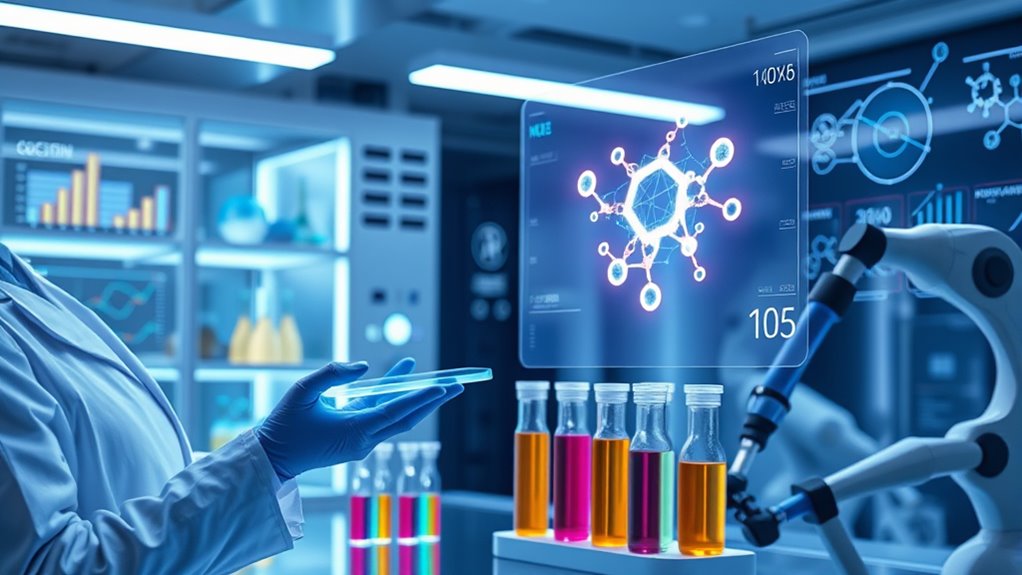
Cutting-edge AI techniques are transforming drug discovery by enabling more precise and efficient identification of promising candidates. You benefit from advanced methods like machine learning, deep learning, natural language processing, and reinforcement learning that analyze complex biomedical data. These tools help you explore chemical spaces previously inaccessible, accelerating early-stage discovery. You can also leverage AI to:
AI-driven methods are revolutionizing drug discovery, enabling faster, more accurate identification of promising candidates.
- Integrate multi-omics data for target identification and validation
- Extract insights from unstructured biomedical literature and clinical notes
- Optimize molecular design through reinforcement learning, improving decision-making
- Chemical space exploration is enhanced by AI, allowing you to identify novel compounds more rapidly.
These techniques reduce time and costs, allowing you to focus on the most promising drug candidates. While AI markedly enhances discovery, it still works best when combined with expert judgment and traditional validation steps, ensuring reliable progress toward new medicines.
Recent Computational Techniques in De Novo Drug Design (Bio-IT and AI)
As an affiliate, we earn on qualifying purchases.
As an affiliate, we earn on qualifying purchases.
Overcoming Challenges: From Promises to Clinical Successes

Despite the promising capabilities of AI in drug discovery, turning these innovations into clinical successes remains a significant challenge. Many AI-designed candidates fail to translate from laboratory models to human trials due to unforeseen toxicity, complex biology, or inadequate efficacy. You need to recognize that AI can streamline early research, but it doesn’t eliminate the lengthy, costly, and unpredictable nature of clinical development. Validating AI predictions requires rigorous testing, and even promising candidates can stumble in later phases. To overcome these hurdles, you must integrate AI insights with traditional validation methods and real-world data. This rigorous testing process is essential to ensure safety and efficacy before proceeding to human trials. Additionally, understanding the importance of continuous review and adaptive strategies can significantly enhance the chances of successful translation from discovery to medicine. Recognizing the role of cybersecurity vulnerabilities in safeguarding sensitive research data is also crucial during this process to prevent potential threats that could delay development. Furthermore, considering the regulatory landscape is vital to navigate the complexities of approval processes effectively and efficiently. Incorporating clinical validation with AI-driven insights can further improve the accuracy of predictions, leading to better outcomes.
Regulatory Advances Supporting AI-Generated Medicines

Regulatory agencies are making significant strides to keep pace with AI-driven drug development by establishing clear frameworks for the evaluation and approval of AI-generated medicines. These agencies are developing guidelines that address AI’s unique challenges, such as data transparency, validation, and safety. You’ll find initiatives like the FDA’s risk-based credibility framework encouraging industry adoption. This progress includes:
- Formal guidance on submitting AI-based data, boosting industry confidence.
- Acceptance of AI-accelerated workflows for target validation and molecule design.
- Recognition of AI-designed drug candidates progressing into clinical trials as proof points.
These advancements help ensure that AI-driven innovations undergo rigorous review, maintain safety standards, and gain regulatory approval, ultimately fostering trust and accelerating the delivery of new, effective medicines.
AI in Oncology: Unlocking New Therapeutic Opportunities

You can see how AI is transforming oncology by pinpointing new cancer targets and refining treatments with unprecedented accuracy. It enables precision oncology, allowing you to develop therapies tailored to individual patient profiles. As a result, AI-driven methods are opening up powerful opportunities to improve outcomes and accelerate drug discovery in cancer care.
AI Identifies Cancer Targets
AI is transforming oncology by enabling the rapid identification of novel cancer targets that were previously difficult to detect. You can now leverage AI to uncover hidden molecular vulnerabilities and oncogenic drivers that traditional methods might miss. This accelerates the discovery of promising therapeutic avenues, making treatments more precise.
You’ll find AI tools that:
- Integrate multi-omics data to reveal unique cancer biomarkers
- Analyze vast biomedical literature to identify emerging targets
- Predict oncogenic pathways and vulnerabilities with high accuracy
Precision Oncology via AI
Building on the ability to identify cancer targets, advanced AI techniques are now transforming how you approach personalized treatments through precision oncology. AI analyzes vast datasets—genomics, proteomics, clinical records—to uncover unique tumor profiles and vulnerabilities. You can leverage machine learning and deep learning to predict how specific patients might respond to targeted therapies, reducing trial-and-error. Natural language processing helps extract insights from scientific literature and electronic health records, enriching your understanding of tumor behavior. Reinforcement learning optimizes drug design tailored to individual genetic makeup. This integration accelerates treatment development, improves patient outcomes, and minimizes side effects. As AI continues to evolve, it empowers you to deliver more precise, effective, and adaptive cancer therapies, revolutionizing oncology care.
Accelerating Peptide and Biologics Development With AI

Advancements in AI are transforming peptide and biologics development by enabling faster and more accurate design, optimization, and validation processes. You can leverage AI to explore vast molecular spaces, predict biological activity, and refine candidate structures efficiently. This accelerates identifying promising therapeutic peptides and biologics, reducing traditional trial-and-error methods. AI-driven tools help optimize stability, potency, and specificity, streamlining manufacturing considerations early in development.
AI accelerates peptide and biologics development, enabling faster, more precise design and optimization for improved therapeutic outcomes.
- Rapidly generate novel peptide sequences with high activity predictions
- Improve biologic stability and reduce immunogenicity through AI modeling
- Simulate biological interactions to forecast efficacy and safety outcomes
These capabilities shorten development timelines and lower costs, empowering you to bring innovative biologics to market faster while maintaining rigorous quality standards.
The Role of AI in Personalized Medicine and Target Identification

Personalized medicine is revolutionizing healthcare by tailoring treatments to individual patients’ genetic and molecular profiles. AI accelerates this shift by analyzing vast datasets from genomics, proteomics, and clinical records, helping you identify precise drug targets. Machine learning models sift through complex biological information to find unique disease drivers for each patient. Natural language processing extracts insights from biomedical literature and clinical notes, enriching your understanding of potential targets. Reinforcement learning optimizes molecular design tailored to specific patient needs. This integration enables you to develop more effective, individualized therapies faster while reducing trial-and-error. By combining AI with multi-omics data, you gain a deeper understanding of disease mechanisms, making targeted interventions more accurate and personalized, ultimately improving patient outcomes and transforming how treatments are developed.
Building the Future: Holistic Approaches to Drug Development

As AI-driven insights refine target identification and molecular design, the limitations of traditional drug development become more apparent. You’re now moving toward all-encompassing approaches that integrate diverse data sources and streamline workflows. This shift emphasizes understanding the entire drug development ecosystem, not just isolated steps. You’ll see efforts to combine real-world patient data, preclinical results, and molecular insights into a unified framework. This approach helps identify potential failures earlier, reduce costs, and improve success rates.
- Integrating clinical, genomic, and environmental data for comprehensive insights
- Utilizing AI to simulate entire biological systems for better target validation
- Developing adaptive workflows that respond dynamically to new data and findings
Holistic methods aim to create more efficient, precise, and patient-centered drug development pipelines.
Real-World Examples of AI-Driven Breakthroughs

You can see AI making a real impact with rentosertib, which recently entered Phase 2 trials for pulmonary fibrosis, showing promising early results. Additionally, AI-driven methods have identified novel cancer targets by analyzing complex genomic and clinical data, uncovering vulnerabilities missed by traditional approaches. These breakthroughs demonstrate how AI accelerates drug development and sharpens focus on effective therapies.
Rentosertib’s Clinical Progress
Rentosertib’s journey into clinical trials exemplifies how AI-driven drug discovery is translating into tangible breakthroughs. Using advanced AI models, researchers identified this promising candidate efficiently, accelerating the development timeline. Its progression into Phase 2 trials in 2025 marks a significant milestone, especially for idiopathic pulmonary fibrosis treatment. You can see AI’s impact through:
- Rapid target validation and candidate optimization, reducing traditional delays
- Integration of multi-omics data guiding precise molecular design
- Streamlined clinical trial planning, improving patient stratification and outcomes
This progress demonstrates AI’s potential to shorten drug development cycles and enhance success rates. Rentosertib’s advancement not only validates AI’s role but also inspires confidence in future AI-guided therapies making their way through clinical phases.
AI-Identified Cancer Targets
AI has revolutionized cancer research by enabling the rapid identification of novel therapeutic targets that traditional methods might overlook. It analyzes vast datasets from genomics, transcriptomics, and clinical records to uncover hidden vulnerabilities in tumors. For example, BenevolentAI predicted new cancer targets by integrating multi-omics and patient data, accelerating drug development. AI models now pinpoint oncogenic drivers and resistance mechanisms more accurately, guiding personalized therapies. This approach shortens discovery cycles and improves target validation.
| Benefit | Impact |
|---|---|
| Faster target discovery | Speeds up identifying promising therapeutic sites |
| Enhanced accuracy | Reduces false positives and improves confidence |
| Integration of diverse data | Provides exhaustive insights for better decisions |
| Personalized medicine | Enables targeted, patient-specific treatments |
Frequently Asked Questions
How Do AI Models Ensure Accuracy in Predicting Drug Safety Profiles?
AI models guarantee accuracy in predicting drug safety profiles by analyzing vast biomedical datasets, identifying potential toxicities, and flagging safety risks early. You can trust these models because they integrate diverse data types—genomics, clinical notes, and chemical properties—and use advanced algorithms like deep learning and reinforcement learning. Continuous validation against experimental and clinical data helps refine predictions, making AI a reliable tool for evaluating safety before progressing to human trials.
What Are the Main Barriers to AI Adoption in Regulatory Approval Processes?
You face barriers like regulatory uncertainty, as agencies require extensive validation of AI tools before approval. Limited understanding of AI’s capabilities among regulators slows acceptance, and there’s concern over transparency and reproducibility of AI models. Additionally, integrating AI data into existing frameworks can be complex and costly. You also need more standardized guidelines, which can delay the approval process, as regulators seek assurance of safety and efficacy from AI-driven data.
How Does AI Handle Data Privacy Concerns in Drug Discovery?
You can handle data privacy concerns in drug discovery by implementing strict data anonymization and encryption protocols. AI systems should comply with regulations like GDPR and HIPAA, ensuring sensitive information is protected. You also need to establish clear data governance policies, limit access to authorized personnel, and regularly audit data handling processes. Collaborate with legal and security experts to maintain compliance and build trust among stakeholders throughout the drug development process.
What Strategies Improve AI Translation From Preclinical to Clinical Success?
Think of AI as a bridge builder, connecting preclinical promise to clinical success. To strengthen this bridge, you should focus on robust validation of AI models, ensuring they’re grounded in real-world data. Incorporate diverse datasets for better generalization, collaborate closely with regulatory bodies, and prioritize transparent, explainable AI. These strategies help translate early findings into safe, effective therapies, turning promising preclinical results into real patient benefits.
How Is AI Used to Identify Rare or Orphan Disease Targets?
You use AI to identify rare or orphan disease targets by analyzing multi-omics data, clinical records, and biomedical literature to find unique disease signatures. Machine learning models highlight potential biomarkers and molecular pathways specific to these conditions. You can also simulate biological systems virtually, uncovering novel targets that traditional methods might miss. This accelerates drug discovery for rare diseases, making it more precise and efficient.
Conclusion
As you navigate the evolving landscape of AI-driven drug discovery, remember it’s like steering a ship through uncharted waters—each breakthrough lights the way forward. With AI acting as your compass, you can accelerate the journey from lab to patient, transforming hope into reality. Embrace these innovations, and you’ll help chart a course toward faster, more personalized medicines, ultimately turning the vast ocean of possibilities into tangible cures that make a difference.