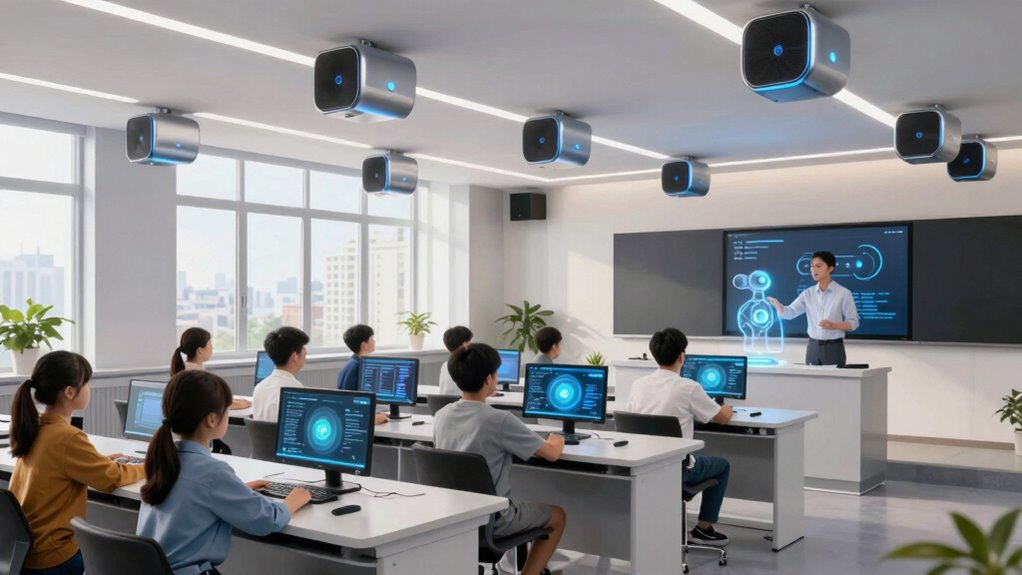

For AI language learning in a classroom, I’d start with the Avantree VoxAmp Lite as the best overall pick for its wireless microphone and 15W amplification, a useful pairing for teacher-led speaking practice. The WinBridge is a standout if you want Bluetooth playback alongside voice amplification, while the dual-mic models suit activities where more than one speaker needs a microphone. The main tradeoffs are wireless freedom versus simpler wired setups, and extra features versus an easy-to-manage classroom kit. A speaker can help learners hear prompts and models, but it does not replace the AI app, device, or headphones needed for individual practice. Read on for the full breakdown and a guide to matching a speaker setup to your room and lesson style.

Get business pricing on tech for your team
- Business-only prices and quantity discounts
- Tax-exempt purchasing
- Multiple users, one account, clear invoices
Complete the kit


Key Takeaways
Microphone setup matters as much as speaker output: the Avantree VoxAmp Lite combines a wireless microphone with 15W amplification, while the wired headset option favors a simpler connection over freedom of movement.
Bluetooth is most useful when lessons include shared audio: the WinBridge and several Bluetooth-equipped models can serve playback needs as well as teacher voice amplification.
Dual-microphone models fit partner and group activities: the white magnetic-lavalier model and the dual wireless lavalier model offer more speaker flexibility than single-mic choices.
Portability and room coverage are different priorities: compact picks such as the ZOWEETEK mini suit mobile teaching, while higher-output options such as the 15W models are better candidates for rooms that need more reach.
More features can add setup work: a basic wired headset can be easier to manage than multiple wireless microphones, so the right choice depends on who will operate the equipment during lessons.
| 15W Wireless Voice Amplifier with Bluetooth Headset Microphone |  | Best for Large Classrooms | Output power: 15W | Stated coverage area: Up to 10,000 sq ft | Amplifier battery capacity: 2600mAh | VIEW ON AMAZON | See Our Full Breakdown |
| Voice Amplifier for Teachers with 2 Magnetic Lavalier Mics, White |  | Best for Shared Teaching | Output wattage: 15W | Microphones: 2 magnetic lavalier microphones | Continuous-use battery life: Up to 15 hours | VIEW ON AMAZON | See Our Full Breakdown |
| SHIDU SD-258 Portable Voice Amplifier with Microphone |  | Best Compact Wired Pick | Model: SD-258 | Output power: 10W | Battery capacity: 1800mAh lithium-ion | VIEW ON AMAZON | See Our Full Breakdown |
| Wireless Voice Amplifier with Wireless Lavalier Mic for Teachers |  | Best for Noisy Classrooms | Microphone: Omnidirectional wireless lavalier with active noise reduction | Battery life: 10–12 hours | Wireless range: About 20 meters | VIEW ON AMAZON | See Our Full Breakdown |
| Wireless Voice Amplifier with Lavalier Microphone and Bluetooth Speaker |  | Best for Quick Wireless Setup | Model: K108 | Battery capacity: 2200mAh | Amplifier battery life: 10–12 hours | VIEW ON AMAZON | See Our Full Breakdown |
| ZOWEETEK Portable Rechargeable Mini Voice Amplifier for Teachers |  | Best for Long Lessons Without Wireless Setup | Output: 10 watts | Battery: 1800 mAh rechargeable lithium | Runtime: Up to 12 hours | VIEW ON AMAZON | See Our Full Breakdown |
| Digimore Wireless Voice Amplifier for Teachers (D-1200 WL) |  | Best for Fast-Charging Wireless Headset Use | Power output: 10 W | Battery capacity: 3.7 V, 2000 mAh | Runtime: Up to 10 hours | VIEW ON AMAZON | See Our Full Breakdown |
| Portable Voice Amplifier Wired Headset Microphone for Teachers |  | Best for Bluetooth Lesson Playback | Output: 10 W | Battery life: 7–8 hours | Charging time: 3 hours via USB-C | VIEW ON AMAZON | See Our Full Breakdown |
| Voice Amplifier for Teachers with Dual Wireless Lavalier Microphones & Noise Reduction |  | Best for Paired Speaking Activities | Output: 10 watts | Connectivity: Bluetooth, 2.4G wireless | Battery capacity: 2000 mAh | VIEW ON AMAZON | See Our Full Breakdown |
| WinBridge Voice Amplifier with Bluetooth, Portable Speaker and Microphone |  | Best for Large Classes and All-Day Use | Output power: 15 W | Claimed coverage: 10,000 sq. ft. | Amplifier battery capacity: 2600 mAh | VIEW ON AMAZON | See Our Full Breakdown |
| Avantree VoxAmp Lite Wireless Microphone for Teachers, 15W Voice Amplifier |  | Best for Recording AI Language Lessons | Power output: 15 W | Coverage: Up to 100 people | Amplifier battery life: Up to 15 hours | VIEW ON AMAZON | See Our Full Breakdown |
| classroom speakers for ai language learning | Connectivity |
|---|---|
| 15W Wireless Voice Amplifier w | Bluetooth, USB |
| Voice Amplifier for Teachers w | Bluetooth 5.3, USB, wireless |
| SHIDU SD-258 Portable Voice Am | USB, Micro SD, 3.5mm AUX |
| Wireless Voice Amplifier with | Bluetooth, wireless |
| Wireless Voice Amplifier with | Bluetooth, USB, TF/SD card |
| ZOWEETEK Portable Rechargeable | — |
| Digimore Wireless Voice Amplif | — |
| Portable Voice Amplifier Wired | Wired, Bluetooth 5.3, USB, TF card |
| Voice Amplifier for Teachers w | Bluetooth, 2.4G wireless |
| WinBridge Voice Amplifier with | — |
| Avantree VoxAmp Lite Wireless | — |
More Details on Our Top Picks
15W Wireless Voice Amplifier with Bluetooth Headset Microphone
For a teacher who needs voice support across a large room, this model pairs 15W output with a stated coverage area of up to 10,000 square feet. Its headset microphone keeps the speaker close to the teacher’s voice, while the mute control can help pause amplification between activities. Compared with the SHIDU SD-258, it offers higher listed output and Bluetooth connectivity, but the SHIDU is lighter and supports Micro SD playback. The 12–15-hour amplifier runtime suits a full teaching day; the microphone’s 8–10-hour runtime is shorter, so it may need separate charging during extended use. Belt-clip and lanyard options add flexibility, though the provided details do not give the unit’s weight or dimensions, making fit less predictable.
Pros:- 15W output and stated coverage up to 10,000 square feet suit larger teaching spaces.
- Headset microphone includes one-button Bluetooth pairing and a mute function.
- Amplifier battery is listed for 12–15 hours of use.
- Belt clip and lanyard allow more than one carrying setup.
Cons:- Microphone runtime of 8–10 hours is shorter than the amplifier’s listed runtime.
- No weight or dimensions are provided, making portability harder to judge.
- Playback details list USB and Bluetooth but do not specify support for memory cards.
Best for: Teachers leading lessons in large classrooms who want a wireless headset, mute control, and long amplifier runtime.
Not ideal for: Teachers who prioritize a very light, size-documented unit or need a microphone that lasts as long as the amplifier on one charge.
- Output power:15W
- Stated coverage area:Up to 10,000 sq ft
- Amplifier battery capacity:2600mAh
- Amplifier battery life:12–15 hours
- Microphone battery life:8–10 hours
- Connectivity:Bluetooth, USB
- Warranty:365 days
Our verdict“Choose this model for broad classroom coverage and a wireless headset, provided you can manage the shorter microphone runtime.”
Voice Amplifier for Teachers with 2 Magnetic Lavalier Mics, White
The standout here is the inclusion of two magnetic lavalier microphones, a practical fit for co-teaching or passing speaking duties between instructors without relying on a headset. It also combines voice amplification with Bluetooth streaming and USB playback, much like the 15W Wireless Voice Amplifier, but this Gicorino specifies up to 15 hours of continuous unit use and up to seven hours per mic. That split makes mic charging part of the day’s planning. Its lightweight ABS body, shoulder strap, and battery indicator help with transport and checking charge, while the single-channel design keeps the audio setup simple. Compared with the SHIDU SD-258, it offers wireless lavaliers rather than a wired microphone, but its listed bulk may bother teachers who carry the amplifier in a pocket.
Pros:- Two magnetic lavalier microphones support shared or alternating instruction.
- Voice amplification, Bluetooth streaming, and USB playback cover common classroom uses.
- Unit runtime is listed at up to 15 hours.
- Shoulder strap and battery indicator make transport and charge checks easier.
Cons:- Each microphone is listed for up to seven hours, shorter than the amplifier runtime.
- Single-channel output limits more advanced audio arrangements.
- The unit may feel bulky when carried in a pocket, and noise reduction may not suit very noisy spaces.
Best for: Co-teachers and language instructors who want two clip-on microphones available for shared speaking duties.
Not ideal for: Teachers who need advanced multi-channel audio, pocket-sized portability, or reliable speech reinforcement in very noisy rooms.
- Output wattage:15W
- Microphones:2 magnetic lavalier microphones
- Continuous-use battery life:Up to 15 hours
- Microphone battery life:Up to 7 hours per mic
- Charging time:3–5 hours
- Connectivity:Bluetooth 5.3, USB, wireless
- Channels:1
- Enclosure material:ABS
Our verdict“Pick this Gicorino for shared teaching and two clip-on mic options, but skip it if your room is very noisy or your setup needs multiple audio channels.”
SHIDU SD-258 Portable Voice Amplifier with Microphone
The SHIDU SD-258 is the most clearly documented compact option in this group: it weighs 5.74 ounces and measures 3.35 by 1.57 by 4.13 inches. That makes it easier to judge for belt or lanyard use than the 15W Wireless Voice Amplifier, whose dimensions are not supplied. Its 10W output is lower than that model’s 15W, so I’d favor the SHIDU for a smaller class or a teacher who values light carry over maximum listed power. USB, Micro SD, and AUX playback give it more listed wired media options than the wireless Lavalier models. The tradeoff is the wired microphone, which can restrict movement during lessons; careful placement also matters to reduce feedback. Its 12-hour amplification runtime supports a teaching day.
Pros:- At 5.74 ounces, it is a clearly specified lightweight option.
- USB, Micro SD, and 3.5mm AUX support several playback sources.
- Amplification battery life is listed at up to 12 hours.
- Detachable belt clip and neck strap offer flexible carrying.
Cons:- The wired microphone can limit movement compared with wireless options.
- Its 10W output is lower than the 15W models in this batch.
- Microphone and speaker placement need care to avoid feedback.
Best for: Teachers in small-to-medium classrooms who want a lightweight amplifier, wired mic, and USB or Micro SD lesson playback.
Not ideal for: Instructors who move widely around the room and need a wireless microphone or higher listed output.
- Model:SD-258
- Output power:10W
- Battery capacity:1800mAh lithium-ion
- Battery life:12 hours amplification; 10 hours music
- Charging time:3–5 hours
- Weight:0.36 lb (5.74 oz)
- Dimensions:3.35 x 1.57 x 4.13 in
- Connectivity:USB, Micro SD, 3.5mm AUX
Our verdict“Choose the SD-258 for lightweight wired amplification and flexible media playback, not for unrestricted movement around a large classroom.”
Wireless Voice Amplifier with Wireless Lavalier Mic for Teachers
This model puts its emphasis on speech intelligibility: the omnidirectional lavalier microphone is described as having active noise reduction, a useful feature when student activity competes with spoken instructions. At 9.6 ounces, it is still portable, and the clip and waist strap support hands-free classroom use. Compared with the SHIDU SD-258, it avoids a wired mic and adds wireless freedom, while the SHIDU offers more playback formats and clearer size specifications. The stated wireless range reaches about 20 meters, which is enough for many rooms but may constrain teachers who move farther away. Battery life is listed at 10–12 hours. Feedback remains possible if the mic sits too close to the speaker, so placement still matters despite the noise-reduction feature.
Pros:- Omnidirectional lavalier microphone includes active noise reduction.
- Wireless operation avoids the movement limits of the SHIDU SD-258’s wired mic.
- Listed 10–12-hour battery life suits many school days.
- Clip and waist strap support hands-free carrying.
Cons:- Wireless range is limited to about 20 meters.
- Mic placement too close to the speaker can cause feedback.
- The provided specifications do not state output wattage or battery capacity.
Best for: Teachers in active classrooms who want a wireless lavalier with noise reduction and hands-free carrying.
Not ideal for: Instructors who teach across spaces larger than the stated wireless range or need detailed playback-format options.
- Microphone:Omnidirectional wireless lavalier with active noise reduction
- Battery life:10–12 hours
- Wireless range:About 20 meters
- Weight:9.6 oz
- Dimensions:1.8 x 0.8 x 2 in
- Connectivity:Bluetooth, wireless
- Channels:2
- Enclosure material:Plastic
Our verdict“Choose this model for wireless speech support in busy classrooms, as long as its 20-meter range fits your teaching area.”
Wireless Voice Amplifier with Lavalier Microphone and Bluetooth Speaker
Automatic pairing makes this a sensible choice for teachers who want to start a lesson without spending time linking a separate lavalier and amplifier. Like the B0H4LTZVY7 model, it combines a wireless lavalier, active noise reduction, and a stated 20-meter transmission range; the difference is that this unit also lists USB and TF/SD playback. Its 2200mAh battery supports 10–12 hours of amplifier use, while the microphone lasts six to eight hours, so long teaching days may call for a mic recharge. Compared with the Gicorino’s two microphones, this is a simpler one-mic setup, better suited to solo instruction than shared teaching. The supplied details flag occasional pairing problems, which temper the convenience of automatic pairing.
Pros:- Automatic pairing simplifies setup for a single teacher.
- Active noise reduction is intended to improve speech clarity in noisy settings.
- USB and TF/SD playback add options beyond Bluetooth.
- Amplifier runtime is listed at 10–12 hours.
Cons:- Occasional pairing issues may require restarting the devices.
- The 20-meter transmission range may limit movement in larger spaces.
- Microphone runtime is six to eight hours, shorter than the amplifier runtime.
Best for: Solo teachers who want a wireless lavalier, quick pairing, and onboard USB or TF/SD playback.
Not ideal for: Co-teachers who need two microphones or instructors who cannot accommodate occasional pairing resets and shorter mic runtime.
- Model:K108
- Battery capacity:2200mAh
- Amplifier battery life:10–12 hours
- Microphone battery life:6–8 hours
- Amplifier charging time:3–4 hours
- Microphone charging time:1–1.5 hours
- Transmission range:20 meters
- Connectivity:Bluetooth, USB, TF/SD card
- Weight:10.5 oz
Our verdict“Pick this for a straightforward solo-teacher setup with multiple playback options, but choose the Gicorino if you need two microphones.”
ZOWEETEK Portable Rechargeable Mini Voice Amplifier for Teachers
The ZOWEETEK suits teachers who want to make spoken prompts easier to hear without relying on a wireless microphone connection. Its 10W output and claimed coverage for areas up to 10,000 square feet put it in the same broad classroom-use category as the WinBridge WB002, while its up to 12-hour runtime supports a full day of lessons. For AI language practice, its AUX and TF/USB playback let a teacher play listening material through the speaker, but Bluetooth-free connectivity means a phone or tablet may need a cable or supported storage card. Compared with the WinBridge, it gives up wireless pairing and the higher 15W output in exchange for a simple, lightweight setup with an adjustable built-in microphone. Its 5.76-ounce body is easy to wear, though the battery is non-removable and charging takes 3–5 hours.
Pros:- 10W output is designed to make a teacher’s voice clearer across a classroom.
- Up to 12 hours of use suits a long teaching day.
- AUX, USB, and TF card playback support several ways to play listening exercises.
- Lightweight body can be clipped on, worn at the waist, or hung around the neck.
Cons:- No Bluetooth, so wireless playback from a phone or tablet is not supported.
- The rechargeable battery is non-removable.
- A 3–5 hour charge is slower than the Digimore D-1200 WL’s stated approximately one-hour charging time.
Best for: Teachers who want a lightweight voice amplifier for daily speaking practice and can play lesson audio over AUX or TF/USB.
Not ideal for: Teachers who routinely stream AI-generated audio wirelessly from a phone or tablet, since this model has no Bluetooth.
- Output:10 watts
- Battery:1800 mAh rechargeable lithium
- Runtime:Up to 12 hours
- Charging time:3–5 hours
- Audio inputs:AUX, USB, TF card, Micro SD
- Dimensions:4.33 x 1.5 x 3.46 inches
- Weight:5.76 ounces
- Mounting:Clip-on, freestanding, or tie/strap
Our verdict“Choose the ZOWEETEK for lightweight, long-running voice amplification when wired or card-based lesson playback is sufficient.”
Digimore Wireless Voice Amplifier for Teachers (D-1200 WL)
The Digimore D-1200 WL is a focused pick for teachers who speak while moving around the room and want to keep both hands free. Its cardioid condenser headset and stated 50-foot wireless range suit call-and-response drills and spoken directions, while the separate additional mic input gives the setup some room to grow. A key distinction is charging: Digimore lists about one hour over USB-C, far less than the ZOWEETEK’s 3–5 hours, though its runtime is up to 10 hours rather than 12. The WinBridge WB002 offers more output power at 15W and Bluetooth playback, but the Digimore’s included wireless headset and fast charge make it a practical choice when voice projection matters more than streaming lesson audio. Its 10W output is aimed at small to medium groups, not large or noisy venues.
Pros:- Wireless cardioid headset supports hands-free instruction.
- Stated wireless range reaches up to 50 feet.
- USB-C charging is listed at approximately one hour.
- Up to 10 hours of runtime covers a substantial teaching day.
Cons:- 10W output is better suited to small and medium groups than large venues.
- Only one microphone is included; an additional mic must be purchased separately.
- The supplied details do not list Bluetooth or other playback inputs for lesson audio.
Best for: Teachers leading small or medium classroom speaking activities who want a hands-free wireless headset and quick between-class charging.
Not ideal for: Teachers needing a higher-output speaker for a large, noisy room or Bluetooth playback for AI lesson audio.
- Power output:10 W
- Battery capacity:3.7 V, 2000 mAh
- Runtime:Up to 10 hours
- Charging:Type-C; approximately 1 hour
- Microphone:Cardioid condenser wireless headset
- Wireless range:Up to 50 feet
- Additional mic input:Yes
- Warranty:1 year for manufacturing defects
Our verdict“Pick the Digimore when hands-free voice projection and quick charging matter more than high output or wireless audio streaming.”
Portable Voice Amplifier Wired Headset Microphone for Teachers
For classrooms using a phone or tablet to play AI-generated dialogues, this AKALULI amplifier offers a useful combination of Bluetooth 5.3 playback and a wired headset microphone. USB and TF card playback add alternatives for saved listening tracks, and the listed noise suppression is intended to help keep amplified speech clearer. Compared with the ZOWEETEK, it is easier to pair with a mobile device but gives up several hours of stated runtime: its battery lasts 7–8 hours, against the ZOWEETEK’s up to 12. The 10W output matches the Digimore D-1200 WL on paper, but Digimore supplies a wireless headset; AKALULI’s voice input is wired, which can limit movement. Its lightweight clip-or-lanyard format helps with portability, though the plastic enclosure and analog-only volume dial keep the design basic.
Pros:- Bluetooth 5.3 supports wireless playback from compatible lesson devices.
- USB flash drive and TF card playback offer additional audio sources.
- 10W output and stated noise suppression are suited to spoken classroom content.
- At 0.44 lb, it can be clipped on or worn with a lanyard.
Cons:- The included headset microphone is wired, unlike the Digimore D-1200 WL’s wireless headset.
- Listed battery life is 7–8 hours, shorter than the ZOWEETEK and WinBridge claims.
- The analog volume dial has no visual speaker-level indicator.
Best for: Teachers who stream AI conversation samples from a phone or tablet and prefer Bluetooth playback with a wearable amplifier.
Not ideal for: Teachers who need a wireless microphone, more than a school day’s worth of runtime, or a visible speaker-level display.
- Output:10 W
- Battery life:7–8 hours
- Charging time:3 hours via USB-C
- Connectivity:Wired, Bluetooth 5.3, USB, TF card
- Weight:0.44 lb
- Dimensions:3.3 x 1.3 x 4 inches
- Material:Plastic
- Warranty:1 year
Our verdict“Choose this AKALULI model if Bluetooth playback for AI listening exercises is more useful than a wireless headset or extended runtime.”
Voice Amplifier for Teachers with Dual Wireless Lavalier Microphones & Noise Reduction
This system stands out for two wireless lavalier microphones, a feature that fits paired dialogues, role-play, and teacher-student pronunciation practice better than the single-headset Digimore D-1200 WL. The 2.4G wireless connection is listed with a range of up to 65 feet, and Bluetooth adds a route for streaming AI-generated listening material. Its DSP noise reduction is aimed at clearer speech, while the charging case helps manage the microphones between activities. The tradeoff is that the amplifier is rated at 10W and runs for up to eight hours, shorter than the WinBridge WB002’s 12–15-hour amplifier claim. Each microphone is listed for up to six hours, so a long day may call for charging breaks. The system also calls for careful speaker and microphone placement to limit signal interference.
Pros:- Two wireless lavalier microphones support paired speaking and role-play exercises.
- Bluetooth supports audio playback from compatible classroom devices.
- DSP noise reduction is designed to help keep speech clear.
- Charging case and stated 20-meter wireless range support mobile classroom use.
Cons:- Amplifier runtime is up to 8 hours, shorter than the WinBridge WB002’s stated 12–15 hours.
- Microphones last up to 6 hours each and may need charging during extended use.
- Speaker and microphone placement may require care to reduce signal interference.
Best for: Language teachers who regularly run two-person dialogues and want both participants amplified alongside Bluetooth lesson playback.
Not ideal for: Teachers who need a simple single-mic setup, the longest runtime, or minimal attention to wireless placement.
- Output:10 watts
- Connectivity:Bluetooth, 2.4G wireless
- Battery capacity:2000 mAh
- Amplifier runtime:Up to 8 hours
- Microphone runtime:Up to 6 hours each
- Wireless range:20 meters (65 feet)
- Microphones:Two wireless lavalier microphones with charging case
- Warranty:36 months
Our verdict“Pick this system for paired language practice where two wireless voices matter more than maximum runtime or setup simplicity.”
WinBridge Voice Amplifier with Bluetooth, Portable Speaker and Microphone
The WinBridge WB002 is the strongest fit here for teachers who need higher output and long operating time in a larger class. Its 15W output exceeds the 10W ratings of the ZOWEETEK and Digimore, while the stated coverage is roughly 10,000 square feet, including classrooms of about 50 students. Bluetooth pairing makes it straightforward to play AI-generated dialogue from a compatible device, and the 12–15-hour amplifier runtime is the longest stated among these five options. The headset microphone has its own 8–10-hour battery life, so it may need attention before the amplifier does. Unlike the dual-lavalier system, it supplies one headset, making it less suited to two-person amplified role-play. Its design is described mainly for indoor use, with no outdoor performance details provided.
Pros:- 15W output is higher than the 10W ratings of the ZOWEETEK and Digimore models.
- Bluetooth supports playback of AI lesson audio from compatible devices.
- Amplifier runtime is listed at 12–15 hours.
- Includes a headset mic, Type-C charging, belt clip, and lanyard.
Cons:- Only one headset microphone is included, unlike the dual-lavalier system.
- The microphone’s 8–10-hour battery life is shorter than the amplifier’s maximum stated runtime.
- Outdoor performance is not specified.
Best for: Teachers with larger classes who want Bluetooth playback, a headset microphone, and long runtime for repeated speaking and listening lessons.
Not ideal for: Teachers who need two simultaneous wireless microphones or a system with specified outdoor performance.
- Output power:15 W
- Claimed coverage:10,000 sq. ft.
- Amplifier battery capacity:2600 mAh
- Amplifier battery life:12–15 hours
- Microphone battery life:8–10 hours
- Charging port:Type-C
- Included microphone:Bluetooth headset microphone
- Warranty and support:1 year warranty plus lifetime support
Our verdict“Choose the WinBridge WB002 for a larger classroom that needs stronger output, Bluetooth audio, and long amplifier runtime with one headset mic.”
Avantree VoxAmp Lite Wireless Microphone for Teachers, 15W Voice Amplifier
The Avantree VoxAmp Lite is the most lesson-capture-focused choice in this roundup: its USB recording supports MP3 and WAV, so teachers can save spoken practice for replay or review. That pairs well with AI language activities where learners benefit from hearing prompts and their own responses again. Its 15W output is specified for groups of up to 100, while Bluetooth playback lets a teacher speak over audio without stopping the lesson track. Compared with the ZOWEETEK Portable Rechargeable Mini Voice Amplifier, the VoxAmp Lite offers more explicit recording and playback capability for classroom materials, rather than prioritizing a compact amplifier format. The tradeoffs are a single included microphone and separate-purchase cost for a second mic. Battery life is listed at up to 15 hours for the amplifier and 9.5 hours for the headset, but simultaneous amplification and Bluetooth use may reduce runtime.
Pros:- USB recording and playback in MP3 or WAV supports lesson capture and replay.
- 15W output is specified to cover groups of up to 100 people.
- Bluetooth audio can play while the teacher speaks through the headset mic.
- Wireless headset operation leaves the teacher’s hands free for classroom activities.
Cons:- Only one microphone is included; a second microphone is sold separately.
- Using Bluetooth audio and amplification together may shorten battery life.
- The headset’s stated battery life is shorter than the amplifier’s, at up to 9.5 hours.
Best for: Language teachers who want hands-free amplification plus USB recordings of lessons or speaking practice for later playback.
Not ideal for: Teachers who need two microphones ready for paired speaking exercises without buying an additional mic, or who rely on Bluetooth and amplification continuously throughout long teaching days.
- Power output:15 W
- Coverage:Up to 100 people
- Amplifier battery life:Up to 15 hours
- Headset battery life:Up to 9.5 hours
- Recording media:USB drive
- Recording formats:MP3 and WAV
- Bluetooth audio:Supported; simultaneous playback while speaking
- Dual-microphone support:Yes; second microphone sold separately
Our verdict“Choose the VoxAmp Lite if recording and replaying AI language lessons matters as much as reaching a large class, but plan for an extra mic if students need paired wireless audio.”

How We Picked
I ranked these 11 classroom speakers around the needs of AI-supported language lessons: clear teacher speech, practical microphone placement, classroom coverage, and compatibility with shared audio playback. I also considered whether a model’s microphone arrangement supports demonstrations, learner participation, or only one speaker at a time. Portability, battery-powered use, setup simplicity, and the potential for classroom handling all shaped the comparison.
The ranking favors options that combine useful speech amplification with a microphone setup that suits varied lessons, rather than models that appear feature-rich but add little to language practice. The Avantree VoxAmp Lite leads for its 15W output and wireless microphone; the WinBridge stands out for pairing amplification with Bluetooth speaker use. Dual-mic models rank well for shared speaking, while compact and wired choices serve narrower needs. Product names and listed features guide these recommendations; buyers should check current specifications and device compatibility before ordering.
Factors to Consider When Choosing Classroom Speakers For Ai Language Learning
Choosing a speaker for AI language learning is less about adding volume and more about supporting the way a class listens and speaks. I’d match the setup to the room, the number of people who need a microphone, and whether lessons use shared audio or individual devices.
Match Coverage to the Room, Not Just the Wattage
A larger output figure can be helpful, but room shape, background noise, and where students sit also affect speech clarity. In a small group, a compact amplifier may be easier to carry and position than a more powerful unit. For a long or noisy room, prioritize clear voice projection and test whether learners at the back can understand consonants, not just hear sound. Avoid placing the speaker beside the microphone, since that can create feedback or muddy the teacher’s voice. If the class often changes rooms, portability may matter more than extra output. Ask whether the speaker will amplify a teacher at the front or support audio playback for the whole room; those jobs can call for different placement and volume.
Choose a Microphone for the Lesson Format
A headset keeps a microphone near the teacher’s mouth, which can help maintain a steady level while moving around. A lavalier clips to clothing and leaves the face unobstructed, but its position can shift as the wearer turns or handles materials. Dual microphones are useful when a teacher and learner, or two learners, need to speak through the same system; they also mean more devices to charge, pair, and keep track of. A wired mic avoids wireless pairing and battery management, though its cable can restrict movement. Think about how often learners will take turns speaking before paying for a second mic. For individual AI exercises, a shared classroom microphone may not be the right tool at all; learners may need personal audio equipment instead.
Decide Whether Bluetooth Playback Is Part of the Job
Bluetooth can let a teacher play listening prompts, sample dialogue, or audio from a compatible device through the classroom speaker. That is useful when the whole group needs to hear the same material, but it is not automatically a substitute for the AI platform’s own connection or features. Check that the speaker can handle the sources your lessons use, and confirm whether audio playback and microphone amplification can work together as needed. Wireless playback may add pairing steps at the start of class, so a reliable routine matters. If lessons rely mostly on the teacher’s voice, a simpler amplifier may be easier to operate. For pronunciation practice, keep playback clear and avoid turning the volume up so far that it masks students’ own voices.
Plan for Batteries, Charging, and Classroom Storage
Rechargeable equipment can reduce the need for disposable batteries, but the speaker and microphone may have separate charging needs. A dual-mic kit adds another item to charge and store, which can become a problem when several people share classroom equipment. Check how the unit is charged, what accessories are included, and whether the microphone can be stored safely between lessons. A compact model may be easier to carry, while a larger speaker can be less convenient to move or pack away. Set up a charging routine tied to the school day rather than waiting for a low-battery warning during instruction. Also plan where the unit lives when not in use; portable gear is more useful when staff can find it quickly.
Keep AI Devices and Classroom Audio Roles Clear
A classroom speaker amplifies sound; it does not necessarily connect directly to an AI service or improve the service’s speech recognition. The learner’s phone, tablet, or computer typically runs the language-learning software, while the speaker can support teacher demonstrations or group listening. Before buying, map out which device produces the audio, which microphone captures speech, and whether students need private listening. Playing an AI prompt aloud can help a group follow along, but it may reduce privacy and make simultaneous speaking harder. For activities where the software listens to individual pronunciation, confirm how the app receives microphone input and whether the room speaker could cause echo or interference. Separating these roles prevents expecting one speaker to replace a headset, device, or classroom audio system.
Pay for Features Your Class Will Actually Use
Extra microphones, Bluetooth playback, and higher output can be worthwhile when they solve recurring lesson needs. They are less compelling if the speaker will mostly be used for short teacher explanations in a small room. A wired setup can be a sensible choice when predictable operation matters more than movement, while a wireless kit may suit teachers who circulate or run role-play. Consider who will set up the equipment and how much time the class can spend troubleshooting connections. If multiple teachers share the speaker, simple controls and a clear storage routine can matter more than a long feature list. Choose the least complicated setup that supports your regular activities, then add capability only where it changes how students participate.
Frequently Asked Questions
Can a classroom speaker connect directly to an AI language-learning app?
Usually, the app runs on a phone, tablet, or computer, and the speaker plays audio from that device if the connection method is compatible. Bluetooth playback can be useful for group listening, but it does not mean the speaker itself runs an AI service. The app may still rely on the device’s microphone to capture a learner’s answer. If the app needs to hear one student clearly, a room speaker can introduce background sound or feedback. Check the app’s audio routing options and the speaker’s supported connections before relying on them together.
Should I choose one microphone or a dual-microphone system?
Choose one microphone if the teacher usually leads the lesson and students respond from their seats. A dual-microphone setup makes more sense for demonstrations, paired dialogue, or activities where learners take turns speaking through the amplifier. It also adds charging, storage, and pairing tasks, so it may be unnecessary for a class with one regular speaker. Think about how often two people must be heard by the whole room at the same time. For AI activities that capture each learner individually, separate device microphones or headsets may still be needed.
Is a 15W voice amplifier enough for a classroom?
Output alone cannot determine whether a speaker will suit a particular room. A 15W model may be a practical option for teacher voice amplification, but room size, layout, background noise, and speaker placement affect how clearly students hear. Check whether the unit can be placed where sound reaches the whole class without pointing toward the microphone. If possible, test speech from the back of the room at a comfortable volume. A larger or noisier space may need a different audio setup, while a small group may benefit more from portability and simple controls.
Will Bluetooth audio cause problems during pronunciation practice?
Bluetooth playback can work well for playing a model phrase to the whole class, but it does not guarantee clean microphone capture for AI scoring. If a device listens for a student response while the speaker is active, playback may leak into the microphone and affect recognition. Use the app’s recommended audio setup, lower playback volume when students speak, or give learners individual headphones when the activity requires focused listening. Test the exact device and app combination before using it in a lesson. For group discussion, keep the speaker volume modest enough that students can hear one another.
Is a wired headset a better choice than a wireless lavalier for teachers?
A wired headset can be a strong fit when ease of operation and a consistent microphone position matter more than moving freely. A wireless lavalier avoids a cable and may feel less intrusive, but it needs charging and can shift on clothing. Teachers who circulate, gesture, or run role-play may prefer wireless movement; teachers who want fewer connection steps may favor a wired setup. Consider how the microphone will be shared, cleaned, and stored between classes. Also check whether the placement captures speech clearly when the teacher turns away from the speaker.
Conclusion
For a flexible classroom setup, I’d choose the Avantree VoxAmp Lite as best overall, with its 15W amplification and wireless microphone. The best value depends on the simplest setup that covers your lessons: the wired headset amplifier is a sensible pick for teachers who do not need wireless movement or extra microphones. For a best premium-style feature set, I’d look at the dual wireless lavalier model with noise reduction if shared speaking and reduced ambient noise are regular needs, while accepting the extra setup. Beginners may find a single-microphone option easier to manage than a dual-mic kit; the ZOWEETEK mini is a compact candidate for small groups. For Bluetooth lesson playback, choose the WinBridge; for partner speaking, compare the two-microphone models. Match the speaker to your room and activity, and check app and device compatibility before deciding.