AI is helping you bridge the education gap in developing countries by expanding access through solar-powered and offline devices, overcoming infrastructure barriers. It personalizes learning, boosts engagement, and improves outcomes for marginalized students. AI translation tools break language barriers, making education more inclusive. By supporting literacy initiatives and building local AI skills, communities can create sustainable solutions. Keep exploring how these innovations are transforming educational opportunities worldwide and what they could mean for your own efforts.
Key Takeaways
- AI provides personalized, adaptive learning tools to support marginalized students and narrow achievement gaps.
- Solar-powered AI devices enable access to quality education in remote, off-grid, and underserved areas.
- AI translation technology overcomes language barriers, making education more inclusive for diverse learners.
- Offline AI applications and mobile networks facilitate continuous learning without unreliable internet or electricity.
- AI literacy initiatives and training programs build local capacity, ensuring sustainable and equitable educational development.
Expanding Access Through AI-Enabled Remote Learning

How does AI expand access to education in remote and underserved areas? AI makes learning possible where traditional classrooms can’t reach. You can access AI-enabled remote classrooms even in rural Kenya, where test scores improved by 29%. Solar-powered AI tablets in remote Australian tribal schools increased attendance by 17%, overcoming infrastructure hurdles. These tools deliver personalized content, allowing students to learn at their own pace, regardless of local teacher shortages. AI platforms also connect students to quality resources and teachers virtually, bridging geographic gaps. In places with high student-to-teacher ratios, AI supports individualized instruction that would otherwise be impossible. Additionally, leveraging community engagement can help foster a sense of identity and belonging among students in diverse communities. By providing affordable, scalable solutions, AI guarantees that students in remote regions gain access to quality education, helping close the global learning divide. Moreover, advancements in AI-driven automation are enabling the development of more sophisticated learning tools that adapt to each student’s needs, further enhancing educational equity.
Overcoming Language Barriers With AI Translation Tools
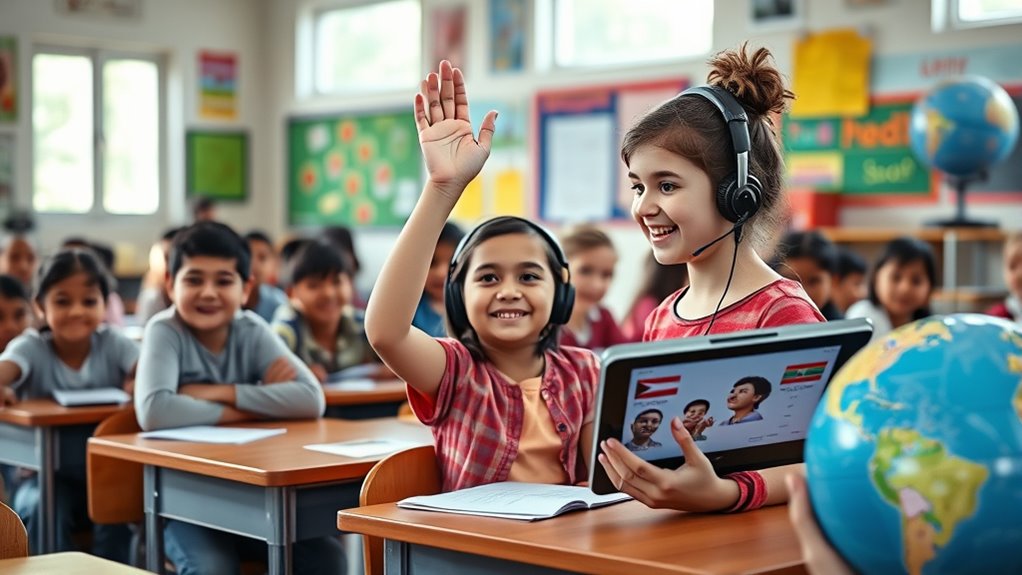
AI translation tools are transforming education by breaking down language barriers that once limited student access and understanding. You can now access learning materials, lectures, and discussions in your native language, no matter where you are. These tools support over 87 languages across more than 42 countries, making education more inclusive. With real-time translation, students in multilingual classrooms or remote areas can participate fully without language becoming a obstacle. Teachers also benefit by reaching diverse student populations more effectively. AI translation tools adapt quickly to different dialects and terminologies, ensuring clearer communication. This technology not only enhances comprehension but also builds confidence in students learning in a second language. As a result, languages no longer hinder your ability to succeed academically.
Enhancing Educational Outcomes for Marginalized Students

Did you know that AI-driven interventions are considerably narrowing achievement gaps among marginalized students? You can see this impact through several approaches.
- Personalized AI tutoring helps low-income students improve math scores by 22%, tailoring lessons to individual needs.
- AI-powered programs in refugee camps enable 19,000 children to gain basic literacy in under six months.
- Adaptive learning platforms close achievement gaps by an average of 15%, providing equitable access to quality education.
- AI translation tools support students speaking 87 languages, enhancing comprehension and engagement.
These interventions guarantee marginalized students receive targeted support, overcoming barriers that once hindered their progress. With AI, you can foster inclusion, boost outcomes, and reduce disparities in education access and achievement.
Addressing Infrastructure Challenges With Solar-Powered Devices

Have infrastructure limitations ever hindered access to quality education in remote areas? If so, solar-powered devices can make a real difference. You can deploy AI tablets and laptops powered by solar energy, ensuring they work even where electricity is scarce or unreliable. These devices are portable, durable, and easy to maintain, making them ideal for isolated communities. By eliminating the dependency on grid power, solar solutions help bring consistent learning tools directly to students. With AI-enabled content, students gain access to personalized lessons, interactive exercises, and language translation, all without electricity concerns. This approach not only improves access but also fosters engagement, attendance, and learning outcomes, making education more equitable in regions where traditional infrastructure falls short. Additionally, understanding Relationships – Personality Test can help educators and community leaders foster supportive environments that enhance student well-being and motivation. Incorporating sustainable energy solutions can further support long-term educational initiatives in these challenging settings. Moreover, leveraging Efficient General Ledger Coding practices can streamline administrative tasks associated with managing these educational programs, ensuring accurate tracking and reporting of resources used. Utilizing low-maintenance, durable devices ensures sustainability and reduces the need for frequent repairs, which is crucial in remote areas. Implementing aesthetic wall organization in educational facilities can also create a more conducive learning environment, promoting focus and community spirit.
Supporting Literacy and Basic Skills in Refugee Camps

You can see how AI literacy initiatives are transforming refugee camps by providing children with essential reading and writing skills. These programs have helped over 19,000 kids learn basic literacy in less than six months, showing significant progress. As a result, more vulnerable populations gain access to education that was previously out of reach.
AI Literacy Initiatives
How are AI literacy initiatives transforming education in refugee camps? They’re bridging gaps by providing accessible, scalable learning tools. These initiatives empower children and adults to develop foundational skills essential for integration and future opportunities. AI-driven platforms are tailored to diverse languages and literacy levels, overcoming language and resource barriers. They also foster digital fluency, preparing learners for modern workplaces. With minimal infrastructure, solar-powered tablets and translation tools make education feasible even in remote settings. These efforts accelerate basic literacy and skills acquisition, creating pathways out of poverty and uncertainty. Moreover, scalable learning solutions ensure that educational programs can grow rapidly to reach more learners in need. Additionally, integrating education technology with local community support enhances engagement and sustainability of these initiatives. Incorporating sustainable practices in deployment ensures long-term impact and environmental responsibility. Leveraging knowledge about dog breeds can inspire innovative ways to customize educational content for diverse learner needs, promoting inclusivity and engagement.
Literacy Gains Achieved
In refugee camps, AI-driven platforms are delivering remarkable literacy and basic skills improvements by providing tailored, accessible learning experiences. These programs adapt to each child’s pace, language, and learning style, ensuring personalized support. In under six months, pilot AI initiatives helped 19,000 children acquire essential reading and writing skills, narrowing achievement gaps. AI tools also translate content into multiple languages, overcoming linguistic barriers and fostering inclusivity. Interactive video lessons and gamified exercises motivate learners and enhance engagement, leading to higher retention. Teachers gain real-time insights into student progress, allowing targeted interventions. Overall, these AI solutions accelerate literacy gains, empower children with crucial skills, and create a foundation for future educational growth, even in resource-constrained refugee settings.
Bridging the Digital Divide With AI in Underserved Communities

You can see how AI expands access by bringing technology to remote communities, even where infrastructure is limited. By using solar-powered tablets and translation tools, it overcomes obstacles and supports inclusive learning for all students. These innovations help bridge the digital divide, ensuring underserved communities aren’t left behind. Moreover, implementing data-driven insights can effectively raise awareness and foster support for these initiatives among global audiences. Additionally, AI-driven personalization ensures that educational content meets the diverse needs of students in different regions, further enhancing learning outcomes. Recognizing the importance of regional resources, tailored AI solutions can better align with local educational challenges and opportunities, such as leveraging hybrid technology to adapt to various infrastructure levels.
Expanding Access Through Technology
AI is transforming access to education in underserved communities by overcoming infrastructure and resource barriers. It enables remote learning through affordable, solar-powered devices, making digital education feasible in areas with limited electricity. AI translation tools break down language barriers, supporting students in over 87 languages across 42 countries. Additionally, AI-powered remote classrooms use low-cost technology to reach rural students, boosting engagement and learning outcomes. You can leverage these innovations to expand educational reach and ensure no student is left behind. Here are some key ideas:
- Solar-powered AI tablets in remote areas
- Multilingual AI translation tools
- Remote classrooms utilizing affordable tech
- AI-driven content tailored to local needs enhancing educational relevance
Implementing these solutions can also improve digital literacy and foster community involvement in education. Furthermore, integrating AI solutions can help bridge the digital divide, ensuring equitable access to quality education for all students. Incorporating educational content that reflects local cultures and languages can further increase student engagement and understanding.
Overcoming Infrastructure Challenges
Bridging the digital divide in underserved communities requires innovative solutions that address infrastructure limitations head-on. You can leverage AI-powered tools like solar-powered tablets, which work reliably in areas with unstable electricity, to deliver educational content without constant power. Mobile networks and offline AI applications allow students to access learning resources without internet dependency. Language barriers are broken down through AI translation tools supporting multiple languages, making content accessible even in remote regions. Community-based initiatives, such as deploying AI-enabled solar devices, improve connectivity and engagement. These approaches ensure that infrastructure challenges don’t prevent students from benefiting from quality education. By combining AI with adaptable hardware and offline solutions, you create sustainable pathways to bridge infrastructure gaps and expand educational access in underserved communities. Incorporating affordable connectivity solutions further enhances the reach of these initiatives, ensuring more students can benefit from digital learning tools.
Promoting Inclusive Learning
How can technology guarantee that all students, regardless of their location or resources, have equal access to quality education? AI plays a vital role in promoting inclusive learning by breaking down barriers. It adapts content to students’ language, literacy level, and learning style, ensuring everyone can participate. AI also provides affordable solutions, like solar-powered tablets and offline resources, making education accessible in remote areas. Additionally, translation tools bridge language gaps for multilingual students, fostering understanding. Finally, AI-driven platforms enable teachers to personalize instruction and support marginalized groups effectively. Here are some ideas to promote inclusive learning:
- Language and literacy customization
- Offline and solar-powered devices
- Translation tools for multilingual students
- Personalized learning pathways
Building AI Literacy and Capacity in Developing Regions

Building AI literacy and capacity in developing regions is essential for ensuring equitable access to educational innovations. You can help bridge the digital divide by supporting initiatives that provide training and resources to educators and students. Investing in local AI training programs empowers communities to develop their own solutions, fostering sustainable growth. Collaborate with governments and nonprofits to establish workshops, online courses, and mentorship opportunities that focus on AI fundamentals and application. Promoting awareness about AI’s potential benefits encourages responsible use and innovation. By building local expertise, you enable regions to adapt AI tools to their specific needs, improving educational outcomes and closing existing gaps. Ultimately, increasing AI literacy creates a foundation for equitable, long-term educational development across developing countries.
Frequently Asked Questions
How Sustainable Are AI Solutions in Low-Resource Educational Settings?
AI solutions in low-resource settings can be sustainable if they’re adaptable, affordable, and designed with local infrastructure in mind. You should prioritize solar-powered devices and open educational resources to keep costs low. Training teachers and students in AI literacy guarantees long-term use. Regular updates and community involvement also help maintain relevance and effectiveness, making these solutions a viable, lasting part of education in resource-constrained environments.
What Are the Risks of Bias in Ai-Driven Educational Tools?
You should be aware that bias in AI-driven educational tools can lead to unfair treatment of students. If the data used to train these systems is biased, it may reinforce stereotypes or overlook specific needs of marginalized groups. This can limit access or create unequal learning opportunities. To mitigate this, you need to guarantee diverse data sources, regularly evaluate AI outcomes, and involve educators and students in development processes.
How Do Teachers Adapt to AI Integration in Classrooms?
As AI becomes more integrated, you adapt by embracing ongoing training and staying curious. You learn to balance AI tools with your teaching style, using them to personalize lessons and support diverse learners. Collaboration with colleagues helps you navigate challenges, while feedback from students guides your approach. By remaining flexible and open-minded, you turn AI into an ally, enhancing engagement and fostering inclusive learning environments.
What Policies Ensure Equitable AI Access for Marginalized Students?
You can guarantee equitable AI access for marginalized students by supporting policies that fund AI infrastructure in underserved communities, like national grants and government-backed investments. Promote open educational resources to lower costs and expand access. Encourage training programs for teachers and students to build AI literacy, addressing confidence gaps. Also, advocate for multilingual AI tools to break language barriers, ensuring all students benefit equally from AI-enhanced education opportunities.
How Is Student Data Privacy Protected in Ai-Based Education?
You’re protected through strict data privacy policies that require AI providers to follow regulations like GDPR or COPPA. These rules mandate data encryption, anonymization, and user consent before collecting information. Schools also implement secure systems, restrict access to student data, and regularly audit AI tools. By staying informed about privacy policies and advocating for transparency, you help verify your data remains safe while benefiting from AI-based education.
Conclusion
Imagine AI as a bridge spanning the vast ocean of educational inequality. With each innovative tool, you’re helping students in developing countries reach shores of opportunity they once only dreamed of. Your support turns this bridge into a pathway of hope, empowering every child to build a brighter future. Together, you’re lighting the way, transforming barriers into stepping stones, and unleashing potential that can change the world—one learner at a time.