
TL;DR
Open a free Amazon Business account
Business pricing, bulk buying and tax-exempt orders.
Create a free accountAs an affiliate, we earn on qualifying purchases.
Mistral is positioning itself as Europe’s sovereign AI stack, emphasizing control, open weights, and full infrastructure ownership. It aims to serve regulated industries and governments, betting that strategic independence beats raw model size.
Every time you hear about Mistral, it’s not just about a new AI model. It’s about a different kind of game—one where control, sovereignty, and European independence take center stage. This isn’t just a tech story; it’s a geopolitical one, wrapped in lines of code.
In this article, you’ll see how Mistral’s strategy aims to appeal to organizations that crave control—governments, banks, defense firms—and why that might matter more than sheer model size or raw performance. We’ll explore what makes Mistral’s approach both promising and challenging, and what it really means in the bigger AI picture.
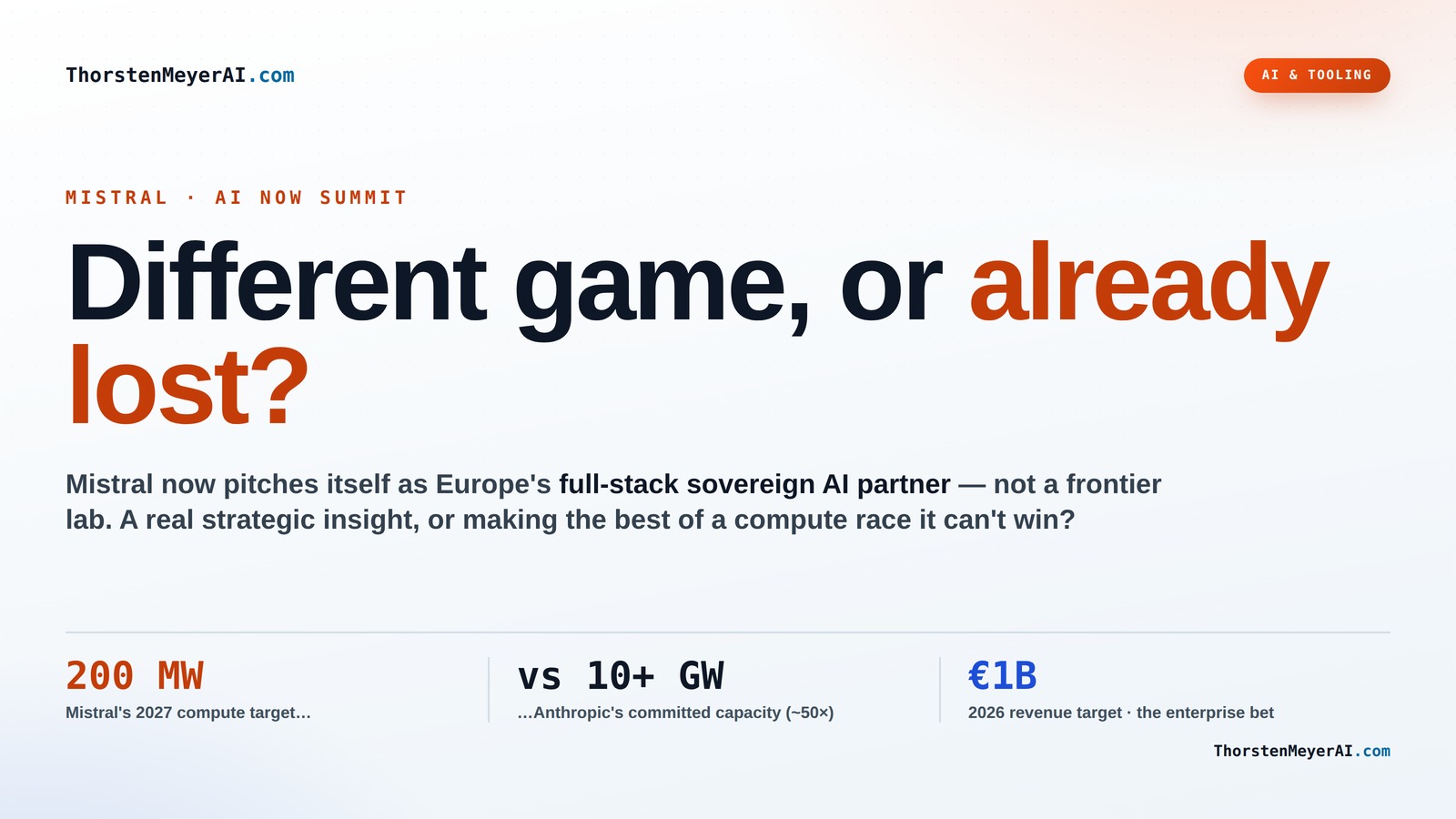
Different game, or already lost?
Mistral now pitches itself as Europe’s full-stack AI provider — compute, models, platform, consultancy — not a frontier-model lab. Is that a real strategic insight, or making the best of a race it can’t win? Both readings fit the same facts.
From model lab to full-stack provider
The clearest signal from the summit wasn’t a model — it was a posture. Heavy on enterprise logos and partnerships (ASML, BNP Paribas, Alexa+), light on new-model announcements. That absence is exactly what skeptics seized on.
Compute
40MW Paris DC + Sweden build · 200MW target by 2027
Models
Open & custom · efficient · you own and run them
Platform
Forge for custom models · Vibe for Work agent
Consultancy
Sales teams, integrators, EU provenance & support
Small & focused, or large & general?
Mistral bets on specialized small models. The claim isn’t that they win a reasoning leaderboard — they don’t. It’s that on the metrics that matter in production agent systems, a purpose-built small model wins. Flip the metric to see the case reverse.
Small specialized vs large general — by what you measure
In token-heavy agentic apps making hundreds of calls, speed/energy/cost compound. Toggle the metric.
Narrow models doing real work
Each is one model doing one thing efficiently — the tangible version of the strategy. Strong on their own terms; the open question is whether the bundle beats a free Chinese open-weight download.
On-prem KYC compliance
Mistral models run inside the bank’s walls for know-your-customer checks. Sensitive financial data never leaves. (BNP was Mistral’s first customer, 2023.)
Voxtral multilingual voice
A focused voice model powering Alexa+ across Europe — speed and efficiency over raw size.
Robostral industrial robotics
Plus a “physics AI” push (via the Emmi acquisition) into aerospace, automotive & semiconductor design and simulation.
Document AI / OCR at scale
Large-scale text extraction — the unglamorous, high-volume enterprise work small models excel at.
The strategy is downstream of the compute gap
Once you see the raw numbers, “why is Mistral behind?” answers itself — and the specialized-small-model strategy starts looking partly like a smart adaptation to a binding constraint, not a pure philosophical choice.
Compute & capital · Mistral vs a frontier leader, this same week
Not a knock — it’s the constraint that forces the efficiency-first, sovereignty-wedge strategy. Adapting intelligently to your position is what good strategy is.
“I want them to win, but I’m worried”
That ambivalence is the most accurate read of where Mistral sits. The enterprise pivot gets read two opposite ways — and both deserve airing.
On-prem, real sales teams, the Koyeb deployment acquisition, EU provenance — exactly what regulated enterprises want, and stickier than consumer mindshare. Targeting €1B revenue in 2026 with 1,000 staff, up from 15 people and one customer in 2023. US closed-API labs structurally can’t match the sovereignty axis.
“Software consultancy with a data center,” not a foundation-model moat. Enterprise B2B is where European startups go when they can’t win consumer or world-scale SaaS. Why pay Mistral on-prem when you could run Qwen free? One paying Le Chat Pro user said the quality gap with frontier labs is now hard to ignore.
Key Takeaways
- Mistral’s focus on sovereignty and open weights targets Europe’s regulated sectors, emphasizing control and independence over pure model size.
- Self-hosted, full-stack AI solutions appeal to organizations wary of vendor lock-in and data residency issues, but come with operational tradeoffs.
- Small, purpose-built models can outperform giants in real-world enterprise tasks by prioritizing speed, cost, and energy efficiency.
- European AI sovereignty is driven by regulatory, political, and strategic concerns—making Mistral’s approach a timely response.
- Choosing Mistral requires careful consideration of infrastructure, costs, and compliance needs beyond just model performance.
European AI sovereignty computing hardware
As an affiliate, we earn on qualifying purchases.
As an affiliate, we earn on qualifying purchases.
What Does ‘Sovereign’ Really Mean for Mistral?
’Sovereign’ in Mistral’s world means control—over data, infrastructure, models, and updates. It’s a stance against reliance on US cloud giants or closed APIs. Think of it like owning your house versus renting an apartment—you get to paint the walls, upgrade wiring, and decide who visits.
For example, BNP Paribas runs Mistral models on-premise to keep sensitive financial data inside their secure servers. They’re not just testing models; they’re embedding AI deep into their core operations, with full control over how and where it runs.
This approach appeals to regulated sectors where data residency and compliance matter. It’s about having the keys, not just the map.
Why does this matter? Because in high-stakes industries, control over AI infrastructure isn’t just a convenience—it’s a safeguard against data breaches, regulatory penalties, and loss of strategic autonomy. The tradeoff is that this approach demands significant investment in infrastructure, expertise, and maintenance, which can slow down deployment and increase costs. Yet, for organizations prioritizing security and independence, these costs are justified for peace of mind and compliance assurance.

enterprise AI model deployment platform
As an affiliate, we earn on qualifying purchases.
As an affiliate, we earn on qualifying purchases.
How Mistral Differs from US AI Giants Like OpenAI and Anthropic
| Feature | Mistral |
|---|---|
| Model access | Open weights, self-hosting, full control |
| Deployment | On-premise, private cloud, flexible infrastructure |
| Focus | Sovereignty, European market, regulated industries |
| Model size | Small to medium, optimized for efficiency |
By contrast, US giants like OpenAI and Anthropic heavily lean on closed APIs, offering less control but focusing on scale and general-purpose performance. Learn more about AI industry trends. Mistral’s niche is about independence—letting organizations own and run their models, especially in Europe.
These differences aren’t just technical—they reflect divergent philosophies about control, security, and strategic autonomy. US companies prioritize rapid deployment and ease of access, often at the expense of control. Mistral emphasizes sovereignty, which appeals to organizations wary of vendor lock-in and external dependencies. The tradeoff? Organizations might face higher initial setup costs and operational complexity but gain long-term control and compliance advantages.

As an affiliate, we earn on qualifying purchases.
Why Europe’s Love for Sovereignty Is Changing the AI Game
European organizations face unique pressures—strict data laws, procurement policies, and concerns over reliance on US or Chinese tech giants. DeepIntellica’s insights on AI sovereignty. Mistral’s focus on sovereignty hits a nerve here.
For instance, the European Union’s push for digital independence and stricter data rules means that companies like BNP Paribas prefer models they can fully own and control. That’s a big shift from the US model of cloud reliance.
It’s a political and strategic move—more than just a business tactic. Mistral’s positioning aligns with this wave, making it a go-to for governments and regulated firms looking for trustworthy, controllable AI options.
This shift isn’t just about compliance—it’s about strategic resilience. Countries and organizations want to reduce their vulnerability to external disruptions, geopolitical tensions, and foreign surveillance. The implication? A growing market for sovereign AI solutions that can operate independently of external cloud services, even if that means sacrificing some scalability or convenience. The challenge is balancing control with innovation speed, as self-hosted solutions often lag behind cloud-native offerings in agility and updates.

As an affiliate, we earn on qualifying purchases.
Is Open-Weight Self-Hosting the Future? Pros and Cons
Many believe open weights and self-hosting are the future for regulated and privacy-conscious organizations. But it’s not just about control; it’s about practicality.
Here’s a quick rundown:
- Pros: Full data control, customization, no vendor lock-in, compliance assurance.
- Cons: Higher operational complexity, maintenance responsibilities, and potentially higher costs.
For example, Abanca, a regional bank, uses Mistral models locally to handle sensitive customer data. They avoid exposing information to external parties but pay the price in infrastructure management and staffing. This tradeoff means organizations must weigh the value of control against the operational overhead—some might find the added security worth the extra effort, while others could see it as a barrier to rapid innovation.
Ultimately, the decision hinges on an organization’s risk appetite, technical capacity, and strategic priorities. For highly regulated sectors, the benefits of sovereignty often outweigh the costs, but for others, cloud-based solutions may still be more practical despite the risks.

Small Models, Big Gains: Why Mistral Bets on Focused, Efficient AI
Mistral champions small, purpose-built models over giant general-purpose ones. Why? Because in real-world enterprise use, speed, cost, and energy draw matter more than chasing leaderboard scores.
Think of Mistral’s Voxtral for multilingual voice—optimized for European languages and low latency. Or Robostral—tailored for industrial robotics. These models are narrow, but they do their jobs fast and cheap, especially at scale.
Focusing on smaller models allows Mistral to deliver tailored solutions that meet specific industry needs without the massive resource requirements of larger models. This approach reduces deployment costs and speeds up iteration cycles, making AI more accessible for organizations with limited infrastructure. The tradeoff? Smaller models may lack the versatility of larger models, but for targeted applications, their efficiency and reliability make them more practical and strategically aligned with sovereignty goals.

The Real Power of Mistral’s Strategy: Winning by Serving a Niche
Is Mistral trying to beat Google or OpenAI on benchmarks? Not really. Its strength lies in serving a specific customer segment—those who need control, compliance, and sovereignty.
This isn’t about being the biggest; it’s about being the best choice for regulated, data-sensitive organizations. That’s why Mistral’s full-stack approach, open weights, and European roots resonate.
By focusing on niche markets, Mistral can tailor its offerings to meet strict regulatory standards and build trust with clients who prioritize security and independence. This strategic positioning enables Mistral to carve out a sustainable competitive advantage in a crowded market—serving those who value control over raw performance. It’s a classic case of specialization creating strength, especially in a landscape where trust and compliance are paramount.
Practical Buyer Questions: What Really Matters When Choosing Mistral?
If you’re considering Mistral for your organization, here’s what you should ask:
- Where do the model weights live? On your servers or Mistral’s cloud?
- Who controls upgrades and maintenance?
- What’s the total cost of ownership—hardware, support, deployment?
- How well does it comply with local data laws?
- Is the performance enough for your use case?
Beyond technical specs, these questions reveal how well Mistral aligns with your strategic priorities. For regulated industries, control over data residency, upgrade cycles, and compliance processes can determine the success or failure of an AI deployment. Organizations should evaluate whether the operational overhead and costs are justified by the security and independence gains. Ultimately, these considerations help ensure that the AI solution fits not just technically but strategically—supporting long-term resilience and compliance.
Frequently Asked Questions
What does ‘sovereign’ mean in Mistral’s context?
It means having control over the entire AI stack—model weights, hosting, upgrades, and data handling—so organizations aren’t dependent on external vendors or cloud providers. It’s about owning your AI environment.
How is Mistral different from OpenAI or Anthropic?
Mistral offers open-weight models that organizations can self-host, giving them full control over deployment and data. US companies primarily rely on closed APIs, limiting control but focusing on scale and ease of use.
Why do European organizations care so much about AI sovereignty?
Because of strict data laws, procurement policies, and strategic concerns about technological dependence. European regulators and buyers want to keep their data and AI infrastructure within their borders.
Is sovereign AI less powerful than closed, API-only models?
Not necessarily. It’s more about fitting the specific needs—control, compliance, and customization—than just chasing benchmark scores. For many regulated sectors, sovereignty is more valuable than raw performance.
What are the main downsides of choosing sovereign AI?
Operational complexity and higher costs. Managing your own infrastructure, updates, and security can be a challenge—especially compared to the simplicity of cloud APIs.
Conclusion
Mistral’s gamble on sovereignty isn’t just a political stance—it’s a business strategy rooted in real market demands. For organizations that value control, compliance, and independence, it offers a compelling alternative to the US giants.
In the end, whether Mistral wins or not depends on how well it can balance technical capability with the strategic needs of its customers. Control might just be the new currency in AI’s future.

Flea & tick season Picks
flea and tick prevention
As an affiliate, we earn on qualifying purchases.