
🔍 Read the full analysis: Exploring Anthropic's Model Hardware Standard For AI Innovation on ThorstenMeyerAI.com

Get business pricing on tech for your team
- Business-only prices and quantity discounts
- Tax-exempt purchasing
- Multiple users, one account, clear invoices
TL;DR
Anthropic has opened a limited research preview of its Model Hardware Standard (MHS), designed to enable AI agents to operate physical equipment through shared drivers. Early partner projects suggest potential for faster, more flexible automation, but safety and performance validation are still ongoing.
Anthropic has launched a limited research preview of its Model Hardware Standard (MHS), as detailed in the original analysis, opening early access to select laboratories and manufacturers. The standard aims to enable AI agents to discover, monitor, and operate physical equipment through shared, programmable drivers, potentially transforming laboratory automation and multi-instrument workflows.
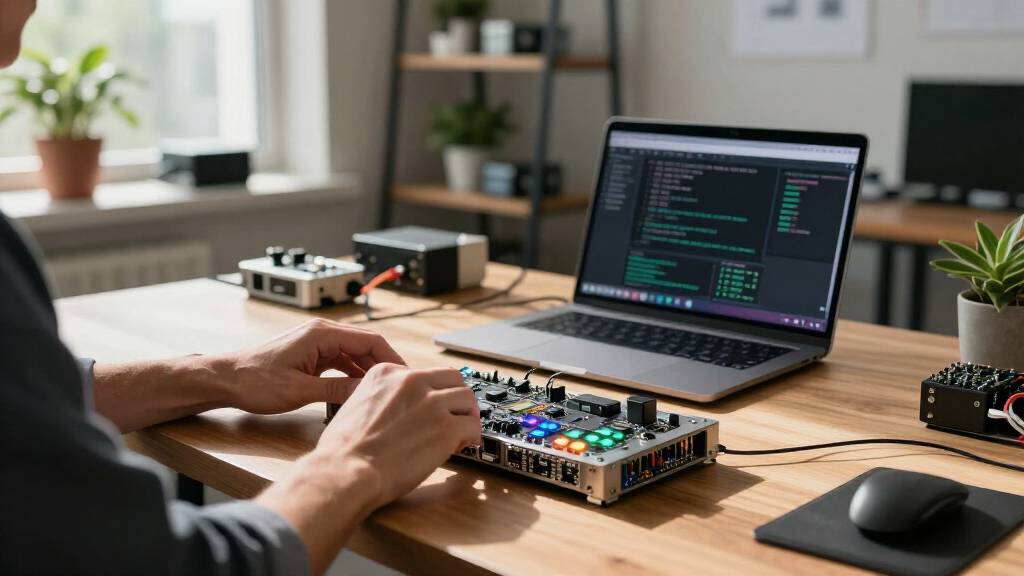
The Model Hardware Standard provides a common interface for connecting AI systems to hardware like microscopes, liquid handlers, robotic arms, and lasers. Developed initially with the HHMI Janelia Research Campus, MHS introduces a standardized software driver layer that describes device capabilities, enforces safety limits, and exposes basic operations such as reading temperatures or adjusting settings.
Anthropic states that the preview allows participating organizations to test how well AI agents can discover equipment, monitor operational data, and coordinate multiple instruments. Early projects include protein assay automation at Genentech, microscope control at Janelia, and laser stabilization at QuEra, a quantum computing firm. For more on hardware standards in AI, see this detailed overview. For example, QuEra reported that an AI-developed controller recovered a laser lock in 99.3% of tests, although no independent validation has been published.
The goal of MHS is to reduce the time and effort traditionally required to integrate diverse laboratory instruments—often taking weeks or months—down to hours or minutes. This could lead to more flexible, scalable automation, especially in complex research environments where multiple vendor devices are used. However, the current implementation relies heavily on expert supervision to prevent safety risks, as errors in physical control can cause damage or safety hazards. Learn more about the importance of safety standards in AI hardware at this analysis.
Potential Impact on Laboratory and Industrial Automation
The Model Hardware Standard addresses a longstanding interoperability challenge in laboratory and industrial automation—fragmented device interfaces requiring custom integration. If successfully validated, MHS could streamline workflows, reduce setup times, and enable more adaptable AI-driven operations across diverse environments.
However, the safety and reliability of AI-controlled physical equipment remain critical concerns. The current prototype depends on strict supervision, and the risk of errors—such as damaging samples or equipment—persists. Widespread adoption will depend on demonstrating consistent safety, robustness, and support across hardware vendors.
As an affiliate, we earn on qualifying purchases.
Background on Multi-Vendor Laboratory Automation Challenges
Laboratories and factories often rely on equipment from multiple vendors, each with proprietary control software, leading to complex, fragile integrations. Traditionally, connecting AI systems to diverse instruments involves custom programming, which is costly, time-consuming, and difficult to reproduce. This has limited the scalability and flexibility of automation efforts.
Anthropic’s development of MHS stems from ongoing research collaborations, notably with HHMI Janelia, aiming to replace numerous point-to-point connections with a unified, standardized interface. Early tests with biotech, robotics, and quantum computing organizations have shown promising reductions in integration time and increased control capabilities, but comprehensive validation remains pending.
“MHS could significantly lower the barriers to automating complex laboratory workflows, making AI-driven experiments more accessible and scalable.”
— Thorsten Meyer, AI researcher
automated microscope control system
As an affiliate, we earn on qualifying purchases.
As an affiliate, we earn on qualifying purchases.
Uncertainties Around Safety and Broader Compatibility
As MHS remains in early preview, it is unclear how well the standard will perform across the full spectrum of laboratory and industrial equipment, especially in real-world, failure-prone environments. No independent validation or extensive safety testing has yet been published, and the system currently supports only programmable devices, leaving out many legacy or non-programmable tools.
Questions also remain about how effectively the standard can enforce safety limits in practice, prevent errors, and handle unexpected scenarios such as sensor failures or communication disruptions.
As an affiliate, we earn on qualifying purchases.
Next Steps for Validation and Broader Adoption
Anthropic is accepting applications for the limited preview, with plans to expand testing across more organizations and device types. The company intends to publish detailed safety evaluations, deployment practices, and a physical-safety roadmap before a public release.
Future milestones include independent multi-site testing, incident reporting, and validation of safety benchmarks. The key test will be whether MHS can reliably produce consistent results while maintaining human oversight and safety limits during failures or anomalies.
As an affiliate, we earn on qualifying purchases.
Key Questions
What types of equipment are compatible with MHS?
Currently, MHS supports programmable devices such as microscopes, liquid handlers, lasers, and robotic arms. Support for non-programmable or legacy equipment is not yet available.
When will MHS be publicly available?
There is no confirmed date for the open-source release. Anthropic plans to publish findings and deployment guidance after completing further testing and validation with preview partners.
How does MHS improve safety in AI-controlled laboratories?
MHS includes device descriptions and safety limits at the driver level, aiming to prevent unsafe commands. However, its effectiveness depends on robust enforcement and oversight, which are still under development.
Can MHS work with existing laboratory equipment?
Support is limited to equipment with programmable interfaces. Many existing devices without such interfaces will require new drivers or manufacturer cooperation to be compatible.
What are the main risks associated with MHS?
The primary risks involve physical damage or safety hazards resulting from errors in physical control. Ensuring reliable enforcement of safety limits and handling unexpected failures are ongoing challenges.
Primary source: Anthropic · via ThorstenMeyerAI.com
Halloween Picks
halloween
As an affiliate, we earn on qualifying purchases.