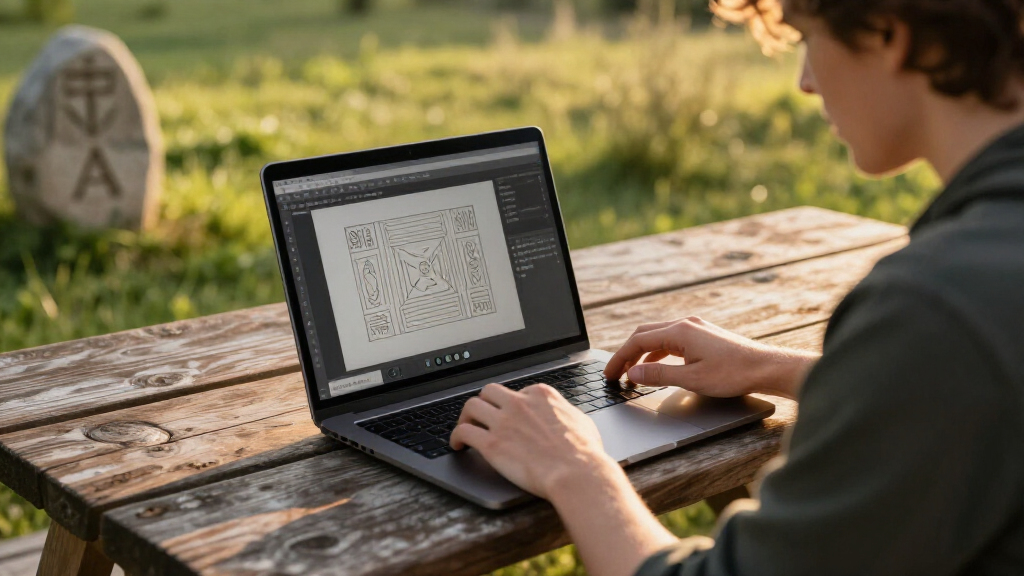

🔍 Read the full analysis: How AI Enhances SVG Carving Animation: A Deep Dive Into 'The Runestone Field' on ThorstenMeyerAI.com

Get business pricing on tech for your team
- Business-only prices and quantity discounts
- Tax-exempt purchasing
- Multiple users, one account, clear invoices
TL;DR
AI-driven SVG carving animation transforms ‘The Runestone Field’ into a dynamic digital experience. This development showcases how automation elevates visual storytelling, bridging ancient art and modern tech.
Thorsten Meyer’s team has integrated artificial intelligence into SVG carving animation to produce a highly detailed, dynamic visualization of ‘The Runestone Field.’ This innovative approach enhances storytelling by transforming static runic carvings into fluid, animated narratives, demonstrating the potential of AI in digital art and historical reconstructions.
The project, titled ‘The Runestone Field — Carve Words Into Winter,’ employs AI algorithms to automate and refine the SVG carving process, resulting in animations that reveal intricate details of ancient runic inscriptions. The team used a combination of precise SVG techniques and machine learning models to generate smooth, realistic carving effects, allowing viewers to explore the carvings as if they are being created in real time.
According to the creators, this method not only preserves the artistry of traditional runic carvings but also introduces a new level of interactivity and immersion. The animations are designed to evoke a sense of discovery, with stones seemingly speaking as their carvings come to life through fluid motion. The project was showcased in a live demonstration, attracting attention for its seamless blend of historical craftsmanship and automation.
Developers highlighted that AI played a crucial role in automating complex tasks, such as pattern recognition and stroke simulation, which traditionally require extensive manual effort. This automation accelerates production and allows for more detailed and accurate representations of ancient symbols, making the storytelling more engaging and educational.
How AI Enhances SVG Carving Animation: A Deep Dive Into ‘The Runestone Field’
Thorsten Meyer’s team integrated artificial intelligence into SVG carving animation for ‘The Runestone Field — Carve Words Into Winter,’ transforming static runic inscriptions into fluid, real-time animated narratives that bridge ancient craftsmanship and modern machine learning.
“Digital artisans can blend craftsmanship with automation, creating immersive storytelling experiences that connect history with modern technology.”
— Thorsten MeyerWhy AI-Enhanced SVG Carving Matters
Beyond a single project, the integration of AI into SVG carving signals a shift toward automated, scalable approaches in digital art — reducing the time and skill barriers traditionally associated with complex animation, and making cultural heritage more accessible.
Preservation & Access
AI offers a means to preserve and animate ancient art forms with increased detail and realism, making historical artifacts engaging and accessible to wider audiences.
Interactive Media
Viewers can explore detailed animations that reveal additional layers of meaning within historical artifacts, evoking a sense of discovery as stones seemingly speak.
Lowered Barriers
Automation reduces the time and skill barriers of complex animation, pointing toward scalable, repeatable approaches across digital humanities and visual design.
From Stone to Screen: The AI Carving Pipeline
AI played a crucial role in automating complex tasks such as pattern recognition and stroke simulation — work that traditionally demands extensive manual effort. The result: viewers explore carvings as if being created in real time.
Capture Runes
Runic inscriptions are digitized, preserving authentic detail from stone and wood carvings.
Pattern Recognition
Machine learning models identify symbol structures and carving patterns automatically.
Stroke Simulation
AI generates smooth, realistic carving effects with refined SVG stroke paths.
Animated Reveal
Fluid motion reveals inscriptions as if carved in real time, stone by stone.
Immersive Story
Interactive display connects viewers with ancient narratives in virtual exhibits.
Traditional Methods vs. AI-Driven Animation
| Capability | Traditional Carving Craft | Static Digital / Early Animation | AI-Enhanced SVG Carving |
|---|---|---|---|
| Detail Fidelity | ✓ Authentic | ~ Limited detail | ✓ Intricate, accurate |
| Production Speed | ✗ Painstaking | ~ Moderate effort | ✓ Automated, fast |
| Real-Time Animation | ✗ Not possible | ✗ Simple only | ✓ Fluid & dynamic |
| Interactivity | ✗ Static object | ~ Passive viewing | ✓ Immersive exploration |
| Scalability to Other Art | ✗ One-of-a-kind | ~ Manual adaptation | ~ Promising, unproven |
Where AI Moves the Needle
Qualitative assessment of how AI-driven carving automation changes key dimensions of digital heritage production, based on the project team’s live demonstration and reported outcomes.
What Readers Want to Know
Open questions remain about scalability, authenticity, and the technology’s application beyond ‘The Runestone Field’ — while the team plans accessible tools for artists, historians, virtual museums, and educational platforms.
How does AI improve SVG carving animation?
AI automates complex pattern recognition and stroke simulation, enabling more detailed, realistic, and fluid animations that would be time-consuming to produce manually.
Can it be used for other historical art?
Yes — the techniques can potentially be adapted to animate reliefs, murals, and sculptures, with further customization for each medium.
What are the main challenges?
Ensuring scalability, maintaining authenticity, and managing the technical complexity of automating detailed artistic patterns across diverse runic styles.
Will it replace traditional craftsmanship?
No. It complements craftsmanship by providing new tools for visualization and storytelling, rather than replacing human artisans.
Why AI-Enhanced SVG Carving Matters for Digital Art
This development demonstrates how artificial intelligence can influence digital storytelling by automating detailed artistic processes. For historical reconstructions, AI offers a means to preserve and animate ancient art forms with increased detail and realism, potentially making cultural heritage more accessible and engaging for audiences.
Furthermore, the integration of AI into SVG carving opens new possibilities for interactive media, where viewers can explore detailed animations that reveal additional layers of meaning within historical artifacts. It also indicates a move toward more automated, scalable approaches in digital art, reducing the time and skill barriers traditionally associated with complex animations.
For the broader field of digital humanities and visual design, this project exemplifies how technology can serve as a tool to enhance craftsmanship. As AI tools become more advanced, artists and historians may increasingly utilize automation to animate and interpret ancient stories, fostering a deeper understanding of historical narratives.
As an affiliate, we earn on qualifying purchases.
Historical and Technological Background of Runic Carvings
Runic carvings have been a significant form of communication and artistic expression in northern European cultures for centuries. Traditionally, these carvings were painstakingly etched into stone and wood, often depicting stories, memorials, or symbols of spiritual significance. Preserving and recreating these carvings digitally has been a challenge, especially when aiming to maintain authenticity and detail.
Recent advancements in digital art and automation have enabled new approaches to visualizing ancient artifacts. Prior efforts largely focused on static images or simple animations, but the advent of AI-driven techniques now allows for more dynamic and realistic representations. The ‘Runestone Field’ project builds upon these developments, combining traditional craftsmanship with modern machine learning to create immersive visualizations.
In the broader context, this project reflects a growing trend of using AI to enhance cultural heritage preservation, making historical artifacts more accessible and engaging through digital means. It also aligns with ongoing efforts to integrate technology into archaeology and art history for educational and preservation purposes.
“Our project demonstrates how digital artisans can blend craftsmanship with automation, creating immersive storytelling experiences that connect history with modern technology.”
— Thorsten Meyer
As an affiliate, we earn on qualifying purchases.
Remaining Questions About AI-Driven SVG Carving
While the project demonstrates promising results, questions remain regarding the scalability and adaptability of the AI techniques for other applications beyond ‘The Runestone Field.’ Specific details about the algorithms used, their limitations, and their performance with different styles of carvings have not been publicly disclosed. Additionally, discussions continue within the digital heritage community about the long-term preservation and authenticity of AI-generated animations.
As an affiliate, we earn on qualifying purchases.
Future Developments in AI and Digital Heritage
Moving forward, the team plans to improve their AI models to accommodate a broader range of runic styles and artifacts. They aim to develop accessible tools that enable artists and historians to create similar animations without requiring extensive technical expertise. Further testing will explore how these techniques can be integrated into educational platforms, virtual museums, and interactive exhibits. The project also encourages collaboration between technologists and cultural institutions to digitize and animate other historical carvings and artworks.
digital heritage visualization tools
As an affiliate, we earn on qualifying purchases.
As an affiliate, we earn on qualifying purchases.
Key Questions
How does AI improve SVG carving animation?
AI automates complex pattern recognition and stroke simulation, enabling more detailed, realistic, and fluid animations of carvings that would be time-consuming to produce manually.
Can this technology be used for other types of historical art?
Yes, the techniques developed can potentially be adapted to animate various forms of ancient art, including reliefs, murals, and sculptures, with further customization.
What are the main challenges facing AI-enhanced SVG carving?
Key challenges include ensuring scalability, maintaining authenticity, and managing the technical complexity of automating detailed artistic patterns across diverse styles.
Will this technology replace traditional craftsmanship?
No, it complements traditional craftsmanship by providing new tools for visualization and storytelling, rather than replacing human artisans.
How accessible will these animations be to the public?
Future developments aim to integrate these animations into digital platforms like virtual museums and educational apps, making them widely accessible.
Source: ThorstenMeyerAI.com
Fall Picks
fall essentials
As an affiliate, we earn on qualifying purchases.