
🔍 Read the full analysis: How To Choose Among The 10 Best Network Attached Storage Devices For 2027 on ThorstenMeyerAI.com

Get business pricing on tech for your team
- Business-only prices and quantity discounts
- Tax-exempt purchasing
- Multiple users, one account, clear invoices
TL;DR
ThorstenMeyerAI.com’s buying guide compares 10 NAS devices for 2027, from four-bay UGREEN enclosures to single-bay BUFFALO systems with a drive included. Its recommendations are based on fit and tradeoffs, not independently verified performance tests; shoppers should confirm current specifications and plan a separate backup.
ThorstenMeyerAI.com’s 2027 buying guide compares 10 network-attached storage (NAS) devices, naming the four-bay UGREEN DXP4800 Plus its overall pick and the two-bay Synology DS225+ its choice for buyers seeking a smaller setup. The guide also highlights two single-bay BUFFALO models that include storage, contrasting a simpler purchase with diskless systems that buyers configure themselves.
According to ThorstenMeyerAI.com’s guide, the central distinction is storage capacity and expansion versus convenience. The roundup places the UGREEN DXP4800 Plus, DXP4800 Pro and DH4300 Plus in the four-bay group, offering more drive slots than its listed two-bay and single-bay alternatives. More bays can leave room for a growing collection, but buyers may need to budget for additional drives and manage more hardware.
The guide lists five two-bay options: the UGREEN DXP2800, Synology DS225+, DS223, DS223j and DH2300. It presents these as options for a more focused home storage plan, with less expansion headroom than four-bay devices. The roundup identifies the BUFFALO LinkStation 210 4TB and 2TB as single-bay systems with a drive included; the 4TB version has more bundled capacity than the 2TB version.
ThorstenMeyerAI.com says it compared bay count, included storage, flexibility, usability and maintenance. The guide describes most listed models as diskless, meaning buyers must select and install drives separately. It recommends checking manufacturer specifications for supported drives, networking, software features and storage configurations. The supplied guide does not state a publication date or prices, and provides no test results or detailed specifications for every model.
The 10 picks
- 1
 UGREEN NAS DXP4800 Pro 4-Bay Desktop NAS with Intel Core i3-1315U, 8GB DDR5,…View on Amazon →
- 2
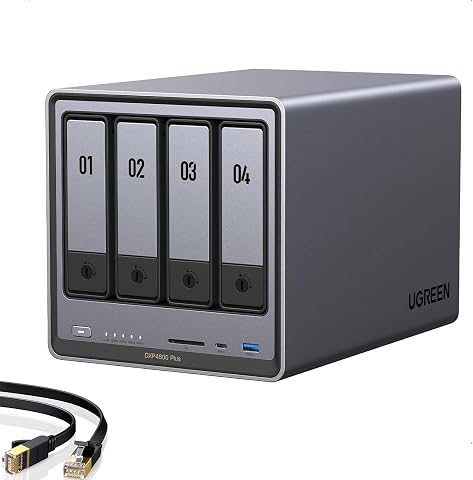 UGREEN DXP4800 Plus 4-Bay NASView on Amazon →
- 3
 UGREEN NAS DXP2800 2-Bay for Advanced Home Users, Remote Workers & CreatorsView on Amazon →
- 4
 UGREEN NAS DH4300 Plus 4-Bay NAS Storage EnclosureView on Amazon →
- 5
 Synology DS225+ 2-Bay Diskless NASView on Amazon →
- 6
 Synology DS223 2-Bay Diskless NASView on Amazon →
- 7
 UGREEN NAS DH2300 2-Bay Desktop NASync, Support Capacity 64TB (Diskless), Rem…View on Amazon →
- 8
 Synology DiskStation DS223j 2-Bay NAS Enclosure (Diskless)View on Amazon →
- 9
 BUFFALO LinkStation 210 4TB 1-Bay NASView on Amazon →
- 10BUFFALO LinkStation 210 2TB 1-Bay NAS with Included Hard DriveView on Amazon →
Match Bay Count to Storage Plans
The choice affects both the initial purchase and how a storage setup can adapt over time. As the guide’s comparison of single-bay, multi-bay and diskless models illustrates, a single-bay device with an included drive involves fewer setup decisions but offers fewer drive options than a multi-bay enclosure. A diskless model gives buyers more control over drive selection, while adding cost, installation work and compatibility checks.
The guide also cautions against treating a NAS as a complete backup plan. Centralizing files can make them accessible across a home or office network, but does not by itself protect against accidental deletion, device damage or theft. Buyers should plan an independent second copy and check how the device supports scheduled backups and restoration. That practical planning may matter more than choosing a model with the highest bay count.
Products Worth Considering

LG UltraGear 27-inch QHD OLED Gaming Monitor, 240Hz, 0.03ms, G-SYNC Compatible, FreeSync Premium Pro, HDR True Black 400

Jackery HomePower 3600 Plus Portable Power Station, 3584Wh, 3600W

Samsung 32 Odyssey G5 QHD Gaming Monitor
As an affiliate, we earn on qualifying purchases.
How the Guide Groups Its Picks
Based on the supplied material, ThorstenMeyerAI.com’s roundup is a buying guide, not a reported product-testing study. The site says it compares devices against common storage needs, including shared access, backups, expected data growth and the amount of setup a household or small office can manage. Its stated approach favors models with room to adapt while retaining smaller and simpler alternatives for buyers with limited needs.
The guide also distinguishes between hardware choice and software experience, naming Synology and UGREEN as different routes through the category but offering no detailed feature-by-feature comparison. It advises shoppers to consult current manufacturer specifications and match network capabilities to their router, switch and client devices. As the guide’s discussion implies, drive count alone does not establish transfer speed or suitability for a particular workload.
Prices and Specifications Need Checking
The supplied ThorstenMeyerAI.com material does not state prices, testing conditions, benchmark results or product availability, and it does not provide a detailed specification sheet for all 10 devices. The site’s recommendations should therefore be read as editorial judgments based on its stated criteria, not as proof that one model will outperform another in every home or office.
The supplied guide also does not establish which exact drive types, network ports, software functions or storage configurations each model supports. Those details can affect compatibility and cost, and may change. Buyers should verify them with the manufacturers rather than assume devices in the same bay-count category work alike.
Verify Details Before Purchase
Before choosing, estimate how much storage is in use now and how quickly it may grow, then decide how much setup work is acceptable. Compare the full cost of each option, including separately purchased drives for a diskless enclosure, and confirm that the NAS connects appropriately to the existing network.
ThorstenMeyerAI.com’s guide advises shoppers to check current manufacturer information for supported drives, backup and restore features, and any relevant expansion limits. The supplied material does not announce a subsequent review or testing milestone, so the recommendations are a starting point for comparison rather than a substitute for checking current product details.
Key Questions
Which NAS does the guide recommend overall?
ThorstenMeyerAI.com names the UGREEN DXP4800 Plus as its overall pick, emphasizing its four drive bays and room to grow. The supplied guide does not provide benchmark results or prices.
Which models are listed as two-bay options?
ThorstenMeyerAI.com’s roundup lists the UGREEN DXP2800, Synology DS225+, Synology DS223, Synology DS223j and UGREEN DH2300 as two-bay choices. Check each manufacturer’s current specifications for supported configurations and features.
What is the difference between diskless and drive-included NAS devices?
According to the guide, a diskless NAS requires a separate drive purchase and installation but gives the buyer more control over drive selection. The listed BUFFALO LinkStation 210 models include a drive, reducing setup decisions; the roundup identifies 2TB and 4TB versions.
Does a NAS replace a separate backup?
No. The guide says a NAS centralizes files but does not protect them from every risk, including deletion, device damage or theft. It recommends planning an independent second copy and checking backup and restoration options.
Source: ThorstenMeyerAI.com