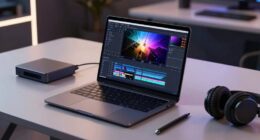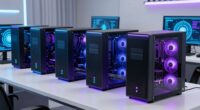
Mini PCs are suddenly a big deal for edge AI because they offer powerful processing in a compact, energy-efficient design, making them ideal for space-constrained environments. They enable real-time decision-making and local data handling, reducing reliance on cloud connections and lowering latency. With customizable hardware options, they adapt to various AI workloads and deployment scenarios. If you want to explore how these tiny devices are transforming edge AI, there’s plenty more to uncover.
Key Takeaways
- Their compact size allows deployment in limited or remote spaces, expanding edge AI applications.
- High processing power enables real-time decision-making locally, reducing latency and cloud dependence.
- Energy efficiency lowers operational costs and supports sustainable, long-term edge AI solutions.
- Hardware customization offers tailored performance for diverse AI workloads and deployment environments.
- Seamless cloud integration enhances data management, updates, and system scalability at the edge.

As edge AI continues to transform industries, mini PCs have emerged as powerful, compact solutions for running advanced AI workloads close to data sources. These tiny machines pack impressive processing capabilities into a small footprint, making them ideal for edge environments where space, power, and real-time performance matter. You’ll find that mini PCs excel at handling data locally, reducing reliance on cloud-based processing and minimizing latency. This local processing is essential for applications like smart surveillance, autonomous vehicles, and industrial automation, where quick decision-making can’t wait for data to travel back and forth to the cloud.
One of the most compelling reasons to consider mini PCs for edge AI is their seamless cloud integration. While they operate independently, they can still connect effortlessly to cloud services for data backup, updates, or centralized management. This hybrid approach allows you to leverage the power of cloud infrastructure without sacrificing the immediacy and reliability of local processing. Mini PCs act as intelligent gateways—collecting, analyzing, and pre-processing data at the source, then uploading only essential information or insights to the cloud. This setup not only improves overall system efficiency but also reduces bandwidth costs and network congestion. Additionally, their ability to localize data processing ensures faster response times and greater privacy protection. Moreover, mini PCs are often equipped with hardware that supports advanced AI accelerators, enabling them to handle more complex tasks efficiently at the edge. Incorporating energy-efficient components further enhances their suitability for remote deployments where power is limited.
Mini PCs seamlessly connect to cloud services, enabling efficient data management and reducing bandwidth and network congestion.
Power efficiency is another critical advantage that makes mini PCs stand out in the edge AI landscape. Unlike traditional servers or larger computing units, these compact devices consume considerably less energy, which is essential for deployments in remote or hard-to-reach locations where power supplies may be limited or expensive. You’ll appreciate their low power consumption because it translates directly into lower operational costs and a smaller carbon footprint. Many mini PCs are built with energy-efficient components and optimized hardware, ensuring that you get maximum performance without draining your power source. This efficiency is further enhanced by the compact size, enabling deployment in space-constrained environments while maintaining high performance. This small footprint also makes them easier to integrate into existing infrastructure and various environments, providing greater deployment flexibility. This efficiency enables longer, more reliable operation in environments where maintenance might be difficult or infrequent.
Furthermore, mini PCs are highly versatile and customizable. You can select hardware configurations tailored specifically to your AI workload, whether that means adding specialized processors, GPUs, or accelerators. Their small size also makes deployment flexible—you can mount them on walls, integrate them into existing infrastructure, or place them in tight spaces without issue. This adaptability, combined with their power efficiency and ability to integrate smoothly with cloud systems, explains why mini PCs are suddenly a big deal in edge AI. They provide the right balance of performance, sustainability, and connectivity, empowering you to deploy smarter, faster, and more efficient edge AI solutions.

MINISFORUM AI X1-255 Mini PC Barebone with AMD Ryzen 7 255 (8C/16T, up to 4,9 GHz), HDMI/DP/USB4 (4K@120 Hz), Dual Speaker/DMIC,USB-A X 3, 2.5G LAN, Wi-Fi 7/BT5.4
【Powerful Processor】: AI X1-255 is equipped with AMD Ryzen 7 255 processor (8 cores /16 threads, Zen4 architecture,…
As an affiliate, we earn on qualifying purchases.
As an affiliate, we earn on qualifying purchases.
Frequently Asked Questions
How Do Mini PCS Compare to Traditional Servers for Edge AI?
Mini PCs excel over traditional servers for edge AI because they offer superior hardware flexibility and power efficiency. You can easily customize mini PCs for specific AI tasks, and they consume less energy, making them ideal for remote or space-constrained environments. Unlike bulky servers, mini PCs are portable, cost-effective, and deliver quick processing, allowing you to deploy edge AI solutions faster and more efficiently.
What Are the Security Concerns With Using Mini PCS in Edge Environments?
You should be aware that using mini PCs in edge environments raises security concerns like data encryption and physical security. If you don’t encrypt sensitive data, it’s vulnerable to breaches, especially if the device is stolen or tampered with. Physical security is vital too; make certain mini PCs are protected against theft and unauthorized access, as their compact size makes them easier targets. Proper security measures help safeguard your edge AI deployments effectively.
How Scalable Are Mini PCS for Large-Scale AI Deployments?
Imagine stacking tiny building blocks into a towering city—that’s how scalable mini PCs are for large-scale AI deployments. Their power efficiency and cost-effectiveness let you expand your network without draining resources or budgets. You can deploy hundreds or thousands across various locations, creating a seamless, connected AI ecosystem. This flexibility makes mini PCs a smart choice for growing edge AI needs, turning small steps into giant leaps.
What Is the Typical Lifespan of a Mini PC Used in Edge AI?
You can expect a mini PC used in edge AI to last around 3 to 5 years, depending on how well you maintain its hardware durability and power efficiency. Regular updates and proper cooling help extend its lifespan. While mini PCs are designed for continuous operation, their compact size makes them more sensitive to heat and wear, so monitoring performance and replacing components as needed guarantees peak longevity.
Are Mini PCS Suitable for Real-Time Processing in Critical Applications?
Yes, mini PCs are suitable for real-time processing in critical applications because they offer low power consumption, which helps reduce heat and energy costs, and they’re built with hardware durability in mind to withstand challenging environments. Their compact size allows for quick data processing at the edge, guaranteeing minimal latency. Just make certain you select models with robust components tailored for real-time needs, and you’ll have reliable performance in critical scenarios.

GEEKOM A9 Max AI Mini PC, with AMD Ryzen AI 9 HX 370 (80 Tops), Copilot+ PC, Radeon 890M, 32GB DDR5 (Not LPDDR), 1TB SSD, Win 11 Pro, WiFi 7, BT 5.4, USB4, HDMI 2.1, Dual 2.5GbE, 8K, 3-Year Warranty
💥[𝟮𝟬𝟮𝟲 𝗟𝗮𝘁𝗲𝘀𝘁 𝗨𝗽𝗴𝗿𝗮𝗱𝗲 – 𝗨𝗻𝗺𝗮𝘁𝗰𝗵𝗲𝗱 𝗔𝗜 𝗣𝗲𝗿𝗳𝗼𝗿𝗺𝗮𝗻𝗰𝗲] The A9 Max Mini PC takes AI performance to the next…
As an affiliate, we earn on qualifying purchases.
As an affiliate, we earn on qualifying purchases.
Conclusion
Don’t dismiss mini PCs as just small or simple—they’re powerful tools for edge AI, offering compact size without sacrificing performance. You might worry about their capabilities, but today’s mini PCs pack enough processing power to handle complex AI tasks right at the edge. So, whether you’re deploying AI in tight spaces or need quick, local insights, these tiny devices prove that size isn’t everything. Embrace mini PCs—they’re shaping the future of edge AI, and you don’t want to miss out.

GMKtec Desktop Mini PC Intel N150 Processor (Turbo 3.6GHz) 12GB DDR5 512GB SSD Dual LAN, Mini Computer, 4K Triple Display, WiFi6, BT5.2, Energy Efficient
【2025 INTEL TWIN LAKE N150 PROCESSOR】The G2 Plus mini pc uses the latest Twin Lake N150 CPU 4…
As an affiliate, we earn on qualifying purchases.
As an affiliate, we earn on qualifying purchases.

GEEKOM GT1 Mega AI Mini PC, with Intel 14th Gen Core Ultra 9 185H | 32GB DDR5 1TB NVMe SSD | Intel Arc Graphics | Dual 2.5G LAN & WiFi 7 | 8K Quad Display | Windows 11 Pro | 3-Year Warranty | SD Solt
🚨 𝗜𝗻𝗱𝘂𝘀𝘁𝗿𝘆 𝗦𝘂𝗽𝗽𝗹𝘆 𝗔𝗹𝗲𝗿𝘁 – AI-driven DDR memory shortages have led to significant cost fluctuations.To keep the GEEKOM…
As an affiliate, we earn on qualifying purchases.
As an affiliate, we earn on qualifying purchases.