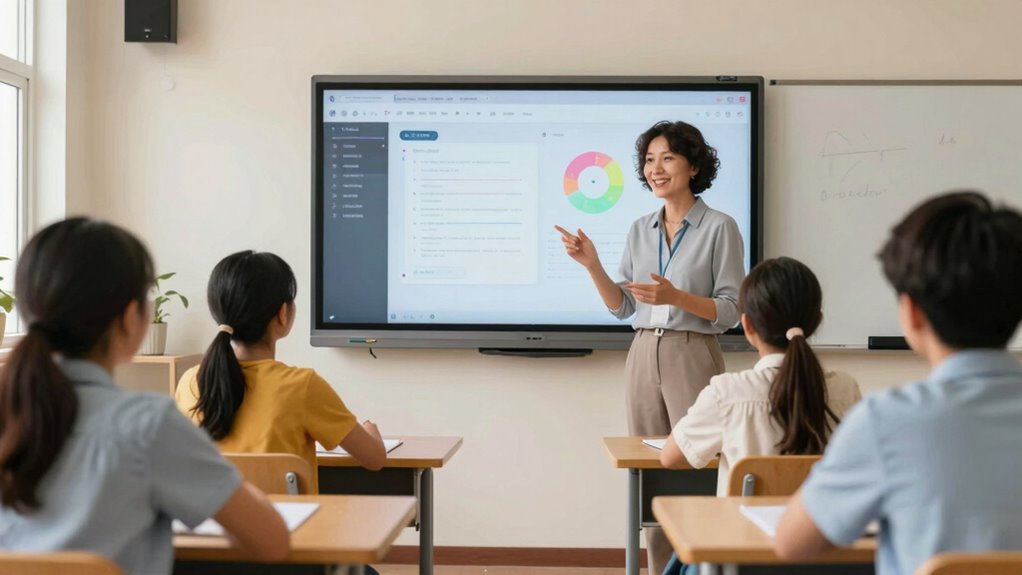

You can effectively incorporate AI into your teaching by automating routine tasks like grading and data analysis, freeing your time for meaningful student interactions. Use AI-generated insights to personalize feedback and support individual growth, but always add your own insights for a caring touch. Balance technology with empathetic conversations and mentorship to maintain strong relationships. If you want to discover how to integrate AI thoughtfully without losing your personal connection, keep exploring these strategies.

Get business pricing on tech for your team
- Business-only prices and quantity discounts
- Tax-exempt purchasing
- Multiple users, one account, clear invoices
Key Takeaways
- Use AI for routine tasks like grading and administrative work, but always review and add personal insights.
- Leverage AI to provide personalized feedback that highlights strengths and growth areas, maintaining a caring approach.
- Analyze student data with AI to identify learning gaps, then address them through meaningful, human-centered interactions.
- Prioritize building relationships through conversations and mentorship, ensuring technology supports rather than replaces personal connections.
- Balance AI integration with empathetic engagement, ensuring technology enhances but does not diminish the human element in education.

As artificial intelligence becomes more integrated into education, teachers face the challenge of leveraging its benefits without sacrificing the personal connections that foster student growth. AI tools like automated grading and personalized feedback can streamline your workload, freeing up more time to focus on meaningful student interactions. Automated grading allows you to quickly assess multiple-choice questions and even some written responses, providing instant results that help students understand their progress right away. This means you can spend less time buried in papers and more time engaging with students about their learning challenges and goals. However, it’s essential to remember that automated grading isn’t a substitute for your judgment. Use it as a starting point, then review and personalize feedback to ensure students feel supported and understood.
Personalized feedback is another powerful way to harness AI without losing your human touch. AI systems can analyze individual student work and suggest tailored comments, highlighting strengths and pinpointing areas for improvement. This targeted feedback helps students feel seen and understood, which is critical for motivation and growth. Still, the real impact comes when you add your own insights and encouragement. Use AI-generated suggestions as a foundation, then craft personalized messages that address each student’s unique needs and personality. This approach maintains the human connection, showing students that you care about their progress beyond just grades. Additionally, understanding how AI can assist with content analysis can help you better interpret student data and tailor your teaching strategies accordingly. Recognizing the role of evidence-based insights can further enhance your teaching effectiveness by grounding your decisions in proven methods. Incorporating AI’s capabilities thoughtfully can also help you identify patterns and learning gaps, allowing for more targeted interventions. Moreover, being aware of how AI tools can support educational research enables you to stay current with emerging best practices in teaching.
While AI tools can handle routine tasks, don’t let them replace your personal interactions. Keep the focus on building relationships by dedicating time for conversations, mentorship, and understanding student experiences. AI can support your efforts by providing data and insights, but it shouldn’t define your teaching style. Strive for a balance where technology handles the administrative side, freeing you to be more present and empathetic during lessons and one-on-one meetings.
Incorporating AI thoughtfully means recognizing its potential to enhance your teaching while remaining aware of its limits. Use automated grading to speed up assessments, but always review results to maintain accuracy and fairness. Leverage personalized feedback to make learning more relevant, but add your voice to deepen the impact. Ultimately, by blending AI efficiency with your human empathy, you create a learning environment that’s both innovative and nurturing—where students thrive both academically and personally.
automated grading software for teachers
As an affiliate, we earn on qualifying purchases.
As an affiliate, we earn on qualifying purchases.
Frequently Asked Questions
How Can AI Personalize Learning Without Replacing Teacher-Student Relationships?
You can use AI to personalize learning by offering tailored feedback and adaptive assessments that respond to each student’s progress. This technology complements your teaching, not substitutes it, by highlighting individual needs and fostering engagement. You maintain the human connection by interpreting AI insights, providing emotional support, and guiding students through challenges. This balance ensures technology enhances your relationships, making learning more effective without sacrificing the personal touch.
What Are the Ethical Considerations When Integrating AI in Classrooms?
When integrating AI, you need to prioritize privacy and fairness. Protect student data by implementing strict security measures, and actively work to mitigate bias in algorithms to guarantee equitable education. Be transparent about how AI tools operate and involve students, parents, and educators in decision-making. By balancing innovation with integrity, you create a classroom culture where technology supports learning without compromising ethical standards.
How Do Teachers Balance AI Automation With Human Empathy?
You balance AI automation with human empathy by prioritizing emotional intelligence in your interactions. Use AI to handle routine tasks, freeing you to engage in creative collaboration and connect on a deeper level with students. Stay attentive to students’ emotions, showing understanding and support. This approach guarantees technology enhances your teaching without replacing the essential human elements that foster trust, motivation, and genuine learning experiences.
Can AI Address Diverse Learning Needs Effectively?
AI acts like a chameleon, adapting to each learner’s needs. It can effectively address diverse learning needs through adaptive assessments and personalized language support, ensuring every student gets tailored help. You can leverage AI to identify individual strengths and challenges, then adjust lessons accordingly. This way, technology enhances your teaching, making education more inclusive and responsive, without replacing the human connection that truly nurtures student growth.
What Training Do Teachers Need to Use AI Responsibly?
You need training in AI skillsets and data literacy to use AI responsibly. Focus on understanding how AI works, its limitations, and ethical considerations. Develop skills in interpreting data and customizing AI tools for your students’ needs. Participating in workshops, online courses, and professional development programs helps build confidence. This education guarantees you leverage AI effectively while maintaining a human-centered approach, fostering trust and personalized learning experiences.
personalized student feedback tools
As an affiliate, we earn on qualifying purchases.
As an affiliate, we earn on qualifying purchases.
Conclusion
Remember, technology is a tool, not a replacement for your humanity. As you embrace AI’s potential, let it amplify your empathy, creativity, and connection with students. Think of AI as a paintbrush—enhancing your masterpiece, not replacing your brushstrokes. By blending innovation with your unique touch, you create an educational experience that’s both inspiring and authentic. After all, isn’t the heart of teaching what makes it truly unforgettable?
As an affiliate, we earn on qualifying purchases.
teacher mentorship and communication tools
As an affiliate, we earn on qualifying purchases.
As an affiliate, we earn on qualifying purchases.
Columbus Day / Indigenous Peoples' Day Picks
long weekend sales
As an affiliate, we earn on qualifying purchases.