
TL;DR

Get business pricing on tech for your team
- Business-only prices and quantity discounts
- Tax-exempt purchasing
- Multiple users, one account, clear invoices
A new 2026 buying report from Thorsten Meyer AI ranks the ten AI mini PCs expected to lead the compact desktop market this year. The MINISFORUM AI X1 Pro, built on AMD’s Ryzen AI 9 HX370, takes the top overall spot, with GEEKOM and GMKtec models close behind. Most performance and TOPS figures are vendor claims that have not been independently benchmarked.
A new 2026 buying report from Thorsten Meyer AI has named the MINISFORUM AI X1 Pro the best overall AI mini PC, leading a list of ten compact machines expected to dominate the small-form-factor market this year. The roundup compared ten models from three brands — MINISFORUM, GEEKOM and GMKtec — on processor power, memory, storage and connectivity, giving buyers a snapshot of which compact desktops are best positioned for on-device AI workloads in 2026.
The top-ranked MINISFORUM AI X1 Pro pairs an AMD Ryzen AI 9 HX370 processor — 12 cores, 24 threads, boosting up to 5.1 GHz — with a Radeon 890M integrated GPU. According to the report, it supports up to 128GB of DDR5 memory at 5600MHz and up to three PCIe 4.0 SSDs, with independent cooling fans for the CPU and storage.
For professional AI workloads — the kind that are fueling pitches to host a mini data center at home — the report singles out the GEEKOM A9 Max, which it says delivers up to 86 TOPS of AI performance through an XDNA 2 NPU rated at up to 55 TOPS, alongside dual PCIe Gen4 NVMe slots supporting up to 8TB. The GEEKOM IT15 is named the leading Intel-based option, running a Core Ultra 9 285H — 16 cores, up to 5.4 GHz — with an Arc 140T GPU, WiFi 7 and 8K display support.
Other models on the list include the GMKtec EVO-X2, configured with AMD’s Ryzen AI Max+ 395, a Radeon RX 8060S GPU with 40 compute units and up to 128GB of LPDDR5X memory, and the GMKtec EVO-X1, which the report highlights for multi-display AI and content creation with triple 8K output. The GEEKOM IT13 MAX and the GEEKOM 2026 Edition A7 MAX round out the lower-cost and office-focused entries. The report notes that prices vary widely across the ten models, with premium configurations offering more power and expandability while budget options focus on essential AI tasks.
Why Compact AI Desktops Matter for Buyers Now
The ranking arrives as on-device AI processing becomes a mainstream buying criterion rather than a niche concern. Mini PCs with dedicated NPUs can run local inference, AI-assisted editing and productivity features without sending data to cloud services, which matters to users concerned about latency, subscription costs and data privacy.
For buyers, the report’s practical value lies in its framing of the central tradeoffs: raw power versus expandability versus price. According to the report, expandability — RAM and SSD slots that allow future upgrades — is critical for future-proofing, especially for demanding AI workloads. Connectivity features such as WiFi 7, USB4 and multi-display 8K support are now common among top-tier models, narrowing the gap between compact desktops and full-size workstations.
The list also signals where the component market is heading. Eight of the ten ranked machines use AMD Ryzen AI-class processors, with Intel’s Core Ultra line holding the remaining slots — a split that reflects AMD’s current momentum in integrated AI silicon for small-form-factor systems.
As an affiliate, we earn on qualifying purchases.
How Ryzen AI Chips Reshaped the Mini PC Market
Mini PCs were long treated as low-power machines for basic office work. That changed as AMD and Intel began shipping mobile-class chips with integrated NPUs alongside capable integrated graphics, allowing compact systems to handle AI inference, video editing and 3D rendering that previously required discrete GPUs.
AMD’s Ryzen AI 9 HX370, which powers four of the ten ranked models, has become the segment’s reference chip, according to the report’s key takeaways, which state that models like the HX370 lead in raw power. Newer parts, including the Ryzen AI Max+ 395 with up to 128GB of unified LPDDR5X memory, have pushed the category further toward workstation territory. Intel’s answer is the Core Ultra 9 285H, featured in the GEEKOM IT15.
Brands such as MINISFORUM, GEEKOM and GMKtec have built their 2026 lineups around these chips, competing on cooling design, storage capacity — up to 12TB in the top-ranked X1 Pro’s configuration — and display output rather than size alone.
“Expandability options such as RAM and SSD slots are critical for future-proofing, especially for demanding AI workloads.”
— Thorsten Meyer AI report, key takeaways
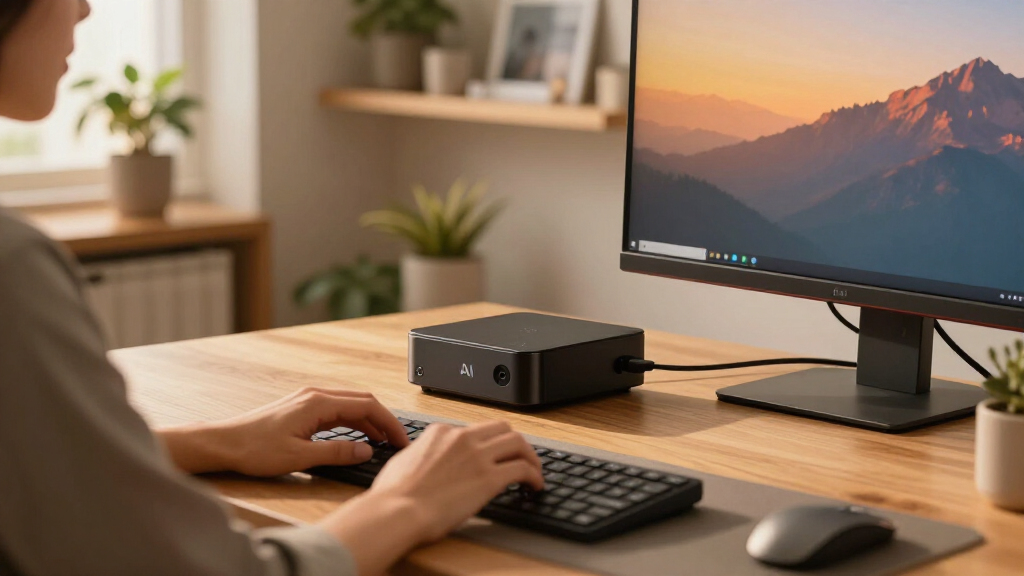
AI mini PC for on-device AI workloads
As an affiliate, we earn on qualifying purchases.
As an affiliate, we earn on qualifying purchases.
Unverified TOPS Figures and Pricing Gaps
Several performance claims in the report come from manufacturer specifications rather than independent testing. The GEEKOM A9 Max’s figures of 86 TOPS overall and 55 TOPS from its XDNA 2 NPU are vendor numbers, and TOPS ratings do not translate directly into real-world AI application speed. No independent benchmark results are cited.
The report also contains naming inconsistencies it does not resolve. The A9 Max’s processor appears variously as a Ryzen AI 9 HX470 and a Ryzen AI 9 470, while one GMKtec EVO-X2 configuration is listed with a Ryzen 5 3950 even as the same model line is described elsewhere with a Ryzen AI Max+ 395. It is not yet clear whether these are typos or distinct SKUs. Exact pricing for most models is not disclosed, making direct value comparisons difficult, and the report does not state when during 2026 its testing was conducted.
As an affiliate, we earn on qualifying purchases.
Price Shifts and New Ryzen AI Max Models Ahead
Buyers should expect the rankings to shift through the rest of 2026. Systems built on AMD’s Ryzen AI Max+ 395 platform are still reaching the market in volume, and wider availability is likely to put pressure on the prices of HX370-based machines that currently dominate the list.
The next milestone for the category is independent benchmark testing of the top-ranked models under real AI workloads, which would either confirm or challenge the vendor TOPS figures the report relies on. Readers weighing a purchase now versus later face the report’s core tradeoff: current models like the MINISFORUM AI X1 Pro are available and expandable today, while newer silicon and potential price cuts remain on the horizon.
As an affiliate, we earn on qualifying purchases.
Key Questions
Which AI mini PC is the best overall pick for 2026?
According to the Thorsten Meyer AI report, the MINISFORUM AI X1 Pro is the best overall choice, combining an AMD Ryzen AI 9 HX370 processor, a Radeon 890M GPU, support for up to 128GB of DDR5 RAM and up to three PCIe 4.0 SSDs.
Should I choose an AMD or Intel AI mini PC?
Eight of the ten ranked models use AMD Ryzen AI chips, which the report credits with leading in raw power. The top Intel option is the GEEKOM IT15 with a Core Ultra 9 285H, recommended for users who want strong performance with flexible connectivity, including WiFi 7 and 8K support.
How much RAM do I need for AI workloads on a mini PC?
Most ranked models ship with 32GB of DDR5, which covers typical AI-assisted productivity and creative work. For heavier local inference or 3D rendering, the report favors machines upgradeable to 128GB, such as the GMKtec EVO-X2 with LPDDR5X memory.
Are the TOPS performance figures in the report reliable?
The TOPS numbers — such as the GEEKOM A9 Max’s claimed 86 TOPS — are manufacturer specifications, not independently verified benchmarks. They are useful for rough comparisons between NPUs but do not predict real-world application performance on their own.
What connectivity should an AI mini PC have in 2026?
The report identifies WiFi 7, USB4, HDMI 2.1 and multi-display 8K output as standard among top-tier models. Buyers running several monitors should look at machines like the GMKtec EVO-X1, which supports triple 8K displays.
Source: Thorsten Meyer AI
Halloween Picks
halloween
As an affiliate, we earn on qualifying purchases.