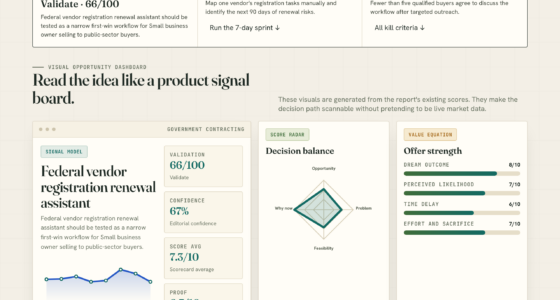

📊 Full opportunity report: The $60 Billion Bargain: Why Cursor Could Be a Steal for SpaceX on ThorstenMeyerAI.com — validation score, market gap, and execution plan.
Open a free Amazon Business account
Business pricing, bulk buying and tax-exempt orders.
Create a free accountAs an affiliate, we earn on qualifying purchases.
TL;DR
SpaceX acquired Cursor for $60 billion in stock, capitalizing on its fast revenue growth and strategic position in AI coding tools. The deal is a rare, low-cost investment due to SpaceX’s high market valuation and Cursor’s accelerating revenue.
SpaceX has acquired Cursor, an AI coding toolmaker, for $60 billion in all-stock. This strategic move occurred just days after SpaceX’s IPO, which valued the company at over $2 trillion. The deal, confirmed by SpaceX, is notable for its size and timing, making it one of the largest venture-backed startup acquisitions ever.
The purchase was entirely in SpaceX stock, representing only about 3.4% dilution at the IPO valuation, and caused SpaceX’s market cap to briefly surpass Microsoft and Amazon. Despite the headline figure, the deal’s valuation is justified by Cursor’s rapid revenue growth, which doubled from $2 billion in February to $4 billion in June. Anysphere, Cursor’s parent company, projects revenue reaching $6 billion by the end of 2026.
Cursor leads in AI coding with over 1 million paying users and 50,000 enterprise customers, including more than half of the Fortune 500. Its profitability, driven by enterprise subscriptions, contrasts with SpaceX’s cash-intensive rocket and satellite operations. The company also developed its own coding model, Composer, which now handles most of Cursor’s work.
Importantly, the deal blocks competitors like OpenAI and Microsoft from acquiring Cursor, giving SpaceX a strategic advantage in developer tools and enterprise AI workflows. The acquisition also addresses Cursor’s reliance on third-party models, which was squeezing margins due to high API costs and competition from labs like Anthropic.
The $60B bargain: why Cursor could be a steal
$60 billion for a code editor sounds like a bubble. Look past the headline and the price isn’t the scandal — it’s the discount. Here’s the case that SpaceX got Cursor cheap.
A melting multiple, paid in appreciating paper that cost almost nothing, for the profitable leader of the only AI category reliably making money — plus the missing app layer and an escape from the margin trap. If the growth holds and integration doesn’t break the product, $60B will read like a down payment. The risk isn’t overpaying for what Cursor is — it’s breaking what made it worth buying.
Impact of the Cursor Acquisition on SpaceX and AI
This deal exemplifies a strategic shift for SpaceX, moving beyond aerospace into the AI software ecosystem. By acquiring Cursor, SpaceX gains a profitable foothold in a rapidly growing market, a powerful developer interface, and a way to internalize AI costs. The move also prevents rivals from gaining access to Cursor’s customer base and technology, securing a competitive edge in enterprise AI.
Furthermore, the acquisition illustrates how SpaceX leverages its high market valuation to make low-cost, high-impact investments. It signals a broader strategy of vertical integration, aiming to control more of the AI supply chain and improve margins on its AI-driven initiatives, including its own models and infrastructure.
As an affiliate, we earn on qualifying purchases.
Background on Cursor and SpaceX’s AI Strategy
Cursor, developed by Anysphere, has grown rapidly since its founding, with revenue doubling every few months. It became a leader in AI coding tools, serving major corporations and developing its own models, notably Composer. Its growth attracted attention from tech giants like Microsoft and OpenAI, which declined to acquire it.
SpaceX, led by Elon Musk, has historically focused on aerospace but has increasingly invested in AI, notably through its in-house AI research division, xAI. The company’s high valuation has enabled it to make strategic acquisitions in the tech sector, often paying with stock that appreciates in value at the time of purchase.
This acquisition aligns with Musk’s broader approach of vertical integration, aiming to bring AI development in-house to reduce costs and enhance control over AI technology used across SpaceX’s ventures and Musk’s other companies.
“This acquisition is a strategic move to secure a profitable, fast-growing AI coding platform that complements our existing AI efforts and blocks competitors.”
— Elon Musk
As an affiliate, we earn on qualifying purchases.
Unanswered Questions About the Acquisition’s Future
It remains unclear how SpaceX will fully integrate Cursor’s technology and team into its broader AI efforts. Details on how the company plans to monetize Cursor’s assets long-term, or whether it will expand beyond coding tools, are still developing. Additionally, the impact on competitors and the AI software landscape is yet to be seen.
As an affiliate, we earn on qualifying purchases.
Next Steps for SpaceX and Cursor Integration
SpaceX is likely to accelerate the integration of Cursor’s technology into its infrastructure and AI models. Expect announcements on new product offerings, expanded enterprise services, or further acquisitions to consolidate its position. Regulatory and market reactions will also shape the competitive landscape in AI software.
As an affiliate, we earn on qualifying purchases.
Key Questions
Why did SpaceX pay so much for Cursor?
Because Cursor is rapidly growing, profitable, and strategically valuable, offering a foothold in AI coding tools, developer workflows, and enterprise markets, making the high valuation justifiable.
What does this mean for competitors like OpenAI or Microsoft?
It blocks their access to Cursor’s customer base and technology, potentially giving SpaceX a competitive edge in enterprise AI and developer tools.
Will SpaceX develop its own AI models now?
Likely yes, especially since Cursor already built its own coding model, Composer, which is slated for integration into SpaceX’s broader AI stack.
How does the deal affect SpaceX’s financial position?
Because the acquisition was paid in stock, it caused minimal dilution and briefly boosted SpaceX’s stock price, leveraging its high valuation to make a low-cost strategic investment.
What are the risks of this acquisition?
Potential risks include integration challenges, market shifts in AI, or Cursor’s growth slowing down, which could impact expected returns.
Source: ThorstenMeyerAI.com
NFL season / tailgating Picks
team gear
As an affiliate, we earn on qualifying purchases.