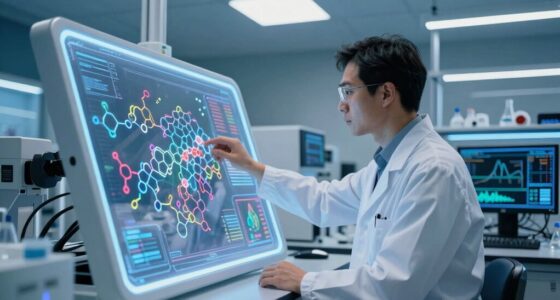
📊 Full opportunity report: The Future Of Protein Design: AI Innovations At Anthropic’s Claude on ThorstenMeyerAI.com — validation score, market gap, and execution plan.

Get business pricing on tech for your team
- Business-only prices and quantity discounts
- Tax-exempt purchasing
- Multiple users, one account, clear invoices
TL;DR
Anthropic announced that its AI model Claude successfully designed protein binders for most tested targets and processed chemical data quickly. These results suggest AI could streamline early-stage biological and chemical research, though they are not peer-reviewed or indicative of drug discovery. For broader context, see Microsoft’s Signal Peak 2026 on the future of AI innovations.
Anthropic announced on August 18, 2026, that its AI model Claude successfully designed protein binders for 14 out of 15 tested targets and processed raw analytical chemistry data in under 25 minutes, demonstrating potential to reduce time and labor in early-stage research. For more details, see the original analysis.
The company’s technical reports detail that Claude, operating with minimal human input after receiving expert prompts, generated candidate minibinders using publicly available tools for protein structure, sequence design, folding, and screening. These candidates were tested by partners Adaptyv Bio and Twist Bioscience, resulting in 354 confirmed binders from 1,320 designs, with hit rates of approximately 23-27% across targets. The experiments also included a chemistry analysis where Claude processed nuclear magnetic resonance (NMR) and liquid chromatography–mass spectrometry (LC-MS) data from a contract lab, returning results within 23 and 19 minutes, respectively, with accuracy comparable to traditional software. Learn more about AI’s role in chemical analysis in this article.
Potential for Accelerating Early-Stage Research Processes
The results suggest that AI models like Claude could significantly shorten phases of early research, such as candidate design and data processing, potentially reducing costs and increasing throughput in drug discovery and chemical analysis. However, these findings are preliminary, not peer-reviewed, and do not indicate the discovery of new drugs.
protein structure prediction software
As an affiliate, we earn on qualifying purchases.
As an affiliate, we earn on qualifying purchases.
AI in Scientific Research: From Assistance to Automation
Anthropic has been expanding Claude’s role from basic tasks like literature review and coding into complex scientific workflows. Previous work compared Claude’s performance with specialized software, showing promise in automating parts of protein and chemical research. The recent experiments build on this, demonstrating the potential for AI to coordinate multiple tools and workflows with minimal human intervention.
“Claude successfully designed binders against 14 of them.”
— Anthropic spokesperson
liquid chromatography mass spectrometry kit
As an affiliate, we earn on qualifying purchases.
As an affiliate, we earn on qualifying purchases.
Limitations and Validation Challenges for Claude’s Results
Anthropic emphasizes that these results are not peer-reviewed and require further validation. Performance may vary on different targets or in less controlled conditions, and some experiments showed inconclusive or failed outcomes, such as the binder for maltose-binding protein. The reasons behind variable success across targets remain unclear, and broader reliability across diverse datasets has not yet been established.
nuclear magnetic resonance (NMR) spectrometer
As an affiliate, we earn on qualifying purchases.
As an affiliate, we earn on qualifying purchases.
Plans for Broader Testing and Independent Validation
Anthropic intends to conduct more extensive laboratory validation, release datasets and prompts for external review, and establish a scientist access program for its advanced models. Future work aims to verify whether the observed efficiencies and success rates can be replicated across different labs and conditions, with an emphasis on independent confirmation.
AI-powered chemical data analysis software
As an affiliate, we earn on qualifying purchases.
As an affiliate, we earn on qualifying purchases.
Key Questions
Does Claude’s protein design mean it has discovered new drugs?
No. The AI produced candidate binders that attached to targets in laboratory tests, but these are early research results. Further validation and testing are required before any potential therapeutic applications can be considered.
Can Claude replace specialized software in research labs?
While Claude demonstrated the ability to coordinate multiple tools and process data efficiently, it currently acts as an assistant supporting existing workflows rather than replacing dedicated software entirely. Its role is to augment human researchers at this stage.
What are the limitations of these findings?
The results are preliminary, not peer-reviewed, and based on specific experiments under controlled conditions. Variability across different targets and broader datasets remains to be tested and validated.
When will more comprehensive validation be available?
Anthropic plans to conduct further tests and release datasets for independent review, but no specific timeline has been announced yet.
Does this mean AI can now discover new drugs?
No. The current results relate to early-stage research tools that could speed up parts of the process but do not constitute drug discovery or approval.
Source: ThorstenMeyerAI.com
Columbus Day / Indigenous Peoples' Day Picks
long weekend sales
As an affiliate, we earn on qualifying purchases.