📊 Full opportunity report: Which Postpartum Recovery Guide Fits Your Delivery Type? on IdeaNavigator AI — validation score, market gap, and execution plan.

Get business pricing on tech for your team
- Business-only prices and quantity discounts
- Tax-exempt purchasing
- Multiple users, one account, clear invoices
TL;DR
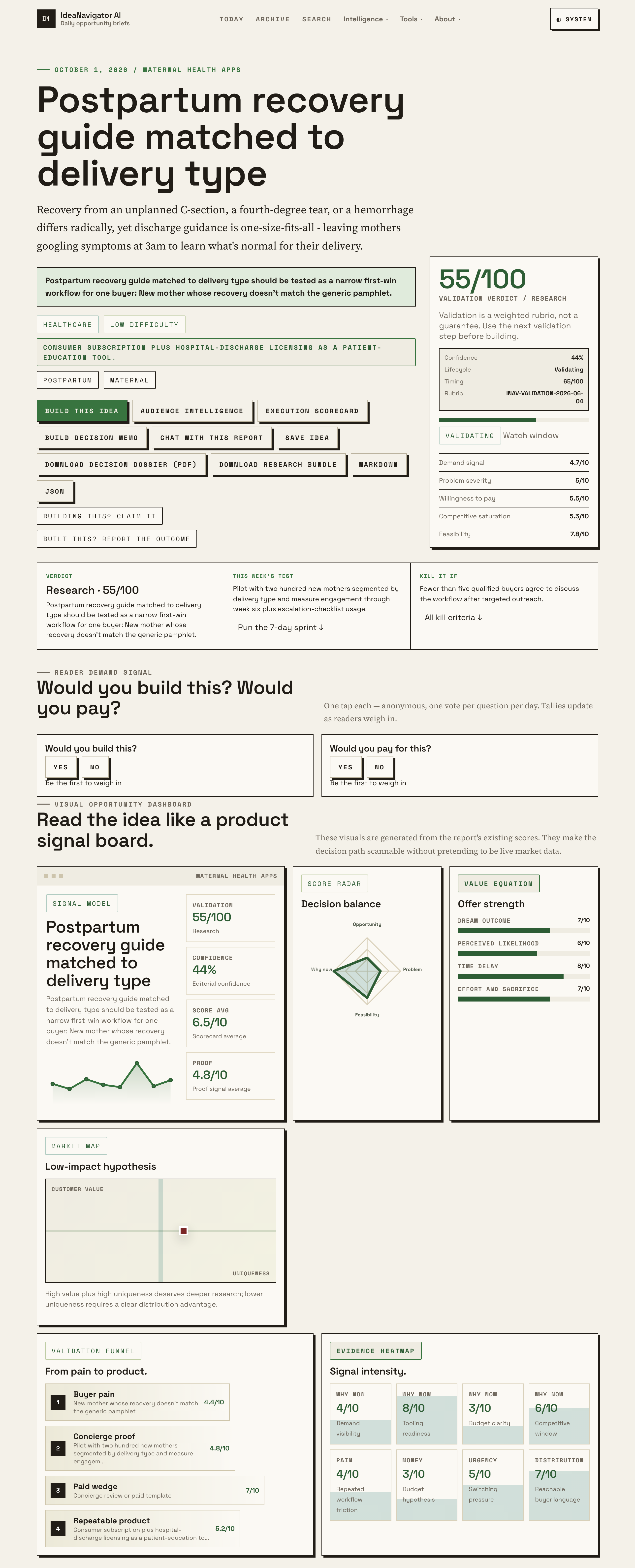
IdeaNavigator AI has outlined a maternal health app concept that would tailor postpartum recovery guidance to a person’s delivery and complications. The proposal includes a 200-person pilot, but no pilot results, clinical validation, hospital partners or launch date are provided.
IdeaNavigator AI has proposed a postpartum recovery guide tailored to delivery details, aiming to address the gap between individual recovery needs and general discharge instructions. The concept calls for testing the guide with 200 new mothers, but no pilot launch, clinical evaluation or hospital agreement is reported.
The proposed guide would begin with an intake covering delivery mode, interventions, complications and feeding. It would then provide week-by-week recovery expectations based on that profile, a checklist of warning signs and summaries to help prepare for the six-week postpartum visit. Those are planned features, not evidence that a working product is available.
The proposal highlights recoveries after an unplanned C-section, a fourth-degree tear or a hemorrhage as examples that can differ from a routine recovery. It says general discharge guidance can leave some mothers searching online for answers about symptoms. The material does not provide research, patient interviews or clinical data establishing how often that happens or whether a tailored guide would improve outcomes.
For validation, IdeaNavigator AI suggests a pilot with 200 new mothers, grouped by delivery type. The proposed measures are engagement through week six and use of the escalation checklist. The concept also identifies two possible revenue channels: a consumer subscription and licensing the guide to hospitals as a patient-education tool. No price, licensing partner or operating model is specified.
Matching Guidance to Recovery Needs
Postpartum recovery can involve different procedures and complications, so a guide that reflects a person’s delivery could make general instructions easier to apply. The concept’s focus on warning signs and preparation for a follow-up visit also points to decisions that matter to patients and care teams after discharge.
However, the proposal does not show that tailoring information will reduce complications, improve recovery or change when patients seek care. Those outcomes would require appropriate clinical review and evaluation. For now, the suggested pilot would measure engagement and checklist use; those indicators can show whether people use the guide, but by themselves would not establish a health benefit.
That distinction matters for both families and potential hospital customers. Patients need clear, trustworthy information that does not replace professional care, while hospitals would need to assess accuracy, safety and fit with their discharge process before adopting an education tool. The idea identifies a possible need and test, but leaves those questions open.
postpartum recovery guide for C-section
As an affiliate, we earn on qualifying purchases.
As an affiliate, we earn on qualifying purchases.
A Proposed Postpartum Care Tool
The concept is framed around a stated opportunity in maternal health apps: make recovery guidance specific to delivery details rather than treating birth as one uniform event. It also points to calls for more individualized postpartum follow-up as a reason to consider the idea. No particular guideline, issuing organization or publication date is identified, so that claim cannot be tied here to a specific recommendation.
The proposed product would sit between hospital discharge and the six-week visit, offering information over the weeks after birth. It is described as a patient-education guide, with a potential consumer subscription and hospital-discharge licensing model. The proposal does not name a developer, clinical adviser or participating hospital, and it does not provide a release schedule.
The suggested test would segment 200 participants by delivery type and track their use through week six. That design could reveal whether different groups engage with the material and whether they use its escalation checklist. The proposal does not specify recruitment methods, comparison groups, consent procedures or how clinicians would review the guidance.
postpartum checklist for complications
As an affiliate, we earn on qualifying purchases.
As an affiliate, we earn on qualifying purchases.
Clinical Review and Pilot Details
No pilot results are available, and the proposal gives no start date. It also does not say who would create or clinically review the recovery expectations and warning-sign checklists, or how the guide would handle advice that depends on an individual’s medical history.
Other open questions include whether hospitals have agreed to test or license the tool, how patient information would be handled, what the subscription would cost and how the proposed 200-person sample would be recruited. The suggested measures concern engagement and checklist use; no plan is given for assessing clinical outcomes or comparing the guide with existing discharge materials.
week-by-week postpartum recovery book
As an affiliate, we earn on qualifying purchases.
As an affiliate, we earn on qualifying purchases.
From Concept to Patient Pilot
The next stated step is to test the concept with 200 new mothers, grouped by delivery type, and track engagement through week six alongside use of the escalation checklist. Before such a pilot could assess the guide in practice, details would be needed on recruitment, clinical review, participant safeguards and how checklist use would be recorded.
Until a pilot, product launch or hospital partnership is announced, the guide remains a proposed maternal health app concept. No schedule or further milestone has been provided.
Source: IdeaNavigator AI
As an affiliate, we earn on qualifying purchases.
Key Questions
Is the postpartum recovery guide available now?
The material describes a proposed product and does not provide a launch date or say that the guide is available.
What would the guide include?
The proposed features are delivery-specific, week-by-week recovery expectations, warning-sign checklists and preparation summaries for the six-week postpartum visit.
Has a 200-person pilot started?
No pilot results or start date are provided. Testing with 200 new mothers is presented as a suggested way to validate the concept.
Would the guide replace medical advice?
The proposal describes a patient-education tool, but does not explain how it would be reviewed or used alongside care from a clinician.
Source: IdeaNavigator AI
Halloween Picks
halloween
As an affiliate, we earn on qualifying purchases.