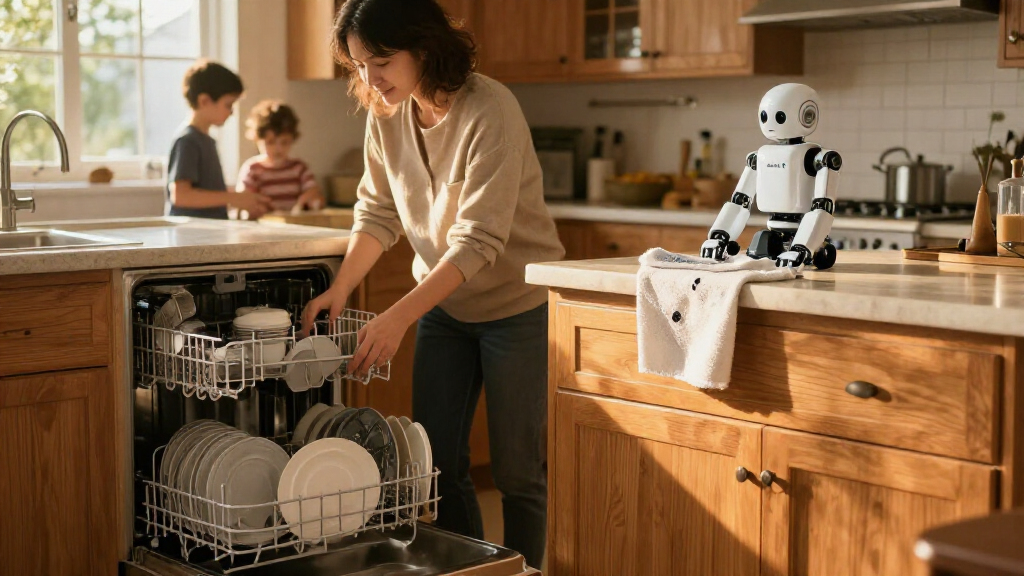

🔍 Read the full analysis: Who Does The Housework When Robots Arrive? Meta's Reported Humanoid Robot Max Raises The Question on ThorstenMeyerAI.com

Get business pricing on tech for your team
- Business-only prices and quantity discounts
- Tax-exempt purchasing
- Multiple users, one account, clear invoices
TL;DR
The Information reported on Oct. 31 that Meta and Chinese robotics company Fourier developed a humanoid prototype called Max in about three months. Meta has not announced the robot; according to the report, the work is for internal research, with no plans to sell the units. Its ability to do household chores has not been established.
Meta and Shanghai-based robotics company Fourier reportedly built a humanoid prototype called Max in about three months, according to a report published by The Information on Oct. 31. Meta has not announced the robot, and the report says the company described its work with Fourier as internal research and experimentation, with no plans to sell the units.
Details attributed to The Information and repeated by outlets including Engadget, The Next Web and Investing.com describe Max as roughly five feet (1.5 metres) tall and weighing about 106 pounds (48 kilograms). It reportedly has a screen that can display facial expressions, speakers and five-fingered hands designed for handling small objects. The robot is said to use Nvidia’s Jetson Thor computing platform.
The report says Meta employees saw Max at an internal robotics summit in late August and that work on a second version, Max 2, began in September. That version is reportedly planned to have a redesigned torso, improved hands, a projector and additional sensors intended to help it manage stairs. These details have not been confirmed in a public announcement from Meta.
Descriptions that Max “can do household chores” go beyond what the source report establishes. The reported ambition is to develop humanoids that could help in homes in the future; no verified demonstration of Max completing domestic tasks, product launch date or retail price has been reported. Reuters said it could not immediately verify the report.
Infographic 01 · Meta’s humanoid, on paper
Max: a humanoid built in about three months
What multiple outlets reported from The Information’s story, and what is not confirmed.
What the report says Max is
From The Information (31 Oct 2026), as carried by Engadget, The Next Web and Investing.com
- Built by Meta with Fourier, a Shanghai robot maker
- Runs on Nvidia Jetson Thor, a computer for robots
- A screen that shows facial expressions, built-in speakers
- Five-fingered hands designed for small objects
- Shown to some Meta staff at an internal summit in late August
- Max 2: new torso, better hands, a projector, sensors for stairs
What you should not take from the headlines
- No Meta announcement. Reuters “could not immediately verify the report.”
- Not for sale. Meta told The Information the work is internal research, with no plans to sell units.
- No chores shown. “Can do household chores” is a goal, not a reported demonstration.
- Dropped: “lifts bottles and toys” and a Muse quote, found only on aggregator sites.
Jetson Thor, per Nvidia: up to 2,070 FP4 teraflops of AI compute, 128 GB memory, 130-watt power envelope; developer kit from $3,499 at launch in August 2025. Meta was named an early adopter.
Sources: The Information (paywalled), reported by Engadget, The Next Web, Investing.com and Reuters, all 31 Oct 2026 · Nvidia, 25 Aug 2025.
Powered by Thorsten Meyer AI
The Work Behind Household Robots
The report matters partly because it connects advances in robotics to work that is often unpaid, underpaid or informal. The International Labour Organization estimates that unpaid care work accounts for 16.4 billion hours globally each day, with women doing about three-quarters of it. Paid domestic work employs an estimated 80 million people worldwide, 83% of them informally, according to the figures cited in the source material.
Those numbers describe the scale of care and household work, not a market that Max can already serve. A prototype is not evidence that a robot can safely clean, cook or care for people in varied homes. If household robots become capable and affordable, their effects could reach workers and families as well as technology companies. The report does not establish whether they would reduce workloads, change who performs the work, or displace paid workers.
For now, the more immediate point is the pace of development: Meta could reportedly draw on an experienced robotics partner and existing computing hardware rather than build every part from scratch. That may shorten prototype development, but it does not resolve the harder questions of reliability, cost, safety and useful performance in an unpredictable home.
Products Worth Considering

Sonos Era 100 Wireless Smart Speaker with Alexa, Black

Apple Watch Series 12 GPS 42mm Smartwatch

Jackery Explorer 300 Portable Power Station, 292Wh
As an affiliate, we earn on qualifying purchases.
A Prototype Built on Existing Work
The reported three-month timeline does not mean Meta created a humanoid platform from the ground up in one season. Fourier already makes robots. In August 2025, the company introduced its GR-3, a 165-centimetre, 71-kilogram machine it described as a “Care-bot” for settings such as nursing homes and rehabilitation centres. The source report portrays the Meta-Fourier project as combining Meta’s AI ambitions with Fourier’s robotics experience and manufacturing capability.
Computing hardware is another part of that picture. Nvidia made its Jetson Thor platform generally available on Aug. 25, 2025, pitching it for robots and other physical AI systems. Nvidia named Meta among its early adopters, and the source material says the same platform is used by 1X’s NEO robot. The reported use of an off-the-shelf robotics computer is one reason Max may represent an assembly of existing capabilities rather than a wholly new technology.
Other companies are also testing home robots, though their claims need to be read with care. 1X sells its NEO home robot for a reported $20,000 and uses remote human “experts” for tasks it does not know how to perform. Figure says its robot completed whole chores in 56% of trials across 30 homes it had not seen before; that is a company-reported result, not an independent finding. These examples suggest that human assistance and limited task performance remain part of the current picture.
“The work with Fourier is for internal research and experimentation, and Meta has no plans to sell the units.”
— Meta, as reported by The Information
What Max Can Actually Do
Key details remain unconfirmed publicly because Meta has not announced Max, and the account rests on a report by The Information that the source material says is behind a paywall. Reuters said it could not immediately verify the report. Meta has not published specifications, footage of the robot performing tasks, or an independent evaluation.
It is also unclear how much of the reported design is functional, how much autonomy Max has, and whether it can operate safely around people, pets and household objects. The statement that hands are designed for small objects does not establish that the robot can reliably pick them up or complete chores. Details about Max 2 and its planned features are likewise reported rather than confirmed by a public Meta release.
The broader effects on domestic work are even less certain. Current examples cited in the source material involve company-reported trials or human remote assistance. They do not show that a humanoid can replace a household’s work, or that it can do so at a price and reliability level useful to most families. The source’s proposed timeline for limited help before 2030 is an assessment, not a confirmed schedule.
Evidence Needed Beyond the Prototype
The next useful milestone would be a direct statement from Meta or Fourier, accompanied by details about what Max has actually demonstrated. A public demonstration or third-party test could help clarify whether the prototype performs household tasks, how much human supervision it needs and what safety limits apply. No launch date has been reported, and Meta’s reported position is that it has no plans to sell the units.
Further information about Max 2 could show whether the reported work on its hands, sensors and ability to handle stairs advances beyond design plans. Until then, Max is best understood as a reported research prototype, not a home robot ready for consumers. The wider question of who benefits if machines take on domestic work will depend on capabilities, affordability and the role of human workers—issues the report does not settle.
Key Questions
Has Meta officially announced Max?
No. The Information reported on the prototype, but Meta has not made a public announcement about Max. Reuters said it could not immediately verify the report.
Can Max do household chores?
That has not been established. The report describes a robot intended to support possible household tasks in the future; it does not provide a verified demonstration that Max completes chores.
Who reportedly built Max?
Meta and Fourier, a robotics company based in Shanghai, reportedly developed the prototype together in about three months, according to The Information.
Will Meta sell the robot?
According to The Information, Meta said the Fourier work is for internal research and experimentation and that it has no plans to sell the units. No price or release date has been reported.
What is known about Max 2?
The report says work began in September on a second version expected to have a redesigned torso, improved hands, a projector and more sensors. Those features and the development timeline have not been confirmed publicly by Meta.
Source: ThorstenMeyerAI.com